I am willing to grant that [transcendent experiences] feel real, but that comes back to the question: Why does anything feel real? It is because your brain creates a model of what feels real. So just as you can have sensory hallucinations, you can have hallucinations of importance. You can have hallucinations of reality, because this is the system that normally tells you what is important. Ordinarily it does so in a gentle and more lawful way, but if it goes amuck, what you get are feelings of awe, wonderment and portentousness. You can accept the subjective reality [of transcendent experiences], without going the extra step and accepting that it was real outside of the internal theater of the mind.”
— Barry Beyerstein PhD, Simon Fraser University, Vancouver, BC.
 CMT:
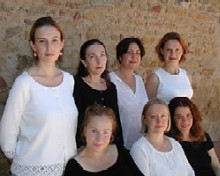
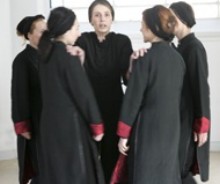
CMT: Members of the Dialogos ensemble sing with the vibrato-free purity typical of good early-music choirs. The solo work from within Dialogos is excellent. Overall, Dialogos’ Tondal is an exuberant and loving performance of intricate music, frequently in multiple overlapping lines that put the singers to the test. The variety of affects donned by the soloists and chorus is remarkable—the more so for taking place within the timbral restraint of the chant form. Dialogos performs on Saturday, 24 February, in
Kansas City .
 DSM:
DSM: Yet more striking is the canticle-like intensity that Dialogos achieves. And the soloists, representing angels and Tondal’s displaced soul, singing antiphonally with the principal group! Rather than theatrical, the effect is genuinely ethereal, climaxing an evening whose serene dignity stands at variance with the violent conflict in not only medieval Croatia and bygone plague- and war-ravaged eras, but also Croatia in the 1990s.
 CMT:
CMT: What about the out-of-body experiences? Tondal’s Vision, the story of an unconscious man whose soul leaves his body, was a popular mystical tale from the 12th century. Some regard it as anticipative of Dante’s Divina Commedia. In the story of Tondal, the soul visits Hell guided by the voice of an unknown angel and gets lost on winding, narrow paths. The soul crosses dark bridges and finally returns to its body. This near-Death “out-of-body” experience seems endless to Tondal but lasts clinically only a few minutes. So we listeners are confronted by the question that Tondal constantly repeats to the angel: “For how long a time was I dead?” The Croatian collection, Vartal, written in the 16th century for a women’s Benedictine community on the Dalmatian coast, is a faithful rendering of the Tondal story.
 DSM:
DSM: There’s dissonant Glagolitic polyphony, juxtaposed with softer motives from the south of Dalmatia, Gregorian melodies and Latin polyphony from regions where Tondal’s Vision was translated and performed. Dialogos’ Tondal puts this in a new context where faces and hand movements and dance all contribute to the artistic effect. The multi-faceted, multi-lingual character of the work contributes to their evocation of floating, ethereal, detached, out-of-bodyness—very convincing.
 CMT:
CMT: I think the inherently multi-lingual, inter-textual character of medieval Croatian music and sacred texts is evocative in yet another way. The inter-texuality invites us to wonder about the conventional distinctions that separate medieval, traditional and contemporary music. How arbitrary are those distinctions? Aren’t the distinctions inscribed by (and ‘inscribing’, in Foucault’s sense or Deleuze’s and Guattari’s sense) the values of major European powers? The conflict-ridden Balkan peoples are clearly not the ones who have articulated/inscribed those distinctions. The wanderings of Tondal’s soul are also the depersonalized, out-of-body wanderings of the Balkan societies. The whole region has been challenged by intrusions and it’s understandable that ego boundaries for everybody there might be a bit diffuse as a result . . .
DSM: Remember that Dalmatia (Serbo-Croatian Dalmacija) is an historic region of Croatia, extending along the Adriatic Sea, approximately from Rijeka (Fiume) to the Gulf of Kotor. Split is the provincial capital; other cities include Zadar (the historic capital), sibenik, and Dubrovnik. Except for a small coastal lowland, Dalmatia is generally mountainous, rising to the Dinaric Alps. The coast, famous for its beauty and resorts, has many bays and harbors protected by a chain of islands. The bulk of the population consists of Roman Catholic Croats; there are also Eastern Orthodox Serbs and some Italians (mainly at Zadar and nearby cities). Dalmatia was definitively subdued by Augustus (35 BCE–33 BCE) and was incorporated with part of Illyria as a Roman province. It was overrun by the Ostrogoths (5th Century), reconquered by the Byzantine Empire (6th Century), and resettled, except in the coastal cities, by the Slavs in the 7th Century. By the 10th Century it was divided between the kingdoms of Croatia (north) and Serbia (south), while Venice held several ports and islands.
 CMT:
CMT: After several centuries of struggle, the coastal islands and most of Dalmatia, except Dubrovnik, were under Venetian control by 1420. Hungary retained the Croatian part, which in 1526 passed to the Turks but was recovered by the Treaty of Karlowitz (1699). The Treaty of Campo Formio (1797) gave Venetian Dalmatia to Austria, and the Treaty of Pressburg (1805) gave it to France. It was first attached to Napoleon's Italian kingdom but in 1809 was incorporated into the Illyrian provs. The Congress of Vienna restored it to Austria(1815). By the Treaty of London (1915) the Allies promised Dalmatia to Italy in return for Italian support in World War I. In 1918 it became part of the newly established kingdom of Serbs, Croats, and Slovenes (after 1929 Yugoslavia), but Italy continued to claim Dalmatia. The Treaty of Rapallo (1920) gave Dalmatia to Yugoslavia, except for Zadar and several islands, which subsequently passed to Italy. During World War II, Italy held most of Dalmatia, and after the war it was returned to Yugoslavia. The Italian peace treaty of 1947 gave Yugoslavia the islands that had been ceded to Italy after World War I. Following Croatia's secession from Yugoslavia in 1991, fighting broke out between Croats and Serbs. Many of the port cities in southeast Dalmatia were heavily shelled as the Serbs, backed by Yugoslavian federal forces. It is more than just the contention of cultures! One can imagine that each person (each Self!) in these regions has always had to fight and defend herself/himself!
 DSM:
DSM: Well, again, what about the out-of-body experience in Tondal? What about the Self that experiences itself out of its Body? You know, researchers recently have begun to explore the neurophysiology of the self and of abnormal states where the sense of self is altered, like out-of-body experiences (OBEs), using functional neuroimaging, PET scanning, and so on. There are to date only a few robust scientific investigations on OBEs, probably because they occur spontaneously, are of short duration, and happen only once or twice in a lifetime for most people. Investigation of OBEs in seizures and psychiatric disease is not much easier, given the rarity and paroxysmal nature of them. But Brugger in Zurich and Pascual-Leone at Harvard and others have recently localized the part of the brain that is most strongly implicated in out-of-body experiences. It is a set of structures in the region of the brain known as the temporoparietal junction.
 CMT:
CMT: Transcendent hallucinations like OBEs are probably more common than generally acknowleged. While they may be a sign of pathology, they occur in 10% or more of ordinary, healthy individuals over their lifetimes. Many of these people associate their experiences with supernatural or religious meaning.
 DSM:
DSM: Partly, I think, this is because it is so sudden, unexpected and uncontrollable. The alteration of consciousness is so intense as to be overwhelming. It is fundamentally different, and perceived to be so, from ordinary consciousness. While the biochemistry and neurophysiology that causes it may be entirely natural and occurring within the person’s head, it’s understandable that such a profoundly unusual experience—being alienated from your own body, having perceptions that are not controllable and located at some distance from where you perceive your body to be—would lead people to ascribe to it some spiritual or transcendent significance. Dawkins and Dennett and others may find that tendency appalling. But it’s just part of our innate response—people in all cultures respond this way when they’re confronted with overwhelming, profoundly frightening altered consciousness . . .
CMT: We know that transcendent experiences may be achieved through behavioral, psychological, chemical and pathological means. Transcendent states can be triggered by either over- or under-stimulation in the brain. The CIA (and, later, researchers at the University of Michigan) developed water floatation systems to precipitate transcendent experiences through sensory deprivation. The world literature describes methods involving physical manipulations such as fasting, meditation, and breathing exercises to obtain altered states of consciousness. Rhythmic drumming and chanting—the production of the mental state is engineered so that believers affirm the spiritual message being taught. The Protestant evangelist, John Wesley, included these techniques in his manuals on how to run a revival meeting. Sadly, similar methods are even used at political rallies. The Nazis raised these manipulations to a high science with chanting, music, and psychological manipulations of fear and rhetoric at their rallies . . .
DSM: Transcendent experiences are often accompanied by feelings of awe, contentment and wonderment that last long after the experience has faded. Such an experience can fundamentally change the way the person views reality and interprets the world around them from that point forward. This is what happened to Tondal. It’s part of the Upanishads and Vedic traditions, too. Dialogos provides us a musical glimpse of that kind of awe and wonderment. I wonder whether Katarina or other members of Dialogos have themselves had an OBE first-hand. The conviction of their performance seems too great to derive from second-hand impressions or merely academic or actorly musicianship . . .
CMT: The profundity of an OBE often leads the person to believe that she/he has experienced a higher or ‘deeper’ reality. The clarity and compellingness of the experience persuades the person of the experience’s meaningfulness and convinces her/him that what was revealed is something they can rely upon and put credence in.
 DSM:
DSM: Beyond that, consider that the emotions associated with transcendent and out-of-body experiences cover a spectrum ranging from blissful ecstasy to utter terror. Individuals having joyful experiences often come away from the OBE feeling they are in some way special, that they have been chosen to receive this message for a purpose. But terrifying experiences are often interpreted as a wake-up call to change one’s ways.
CMT: People report that during the OBE they felt ‘melded with the Universe,’ that they were no longer encumbered with a physical existence, or that they were nowhere or everywhere at once . . .
DSM: Of course, clinical psychiatry interprets transcendent experiences as meaningless or as signs of psychopathology and applies DSM-IV codes and dismissive labels like depersonalization, derealization and ‘loss of ego boundaries.’ That alternative perceptions that’re transient could be aesthetically pleasing or valuable in some way doesn’t seriously occur to them. They try to medicalize everything, hell-bent on eradicating or rationalizing-away anything unusual. Thomas Szasz and Gilles Deleuze and others have written extensively about this. And that pathologizing, value-loaded, medicalizing tendency is partly why healthy people tend to under-report their OBEs. It’s stigmatizing. People may think you’re crazy if you say you’ve had an OBE. Revealing to your doctor or others in gentle society that you’ve had an OBE goes nowhere good . . .
CMT: The sociologist, Nicholas Fox, wrote a useful book that explains Foucault’s and others’ post-modern [or post-structuralist] sociology of health and illness, including behavioral disorders and hallucinations. He illustrates how that differs from modernist sociology, and he reveals the politics that inheres in health talk or illness talk as sociological phenomena. You can easily generalize this to any talk of experiences that are unusual or abnormal. Fox postulates that illness is never merely or just illness, and that language is the primary field for constituting culture. While the stance that illness is never just illness doesn’t restrict the study of illness to the study of the politics of illness, it’s a productive move for Fox, one that sidesteps the dominant ideologies of illness to explore the interests served by those ideologies.
DSM: Fox locates his postmodern social theory of health at the intersection of bodies and social institutions, and opens his account with a theorizing of the Body. He draws his inspiration from Deleuze and Guattari's notion of the Body-without-Organs, a kind of pure surface on which narrative ‘inscriptional practices’ operate. In brief, Bodies are texts. And, by implication, in an out-of-body experience, if one’s self is dissociated from the Body, then there is a crisis of authorship and subjectivity. Who is the subject?
CMT: Fox moves from the Body to the institutions that organize power for the inscribing of Bodies, especially in the health/medical domains. Fox says “all organizations are mythologies constituted discursively to serve particular interests of power, and contested by other interests of power” (p. 49).
W e may understand the organization of care as the organization of technologies of expertise, the (attempted) organization of subjectivity itself.”
— Nicholas Fox, p. 65
DSM: Fox challenges the conventional poststructuralist assumption that a person’s ‘resistance’ comprises a positive response to repressive uses of power, patriarchy, and capitalism.
C are is power, and the possibility of resisting that power entails a refusal of care qua care, and of the very meanings which are associated with professional carers.”
— Nicholas Fox, p. 71
CMT: Anxiety, out-of-placeness, and loss of direction, though, are hardly positive prescriptions for a new sociology, nor do they necessarily entail any specific compromise between the poles of recovering modernism (seductive, but coercive) and promoting post-postmodernism (anxiety-producing, but liberating). To turn an analysis of the past into a prescription of what we should do in the future, as Foucault did, is to perform a conceptual gymnastic double-inversion of event and theory—a maneuver that repoliticizes action. This is what happens in Tondal. So Tondal’s Vision is not merely a medieval narrative, a museum-piece of beautiful historicity. Instead, it’s a full-blown Foucauldian post-postmodern spiritual gymnastic event that challenges the ruling social order, that challenges each one of us to be responsible for our personal and spiritual identity!
DSM: Hmmm. We may wonder whether a concept such as the Person, the site of construction of a Body—of Body interiorities and the Self—would be more productive theoretically and more accurate ethnographically. But, regardless, I think it’s productive to problematize subjectivity and Body discourse—to force us to critically rethink these things. ‘The desiring machines’ of the Deleuzian Body-without-Organs are responsible for the production of ‘docile Bodies’, the concept put forward by Foucault. Yet there seems no good theoretical reason to locate desire, free will, or docility in the Body, with or without organs. Think of Alan Feldman and his Formations of Violence: it was different subjectivities that produced the docile bodies of criminals in Irish prisons, and the aggressive, resistant bodies of political prisoners—and mystics and visionaries, like Tondal or members of Dialogos or you or me.
- Dialogos website
- Dialogos. La Vision de Tondal. (CD Édition Arcana Charlotte et Michel Bernstein, 2005.)
- Katarina Livljanić bio
- CultureNet.hr webpage on Croatian Medieval Music
- CroatianHistory.net webpage on Croatian Medieval Music
- Arzy S, et al. Neural basis of embodiment: distinct contributions of temporoparietal junction and extrastriate body area. J Neurosci. 2006 Aug 2;26(31):8074-81. [1 MB pdf]
- Beyerstein B. Brainscams: Neuromythologies of the New Age. Intl. J. of Mental Health 1990; 19:27-36.
- Blanke O, Arzy S. The out-of-body experience: disturbed self-processing at the temporo-parietal junction. Neuroscientist. 2005;11:16-24.
- Blanke O, et al. Linking out-of-body experience and self processing to mental own-body imagery at the temporoparietal junction. J Neurosci. 2005;25:550-7. [1 MB pdf]
- Bunning S, Blanke O. The out-of body experience: precipitating factors and neural correlates. Prog Brain Res. 2005;150:331-50.
- Deleuze G, Guattari F. Anti-Oedipus: Capitalism and Schizophrenia. Univ Minnesota, 1983.

- Elster J. Multiple Self. Cambridge Univ, 1987.
- Feldman A. Formations of Violence: The Narrative of the Body and Political Terror. Univ Chicago, 1991.
- Foucault M, Davidson A. Psychiatric Power. Palgrave, 2006.
- Foucault M. The Hermeneutics of the Subject. Picador, 2005.
- Foucault M. The Birth of the Clinic: An Archaeology of Medical Perception. Vintage, 1994.
- Foucault M. Madness and Civilization: A History of Insanity in the Age of Reason. Vintage, 1988.
- Foucault M. Power/Knowledge. Pantheon, 1980.
- Fox N. Postmodernism, Sociology and Health. Open Press, 2004.
- Hoghes M. The Mysteries of Redemption: A Treatise on Out-of-Body Travel and Mysticism. Lulu, 2004.
- Kemmerer D, Gupta R. Six feet over: Out-of-body experiences and their relevance to the folk psychology of souls. Behav Brain Sci. 2006;29:478-9.
- Kos K. Style and Sociological Background of Croatian Renaissance Music. Intl Rev Aesthetics Sociol Music 1982; 13:55-82.
- Kren T, ed. Margaret of York, Simon Marmion, and the Visions of Tondal. Getty Trust, 1992.
- Kren T, Wieck R. The Visions of Tondal. Getty Trust, 1990.
- Leland K. Otherwhere: A Field Guide to Nonphysical Reality for the Out-of-Body Traveler. Hampton Roads, 2001.
- Ring K, Cooper S. Mindsight: Near-Death and Out-of-Body Experiences in the Blind. ITP, 1999.
- Szasz. T. Coercion as Cure: A Critical History of Psychiatry. Transaction, 2007.
- Szasz T. Faith in Freedom: Libertarian Principles and Psychiatric Practices. Transaction, 2004.
- Szasz T. Psychiatric Slavery. Syracuse Univ, 1998.
- Szasz T. Pharmacracy: Medicine and Politics in America. Syracuse Univ, 2003.
- Szasz. T. The Myth of Psychotherapy: Mental Healing As Religion, Rhetoric, and Repression. Syracuse Univ, 1988.
- Szasz T. Cruel Compassion: Psychiatric Control of Society's Unwanted. Syracuse Univ, 1998.
- Szasz T. Insanity: The Idea and Its Consequences. Syracuse Univ, 1997.
- Szasz T. The Manufacture of Madness: A Comparative Study of the Inquisition and the Mental Health Movement. Syracuse Univ, 1997.
- Szasz T. The Myth of Mental Illness: Foundations of a Theory of Personal Conduct. Harper, 1984.
- Taylor A. Soul Traveler: A Guide to Out-of-Body Experiences. NAL, 2000.
- Violich F. The Bridge to Dalmatia: A Search for the Meaning of Place. Johns Hopkins Univ, 1998.
- Winfield P. Janacek: Glagolitic Mass. Cambridge Univ, 1992.
- Glagolitic alphabet
- Glagolitic alphabet in context of other alphabets
- TypoPhile alphabets
- Glagolitic wiki
- HermesSOFT Glagolitic and Old Cyrillic
- Glagolitic history
- Monroe Institute for out-of-body experiences
- Committee for Skeptical Inquiry (CSICOP) website
- Vlada Republike Hrvatske