M y wife gave me a Samsung Galaxy Tab 10.1 Android tablet for my birthday. I use it for lots of things, but one of its best purposes is as a music reader on our piano.
A irTurn’s Bluetooth-based BT-105 is out--it has many nice, new features.
F or the BT-105, I've used an inexpensive Levenger Dovetail bookstand as a cradle, accessorized with a bit of Sugru® silicone to keep the tablet or the cradle from moving around with the vibration from vigorous playing/pedaling. I use that mostly with our MIDI keyboard.
B ut I still like and use my original AT-104 with its proprietary RF communication between the pedal transmitter and the USB dongle receiver. For one thing, there are no long-range Bluetooth interference/security issues with the AT-104.
T he 1280x800 pixel resolution of the 10.1-inch Widescreen HD WXGA TFT on the Galaxy is noticeably better than the 1024x768 resolution of the iPad 2’s 9.7-inch screen. (The screen on the Samsung tab has a 16:9 aspect ratio, compared to 4:3 on the iPad 2. In the landscape orientation, which is how I position the tablet on the piano music stand, the Galaxy display is only 4% more pixels vertically, but it’s got 25% more res than the iPad 2 horizontally.)
S o if I’m going to stick with my AT-104 AirTurn, then I need to get the USB receiver dongle attached to the Galaxy Tab, and the USB port is at middle of the bottom edge of the tablet. (I could rotate the Tab 180-degrees to be upside-down, so the USB port is on top. But then I’d have an unsightly dongle or pigtail cable coming out up there.)
T he Samsung USB adapter dongle is okay, but it sticks out 3cm beyond the edge of the tablet, and a male USB connector terminating a typical cable-end sticks out 5cm beyond that. You need some way to elevate the tablet about 10cm for the short male-to-female USB passthru/extender cable to the AirTurn Dongle to connect to the Samsung USB dongle.
E levating the tablet that much is actually an improvement in terms of good visual ergonomics. But you need to keep the tablet secure and level in that position.
A nd there’s another issue—which is the same as the issue that's affected the usability of laptop-based music eReaders for pianists: the front-to-back depth. It may be too deep for some piano music stands. And it’s definitely too deep for harpsichord or organ music stands. Or the rail on the music stand that is fine for 60 gm of paper sheetmusic is too wimpy for a shiny, slippery tablet that weighs 600 gm. There is a significant risk that the tablet will shimmy its way to a bad fall.
A further issue for me, at least, is the visually small form-factor of the tablet--specifically, the fact that the active display area of the 10.1-inch screen comes so close to the edge of the device—makes me want to have slightly wider “margins” framing the visual field that I’m looking at. With the tablet on the Dovetail bookstand, the “near-far” field at the left-hand and right-hand edge of the displayed music interferes with my eyes’ focus. Maybe that is not an issue for you, but it is for me.
S o I cut a 12x14-inch piece of black 3/16-inch Delrin acetal, put some 1/2-inch Delrin brackets on it with Sugru® to cushion them (see photo). You slide the tablet into the lower brackets and press the top edge in past the pan-head “crowns” of the 3 Sugru® bumpers--each one is about 1 mL of Sugru® that is molded to stand proud of the 5/16-inch hole by about 0.03-inch. The Sugru® is just the right Shore-A/durometer hardness to “give” just a little as the tablet edge moves inward and seats flat against the acetal sheet. The mechanical “detent” of the Sugru® is just enough to hold the tablet securely in place but still allow the tablet to be easily plucked out again with gentle finger force.
M y kluged black acetal stand leaves a nice visual margin all around, similar to the whitespace from the staves to the edges of normal sheetmusic paper, in the same focal plane as the image on the tablet. It makes it easier to read the Tab’s display, and it’s compatible with any piano, organ, harpsichord, etc., including ones that have only a tiny, narrow rail/groove for music to stand up in.
H ugh Sung’s Airturn site has plenty of nice stands and brackets to hold tablets and laptops on various types of mic stands or other uprights. Those are great for string players, wind instruments, singers, and other kinds of musicians. But if you’re a pianist and you’ve done ‘home-brew’ things yourself, to enhance the mounting of your tablet on your piano's music stand, please leave a comment below or email me!
O ur ensemble’s touring schedule this year is just brutal. The airline flights and weather-related delays are the worst part of it. The de rigeur dinners with presenters and their sponsors exact an additional toll. Our sleeping quality sucks, and it seems like our reaction-times in critical passages in performances also are ‘off’. We are perpetually fatigued. Seriously, I think it must be very much like ‘combat fatigue’, this perpetual sleep-deprivation, fatigue, high-risk performance situations, and confinement. Brutal! I’m not sure there’s anything that can be done about this—it seems inherent in the nature of a busy performing schedule. Of course we feel lucky, in a perverse way, to have this ‘problem’. But, artistically, it [the fatigue-related impairment of aesthetic values] makes me feel guilty and dissatisfied. Maybe the performance schedules of one or two hundred years ago had more healthy down-time, because travel from city to city naturally took longer. Maybe my envy, my nostalgia, is for a time that never ever was like that. The physical demands and continuous stress are so much more than [Conservatory training] ever prepared us for. It’d be nice to have some way to assess how ‘off’ you are, before going on-stage—or, better, the day before your next performance… time enough to maybe do something about the fatigue. Is there any way to objectively figure out how bad your ‘deficit’ is, to know how much rest you might need in order to get half-way back to ‘normal’?” — Anonymous.
The comment above is reminiscent of the issues in a growing body of research in aviation, on ‘medical flightworthiness’—quantitative assessment of pilots’ cognitive and physiologic readiness to fly and to perform with adequate safety and precision when flying. There are a number of recent books and other resources that provide new insight into the effect of sleep-deprivation and mental and physical fatigue on cognition, emotion, and on-task performance. But relatively little research has been conducted/published regarding the impacts of fatigue on professional musicians. However, aviation and overland transport industries have commissioned scientific psychophysiology studies of fatigue-performance relationships for many decades, and, not surprisingly, there is a wealth of science on this that has been generated by the military in various countries. Most of the findings from those contexts are likely to be generalizable and applicable to the performing arts, including classical music.
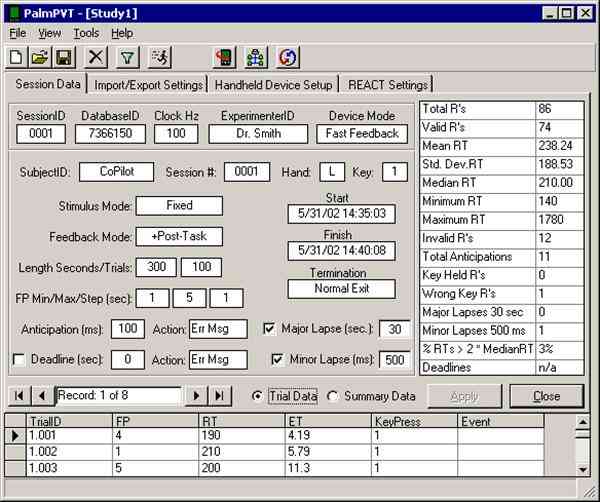
James Miller’s human factors / ergonomics consultancy has a number of webpages and services that are relevant to the topic of this CMT post. And the Walter Reed Army Institute of Research, Psychiatry & Neuroscience Division (WRAIR-PN) has a number of tools for measuring fatigue, including a Palm-based software application that may be helpful for doing serial, self-administered measurements to inform ‘prevention’ or ‘planning’ interventions of the sort that the CMT reader’s comment/question has in mind (see links and screenshots below).
Most of the ergonomics and psychophysiology fatigue-performance research journal literature addresses changes in ‘error rate’ on-task, as a function of fatigue. In addition to error rate, performance is also measured in terms of the time taken to make decisions and check reference screens (‘decision-time’ and ‘check-time’). Subjective measures are also made of workload and environmental resources (personal control and support), of levels of anxiety and fatigue before the task, and of cognitive effort expended during the task. Measurements like these could be made on performing musicians under various conditions of stress and fatigue but, so far as I can tell, no such research has been published to-date. We have to take the results from the existing research literature and extrapolate to what it probably means for musicians.
Heart rate increases with increasing fatigue—not a good thing. Long eye-closure rate (LCR), blink amplitude (BA), eye movement ‘saccade velocity’, saccade rate, and peak saccade velocity all tend to increase (see Morris & Miller 1996, link below). Your response speed slows, despite the increase in sympathetic and parasympathetic nervous system activation. The number of ‘lapses’ in attention per minute increases (see Lamond et al. 2008, link below). You experience more severe and earlier exhaustion of coordination/interaction resolution abilities (see Persson et al 2007). In other words, all of your subjective impressions of what’s happening to your performance are true, or at least are very likely to be true (if findings from aviation and other high cognitive-intensity fields generalize to music)!
Studies by Strang and Berg at Miami University of Ohio show that fatigue has no effect on postural stability during the ‘focal’ movement, and yet caused earlier ‘anticipatory postural adjustments’ (APA) onsets in various muscle groups. In spite of ‘hyper-reactive’ early APA activations, the APA electromyograms of the postural control muscles stay pretty much the same. The findings suggest that fatigue-induced early APA onset is compensatory—it may enhance postural stability by permitting a longer duration APA which in turn counteracts the fatigue-related decreases in the force-producing capability of muscles that contribute to postural stability.
What else? Fatigue causes a decrement in vigilance, not just the ‘penalty’ in terms of slower reaction times (RTs) appearing after a few tens of minutes’ performance, depending on the intensity of the cognitive demands during those minutes. Additionally, fatigue interferes with learning/memorizing new sequences, consolidating memory of sequences already learned, and reinforcing your memory of, or the timing and precision of recall for, sequences that your brain has previously consolidated and stored. In other words, fatigue not only impairs your performance of what you already know; it impairs your learning and rehearsal of new things that you haven’t yet perfected. (This is part of the ‘guilt’ the CMT reader was implying in the comment above: a heavy touring schedule taxes your artistic growth, and this seems intuitively, morally ‘wrong’ to many musicians.)
Walker et al. (2003) suggest that when consolidated memories are retrieved [from memory, during performance], they again are labile and susceptible to interference, and require a period of reconsolidation in order to be preserved intact. Recently consolidated memories also benefit from rest intervals (Hotermans et al., 2006) to maintain their integrity as memories. Scary how performance while fatigued, by preventing such reconsolidation, may actually erode the integrity of the performance-related memories that you’ve invested so much effort to create!
If you’re really serious about undertaking the quantitative assessment of how far gone you are and how much rest you need, you can measure your own condition in the same way that the military does—with PDA-PVT (‘personal digital assistant psychomotor vigilance testing’), developed for Palm PDAs by David Thorne and coworkers at Walter Reed Army Institute of Research in Washington, DC.
Make yourself a spreadsheet or log, and record your measurements daily, just as you would do for your exercise regimen or weight management routine. Keep track of your hours of sleep/napping and other factors that you think are significant for your performance—and correlate these with your PDA-PVT measurements. Experiment with ‘recovery’ maneuvers (e.g., X extra hours of sleep, to recover from Y hours of sleep deficit) over a period of several months, and figure out your own personal program for mitigating the fatigue-related toll of your tour schedule.
Here are some gleanings from James Miller’s website that you may find useful:
Fatigue Countermeasures that Clearly Work
Adequate sleep;
Caffeine in moderate doses;
Napping;
Anchor Sleep (regular sleep period of at least 4h duration, obtained at the same time each night);
Performance Timing / Scheduling changes to provide ‘breaks’;
Good sleeping environment.
Fatigue Countermeasures that Require Supervision by a Physician
Alertness Aids;
Sleep meds;
Bright light;
Melatonin.
Fatigue Countermeasures that Do Not Work, or Cause Health Problems
Nicotine;
Ventilation or Air Conditioning changes;
Temperature adjustments;
Exercise (Do exercise for other health reasons, but not with any hope that it will help relieve the fatigue-related effects on your reaction-times or performance);
Diet and nutritional supplements;
White-Noise or other Ambient Sound maneuvers;
Odor/Fragrance aromatherapy.
Unfortunately, the fatigue aspect of occupational health in professional musicians is under-studied. I hope the links below are helpful. I’d be delighted to hear from you—one way or the other, good or bad—if you try the PDA-PVT software or other approaches. Thanks for the comments and questions!
A s for CoCo™, it was a charming, agreeably quiet, and effective companion. The program notes were informative, and for those who simply wanted a visual aide, the live feed of Morgan conducting (shot from the orchestra’s point of view) was an attractive enhancement. The commentary was useful, particularly in a new and unfamiliar piece such as Bunch’s — the texts linked the music to Lichtenstein’s paintings (shown on the hand-held screen) and directed the listener to changes in mood and instrumentation. But even a well-known work such as Beethoven’s 8th yielded an engaging summary of exposition and development. It wasn’t until the second half, however, that the device proved worth its weight in gold. With the Mahler texts on the hand-held screen, it was no longer necessary to search for them in the program (as any vocal recital fan can tell you, the sound of hundreds of audience members turning pages in unison can be a big distraction). Recital lovers also know that presenters often provide the texts but keep the lights so low no one can read them. Here they were in your hand, illuminated and easy to read! Suddenly, I was convinced: The gadget’s a very good thing.” — Georgia Rowe, Andante, 25-FEB-2005.
One of the biggest problems in compositional ‘form’ (or programming ‘form’, as covered in the previous post ) is achieving a ‘unity’ of style, expressive aesthetics, and meaning. ‘Lack of unity’ assaults the mind and emotions. ‘Expressive incoherence’ is aesthetically ugly and annoying.
But the issue of coherence isn’t just whether the ideas and feelings make sense in the sequences or the mashups and overlaps that are composed/arranged. It also has to do with the slew-rate—how fast the transitions are (as Robert Kirzinger put it) in the context of who’s listening or participating, and in the context of what the listeners’/participants’ skills, training, mood, intentions and goals, and other factors are at the time. The question is not just pertinent to the juxtaposition of pieces by disparate composers. The question of coherence is also raised at the level of movements’ relations to each other within works—how coherent are the movements with each other, in the sequence in which they are arranged—and even down to the phrase level, as David Lewin points out. Or even at the ‘ambient’ configuration level, as Jesper Kyd points out.
Hypothetically, unity can be guaranteed simply by using the same ‘material’ from beginning to end, as is done in some fugues or in some of Steve Reich’s or other minimalists’ pieces. Morton Feldman’s ‘Rothko Chapel’ and ‘Why Patterns?’ on the same disc: same composer, similar meditative intent, similar sound intensity, similar acoustic performance spaces and timbres, similarities in ‘vocality’ among the instrumental and choral parts, different orchestrations but nonetheless cohesive. ‘Why Patterns?’ for flute, glockenspiel and piano, a dissonant vegetative proliferation. The work doesn’t seem to have a beginning or ending. A cosmic, zen-like piece of music, where the audience members are incidental. Coming in half-way through or leaving before the end may not detract from your apprehending its meaning. This has unity and coherence with zen-like qualities of ‘Rothko Chapel’. Just one example, but one that illustrates the multiple dimensions around which aesthetic value judgments must be made and are made.
You can’t tell what 50 sec of the third movement of Morton Feldman’s Rothko Chapel I excerpted, could you! Shall I excerpt 50 sec of John Cage’s 4’33’’ ? The entire piece consists of silences—silences of different lengths, as they say. As a musical piece, 4’33’’ leaves almost no room for the pianist’s interpretation. As long as the pianist watches the stopwatch, she/he can’t play it too fast or too slow. She/he can’t hit the wrong notes. She/he can’t play it too loud or too soft, too flatly or too floridly. What you hear when you listen to 4’33’’ is entirely a matter of chance—nothing of what you hear is anything the composer ‘wrote’ in any ordinary sense. It’s nonetheless a composition—Cage, the godlike Blind Watchmaker, intended for you to have an antiphonal, aleatoric musical experience, without explicitly specifying what the content of that experience will be—only specifying that it should have a pianist, a piano, and be 4’33’’ in duration. It is symbolically rich and it has its own peculiar aesthetic unity and coherence. Different if someone coughs, say, than if a city bus goes by and is heard faintly through the walls of the concert hall. It would be sacrilege if I excerpted 4’33’’ and gave you a 50-sec clip of it. More than sacrilege, it would be incoherent to do so.
E ven more telling is a psychological rationale that suggests why something new should happen at this moment. To assert an I-relation between mm. 29-32 and mm. 33-36 has entailed our obtruding the idea of rows into a piece based, so far, on ‘configurations’. This precipitates a critical point in our reception of the music [Dallapiccola’s ‘Simbolo’]. We may not be fully aware of the crisis, to be sure, but perhaps we sense it obscurely, as suggested by the composer’s indication ‘oscuro’ on the dyad {G, A-flat} at m. 33. Given this state of affairs, something ‘large’ should happen just after mm. 33-36. Perhaps a row will appear in the music. Perhaps some new configuration-type will appear—possibly generating a new ‘variation’. Or perhaps the piece will close, as it in fact does, via the references to the original configuration in mm. 37-42 and then in mm. 42-46. The enigmatic effect of those references is not simply due to a ‘stimmung’ inherent in the material itself. Rather, our puzzlement involves a sense of incompleteness; the music withdraws from us, withholding something from us—that is, the row. We are impelled onwards.” — David Lewin, Dallapiccola’s ‘Simbolo’, in Musical Form & Transformation, 2007, p. 14.
Poorly-constructed fugues can be deadly. If we listen to music that continues for too long without enough rhythmic or harmonic texture to hold our attention then we tend to go to sleep. Carnatic and other asian music presents challenges to those of us whose minds were raised in western traditions; in spite of our concentration, attention becomes an effort.
If the rhythm and/or harmonic textures change, though—not excessively frequently or precipitously, and not too infrequently or glacially—then our attention is captured and remains in focus. We listen to the succession of messages with pleasure, or angst, or whatever emotions are consistent with the content and intent of the music. Each new message must last long enough for it to be meaningful and aesthetically effective. If it doesn’t last long enough, or if it violates our expectations (as Robert Kirzinger said in his email response to the previous CMT post), then it’ll frustrate and irritate us or wear us out. Continuous change or scatological change makes it impossible for us to remember what’s gone before, or to relate one part to another. Inevitably, the lack of completion or fulfillment leaves us dissatisfied and forgetful of what we’ve heard. Do not put your iPod on ‘shuffle’ and expect fulfillment or aesthetic coherence, unless you have a very tiny, already-coherent iTunes library on that iPod.
Human factors engineering for avionics and cockpit-design has many of these same ‘durability of attention’ cognitive issues. In conditions of poor visibility, inexperienced pilots get into spiral dives in several ways, but this is the most common: While the pilot (John Kennedy Jr?) is looking for lights on the ground or other horizon reference, the airplane slowly rolls into a banked attitude. With no horizon visible, the pilot looks at the ‘artificial horizon’ indicator in the cockpit and notices that the horizon bar is not level. The initial reaction is to roll the horizon bar back to level, which rolls the airplane into a steeper bank. This is known as a ‘horizon control reversal’.
In a steep bank, the nose of the airplane drops, and it starts to lose altitude. To maintain altitude, the pilot pulls back, which tightens the turn and steepens the spiral dive. At this point the pilot is confused, disoriented, and no longer in control of the airplane. Such a sequence can and does happen rapidly, and the resulting crash is invariably attributed to ‘pilot error’. No doubt the pilot made the error, but what caused the ‘error’ is never determined nor the probable cause reported.
The term ‘pilot error’ is misused when such errors can be prevented by an experimentally proven equipment modification. In the case of flight attitude control, all that is needed is to cause the ‘little airplane’ symbol on the artificial horizon gauge to rotate in direct response to aileron control inputs. So, to return to a wings-level attitude, the pilot merely has to align the airplane symbol with the displaced horizon bar and maintain that alignment as the real airplane and the artificial horizon bar, rotating in opposite directions, both return to wings-level.
To illustrate, if the airplane rolls to the right, the horizon bar rolls left. The pilot notices this and applies left aileron to align the airplane symbol with the horizon bar, causing the plane to start rolling back toward wings level. As this is going on, the pilot gradually reduces the left aileron input to maintain alignment until the ailerons are neutral when the wings are level. Thus, straight-ahead flight is restored. The three display modes all indicate a bank to the right. The left indicator is rotated counterclockwise. In the center indicator, the airplane symbol is rotated clockwise. In the right indicator, the horizon is the same as on the left, but in addition the airplane symbol is rotated clockwise by the pilot’s aileron input, indicating that the plane will continue to roll to the right. The instrument represented on the left is the standard system in today’s airplanes including John Kennedy’s Piper Saratoga II. With the display at the right, pilots maintain wings-level flight merely by aligning the airplane symbol with the horizon, a natural response.
Each of the three gauge designs has the advantage of ‘judgment-neutrality’. That is, none of the gauges strongly says at any time that the pilot is making a wrong decision—they simply show the fact of pitch-yaw-roll (right-banking/left-banking and nose-up/nose-down attitude) with respect to the ground. You may have your reasons for piloting the plane in the attitude it is taking—that’s up to you; the gauge doesn’t tell you you are wrong to do so, and it doesn’t prejudicially tell you that something bad is probably going to happen if you keep steering that way. That’s just the way a gauge should be!
So, maybe orchestras and presenters should try ‘musical avionics console’ graphical PDAs or VR heads-up goggles to hand out to audience members who want them, to give the audience notice of aesthetic turbulence ahead, or advance views of the aesthetic terrain below. You thought the CoCo™ ConcertCompanion™ text-plus-video RF PDA guides that’ve been tried in 2003-2007 were distracting, aesthetically disturbing? Well, get a load of ConcertFlightSimulator™.
My cup of tea? No, no wireless virtual consoles or PDAs for me. Technophile though I am and alternative-venues classical/newmusic person though I am, I don’t really want more ‘gear’ when participating in a live ‘meat-world’ performance. And I don’t want to hear or see other concert-goers fumbling with the glarey little gizmos either. Not even nice Studierstube PDAs. People dropping their programs on the floor is distracting enough as it is. And I don’t want to be subjected to other people ‘crashing’ their augmented-reality concert flight-deck hand-helds. I don’t want a concert hall full of ‘gamers’ to intrude on my listening (or performing).
No, you [concert presenters, artists, composers, recording/broadcast producers] have the ‘con’. The aesthetic unity and musical ‘safety’ of your ‘flying’ are fine with me just as they are, even when you deviate from the flight-plan or ‘normal’ sequence of movements. I can live with it. I may prefer some other unity, some other coherence. But, then again, I may learn something from you, and from the choices you make. Or I may learn something about the reasons for my deep preferences for hearing all of the movements of Brahms’s Op. 111 Quintet in G major together, with respectful/meditative silences before and after. Either way, I’m happy. Citizenship includes following others, enabling others and just simply trusting others to lead. I would not come down on you for failing to make the best aesthetic decision, and you know that I have every confidence in you, that you will successfully complete our aesthetic/experiential ‘mission’.
Different story, though, in SecondLife or classical music in other VR realms. If some ‘aesthetic avionics gauges’ were available in SL and I could configure my own in-world virtual-concert cockpit the way I want, I might in fact use them. Happy, in SL, to have you as co-pilot. The SL script language isn’t quite up to that yet, though.