O ur ensemble’s touring schedule this year is just brutal. The airline flights and weather-related delays are the worst part of it. The de rigeur dinners with presenters and their sponsors exact an additional toll. Our sleeping quality sucks, and it seems like our reaction-times in critical passages in performances also are ‘off’. We are perpetually fatigued. Seriously, I think it must be very much like ‘combat fatigue’, this perpetual sleep-deprivation, fatigue, high-risk performance situations, and confinement. Brutal! I’m not sure there’s anything that can be done about this—it seems inherent in the nature of a busy performing schedule. Of course we feel lucky, in a perverse way, to have this ‘problem’. But, artistically, it [the fatigue-related impairment of aesthetic values] makes me feel guilty and dissatisfied. Maybe the performance schedules of one or two hundred years ago had more healthy down-time, because travel from city to city naturally took longer. Maybe my envy, my nostalgia, is for a time that never ever was like that. The physical demands and continuous stress are so much more than [Conservatory training] ever prepared us for. It’d be nice to have some way to assess how ‘off’ you are, before going on-stage—or, better, the day before your next performance… time enough to maybe do something about the fatigue. Is there any way to objectively figure out how bad your ‘deficit’ is, to know how much rest you might need in order to get half-way back to ‘normal’?”The comment above is reminiscent of the issues in a growing body of research in aviation, on ‘medical flightworthiness’—quantitative assessment of pilots’ cognitive and physiologic readiness to fly and to perform with adequate safety and precision when flying. There are a number of recent books and other resources that provide new insight into the effect of sleep-deprivation and mental and physical fatigue on cognition, emotion, and on-task performance. But relatively little research has been conducted/published regarding the impacts of fatigue on professional musicians. However, aviation and overland transport industries have commissioned scientific psychophysiology studies of fatigue-performance relationships for many decades, and, not surprisingly, there is a wealth of science on this that has been generated by the military in various countries. Most of the findings from those contexts are likely to be generalizable and applicable to the performing arts, including classical music.
— Anonymous.
J ames Miller’s human factors / ergonomics consultancy has a number of webpages and services that are relevant to the topic of this CMT post. And the Walter Reed Army Institute of Research, Psychiatry & Neuroscience Division (WRAIR-PN) has a number of tools for measuring fatigue, including a Palm-based software application that may be helpful for doing serial, self-administered measurements to inform ‘prevention’ or ‘planning’ interventions of the sort that the CMT reader’s comment/question has in mind (see links and screenshots below).
Most of the ergonomics and psychophysiology fatigue-performance research journal literature addresses changes in ‘error rate’ on-task, as a function of fatigue. In addition to error rate, performance is also measured in terms of the time taken to make decisions and check reference screens (‘decision-time’ and ‘check-time’). Subjective measures are also made of workload and environmental resources (personal control and support), of levels of anxiety and fatigue before the task, and of cognitive effort expended during the task. Measurements like these could be made on performing musicians under various conditions of stress and fatigue but, so far as I can tell, no such research has been published to-date. We have to take the results from the existing research literature and extrapolate to what it probably means for musicians.
Heart rate increases with increasing fatigue—not a good thing. Long eye-closure rate (LCR), blink amplitude (BA), eye movement ‘saccade velocity’, saccade rate, and peak saccade velocity all tend to increase (see Morris & Miller 1996, link below). Your response speed slows, despite the increase in sympathetic and parasympathetic nervous system activation. The number of ‘lapses’ in attention per minute increases (see Lamond et al. 2008, link below). You experience more severe and earlier exhaustion of coordination/interaction resolution abilities (see Persson et al 2007). In other words, all of your subjective impressions of what’s happening to your performance are true, or at least are very likely to be true (if findings from aviation and other high cognitive-intensity fields generalize to music)!
Studies by Strang and Berg at Miami University of Ohio show that fatigue has no effect on postural stability during the ‘focal’ movement, and yet caused earlier ‘anticipatory postural adjustments’ (APA) onsets in various muscle groups. In spite of ‘hyper-reactive’ early APA activations, the APA electromyograms of the postural control muscles stay pretty much the same. The findings suggest that fatigue-induced early APA onset is compensatory—it may enhance postural stability by permitting a longer duration APA which in turn counteracts the fatigue-related decreases in the force-producing capability of muscles that contribute to postural stability.
What else? Fatigue causes a decrement in vigilance, not just the ‘penalty’ in terms of slower reaction times (RTs) appearing after a few tens of minutes’ performance, depending on the intensity of the cognitive demands during those minutes. Additionally, fatigue interferes with learning/memorizing new sequences, consolidating memory of sequences already learned, and reinforcing your memory of, or the timing and precision of recall for, sequences that your brain has previously consolidated and stored. In other words, fatigue not only impairs your performance of what you already know; it impairs your learning and rehearsal of new things that you haven’t yet perfected. (This is part of the ‘guilt’ the CMT reader was implying in the comment above: a heavy touring schedule taxes your artistic growth, and this seems intuitively, morally ‘wrong’ to many musicians.)
Walker et al. (2003) suggest that when consolidated memories are retrieved [from memory, during performance], they again are labile and susceptible to interference, and require a period of reconsolidation in order to be preserved intact. Recently consolidated memories also benefit from rest intervals (Hotermans et al., 2006) to maintain their integrity as memories. Scary how performance while fatigued, by preventing such reconsolidation, may actually erode the integrity of the performance-related memories that you’ve invested so much effort to create!
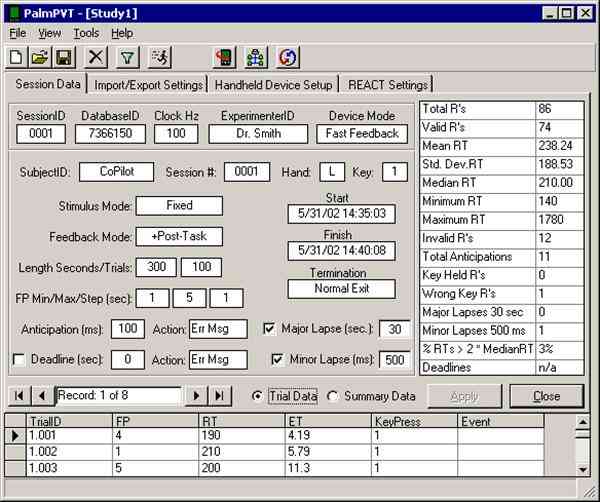
If you’re really serious about undertaking the quantitative assessment of how far gone you are and how much rest you need, you can measure your own condition in the same way that the military does—with PDA-PVT (‘personal digital assistant psychomotor vigilance testing’), developed for Palm PDAs by David Thorne and coworkers at Walter Reed Army Institute of Research in Washington, DC.

Make yourself a spreadsheet or log, and record your measurements daily, just as you would do for your exercise regimen or weight management routine. Keep track of your hours of sleep/napping and other factors that you think are significant for your performance—and correlate these with your PDA-PVT measurements. Experiment with ‘recovery’ maneuvers (e.g., X extra hours of sleep, to recover from Y hours of sleep deficit) over a period of several months, and figure out your own personal program for mitigating the fatigue-related toll of your tour schedule.

Here are some gleanings from James Miller’s website that you may find useful:
- Fatigue Countermeasures that Clearly Work
- Adequate sleep;
- Caffeine in moderate doses;
- Napping;
- Anchor Sleep (regular sleep period of at least 4h duration, obtained at the same time each night);
- Performance Timing / Scheduling changes to provide ‘breaks’;
- Good sleeping environment.
- Fatigue Countermeasures that Require Supervision by a Physician
- Alertness Aids;
- Sleep meds;
- Bright light;
- Melatonin.
- Fatigue Countermeasures that Do Not Work, or Cause Health Problems
- Nicotine;
- Ventilation or Air Conditioning changes;
- Temperature adjustments;
- Exercise (Do exercise for other health reasons, but not with any hope that it will help relieve the fatigue-related effects on your reaction-times or performance);
- Diet and nutritional supplements;
- White-Noise or other Ambient Sound maneuvers;
- Odor/Fragrance aromatherapy.

- James Miller, Human Factors / Ergonomics
- Walter Reed Army Institute of Research, Psychiatry & Neuroscience (WRAIR-PN)
- CiteUlike.org
- National Sleep Foundation
- U.S. DoL Occupational Safety & Health Administration (OSHA) page on unusual work shifts and fatigue.
- Corware.com PalmPVT software
- DSM. Strengthening Lumbrical Muscles. CMT blog, 09-FEB-2008. (Stamina 2.5 response-time measurement software.)
- Apparies R, Riniolo T, Porges S. A psychophysiological investigation of the effects of driving longer-combination vehicles. Ergonomics. 1998;41:581-92.
- Beilock S, Carr T. On the fragility of skilled performance: What governs choking under pressure? J Exp Psychol 2001; 130:701-25.
- Gimmig D, Huguet P, Caverni J, Cury F. Choking under pressure and working memory capacity: when performance pressure reduces fluid intelligence. Psychon Bull Rev 2006; 13:1005-10.
- Gordon S. Mastering the Art of Performance: A Primer for Musicians. Oxford Univ, 2005.
- Greene D. Performance Success : Performing Your Best Under Pressure. Routledge, 2001.
- Hossain J, Ahmad P, Reinish L, Kayumov L, Hossain N, Shapiro C. Subjective fatigue and subjective sleepiness: two independent consequences of sleep disorders? J Sleep Res. 2005;14:245-53.
- Hotermans C, Peigneux P, Maertens de Noordhout A, Moonen G, Maquet P. Early boost and slow consolidation in motor skill learning. Learning & Memory 2006; 13:580-3.
- Kiriyama K, Stickgold R, Walker M. Sleep-dependent learning and motor-skill complexity. Learn Mem. 2004;11:705-13.
- Lal S, Craig A. A critical review of the psychophysiology of driver fatigue. Biol Psychol. 2001;55:173-94.
- Lamond N, Dawson D, Roach G. Fatigue Assessment in the Field: Validation of a Hand-Held Electronic Psychomotor Vigilance Task. Aviation Space Environ Med. 2005;76:486-92. [200KB pdf]
- Lamond N, Jay S, Dorrian J, Ferguson S, Roach G, Dawson D. The sensitivity of a palm-based psychomotor vigilance task to severe sleep loss. Behav Res Methods. 2008;40:347-52.
- Morris T, Miller J. Electrooculographic and performance indices of fatigue during simulated flight. Biol Psychol. 1996;42:343-60.
- Persson J, Welsh K, Jonides J, Reuter-Lorenz P. Cognitive fatigue of executive processes: interaction between interference resolution tasks. Neuropsychologia. 2007;45:1571-9.
- Reinhart R. Basic Flight Physiology. 2e. McGraw-Hill, 1996.
- Stickgold R, Walker M. Sleep-dependent memory consolidation and reconsolidation. Sleep Med 2007; 8:331-43.
- Strang A, Berg W. Fatigue-induced adaptive changes of anticipatory postural adjustments. Exp Brain Res. 2007;178:49-61.
- Walker M, Stickgold R, Alsop D, Gaab N, Schlaug G. Sleep-dependent motor memory plasticity in the human brain. Neuroscience. 2005;133:911-7.
- Walker M, Brakefield T, Hobson J, Stickgold R. Dissociable stages of human memory consolidation and reconsolidation. Nature 2003; 425: 616-20.
- Thorne D, Johnson D, Redmond D, Sing H, Belenky G. Walter Reed palm-held psychomotor vigilance test. Behav Res Meth 2005; 37:111-8. [100KB pdf]


