Showing posts with label psychophysiology. Show all posts

Tuesday, January 3, 2012

Guided imagery in music training and performance

x
I    n order to have fast mobility and clarity on left-hand fingers, string players have to train their fingers to have these 3 elements when dropping their left-hand fingers on the fingerboard: speed; strength; and the fast release right after the drop. The 3 elements on the left-hand fingers take training to build up the strength of the muscles and the speed of the reflex of the fast release. Of course, any ‘tool’ that we gain from our technical training is ultimately to be used to create music that would touch listeners. Sometimes when musicians concentrate too much on technical elements, their music tends to be too mechanical, too careful, and lacks emotion. By contrast, when musicians concentrate on being musical, it actually helps the technical things. For example, whenever I feel my fingers stiffen in fast passages, I always find thinking something light and bubbly helps to increase my fingers’ lightness, mobility, and fast articulations. Whenever I try to sustain a long note [and yet try to musically project vitality and suspense, despite the temporary absence of pitch-change or the lack of overt dynamics changes while the note lasts], I remind myself about the struggles and tension of the music. Whenever I try to create smooth bow changes, I often picture a [calligraphy] paint brush changing its direction, instead of which muscle to move first!”  —  Jackie Lee, Heartland Music Academy, 2012.
Jackie LeeI n reply to the previous post, I received the helpful advice above.

A nother CMT reader emailed me to ask whether there was any scientific research literature that establishes the effectiveness of visual or kinesthetic imagery in music teaching, especially for soloists or chamber performers.

T here’s lots of published research on guided imagery in the neurophysiology and physical medicine and rehab literature—and in the lit for research on aging and stroke. Quite a lot in the dance and sports medicine lit. But there are not very many published controlled research studies in music performance/pedagogy lit, so far as I can tell.

I  will continue looking; please feel free to add comment below or email me if there is a reference that you like.

M eanwhile, here are some links to work that’s relevant to this.
T   he left arm functions, to a large extent, by 'walking' on the fingers. In actual walking, torso balance shifts forward, and it is caught on top of the moving legs. For the cellist's left arm, a similar balance can be felt when the upper arm shifts and must be caught by another finger or the arm will fall over... This ‘walking’ image can be strengthened by imagining that the fingerboard is a staircase... Picturing this helps you feel that your balance is aligned in the Earth's gravity, even though your fingers look angled-back in relation to the surface of the fingerboard.”   —  Jeffrey Solow, cellist, quoted in Bruser, p. 121.
I    n automatic or cyclical movements, actual and motor imagery (MI) durations are similar. When athletes imagine only the dynamic phases of movement or perform MI just before competing, however, the environmental and time constraints lead to underestimating the actual duration [and the benefits of the guided imagery are diminished, despite the speed and ease with which the imagery for brief or cyclical movements is called up]. Conversely, complex attention-demanding movements take longer to image [and so guided imagery for complex movements has impediments to its effectiveness, even if duration over/underestimation does not occur].”   —  Aymeric Guillot, 2005.
T    he bilateral frontal opercular regions [in the brain] are crucial in both preparation for and during music execution and imagining. They may have ‘mirror neuron’ properties that underlie observation or imagining of one’s own performance. The motor areas are differentially activated during the preparation and execution or imagining the sequence.”   —  Rumyana Kristeva, 2003.
Mike Mei, calligrapherD    uring execution of musical sequences in professional musicians, a higher economy of motor areas [in the brain] frees resources for increased connectivity between the finger sequences and auditory as well as somatosensory loops, which may account for the superior musical performance. Professionals also demonstrated more focused activation patterns during imagined musical performance.”   —  Martin Lotze, 2003.

Monday, May 26, 2008

Tempi and Saliency: Psychophysiology, or Why Deceptive Cadences Are Not Always Deceptive

 Sloboda book
W  e do not doubt that attention, recurrent computations, and complexity are important aspects to understand consciousness. However, we propose that these aspects are often trivially necessary rather than sufficient. For example, often it is assumed that consciousness emerges not before several hundreds milliseconds after stimulus onset. Hence, given the short time constants of membranes of neurons, recurrent connections are obviously necessary to store and process the stimulus before consciousness is reached. Complexity is for sure of primary importance for consciousness because networks with the same number of neurons can create trivial as well as complex behavior depending on their connectivity. Therefore, the important question is which kind of connectivity or which exact degree of complexity, determined with which mathematical norm, is sufficient for consciousness ...”
  —  Michael Herzog (Laboratory of Psychophysics, Lausanne), Michael Esfeld (Dept of Philosophy, Univ Lausanne), and Wulfram Gerstner (Computer Sciences and Brain-Mind Institut, Ecole Polytechnique Federale de Lausanne), Neural Networks 2007.
This is a quick post-script on the topic of the previous CMT post, about psychophysiology of modality and tempi.

It turns out that Tibor Bosse and collaborators at the Vrije University in Amsterdam have recently been developing mathematical models of attention, mostly for military applications. Some of these models (and the differential equations underlying them) resemble hydrodynamic models used in cardiovascular physiology (‘windkessel’ models; in German, windkessel means elastic reservoir) and in functional magnetic resonance imaging (fMRI).

 3-element windkessel electrical model
The effect of stimulus rate and its interaction with stimulus type on brain activity during the visual or acoustic stimulus has been investigated using fMRI. Different brain regions show differential responses as a function of time and as a function of the ‘tempo’ or stimulus rate. These results differentiate functionally specific responses in rate-dependent and rate-independent areas.

 4-element windkessel electrical model, with inductance-inertance element
The best approach to the dynamics, though, is probably not a ‘lumped-parameter’ analytical one, like simple windkessel models. Instead, nonlinear wave-front propagation models (Stefan moving-boundary differential-equations) or stochastic network representations may be more realistic as mathematical formalisms. An intermediate approach, such as mathematical approaches used to solve equations for liquid flow through porous media (like aquifers), may be useful, to represent the mesh-like connections and multi-path propagation of signals related to our brains’ perception of musical suspense and resolution (cadences). Have a look at Herzog’s and colleagues’ paper in the recent special issue of the journal Neural Networks and at Tibor Bosse’s papers for a glimpse of how feasible such a quantitative cognitive modeling project is these days.

The results of fMRI (and, presumably, of mathematical modeling of the rate-dependent effects) may enable us to better understand the inter-relationships between tempi and our apprehending meaning in music. For example, so-called ‘deceptive cadences’ to vi (or VI in the minor key) and similar progressions are normally treated in a time-independent way, as a prolongation of the dominant. But in some instances it is better understood as prolonging the tonic, through I-vi. Understanding it in that way, though, depends not only on the context but also on the tempo. In general, the second alternative only if the vi is a middleground harmony or key region and the tempo is relatively slow. Otherwise, we choose the first way as more compelling. The underlying idea of the expansion of the V is that tension in the dominant is not resolved by the deceptive move to vi, but actually heightened; it is only when the true tonic arrives that the tension is removed. But if the tempo is sufficiently slow, the mind anticipates everything. The mind calculates and re-calculates and gauges and re-gauges all the possibilities. The deceptive cadence becomes instead a meta-commentary on irony itself.

 Haydn Sonata Deceptive Cadence Example
In Five Graphic Music Analyses, Schenker showed that the Haydn Sonata analysis includes an extended prolongation of vi within the V that is the underlying harmony of the entire development (see the bass of the top system for the V; see mm. 81-111 of the other levels for the vi, which changes to VI (as V/ii) near the end of the passage).

By definition, a deceptive cadence is any phrase the ends in a way that is different from the anticipated outcome. Deceptive cadences can be disruptive, creating ‘Wow !’ moments in music. Usually, deceptive cadences require a melodic line and an accompaniment. A cadence is deceptive only if the melody ends up on the proper note to end the phrase, but the accompaniment contains unexpected harmony underneath. For example, if your song is in C-Major, you might expect the phrase to end up on a C Major chord, with the melody playing a ‘C’. If, though, the melody ends up on a ‘C’, but the harmony is an A-Minor chord, then this is an unexpected harmony and therefore a deceptive cadence.

Deceptive cadences are an example of how composers blur one phrase into the next. In a deceptive cadence, the melody is finishing off the phrase, while the harmony/accompaniment has already moved ahead, to the beginning of the next phrase. But if the tempo is slow enough, the synapses have had time to caucus with each other and anticipate everything. The ‘Wow!’ is of a totally different type. And the blurrings are no longer blurrings at all: they become meta-commentaries on what transitions are about, and why.

 Cadwallader-Gagne book; Mozart (K. 457) I, mm. 46-52
In Mozart’s piano sonata (K. 457, I), there is the tonic of mm. 36-41 leading to II6 in m. 46, suggesting the imminent arrival of an authentic cadence. But instead we get a deceptive cadence in mm. 47-48 that delays resolution to the mediant key. The delaying effect resets our expectations and inhibits our reaching conclusions so quickly or relying on them so much once we’ve reached them. Cadwallader and Gagne’s book is excellent in its extensive coverage of effects like these. They don’t talk about Glenn Gould’s peculiar treatments of Mozart, though.

In Glenn Gould’s 1981 recording of Bach’s Goldberg Variations he takes a much slower tempo for the aria/sarabande that bookends the variations, or Variation 7, for example. In the recordings of Haydn’s six late piano sonatas (Hob. XVI: 42, 48-52) he plays the slow
movements very slowly, and with more interpretive inflection. His interpretive eccentricities came not from perversity but from a deep fascination: a love that demands a lingering largo; an experimenter's desire to find out nature’s secrets by way of stop-motion photography; an introspection that was selfless, timeless, otherworldly. To Gould, the slow, measured tempi were tools to reveal hidden profundities—in much the same way as they are to Simone Dinnerstein, for example.

In summary, my idea of ‘funnels’ or hydrodynamic windkessel mathematical models for representing the psychophysiology of generation of musical meaning is, evidently, not so rash or novel after all. True, nobody has yet applied these techniques with fMRI and musical stimuli, in the way that Bosse and others have done with visual stimuli for naval and aviation psychophysiology. But the maths and experimental methods are today up to such a task. Cheers!

 Dayan-Abbott book

 Parasuraman book


Thursday, May 22, 2008

Medical Performanceworthiness: Concertizing While Fatigued and Sleep-Deprived

 Fatigue in Fallujah
O  ur ensemble’s touring schedule this year is just brutal. The airline flights and weather-related delays are the worst part of it. The de rigeur dinners with presenters and their sponsors exact an additional toll. Our sleeping quality sucks, and it seems like our reaction-times in critical passages in performances also are ‘off’. We are perpetually fatigued. Seriously, I think it must be very much like ‘combat fatigue’, this perpetual sleep-deprivation, fatigue, high-risk performance situations, and confinement. Brutal! I’m not sure there’s anything that can be done about this—it seems inherent in the nature of a busy performing schedule. Of course we feel lucky, in a perverse way, to have this ‘problem’. But, artistically, it [the fatigue-related impairment of aesthetic values] makes me feel guilty and dissatisfied. Maybe the performance schedules of one or two hundred years ago had more healthy down-time, because travel from city to city naturally took longer. Maybe my envy, my nostalgia, is for a time that never ever was like that. The physical demands and continuous stress are so much more than [Conservatory training] ever prepared us for. It’d be nice to have some way to assess how ‘off’ you are, before going on-stage—or, better, the day before your next performance… time enough to maybe do something about the fatigue. Is there any way to objectively figure out how bad your ‘deficit’ is, to know how much rest you might need in order to get half-way back to ‘normal’?”
  —  Anonymous.
The comment above is reminiscent of the issues in a growing body of research in aviation, on ‘medical flightworthiness’—quantitative assessment of pilots’ cognitive and physiologic readiness to fly and to perform with adequate safety and precision when flying. There are a number of recent books and other resources that provide new insight into the effect of sleep-deprivation and mental and physical fatigue on cognition, emotion, and on-task performance. But relatively little research has been conducted/published regarding the impacts of fatigue on professional musicians. However, aviation and overland transport industries have commissioned scientific psychophysiology studies of fatigue-performance relationships for many decades, and, not surprisingly, there is a wealth of science on this that has been generated by the military in various countries. Most of the findings from those contexts are likely to be generalizable and applicable to the performing arts, including classical music.

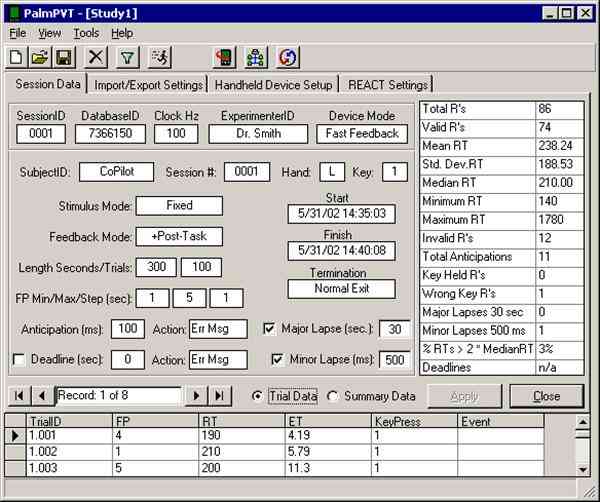
J ames Miller’s human factors / ergonomics consultancy has a number of webpages and services that are relevant to the topic of this CMT post. And the Walter Reed Army Institute of Research, Psychiatry & Neuroscience Division (WRAIR-PN) has a number of tools for measuring fatigue, including a Palm-based software application that may be helpful for doing serial, self-administered measurements to inform ‘prevention’ or ‘planning’ interventions of the sort that the CMT reader’s comment/question has in mind (see links and screenshots below).

Most of the ergonomics and psychophysiology fatigue-performance research journal literature addresses changes in ‘error rate’ on-task, as a function of fatigue. In addition to error rate, performance is also measured in terms of the time taken to make decisions and check reference screens (‘decision-time’ and ‘check-time’). Subjective measures are also made of workload and environmental resources (personal control and support), of levels of anxiety and fatigue before the task, and of cognitive effort expended during the task. Measurements like these could be made on performing musicians under various conditions of stress and fatigue but, so far as I can tell, no such research has been published to-date. We have to take the results from the existing research literature and extrapolate to what it probably means for musicians.

Heart rate increases with increasing fatigue—not a good thing. Long eye-closure rate (LCR), blink amplitude (BA), eye movement ‘saccade velocity’, saccade rate, and peak saccade velocity all tend to increase (see Morris & Miller 1996, link below). Your response speed slows, despite the increase in sympathetic and parasympathetic nervous system activation. The number of ‘lapses’ in attention per minute increases (see Lamond et al. 2008, link below). You experience more severe and earlier exhaustion of coordination/interaction resolution abilities (see Persson et al 2007). In other words, all of your subjective impressions of what’s happening to your performance are true, or at least are very likely to be true (if findings from aviation and other high cognitive-intensity fields generalize to music)!

Studies by Strang and Berg at Miami University of Ohio show that fatigue has no effect on postural stability during the ‘focal’ movement, and yet caused earlier ‘anticipatory postural adjustments’ (APA) onsets in various muscle groups. In spite of ‘hyper-reactive’ early APA activations, the APA electromyograms of the postural control muscles stay pretty much the same. The findings suggest that fatigue-induced early APA onset is compensatory—it may enhance postural stability by permitting a longer duration APA which in turn counteracts the fatigue-related decreases in the force-producing capability of muscles that contribute to postural stability.

What else? Fatigue causes a decrement in vigilance, not just the ‘penalty’ in terms of slower reaction times (RTs) appearing after a few tens of minutes’ performance, depending on the intensity of the cognitive demands during those minutes. Additionally, fatigue interferes with learning/memorizing new sequences, consolidating memory of sequences already learned, and reinforcing your memory of, or the timing and precision of recall for, sequences that your brain has previously consolidated and stored. In other words, fatigue not only impairs your performance of what you already know; it impairs your learning and rehearsal of new things that you haven’t yet perfected. (This is part of the ‘guilt’ the CMT reader was implying in the comment above: a heavy touring schedule taxes your artistic growth, and this seems intuitively, morally ‘wrong’ to many musicians.)

Walker et al. (2003) suggest that when consolidated memories are retrieved [from memory, during performance], they again are labile and susceptible to interference, and require a period of reconsolidation in order to be preserved intact. Recently consolidated memories also benefit from rest intervals (Hotermans et al., 2006) to maintain their integrity as memories. Scary how performance while fatigued, by preventing such reconsolidation, may actually erode the integrity of the performance-related memories that you’ve invested so much effort to create!

 Corware PalmPVT®  session parameters
If you’re really serious about undertaking the quantitative assessment of how far gone you are and how much rest you need, you can measure your own condition in the same way that the military does—with PDA-PVT (‘personal digital assistant psychomotor vigilance testing’), developed for Palm PDAs by David Thorne and coworkers at Walter Reed Army Institute of Research in Washington, DC.

 Corware PalmPVT®  stats: Pilot=Vln1, Copilot=Vln2, Gunner=Vla, Navigator=Vlc
Make yourself a spreadsheet or log, and record your measurements daily, just as you would do for your exercise regimen or weight management routine. Keep track of your hours of sleep/napping and other factors that you think are significant for your performance—and correlate these with your PDA-PVT measurements. Experiment with ‘recovery’ maneuvers (e.g., X extra hours of sleep, to recover from Y hours of sleep deficit) over a period of several months, and figure out your own personal program for mitigating the fatigue-related toll of your tour schedule.

 Corware PalmPVT® response screen
Here are some gleanings from James Miller’s website that you may find useful:
    Fatigue Countermeasures that Clearly Work
  • Adequate sleep;
  • Caffeine in moderate doses;
  • Napping;
  • Anchor Sleep (regular sleep period of at least 4h duration, obtained at the same time each night);
  • Performance Timing / Scheduling changes to provide ‘breaks’;
  • Good sleeping environment.

    Fatigue Countermeasures that Require Supervision by a Physician
  • Alertness Aids;
  • Sleep meds;
  • Bright light;
  • Melatonin.

    Fatigue Countermeasures that Do Not Work, or Cause Health Problems
  • Nicotine;
  • Ventilation or Air Conditioning changes;
  • Temperature adjustments;
  • Exercise (Do exercise for other health reasons, but not with any hope that it will help relieve the fatigue-related effects on your reaction-times or performance);
  • Diet and nutritional supplements;
  • White-Noise or other Ambient Sound maneuvers;
  • Odor/Fragrance aromatherapy.
Unfortunately, the fatigue aspect of occupational health in professional musicians is under-studied. I hope the links below are helpful. I’d be delighted to hear from you—one way or the other, good or bad—if you try the PDA-PVT software or other approaches. Thanks for the comments and questions!

 Any sleep is good sleep.