Showing posts with label occupational health. Show all posts

Thursday, May 22, 2008

Medical Performanceworthiness: Concertizing While Fatigued and Sleep-Deprived

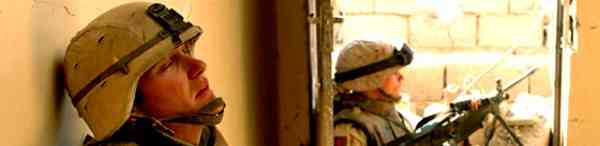
 Fatigue in Fallujah
O  ur ensemble’s touring schedule this year is just brutal. The airline flights and weather-related delays are the worst part of it. The de rigeur dinners with presenters and their sponsors exact an additional toll. Our sleeping quality sucks, and it seems like our reaction-times in critical passages in performances also are ‘off’. We are perpetually fatigued. Seriously, I think it must be very much like ‘combat fatigue’, this perpetual sleep-deprivation, fatigue, high-risk performance situations, and confinement. Brutal! I’m not sure there’s anything that can be done about this—it seems inherent in the nature of a busy performing schedule. Of course we feel lucky, in a perverse way, to have this ‘problem’. But, artistically, it [the fatigue-related impairment of aesthetic values] makes me feel guilty and dissatisfied. Maybe the performance schedules of one or two hundred years ago had more healthy down-time, because travel from city to city naturally took longer. Maybe my envy, my nostalgia, is for a time that never ever was like that. The physical demands and continuous stress are so much more than [Conservatory training] ever prepared us for. It’d be nice to have some way to assess how ‘off’ you are, before going on-stage—or, better, the day before your next performance… time enough to maybe do something about the fatigue. Is there any way to objectively figure out how bad your ‘deficit’ is, to know how much rest you might need in order to get half-way back to ‘normal’?”
  —  Anonymous.
The comment above is reminiscent of the issues in a growing body of research in aviation, on ‘medical flightworthiness’—quantitative assessment of pilots’ cognitive and physiologic readiness to fly and to perform with adequate safety and precision when flying. There are a number of recent books and other resources that provide new insight into the effect of sleep-deprivation and mental and physical fatigue on cognition, emotion, and on-task performance. But relatively little research has been conducted/published regarding the impacts of fatigue on professional musicians. However, aviation and overland transport industries have commissioned scientific psychophysiology studies of fatigue-performance relationships for many decades, and, not surprisingly, there is a wealth of science on this that has been generated by the military in various countries. Most of the findings from those contexts are likely to be generalizable and applicable to the performing arts, including classical music.

J ames Miller’s human factors / ergonomics consultancy has a number of webpages and services that are relevant to the topic of this CMT post. And the Walter Reed Army Institute of Research, Psychiatry & Neuroscience Division (WRAIR-PN) has a number of tools for measuring fatigue, including a Palm-based software application that may be helpful for doing serial, self-administered measurements to inform ‘prevention’ or ‘planning’ interventions of the sort that the CMT reader’s comment/question has in mind (see links and screenshots below).

Most of the ergonomics and psychophysiology fatigue-performance research journal literature addresses changes in ‘error rate’ on-task, as a function of fatigue. In addition to error rate, performance is also measured in terms of the time taken to make decisions and check reference screens (‘decision-time’ and ‘check-time’). Subjective measures are also made of workload and environmental resources (personal control and support), of levels of anxiety and fatigue before the task, and of cognitive effort expended during the task. Measurements like these could be made on performing musicians under various conditions of stress and fatigue but, so far as I can tell, no such research has been published to-date. We have to take the results from the existing research literature and extrapolate to what it probably means for musicians.

Heart rate increases with increasing fatigue—not a good thing. Long eye-closure rate (LCR), blink amplitude (BA), eye movement ‘saccade velocity’, saccade rate, and peak saccade velocity all tend to increase (see Morris & Miller 1996, link below). Your response speed slows, despite the increase in sympathetic and parasympathetic nervous system activation. The number of ‘lapses’ in attention per minute increases (see Lamond et al. 2008, link below). You experience more severe and earlier exhaustion of coordination/interaction resolution abilities (see Persson et al 2007). In other words, all of your subjective impressions of what’s happening to your performance are true, or at least are very likely to be true (if findings from aviation and other high cognitive-intensity fields generalize to music)!

Studies by Strang and Berg at Miami University of Ohio show that fatigue has no effect on postural stability during the ‘focal’ movement, and yet caused earlier ‘anticipatory postural adjustments’ (APA) onsets in various muscle groups. In spite of ‘hyper-reactive’ early APA activations, the APA electromyograms of the postural control muscles stay pretty much the same. The findings suggest that fatigue-induced early APA onset is compensatory—it may enhance postural stability by permitting a longer duration APA which in turn counteracts the fatigue-related decreases in the force-producing capability of muscles that contribute to postural stability.

What else? Fatigue causes a decrement in vigilance, not just the ‘penalty’ in terms of slower reaction times (RTs) appearing after a few tens of minutes’ performance, depending on the intensity of the cognitive demands during those minutes. Additionally, fatigue interferes with learning/memorizing new sequences, consolidating memory of sequences already learned, and reinforcing your memory of, or the timing and precision of recall for, sequences that your brain has previously consolidated and stored. In other words, fatigue not only impairs your performance of what you already know; it impairs your learning and rehearsal of new things that you haven’t yet perfected. (This is part of the ‘guilt’ the CMT reader was implying in the comment above: a heavy touring schedule taxes your artistic growth, and this seems intuitively, morally ‘wrong’ to many musicians.)

Walker et al. (2003) suggest that when consolidated memories are retrieved [from memory, during performance], they again are labile and susceptible to interference, and require a period of reconsolidation in order to be preserved intact. Recently consolidated memories also benefit from rest intervals (Hotermans et al., 2006) to maintain their integrity as memories. Scary how performance while fatigued, by preventing such reconsolidation, may actually erode the integrity of the performance-related memories that you’ve invested so much effort to create!
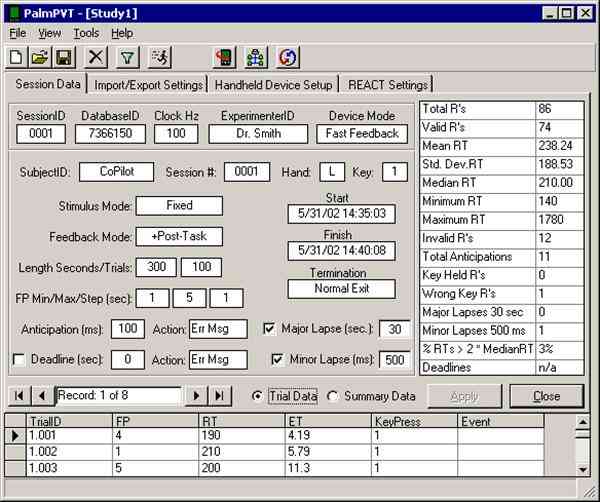
 Corware PalmPVT®  session parameters
If you’re really serious about undertaking the quantitative assessment of how far gone you are and how much rest you need, you can measure your own condition in the same way that the military does—with PDA-PVT (‘personal digital assistant psychomotor vigilance testing’), developed for Palm PDAs by David Thorne and coworkers at Walter Reed Army Institute of Research in Washington, DC.

 Corware PalmPVT®  stats: Pilot=Vln1, Copilot=Vln2, Gunner=Vla, Navigator=Vlc
Make yourself a spreadsheet or log, and record your measurements daily, just as you would do for your exercise regimen or weight management routine. Keep track of your hours of sleep/napping and other factors that you think are significant for your performance—and correlate these with your PDA-PVT measurements. Experiment with ‘recovery’ maneuvers (e.g., X extra hours of sleep, to recover from Y hours of sleep deficit) over a period of several months, and figure out your own personal program for mitigating the fatigue-related toll of your tour schedule.

 Corware PalmPVT® response screen
Here are some gleanings from James Miller’s website that you may find useful:
    Fatigue Countermeasures that Clearly Work
  • Adequate sleep;
  • Caffeine in moderate doses;
  • Napping;
  • Anchor Sleep (regular sleep period of at least 4h duration, obtained at the same time each night);
  • Performance Timing / Scheduling changes to provide ‘breaks’;
  • Good sleeping environment.

    Fatigue Countermeasures that Require Supervision by a Physician
  • Alertness Aids;
  • Sleep meds;
  • Bright light;
  • Melatonin.

    Fatigue Countermeasures that Do Not Work, or Cause Health Problems
  • Nicotine;
  • Ventilation or Air Conditioning changes;
  • Temperature adjustments;
  • Exercise (Do exercise for other health reasons, but not with any hope that it will help relieve the fatigue-related effects on your reaction-times or performance);
  • Diet and nutritional supplements;
  • White-Noise or other Ambient Sound maneuvers;
  • Odor/Fragrance aromatherapy.
Unfortunately, the fatigue aspect of occupational health in professional musicians is under-studied. I hope the links below are helpful. I’d be delighted to hear from you—one way or the other, good or bad—if you try the PDA-PVT software or other approaches. Thanks for the comments and questions!

 Any sleep is good sleep.


Friday, November 16, 2007

Better Eyeglasses for Chamber Musicians?


I  use glasses when playing. I can see the music in the central part of my visual field, but my peripheral vision is out of focus. My sense of where the keys are isn’t as good as it should be. Also, when I glance down the keyboard for jumps I can’t focus. And if there’s a D.C. or D.S. or a repeat that stretches back across a page-break, then I find myself having to move my head and neck to get focus on the part of the page that I’m headed to.

LASIK (keratomileusis) isn’t a good option for older, farsighted musicians like me. LASIK works best for myopia or nearsightedness and has little benefit for presbyopia (the fancy medical term that denotes the inability to focus on near objects due to hardening of the natural lens in the eye).

And graduated-focus glasses for all-purpose use don’t work for reading music, because the magnification for reading is at the bottom of the lens and because the variable-magnification in that area has a relatively narrow-angle field-of-view.

Some musicians seem to do pretty well with bi-focal contact lenses, provided the diopter correction you need is not too large and provided you don’t have too much astigmatism. Still, a single-vision pair of glasses is what I prefer.

But it’s hard to find an optometrist in the U.S.—even in large cities—who really comprehends what a musician needs. Possibly the only ones who truly do understand are the ones who are optometrist-musicians, a somewhat rare breed. So, typically, you visit your friendly conventional non-musician optometrist and tell him that your eye-to-music working distance is X centimeters, and you want ‘music glasses’. When you pick up the glasses you find that, despite the pleasant discussion, he’s given you a “generic” pair of book-reading glasses. Or maybe you tell him you want straight bi-focals with the top part of the lens optimized for an eye-to-music distance of X cm and the bottom part of the lens focused at eye-to-keyboard distance Y, and he looks at you like the request is a giant inconvenience or impossible to do. I doubt that these frustrating experiences are unusual.

What to do? First of all, you need to shop around and find an optometrist who will agree to make glasses for you that are designed for the typical working distance between your eyes and the music. Somebody, optometrist-musician or otherwise, who’ll talk with you and is interested in your special needs and is not trying to persuade you to immediately accept some generified mass-market compromise.

Actually, you can finagle a solution that re-purposes a mass-market eyeglass design. And some of these (see links below) may be quite inexpensive. But you may need to have some detailed and quantitative idea of what you need for your specific playing situation before you walk into the optometrist’s office. That’s what this blog post is about. This post is meant to enable you to have the information you need to have a successful dialogue with your optometrist and get a pair of eyeglasses that is matched to the geometry of your playing environment.

You see, where vision is compromised, the musician has to adapt her/his posture to minimize eye strain. If the musician is using reading glasses designed for a 40 cm normal book-reading distance, she must lean toward the music stand that may be 70 cm away or more, in order to clear the image. But if she leans in, then there is back and neck strain. And if she leans in, the field of vision in lenses designed for book-reading may be too narrow to encompass the entire page or scan easily from one page to the next. Extra head and neck movements are needed to compensate for the narrow field of vision. That’s wrong!

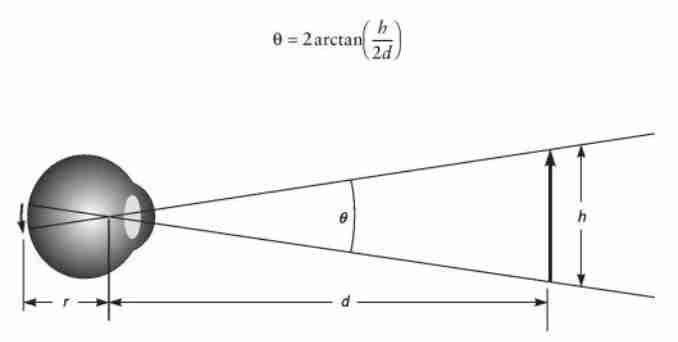
What size lenses would be ideal for your particular eye-to-music viewing distance and your eye-to-eyeglass-lens distance? Well, first you need to say how far away your music stand is from your eyes? How far down your nose do you wear your glasses when you’re playing? How strong is your prescription? All of these things figure into the equations that determine the minimum lens size you’ll need.

And there’s more. The eye’s rotatory movements occur around a center-of-rotation within the globe. Eyeglass optics design usually assumes that this center-of-rotation is in a constant or fixed location, but detailed physiologic studies show that this isn’t fixed or stationary at all, especially when the head is moving vigorously. The center-of-rotation moves medially and laterally inside the eye-socket. And the center-of-rotation of the eye has significant velocity when it does this—in fact, the center-of-rotation moves quickly in a semicircle in the plane of the eye’s rotation. So even simple eye movements are complex, and your eyeglass design should take these things into account—quantitatively, if possible—inasmuch as these movements augur for bigger lens widths. In straight-ahead viewing, the center-of-rotation is located about 13.5mm behind the apex of the cornea on the line of sight.

So how much does the center-of-rotation deviate from this, in its little elliptical path? Optometrists won’t know, but engineers who design aircraft cockpit displays do! Almost all of the conventional optometry and optical engineering literature regards the eye as a sphere whose degrees of freedom are only rotational. An aspect of eye movement that’s seldom considered is translation—linear motion of the globe. At near distances and when the two eyes’ convergence is 20 degrees or more, the eye muscles make the eyeballs translate temporally by up to 0.5 mm. This may seem like a small amount, but it actually is pretty large when you consider the angles involved at small eye-to-glasses (relief) distances of only a few millimeters.

Face Forming of Specs
Another stumbling block is that much of the conventional optometry literature neglects the dynamic nature of how a musician scans the music—far more important for sight-reading than for playing pieces that you know well. Mostly-involuntary movements of the eyes—in slow ‘drifts’ rather than ‘microsaccades’—are thought to be mostly responsible for accurate fixation and fine vision when you scan a page. But let’s say your two eyes need different corrections—different diopters. If the refractive difference for the two eyes along the optical axis between the eye and the part of the page you are scanning is big, then the eyes and brain may not maintain the drift movements necessary to achieve or sustain a clear, unambiguous view of that part of the page. In this situation, the experience you get is similar to a blind-spot—a scotoma—and this amounts to a surprisingly large percentage of the angle that’s bounded by the rims or edges of the eyeglass lenses. So the calculation of minimum lens width may have to take into account the refractive difference between your eyes, as well as the amount of time you spend scanning off-axis for the typical number of pages you have open, the typical eye-to-music distance you have, and so on.

The conventional optometry and optical engineering literature also fails to take into account that a musician moves or rolls her/his head in the natural course of playing their instrument (or singing, or conducting), up to about 25 degrees. The optometrists’ conventional lens design rules fail to recognize that there are torsional movements that the eye executes, to compensate for your head motions. The compensatory ocular torsion (ocular counter-roll) is opposite in direction to the head role, up to about 4 degrees. These dynamic motions interact with regard to the visual field you experience through the eyeglasses when you’re playing music. The optometrists’ design rules are expecting a stationary reader, not a mobile musician. Let’s calculate eyeglass lens width with provisions for movement! What we need is an eyeglass lens-sizing calculation that takes into account (a) the lens edge-related scotomata (what optometrists call the ‘jack-in-the-box effect’) that reduce the effective lens-width [i.e., that reduce the usable lens area in the periphery, near the eyeglass rims or lens edges] and (b) the range of head roll and ocular counter-roll that’s inherent in performing.

What we need, too, is some insight into lens materials. It’s all too likely that a musician will be ‘sold’ a pair of glasses by a salesperson who is persuasive about eyeglass features that affect appearance or weight but who is unaware of the properties that are the ones most relevant to the musician’s use of the glasses.
    Advantages of increased refractive index materials:
  • Thinner lenses give nice aesthetics and weight reduction.
  • In myopia, high index minimizes thickness at the outer edges of the lens. A thinner edge means less light entering into the edge of the lens, which in turn eliminates internal reflections and the visual distraction/confusion from reflections.
    Disadvantages of increased refractive index materials:
  • Worse dispersion (lower Abbé number) and chromatic aberration.
  • Inferior light transmission and reflection properties (Fresnel Reflection Equation), making an anti-reflective coating more important.
  • Greater sensitivity to grinding and polishing precision and manufacturing defects.

Of all of the properties of a lens material, the one that dominates overall optical performance is dispersion, measured by the Abbé number. It sounds like a geeky term, but don’t let that stop you. Ask the optometrist to show you the datasheets on the lens materials you’re considering. Easy!

Low Abbé number lenses have significant chromatic aberration—color fringes above/below or to the left/right of high-contrast objects, like black music note heads on a white page, especially in larger lens sizes and stronger prescriptions (±4 diopter or greater). Generally, lower Abbé numbers are a property of high refractive index lenses, regardless what the material is—glass or plastic. Also, note that the Abbé effect on chromatic aberration is not ‘linear’. That is, a change from 30 to 38 Abbé will not have a noticeable benefit, but a change from 40 to 48 Abbé could be beneficial for a musician who requires a strong correction, who moves her/his head a lot, and who looks ‘off-axis’ quite a bit of the time.

Some people don’t sense color-fringing directly but instead perceive ‘off-axis blurring’. Abbé values as high as 42 produce chromatic aberrations that are noticeable with lens widths bigger than 45mm, especially if the correction is stronger than ±4 diopter. At ±8 diopter, even glass with Abbé 58 gives enough chromatic aberration to interfere with your playing.

The human eye has its own Abbé number, of course. The eye’s Abbé number is independent of the eyeglass lenses’ Abbé number. Your eye:
  • Moves to keep the visual axis close to the achromatic axis (which is, by definition, free of dispersion);
  • Is pretty insensitive in the periphery (at retinal points distant from the fovea, where the cone cells responsible for color vision are concentrated).

Your eye moves to look through various parts of a corrective lens as it shifts its gaze. Some regions of the lens that your eye traverses can be two centimeters or more away from the optical center of the lens. So, despite the eye’s own Abbé properties, the eyeglass lenses’ Abbé value can’t be ignored. People who are sensitive to the effects of chromatic aberrations, who have stronger corrections, who often look off the lens’s optical center, or need larger lens widths to accommodate the geometry of their eye-to-music working distance and page-size will be more affected by chromatic aberration and will therefore be better suited to lens materials that have high Abbé numbers and lower refractive index.

To minimize chromatic aberration interference with the clarity of your seeing the music, you would want to:
  • Try to use the smallest lens height that’s comfortable and still covers the vertical extent of the music page at your typical working distance from the page. Usually, chromatic aberrations are more noticeable as the pupil moves vertically below the optical center of the lens (for example, when you look at the keyboard or down the nether regions of your cello’s fingerboard). Keep in mind, though, that a smaller lens height will make you move your head vertically more, especially while performing pieces that require short and intermediate distance viewing. This could lead to more neck strain.
  • Restrict your choice of lens material to the highest Abbé value at acceptable thickness and weight.

What else? As your gaze shifts from looking through the optical center of the eyeglass lens, the lens-induced astigmatism value increases. In a spherical lens, especially one with a strong correction whose base curve is not in the best spherical form, the lens-induced astigmatism can significantly impair the clarity of your vision in the periphery. In this regard, classical musicians work in stressful, high-glare environments that often require them to maintain asymmetric, off-axis postures for prolonged periods during performances and rehearsals. Maladaptations like astigmatism and anisometropia that are exacerbated by stress and by asymmetric head and body postures haven’t been researched much. Harris’s old paper (link below) discusses a study that shows that sight-readers in music use a different eye scan pattern to read music from the pattern that they use to read written language. To my knowledge, no subsequent publications on this have appeared to-date.

Temple Parallelism of Specs
Taking all of the above into account, I’ve prepared an Excel spreadsheet that lets you input your distances and your diopter correction (via scroll-bars) and calculates the minimum lens width that would enable you to visualize the page(s) on your music stand with a minimum of head and neck motion. This two-eyed calculation takes ocular and facial anatomy into account—for example, the fact that, when you gaze to the right, your left eye is only using a modest percentage of the left lens, and vice versa when you gaze to the left. The equations in the spreadsheet also incorporate the so-called ‘Prentice Rule’ estimate of edge scotoma minus the angle of the pupil subtense, to get the size of the ‘jack-in-the-box’ scotomata at the periphery. This adds significantly to the required lens width for corrections greater than +6 diopter and normal pupil diameters between 4mm and 7mm. Click on the screen shot below, and it will open a window where you can play with the spreadsheet or download it to your computer for off-line use.

I  hope this spreadsheet and the links below are useful for you. As always, if you have a criticism or suggestion, please post a comment below. Thanks!

Spreadsheet to Calculate Minimum Lens Width for Music Glasses

Jalie Optometry book


Wednesday, November 14, 2007

Neuroprotective Approaches for Mitigating Hearing Injury in Chamber Musicians?

Inner Ear Hair Cells. SEM, © SPL / Photo Researchers, Inc.
What, if anything, can a chamber music performer do to restore or preserve hearing? You’re already taking care to avoid noisy environments as much as you can. You avoid playing mp3s at high volume. You wear noise-cancelling headphones when you fly or ride the train. You are careful about your nutrition. You avoid ED meds like Viagra. What else can you do?

Pharmaceuticals and nutraceuticals are no panacea. But there are a few things that have shown recent promise and may deserve consideration, either as neuroprotective preventives [before hearing loss has occurred] or as a component of a regimen aimed at helping the body to recover hearing [when a loss that has occurred is (partially) reversible].

Among anti-oxidants, ebselen [2-phenyl-1,2-benzisoselenazol-3(2H)-one] is not yet FDA-approved for any clinical indication. It’s being studied as a neuroprotective in Japan and elsewhere but not for hearing loss. Based on the interest in hearing loss management among CMT readers in past months, I plan to post again in the future on this topic as new information becomes available regarding this and other meds.

Besides the foregoing, you may want to consider getting audiometry testing done on an annual basis. You want serial measurements so that you will know, quantitatively and objectively, what changes are occurring and respond promptly to those trends. Audiometry should be carried out at 0.25, 0.5, 1.0, 2.0, 4.0, 6.0 and 8.0 kHz so that problems concerning lack of data at certain frequencies do not arise. Longitudinal monitoring by audiometry will enable you to assess whether the preventive or corrective measures you are taking are achieving worthwhile benefits or not.

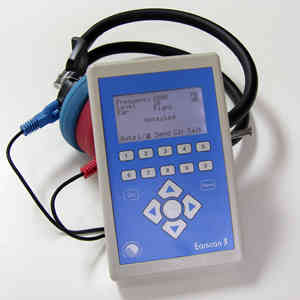
Such testing can be something you perform yourself, if you wish—at whatever time intervals suit you. Small software-driven audiometers that automatically conduct testing are readily available and can be ordered off the web. These can be purchased for $400 to $1,000 (see links below). For an ascending sequence, the automated audiometry self-test sequence begins with the lowest sound-intensity level selected and tests at each level, up to the highest level selected, or until you press the response button after a sound presentation. Once you respond to a sound presentation that the audiometer emits in the headphones, that presentation level is recorded as the screening result. Then it changes to one of the other frequencies and executes another software-controlled sequence of sound-intensity levels for that frequency, and so on, until the entire acoustic spectrum has been sampled. For a descending test sequence, the audiometer software begins at the highest sound-intensity level selected and tests at successive levels down to the lowest level selected. Once you do not press the response button after a signal presentation, the level of the previously presented signal is recorded as the audiometric screening result. It then proceeds automatically to the next frequency to test. When all of the frequencies have been tested, the audiometer then saves the testing results and optionally prints a report or saves the report as a Microsoft Word document or an Adobe Acrobat document. It takes less than 20 minutes to do this at home. Obviously, self-monitoring is no substitute for care by a qualified otolaryngologist / neurologist. But it is an additional option that is available to you with relatively inexpensive, simple, portable equipment today. (After all, you spend quite a bit on your iPod, on your laptop, on other technology ... Why wouldn't you spend several hundred on an audiometer, if you’re a musician?)

MicroAudiometrics ES3S
Okay. So much for what you can do as an individual. What about collective measures? It’s certainly impossible to ask your fellow ensemble members to play more quietly (the equivalent of reducing noise levels in industry). However, it is possible that careful planning of ensembles’ repertoires and the sequence in which pieces are rehearsed might be a general solution to reducing sound level exposures or reducing the ‘duty-cycle’ of high-volume, high sound-pressure intervals.

Apropos of those chamber musicians whose main job is in a symphony orchestra, you should know that some orchestras use screens placed around musicians who play ‘loud’ instruments (brass; percussion) to shield other players from the excessive sound intensity. Of course, the musician playing the high-volume instrument is still exposed. Rarely, the layout of orchestras has also been altered in some cases, by using raised sections in an attempt to reduce local sound levels. Maybe this could be done more often and more deliberately, for the good of all.

Individual use of hearing protection in the form of noise-cancelling headphones and studio audio feeds to all of the players is a possibility, especially now that noise-cancelling headphones are readily available which have good dynamic range and modest sound attenuation. However, in the case of clarinet players, the use of these is not an option, as bone conduction carries the vibrations from the reed, via the upper teeth to the inner ear. Noise-cancelling headphones would interfere with ordinary performance for clarinet and other wind instruments. Totally unworkable.

Chamber Orchestra of Philadelphia, Recording Session, members with headphones on.
M  ost musicians don’t have a clue about this. They start playing music in fourth or fifth grade and nobody mentions the damage they might be causing themselves. A musician who can’t hear is like a painter who can’t see or a sculptor who can’t feel. Not being able to hear the nuances in the music he/she plays – the upper harmonics, the colors. I just don’t have the same confidence I used to. I don’t have the same control. That’s the most frustrating part to me.”
  —  Kris Chesky, Trumpet, and Research Assistant Professor, University of North Texas Center for Music and Medicine

Inner Ear Hair Cells. SEM, © G. Brederg / Photo Researchers, Inc.
CMT should not be considered as medical advice, and the remarks in these blog posts are not a substitute for professional medical advice, diagnosis, or treatment. Never delay or disregard seeking professional medical advice from your physician, pharmacist, or other qualified healthcare provider because of something you have read on CMT. You should always speak with your doctor before you start, stop, or change any prescribed part of your care plan or treatment. CMT understands that reading individual, real-life experiences may be a helpful health information resource but they are never a substitute for professional medical advice from a qualified healthcare provider.