Showing posts with label teaching. Show all posts

Tuesday, January 3, 2012

Guided imagery in music training and performance

x
I    n order to have fast mobility and clarity on left-hand fingers, string players have to train their fingers to have these 3 elements when dropping their left-hand fingers on the fingerboard: speed; strength; and the fast release right after the drop. The 3 elements on the left-hand fingers take training to build up the strength of the muscles and the speed of the reflex of the fast release. Of course, any ‘tool’ that we gain from our technical training is ultimately to be used to create music that would touch listeners. Sometimes when musicians concentrate too much on technical elements, their music tends to be too mechanical, too careful, and lacks emotion. By contrast, when musicians concentrate on being musical, it actually helps the technical things. For example, whenever I feel my fingers stiffen in fast passages, I always find thinking something light and bubbly helps to increase my fingers’ lightness, mobility, and fast articulations. Whenever I try to sustain a long note [and yet try to musically project vitality and suspense, despite the temporary absence of pitch-change or the lack of overt dynamics changes while the note lasts], I remind myself about the struggles and tension of the music. Whenever I try to create smooth bow changes, I often picture a [calligraphy] paint brush changing its direction, instead of which muscle to move first!”  —  Jackie Lee, Heartland Music Academy, 2012.
Jackie LeeI n reply to the previous post, I received the helpful advice above.

A nother CMT reader emailed me to ask whether there was any scientific research literature that establishes the effectiveness of visual or kinesthetic imagery in music teaching, especially for soloists or chamber performers.

T here’s lots of published research on guided imagery in the neurophysiology and physical medicine and rehab literature—and in the lit for research on aging and stroke. Quite a lot in the dance and sports medicine lit. But there are not very many published controlled research studies in music performance/pedagogy lit, so far as I can tell.

I  will continue looking; please feel free to add comment below or email me if there is a reference that you like.

M eanwhile, here are some links to work that’s relevant to this.
T   he left arm functions, to a large extent, by 'walking' on the fingers. In actual walking, torso balance shifts forward, and it is caught on top of the moving legs. For the cellist's left arm, a similar balance can be felt when the upper arm shifts and must be caught by another finger or the arm will fall over... This ‘walking’ image can be strengthened by imagining that the fingerboard is a staircase... Picturing this helps you feel that your balance is aligned in the Earth's gravity, even though your fingers look angled-back in relation to the surface of the fingerboard.”   —  Jeffrey Solow, cellist, quoted in Bruser, p. 121.
I    n automatic or cyclical movements, actual and motor imagery (MI) durations are similar. When athletes imagine only the dynamic phases of movement or perform MI just before competing, however, the environmental and time constraints lead to underestimating the actual duration [and the benefits of the guided imagery are diminished, despite the speed and ease with which the imagery for brief or cyclical movements is called up]. Conversely, complex attention-demanding movements take longer to image [and so guided imagery for complex movements has impediments to its effectiveness, even if duration over/underestimation does not occur].”   —  Aymeric Guillot, 2005.
T    he bilateral frontal opercular regions [in the brain] are crucial in both preparation for and during music execution and imagining. They may have ‘mirror neuron’ properties that underlie observation or imagining of one’s own performance. The motor areas are differentially activated during the preparation and execution or imagining the sequence.”   —  Rumyana Kristeva, 2003.
Mike Mei, calligrapherD    uring execution of musical sequences in professional musicians, a higher economy of motor areas [in the brain] frees resources for increased connectivity between the finger sequences and auditory as well as somatosensory loops, which may account for the superior musical performance. Professionals also demonstrated more focused activation patterns during imagined musical performance.”   —  Martin Lotze, 2003.

Friday, July 10, 2009

Music Lessons and Paroxysmal Mirth

 Umbrellasmile, ©2009 Gary Peterson, Fine Art America
H    vis du har sans for humor, så ved du, hvor godt det er for dit humør og dermed for din afslapning og din musikalsk kunstfærdighed.”

[If you have a sense of humor, then you must know how good it is for your mood and [therefore, or secondarily—] for your relaxedness and musicianship.]
  —  Thomas Raab, Dansk Selskab for Medicinsk Humor.
M y violin teacher, Chiyao "Jackie" Lee, put his fingers on my jaw while I was playing in my lesson with him on Monday night. Immediately that revealed that the muscles contracting there were creating needless, unproductive tension that interfered with the music by imparting that tension to other parts of my body.

T he revelation was so surprising that it made me laugh out loud... a spontaneous giggle from me at this little discovery, hitting me like a lightning-bolt. It’s like a “paroxysm”—instantaneous and uncontrollable: laughing as a kind of a “nano-seizure”.

L ater on in the lesson Jackie puts his hand on my bowtip as I am bowing. Instantly this reveals another fault in the balance of my bow… a fault that’s so delightful to figure out—and so shatteringly obvious in the way that he has revealed it—that this event caused yet another hearty laugh to bubble up inside me!

Y ears ago, Susanne Langer wrote that when it comes to learning instrumental technique, children have a great advantage. Children read “vague and multiple sorts of meaning into pure visual and auditory forms... a fertile openness that enhances intuition, since a child’s mind grasps analogies that a riper experience [of an adult] would reject as absurd.” (p. 110) What I am finding, learning violin as an adult, is a frequent kind of surprise—surprises full of humor that’s directed at my own body, at my own persona.

I n other words, each instrument, including the violin, has a ‘user interface’ (UI). It has a Heideggerian ‘toolness’ or ‘Verstehen’ that has evolved over the centuries to become what it is today—including K-bows and all sorts of other things.

B ut not only the instruments (in my current situation, a ‘composite’ of “violin box + strings + bowstick + bowhair”, or “keyboard + strings + soundboard + pedals”, or “flute body + headjoint”, or “trumpet + mouthpiece”) have UIs. I myself have a UI. My body—has a UI of its own! And sometimes it’s uncooperative. Or let’s just say it is “irregularly irregular” in its cooperativeness. And the learning process precipitates lots of instances where the instrument UI and the body UI collide. One of them balks at what the other is expecting/demanding.

T hen my teacher identifies this “instrument-student corporeal interface conflict” and, by the “mere” act of doing so, makes the UI gremlins vanish (at least temporarily…). That vanishing is so surprising that it is, to me, funny as hell. Makes me laugh, launches these tiny seizures of chuckling.

S ituationally-evoked ‘petit mal status gelasticus’, 50-cent physician phrase.

A nd then, “post-ictally”, when I recover from the chuckling I can continue playing and learning. Jackie is very patient with me. He is extremely perceptive, a wonderful teacher who is capable I think of helping (and surprising) any student at any level—a natural-born educator and one who clearly loves what he is doing.

I  wonder whether his incisive teaching causes ‘status gelasticus’ in other of his adult students…

I t is possible to formulate some features common to all types of humor, including ones involving the experience of something that is paroxysmally surprising, a “peek-a-boo” surprise like what Jackie causes when I have a lesson with him. And, although an overall theory of humor is still lacking, several recent cognitive theories have hinted that humor should be understood as a general biological process of navigating and acting in an ever-changing cognitive environment—which in turn involves discovering and recognizing repeated patterns in novel experiences, internalizing/learning them, and predicting them in the future. The humor comes when some other human being basically “re-wires” or “re-codes” your own body’s UI. You think you “own” your body and “understand” your body. Hogwash. You do not own your body. Your teacher has just re-wired you! That is immensely funny and surprising, to anyone who thinks like an adult. There is the giddiness of a child who has just learned to walk, or to tie her shoes. There is the giddiness of a stroke patient who in rehab is able now to move a limb that he never dreamed he would be able to move again. And there is my giddiness at music lessons.

T homas Raab and colleagues in Copenhagen have recently published papers on the theory of humor—the cognitive and physiological science of humor. You may like to have a look at their website (link below).

L aughter induces the release of beta-endorphins which bind µ3 opiate receptors in the endothelial lining of our blood vessels. Laughter also induces a direct release of nitric oxide (NO) in the circulation. Researchers actually publish scholarly papers on this!

B oth of these—the endorphins and the NO suddenly entering the bloodstream in generous amounts—cause the blood vessels to relax and dilate, and blood pressure promptly goes down (see Miller & Fry 2009). All of that is good for the musicality of whatever sounds we produce.

W hat else? Well, in 1987 Terry Winograd’s and Fernando Flores’s book (link below) was new. It has been my ‘10 Commandments’ reference as I have worked in my professional employment as a software developer over the past 23 years. They prominently feature analysis of computer UIs’ toolness in terms of Heidegger’s philosophical theories. My violin lesson with Jackie on Monday night caused me to pull Winograd & Flores off my bookshelf and re-read it, this time with an eye toward UIs of musical instruments.

M artin Heidegger in the 1930s wrote the bible, so to say, on ontology of toolness. He used the example of hammers, as archtypical of tools with good UIs. You don’t have to learn an abstraction to use it. Little kids when first encountering a hammer and without any parental teaching pick up hammer and begin using it, mostly in the intended hammerlike use-case. Heideggerian ‘toolness’, ‘immanence’—‘usability’, if you like—or the ordinary German word ‘verstehen’.

V erstehen basically means ‘thereness’, ‘openness to experience’, or ‘primordial comprehendability’. Those are the most adequate expressions to convey what it really means. The usual English dictionary translation of verstehen is wimpy, though. Usually some lame, card-boardy thing like ‘understanding’, way too cerebral. That’s not what it means. Not primeval enough. Verstehen is seeing a hook-like object and reflexively and instantaneously imagining that you could use it to catch fish, or seeing a sharp-edged object and imagining without any internal discourse or deliberation that “I could kill and eat food with that”. Or seeing a Google search UI or a good videogame UI and knowing immediately how to interact with it to get a good, valuable, winning result.

O r, for me, feeling the big muscles of my body, plus and arm and right hand, propelling bow with a tension-free, childlike, immanent bowhold—to produce an aesthetically commendable note. Preferrably lots of them, strung together into an aesthetically commendable performance.

B elow are links to my favorite books on the topic of UIs and ‘toolness’, mirthful and otherwise. The value and relevance of Heidegger’s and La Tour’s writings on ‘verstehen’ and the ontology of instruments as being-in-the-world are, I think, underappreciated by musicians…

T aiwanese violist Jackie Lee (my teacher) is a recipient of top prize awards in the ICO Concerto Competition, the Cleveland Institute Concerto Competition, the Ekstrand Competition, the National Viola Competition of Taiwan, and the Taipei City Viola Competition. As an active chamber musician, Lee was a member of the Satori Quartet. Lee has appeared in concerts at the Alice Tully Hall, Harris Hall, Vilar Center, and Severance Hall. He has performed at many summer music festivals, including the Music Academy of the West, Audubon Quartet Seminar and the Takacs Quartet Seminar. Besides serving as a faculty member at the UMKC Academy of Music and Dance (a component of the UMKC Conservatory), Lee’s other teaching activities include the Youth Programs of the Aspen Festival, the Bravo Music Festival, the Kneisel Hall Music Festival and the Taiwan National Institute of Art Summer Chamber Music Academy. Lee received his Master degree in Viola Performance at the Cleveland Institute of Music. While studying there, he also received a degree in Audio Recording Engineering. He is currently a DMA candidate at the UMKC Conservatory of Music and Dance.


Thursday, June 11, 2009

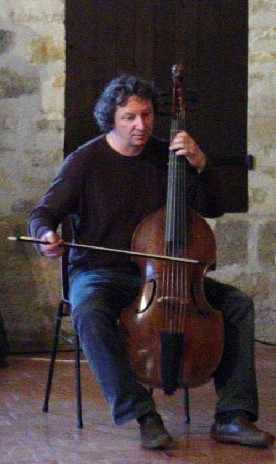
Philippe Pierlot’s Viola da Gamba Masterclass at BEMF

 Philippe Pierlot and Gamba T  he excellence of a teacher is revealed by his/her manner with students—and the ‘light’ that he/she sheds. Philippe Pierlot yesterday conducted a viola da gamba masterclass at BEMF that was exceptionally illuminating—not just for the three students whose performance was critiqued but also for every one of the 100 or so audience members. Philippe’s discussion of Baroque rhythms and ‘inégal’ bowing technique (interpretive emphasis, using a different percentages of bow on two consecutive notes, e.g., on upbeat and downbeat) was magical. Bravo!

Y    our middle finger is the most important, for bow control.”
R    emember that these Marais pieces are dances. This one’s pulse should be in ‘1’, not counted in 3 beats per measure. This other one must be played so that its pulse is in ‘2’, not creeping along in ‘4’.”
Y    ou must think of the phrase structure of the passage you are playing. Think of this as a sentence. Be clear about your intentions—about what you wish to say, and, of course, about what Marais was saying—before you begin.”
P    lay with your bow straight. You must bend your elbow with a fluid motion. Your bowing should be perpendicular, not to your own body, but instead perpendicular to the lady whose [carved] head is at the top of the viol’s pegbox. It is her you are playing for.”
T    hink ‘vocally’. There is no need to ‘mark’ the downbeats—they are obvious enough from the melody line. The phrase structure is enough. Understatement is what you are looking for.”
I    n Marais your releases should be gentle. Respect the ‘end’ of each note.”
K    eep the fingers of your left hand curved. Fingers that are too flat on the fingerboard will give a tone that is confused.”
M    aintain equal bow pressure on both strings in your double-stops. There are of course a few situations where equal sounding of both strings is not wanted, but this is not one of those situations.”
M    any phrase-endings in Marais and others of that period have a retiring, dwindling at the end. Not a diminuendo exactly, more like the end of a thought.”
A    nticipations (before downbeat) have great importance in Marais’s music, and they should get extra emphasis—often more than the subsequent beat. Do not discount the upbeat, the appoggiaturas. This thing is full—full of appogiaturas. They are not so much ‘ornaments’ as the essence of the piece.”
L    ay your bow on the string and push ‘up’; do not push ‘down’ or ‘into’ the string. You must send your tone up! Up to her whose head is at the top of the pegbox. Every note should be lifted ‘up’.”
Y    our bowhold wastes 5 cm. You must hold your bow back close to the frog, close to the nut. If you do not hold it there, you will have a thready tone, the balance of weight will be all wrong and you will have to press your bowhair into the string. Look! Hold it this way, back by the nut, and gravity will do everything for you. Just touch! [the bow to the string] Just let the bow fall onto the string, like so!”
P    lay closer to the bridge—about 4 cm to 6 cm from the bridge. It is a stronger, brighter sound there. And because it is louder, you will not need so much bowspeed to pronounce the notes. Less bowspeed means less arm and bow motion, and you will have plenty of bow left for some of these phrases. You will not have to retake the bow so often.”
M    arais’s notation is actually amazing—remarkably precise for Baroque—his written-out ornaments and annotated articulations, that is. He is telling us quite exactly what he wants here. In Baroque, we are normally happy just to have the notes—the music, most of the music was not much more than a ‘sketch’. But Marais gives us these over-dotting and under-dotting—all these things that are far more than just the notes.”
T    ry to keep your [lower numbered] fingers on the string [as you execute a run of notes on the same string, or a ‘jump’ on the same string]. Do not lift your fingers or ‘leap’ across distances on the string. It’s not just the aesthetics of how it looks… it is also the tone, and your preparation for the notes that are to come.”
T    he longer notes must ‘breathe’. Your bowing must give them a gentle ‘inhalation’. When you breathe in, the flow of air into your lungs begins slowly, then speeds up in the middle, and then slows down as your lungs get close to being full. Your bow must mimic this respiration.”
Y    ou have, I think, too much ‘investment’ in your attack of each note, and neglecting the arc of the overall [musical] sentence. You are too concerned that we will understand where each measure begins and ends. Think of reducing your commitment to the barline. Do not be so invested in the first beat of each measure. We need to know what the sentence is, not what the measure is.”
D    o not accent the second beat of ‘3-2’ hemiolas.”
I    f diction of a fast phrase becomes ‘confused’, bow closer to the bridge, so less bow motion is needed to pronounce each note. You can be closer than that… [about 3 cm].”
T    oo much wrist-extension is a bad temptation. It means your wrist is all the way back—extended so that it cannot be flexible or extend anymore. You want your wrist in a neutral position, so that it can be fluid. Your bow should just float there. If your wrist is in the middle of its range of motion, neutral like that, then you will not have to use so much ‘arm’ as you are doing. Your tone can then be much more expressive.”
M    ore ‘uplift’ in your bowing, please. You should bow as though you were a lute, plucking each note! The clear, ringing tone at the end of each note should be uplifted like a lute string sounds.”
P  hilippe Pierlot has taught at the Conservatoire Maastricht ands Hochschule fûr Musik Trossingen and currently teaches viola da gamba in
the Hague (Koninklijk Conservatorium) and Brussels. It is sheer fun to see him teach. His manner is intense and thoroughgoing but generous. His smile and excitement are infectious. Each little illustration of what he wants—each 2 or three bar demonstration he performs for a masterclass student—is a mini-concert in its own right, a candid snapshot of his real self. Magic.


Sunday, August 24, 2008

Charisma Is Contagious

Campbell book
M  ihaela Ursuleasa was the soloist in Beethoven’s Piano Concerto No. 3 (Op. 37). Ms. Ursuleasa shares Mr. Vanska’s penchant for unusual, often surprising reconsiderations of a score’s essential materials, and their collaboration was electrifying. Still, there was no doubt who was in control here: Ms. Ursuleasa played with a combination of ferocity and clarity that put Beethoven’s already striking contrasts into sharper relief and turned the score into a tense drama. Interpretively she was out on the edge, but it was the kind of high-risk performance that makes the ‘war horses’ worth revisiting.”
  —  Allan Kozinn, NY Times, 22-AUG-2008.
Allan Kozinn’s review of Romanian pianist Mihaela Ursuleasa’s performance in the Lincoln Center’s Mostly Mozart Festival praised a number of the aspects of Mihaela’s charismatic style. I’d heard Mihaela perform earlier this summer in Ireland and can affirm that her playing is exciting: she expresses a wide range of emotions musically; the sonic image that she projects is—despite the emotional range that’s traversed—thoroughly credible, never histrionic. This combination of technical brilliance, lightning-fast wit, charm, enchantment, fascination, magnetism, athleticism, and credibility—what else would we call this except ‘charisma’ or ‘magic’?

Mihaela Ursuleasa
Why are Mihaelas so rare? The perennial issue facing chamber music (and classical music and the arts in general) is how to cultivate more magic like this among a larger number of school-age kids. The U.S. maybe has a more serious issue in this regard than other countries, but it is true all around the world to some degree, with the possible exception of China. We need this ‘magic’ or ‘charisma’ not only in performers, but also in the next generation of composers, conductors, presenters, arts managers and execs of non-profit arts NGOs, recording producers and engineers, and educators. Frankly, we need more of it, too, among current and future-generation audience members.

What I mean is, too often classical music marketing is focused on the ‘sizzle’ and relevance or appeal that the programming or performance has, as if it were merely an excellent “product” or “experience”. IMHO, consumerism in terms of an enticing ‘product’ or venue-bound, Starbucks-oid lifestyle ‘experience’ is fine so far as it goes, competitively. But what you instead want to aim for, I think, is actually far higher than that. You want total suspension of disbelief, at least as much as the best novel or film achieves. You want ‘converts’. Composer/author Greg Sandow comes close to that point of view in his ArtsJournal blog.

Gordon book
C  harisma comes in many forms. Like physical beauty it has many variables, but somehow the various elements must sum up to an effective, powerful presence. Without it in some measure, a person cannot in the long run succeed... The possessors of the magic will survive over the years in the role while others may find themselves less well-known. Appeal of this type is hard to spot in students, but [it is] even more elusive since it is based on some sort of instant psychological exchange—projection and recognition of a social image which needs no explanation in words... a remarkable combination of childlike innocence consumed in the process of pouring out music, untouched by the bittersweet quality of adult experience. At a later time, it may be the full-bodied embracing of life by the youthful adult whose intensity of spirit seems to have the good things of life in abundance... Particularly interesting are those artists whose charismatic index soars with maturity, or even in late years. These artists suddenly ... begin to project maturity, authority, [perplexity, irony, vicissitudes of coping with loss and hurt, etc.] and the simple fact of having successfully met life’s problems square-on and emerging beautifully with strength, wisdom, and compassion.”
  —  Stewart Gordon, Etudes for Piano Teachers, p.123.
Jorgensen book
There is a wonderful new book out by Estelle Jorgensen at Indiana University that’s really worthy of your attention, as it relates to music pedagogy and fostering in kids a genuine and self-sustaining excitement about—and enthusiasm for doing—music. Not just as performers, but ‘doing’ in any of the myriad senses of that word.

W  hitehead’s three stages of education are] romance, instrumentalism, and generalization. ‘Romance’ refers to the phase at which one is introduced to concepts... things go ‘bang’ in the dark and one emerges almost breathless with excitement. ‘Instrumentalism’ is the phase in which one begins to understand more systematically and deeply—how it works. ‘Generalization’ comes as the last phase where romance and instrumentalism come together in a new ‘whole’, this time not only intuitively but also rationally—not only perceptively but also feelingly. The various pieces are put together so that they attain a unity that is needed to [coherently, understandingly] perform and animate a piece of music.”
  —  Estelle Jorgensen, The Art of Teaching Music, p. 249.
Mihaela Ursuleasa is just 30 years old—and, for the charismatic artistry with which she now gifts audiences, we have both her teachers and her family to thank. ‘Nature’ counts for a lot, of course; but ‘nurture’ is everything. And the ‘nurture’ need not always be on-on-one. Sometimes it happens while attending a public performance. For me, a watershed event was hearing Austrian pianist Ingrid Haebler perform Chopin in Minneapolis when I was 7 years old.

Ingrid Haebler
K  önnten Sie sich ohne weiteres vorstellen, dass ihr Kind sich in der Schule mit dem Musik befasst? Sich, nach Anleitung des ehres, „Musikerklamotten” schneidert, sich freudig und verspielt schminkt Schmuckornament mit Symbolen wie Bachköpfen, umgedrehten Mozart Bildnissen oder der Stockhausens bastelt? Ja? Dann sind Sie eine Ausnahme. (Oh, kids today! It requires the enticement of charismatic super-stardom to interest them in classical music. To think otherwise is unrealistic, the exception.)”
  —  Ingrid Haebler.
Until that fierce and charismatic Chopin performance, I had thought of concertizing as some sort of a fascinating ‘show’ that carried with it a certain exotic prestige and social power. It was Haebler’s utter incarnation of several Nocturnes that led me to grasp that serious music could instead be radically intimate and fresh—each time as fresh and real as any fabulous bedtime story could ever be. You just had to make it so! From that moment on, I was ‘hooked’.

We need more Mihaelas and more Ingrids—that combination of ferocity and clarity that captivates audiences. Jorgensen and others provide valuable ideas about how to make that happen, against the odds.

Society of Composers, Newsletter JUL-AUG-2008, p. 6
C  harisma is the source of charisma. It keeps its attention firmly fixed on the social effect and remains agnostic about the traditions themselves, leaving them as a ‘given’ of human experience... charisma as a theory of authority.”
  —  Step Feuchtwang, Grassroots Charisma in China, p.12.