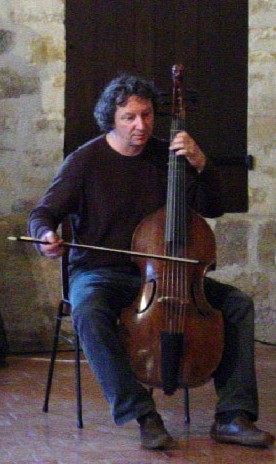
 T he excellence of a teacher is revealed by his/her manner with students—and the ‘light’ that he/she sheds. Philippe Pierlot yesterday conducted a viola da gamba masterclass at BEMF that was exceptionally illuminating—not just for the three students whose performance was critiqued but also for every one of the 100 or so audience members. Philippe’s discussion of Baroque rhythms and ‘inégal’ bowing technique (interpretive emphasis, using a different percentages of bow on two consecutive notes, e.g., on upbeat and downbeat) was magical. Bravo!
Y our middle finger is the most important, for bow control.”
R emember that these Marais pieces are dances. This one’s pulse should be in ‘1’, not counted in 3 beats per measure. This other one must be played so that its pulse is in ‘2’, not creeping along in ‘4’.”
Y ou must think of the phrase structure of the passage you are playing. Think of this as a sentence. Be clear about your intentions—about what you wish to say, and, of course, about what Marais was saying—before you begin.”
P lay with your bow straight. You must bend your elbow with a fluid motion. Your bowing should be perpendicular, not to your own body, but instead perpendicular to the lady whose [carved] head is at the top of the viol’s pegbox. It is her you are playing for.”
T hink ‘vocally’. There is no need to ‘mark’ the downbeats—they are obvious enough from the melody line. The phrase structure is enough. Understatement is what you are looking for.”
I n Marais your releases should be gentle. Respect the ‘end’ of each note.”
K eep the fingers of your left hand curved. Fingers that are too flat on the fingerboard will give a tone that is confused.”
M aintain equal bow pressure on both strings in your double-stops. There are of course a few situations where equal sounding of both strings is not wanted, but this is not one of those situations.”
M any phrase-endings in Marais and others of that period have a retiring, dwindling at the end. Not a diminuendo exactly, more like the end of a thought.”
A nticipations (before downbeat) have great importance in Marais’s music, and they should get extra emphasis—often more than the subsequent beat. Do not discount the upbeat, the appoggiaturas. This thing is full—full of appogiaturas. They are not so much ‘ornaments’ as the essence of the piece.”
L ay your bow on the string and push ‘up’; do not push ‘down’ or ‘into’ the string. You must send your tone up! Up to her whose head is at the top of the pegbox. Every note should be lifted ‘up’.”
Y our bowhold wastes 5 cm. You must hold your bow back close to the frog, close to the nut. If you do not hold it there, you will have a thready tone, the balance of weight will be all wrong and you will have to press your bowhair into the string. Look! Hold it this way, back by the nut, and gravity will do everything for you. Just touch! [the bow to the string] Just let the bow fall onto the string, like so!”
P lay closer to the bridge—about 4 cm to 6 cm from the bridge. It is a stronger, brighter sound there. And because it is louder, you will not need so much bowspeed to pronounce the notes. Less bowspeed means less arm and bow motion, and you will have plenty of bow left for some of these phrases. You will not have to retake the bow so often.”
M arais’s notation is actually amazing—remarkably precise for Baroque—his written-out ornaments and annotated articulations, that is. He is telling us quite exactly what he wants here. In Baroque, we are normally happy just to have the notes—the music, most of the music was not much more than a ‘sketch’. But Marais gives us these over-dotting and under-dotting—all these things that are far more than just the notes.”
T ry to keep your [lower numbered] fingers on the string [as you execute a run of notes on the same string, or a ‘jump’ on the same string]. Do not lift your fingers or ‘leap’ across distances on the string. It’s not just the aesthetics of how it looks… it is also the tone, and your preparation for the notes that are to come.”
T he longer notes must ‘breathe’. Your bowing must give them a gentle ‘inhalation’. When you breathe in, the flow of air into your lungs begins slowly, then speeds up in the middle, and then slows down as your lungs get close to being full. Your bow must mimic this respiration.”
Y ou have, I think, too much ‘investment’ in your attack of each note, and neglecting the arc of the overall [musical] sentence. You are too concerned that we will understand where each measure begins and ends. Think of reducing your commitment to the barline. Do not be so invested in the first beat of each measure. We need to know what the sentence is, not what the measure is.”
D o not accent the second beat of ‘3-2’ hemiolas.”
I f diction of a fast phrase becomes ‘confused’, bow closer to the bridge, so less bow motion is needed to pronounce each note. You can be closer than that… [about 3 cm].”
T oo much wrist-extension is a bad temptation. It means your wrist is all the way back—extended so that it cannot be flexible or extend anymore. You want your wrist in a neutral position, so that it can be fluid. Your bow should just float there. If your wrist is in the middle of its range of motion, neutral like that, then you will not have to use so much ‘arm’ as you are doing. Your tone can then be much more expressive.”
M ore ‘uplift’ in your bowing, please. You should bow as though you were a lute, plucking each note! The clear, ringing tone at the end of each note should be uplifted like a lute string sounds.”P hilippe Pierlot has taught at the Conservatoire Maastricht ands Hochschule fûr Musik Trossingen and currently teaches viola da gamba in
the Hague (Koninklijk Conservatorium) and Brussels. It is sheer fun to see him teach. His manner is intense and thoroughgoing but generous. His smile and excitement are infectious. Each little illustration of what he wants—each 2 or three bar demonstration he performs for a masterclass student—is a mini-concert in its own right, a candid snapshot of his real self. Magic.
- Ricercar Consort website
- BEMF website
- Viola da Gamba Society (U.K.)
- Viola da Gamba Society of America (U.S.)
- Ashbee A, Thompson R, Wainwright J. The Viola da Gamba Society Index of Manuscripts Containing Consort Music. Ashgate, 2008.
- Butt J. Playing with History: The Historical Approach to Musical Performance. Cambridge Univ, 2008.
- Donington R. The Interpretation of Early Music. Norton, 1992.
- Harnoncourt N. Baroque Music Today: Music As Speech : Ways to a New Understanding of Music. Amadeus, 1995.
- Haynes B. The End of Early Music: A Period Performer's History of Music for the Twenty-First Century. Oxford Univ, 2007.
- Houle G. Meter in Music, 1600--1800: Performance, Perception, and Notation. Indiana Univ, 2000.
- Neumann F. Ornamentation in Baroque and Post-Baroque Music. Princeton Univ, 1983.
- O'Loghlin M. Frederick the Great and his Musicians: The Viola da Gamba Music of the Berlin School. Ashgate, 2008.


