Showing posts with label marais. Show all posts

Sunday, June 14, 2009

Trio Hantaï and Marin Marais: Intimate Character Pieces and Politics of Melancholy

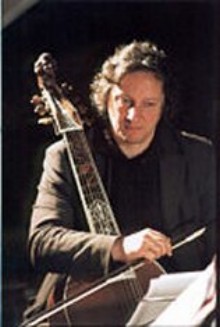
 Trio Hantaï
M    arais’s third book of ‘Pièces de Viole’ (the source of this afternoon’s work) came out in 1711 [when Marais was 55 years old], two years after he withdrew from his operatic career after the failure of his fourth opera, ‘Sémélé’. The suite in C minor from this book begins with a deeply tragic Prélude, which is followed by a vigorous Fantaisie with a brilliant and virtuosic variation or double.”
  —  Robert Mealy, Program Notes, BEMF, 2009.
T    he suites [of Marais] are more loosely organized than those by Couperin. The policy of mixing the ‘difficult’ with the ‘easy’ is discreetly expressed by Marais in his ‘Avertissement’ to Pieces de Viol (I): ‘And because simple melodies meet the tast of a lot of people, I have composed some pieces with this in mind, where chords scarcely enter. One will find others where I have used them more, and several which are entirely filled with them for those who love harmony...’ Marais differs markedly from Couperin in that he made little conscious effort to achieve anything resembling goûts réunis [conforming to prevailing/popular taste]. This is not surprising, since the music itself is so wedded to the [viol] and so bound to the tradition of virtuoso solo performance... Some of Marais’s expressive and quasi-improvisatory preludes, especially those from Book (2), seem indebted to the lute repertory in particular. The same ornaments, the same melodic turns and the same rhythms are found.”
  —  James Anthony, French Baroque Music, p. 389.
T  he Trio Hantaï performance at BEMF yesterday was especially intimate—exerting a wide range of forces on our emotions. The Jordan Hall (New England Conservatory) venue was a bit large for the trio. But, on the other hand, the acoustics of the large hall only served to accentuate the intimacy of the Trio’s playing. It felt as though they were playing in a private home, so great was the person-to-person, player-to-audience expressiveness of each of the three Hantaï brothers.

T  he Marin Marais piece especially captured my imagination—the profound sadness of it. A number of us in the audience had damp eyes—signaling an affective resonance with what we were hearing. We thought of the trials that Marais had been experiencing 300 years ago—not about three Hantai ‘talking-heads’ discoursing about Marais, but instead projecting ourselves into Marais’s actual historical, political situation.We remained intensely ‘present’, not displaced to the margins of what was represented by the Hantaïs’ playing. The signs of this affective state—these tears—were real tears of mourning, just like the ones we cry for, say, Anna Karenina, or other fictive characters.

A    n affect is never a purely psychological thing, nor a purely somatic one.”
  —  Joyce McDougall, The Many Faces of Eros, p. 157.
I  n other words, it was French Baroque stage recreated in Boston, complete with ceremonies where our passions were called into being—by the sacrifices exacted by a world that doesn’t exist anymore. Marais evoked our own [post-modern] subjectivity, from the distance of the 17th/early-18th Century. In short, I loved it.

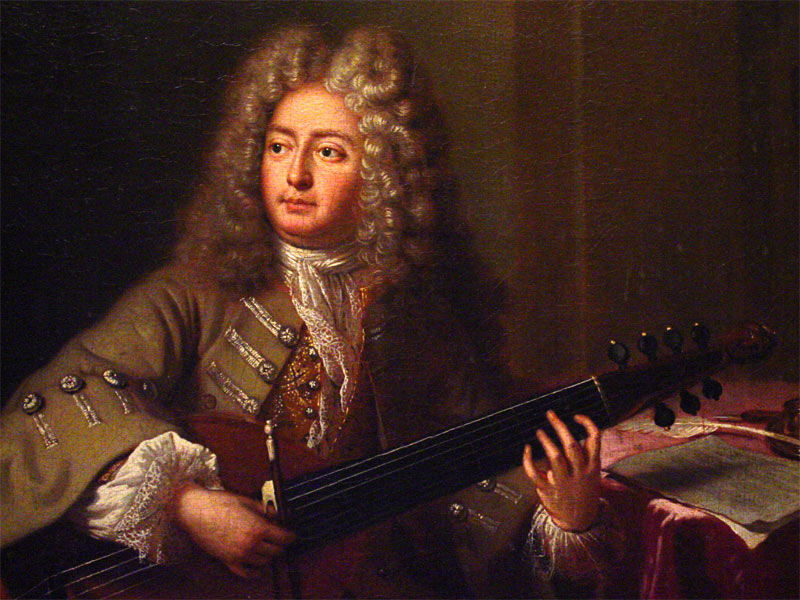
A  t age 20, Marin Marais married Catherine d’Amicourt (on 21-SEP-1676), and they had 19 children together [?!]. He studied composition with Jean-Baptiste Lully and bass viol/da gamba with Monsieur de Sainte-Colombe. Subsequently, he wrote his five remarkable books of ‘Pièces de viole’ (1686-1725), a life’s work that covers the gamut of court preferences and personal emotions. But not a great amount of historical detail or correspondence or other evidence has been preserved, through which we might know very much about Marais’s life. The Milliot – de la Gorce biography from about 20 years ago is good so far as it goes, but it is frustrating in that it is unable to go as far as one might wish. For example, were these ‘Pièces en ut mineur’ (Prélude — Fantaisie — Allemande — Sarabande grave — Gigue — Rondeau) a personal statement or instead an oblique commentary on political developments in France in about 1711?

D    uring the so-called ‘Age of Melancholy’, many writers invoked both traditional and new conceptualizations of the disease in order to account for various types of social turbulence, ranging from discontent and factionalism to civil war. Writing about melancholy became a way to explore both the causes and preventions of political disorder, on both specific and abstract levels. Thus, at one and the same moment, a writer could write about melancholy to discuss specific and ongoing political crises and to explore more generally the principles which generate political conflicts in the first place.”
  —  Adam Kitzes, Politics of Melancholy.
T  he other music by Leclair, Rameau, Couperin, and J. S. Bach was excellent, too; I don’t mean to diminish it by commenting only on the Marais. The wit, imagination, and virtuosity of the Hantaïs’ playing were superb throughout. Jérôme, still bowing to the audience’s applause, rises and sees that Pierre and Marc have already left the stage a few seconds earlier. He shrugs to the audience, gives a comical “Well, you two are at liberty to exit, then” gesture, dangling his viol out toward the gaping stage door through which they had passed. He smiles and good-naturedly exits himself. The Hantaï brothers are masters of absolutely every Baroque gesture that exists, and not only the musical gestures!

  • Pierre Hantaï, harpsichord
  • Jérôme Hantaï, viola da gamba
  • Marc Hantaï, Baroque flute
 X


Thursday, June 11, 2009

Philippe Pierlot’s Viola da Gamba Masterclass at BEMF

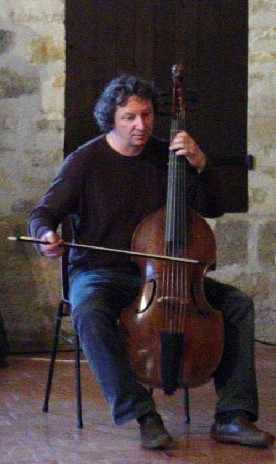
 Philippe Pierlot and Gamba T  he excellence of a teacher is revealed by his/her manner with students—and the ‘light’ that he/she sheds. Philippe Pierlot yesterday conducted a viola da gamba masterclass at BEMF that was exceptionally illuminating—not just for the three students whose performance was critiqued but also for every one of the 100 or so audience members. Philippe’s discussion of Baroque rhythms and ‘inégal’ bowing technique (interpretive emphasis, using a different percentages of bow on two consecutive notes, e.g., on upbeat and downbeat) was magical. Bravo!

Y    our middle finger is the most important, for bow control.”
R    emember that these Marais pieces are dances. This one’s pulse should be in ‘1’, not counted in 3 beats per measure. This other one must be played so that its pulse is in ‘2’, not creeping along in ‘4’.”
Y    ou must think of the phrase structure of the passage you are playing. Think of this as a sentence. Be clear about your intentions—about what you wish to say, and, of course, about what Marais was saying—before you begin.”
P    lay with your bow straight. You must bend your elbow with a fluid motion. Your bowing should be perpendicular, not to your own body, but instead perpendicular to the lady whose [carved] head is at the top of the viol’s pegbox. It is her you are playing for.”
T    hink ‘vocally’. There is no need to ‘mark’ the downbeats—they are obvious enough from the melody line. The phrase structure is enough. Understatement is what you are looking for.”
I    n Marais your releases should be gentle. Respect the ‘end’ of each note.”
K    eep the fingers of your left hand curved. Fingers that are too flat on the fingerboard will give a tone that is confused.”
M    aintain equal bow pressure on both strings in your double-stops. There are of course a few situations where equal sounding of both strings is not wanted, but this is not one of those situations.”
M    any phrase-endings in Marais and others of that period have a retiring, dwindling at the end. Not a diminuendo exactly, more like the end of a thought.”
A    nticipations (before downbeat) have great importance in Marais’s music, and they should get extra emphasis—often more than the subsequent beat. Do not discount the upbeat, the appoggiaturas. This thing is full—full of appogiaturas. They are not so much ‘ornaments’ as the essence of the piece.”
L    ay your bow on the string and push ‘up’; do not push ‘down’ or ‘into’ the string. You must send your tone up! Up to her whose head is at the top of the pegbox. Every note should be lifted ‘up’.”
Y    our bowhold wastes 5 cm. You must hold your bow back close to the frog, close to the nut. If you do not hold it there, you will have a thready tone, the balance of weight will be all wrong and you will have to press your bowhair into the string. Look! Hold it this way, back by the nut, and gravity will do everything for you. Just touch! [the bow to the string] Just let the bow fall onto the string, like so!”
P    lay closer to the bridge—about 4 cm to 6 cm from the bridge. It is a stronger, brighter sound there. And because it is louder, you will not need so much bowspeed to pronounce the notes. Less bowspeed means less arm and bow motion, and you will have plenty of bow left for some of these phrases. You will not have to retake the bow so often.”
M    arais’s notation is actually amazing—remarkably precise for Baroque—his written-out ornaments and annotated articulations, that is. He is telling us quite exactly what he wants here. In Baroque, we are normally happy just to have the notes—the music, most of the music was not much more than a ‘sketch’. But Marais gives us these over-dotting and under-dotting—all these things that are far more than just the notes.”
T    ry to keep your [lower numbered] fingers on the string [as you execute a run of notes on the same string, or a ‘jump’ on the same string]. Do not lift your fingers or ‘leap’ across distances on the string. It’s not just the aesthetics of how it looks… it is also the tone, and your preparation for the notes that are to come.”
T    he longer notes must ‘breathe’. Your bowing must give them a gentle ‘inhalation’. When you breathe in, the flow of air into your lungs begins slowly, then speeds up in the middle, and then slows down as your lungs get close to being full. Your bow must mimic this respiration.”
Y    ou have, I think, too much ‘investment’ in your attack of each note, and neglecting the arc of the overall [musical] sentence. You are too concerned that we will understand where each measure begins and ends. Think of reducing your commitment to the barline. Do not be so invested in the first beat of each measure. We need to know what the sentence is, not what the measure is.”
D    o not accent the second beat of ‘3-2’ hemiolas.”
I    f diction of a fast phrase becomes ‘confused’, bow closer to the bridge, so less bow motion is needed to pronounce each note. You can be closer than that… [about 3 cm].”
T    oo much wrist-extension is a bad temptation. It means your wrist is all the way back—extended so that it cannot be flexible or extend anymore. You want your wrist in a neutral position, so that it can be fluid. Your bow should just float there. If your wrist is in the middle of its range of motion, neutral like that, then you will not have to use so much ‘arm’ as you are doing. Your tone can then be much more expressive.”
M    ore ‘uplift’ in your bowing, please. You should bow as though you were a lute, plucking each note! The clear, ringing tone at the end of each note should be uplifted like a lute string sounds.”
P  hilippe Pierlot has taught at the Conservatoire Maastricht ands Hochschule fûr Musik Trossingen and currently teaches viola da gamba in
the Hague (Koninklijk Conservatorium) and Brussels. It is sheer fun to see him teach. His manner is intense and thoroughgoing but generous. His smile and excitement are infectious. Each little illustration of what he wants—each 2 or three bar demonstration he performs for a masterclass student—is a mini-concert in its own right, a candid snapshot of his real self. Magic.


Thursday, June 14, 2007

Suitte d’un Goût Etranger: International Relations in Pierlot’s Evocative Marais


L uxury is the situation of a society in which riches have become the principal passion. As soon as money has become the exclusive object of the greatest number of society, there can be no more powerful motive than the desire to acquire it. There is no enthusiasm but that of opulence; there is no other emulation but to procure by the swiftest of routes those signs which are admitted by all to represent power, pleasures, and felicity.”
  —  Baron d'Holbach, Politique Naturelle, 1773, p. 130.

DSM: We in the twenty-first century may regard 12-tone music as if we had invented it, inhaled it, and thoroughly identify with the modern aporias that it expresses. But the Baroque literature could and should be equally resonant. The Baroque poets speak to us when they respond to the Thirty Years War and other tensions, insofar as such destructive wars and plutocracies are also leaving their mark on our own time—international relations gone awry, and, in the U.S., the longing for a return to effective statecraft.

CMT: Philippe Pierlot illustrated this inter-epochal concept beautifully last night at the Boston Early Music Festival, in his performance ‘Les Festes Galantes’ with harpsichordist Jan Willem Jansen. The entire program was technically superb, but the Marais pieces especially were particularly moving. Pierlot is Professor in the Hochscule fûr Musik, Trossingen, Germany. He lives in the belgian Ardennes and, among other things, directs the Ricercar Consort. In his account of these Baroque pieces, Marais’ Suittes, there’s a sensitivity to international relations — a reflet d’une perspective étrangère.

DSM: Contrast the expressions in Pierlot’s account of Marais’ Suittes last night with those of the film, Tous les Matins du Monde—with Gérard Depardieu cast as Marais. The film follows Marais from highly talented but self-centered student, through his personal follies with Sainte-Colombe’s daughter, to Marais’ old age, troubled by the realization that music—his talent, n’importe quoi—was so much greater than his ego had allowed him to explore. The film delivers a sense of real authenticity, but it’s an authenticity of an introverted sort. By contrast, these Suittes in Pierlot’s hands have a distinctly outward-directed, transnational flavor.

CMT: I’ve never heard anybody produce a tone like Pierlot’s, starting a long note so tenuously as to be more like whitespace, empty and begging for its fulfillment yet so clear and prophetic—clairvoyant even. Pierlot’s playing is the sheer epitome of Truth in a viol. We learn a lot from Pierlot—about the human condition, not just about musical expression.

DSM: This Marais music (1656-1728) presages Claude Helvétius’s writing on eighteenth century materialism. He knew courtly society, he knew the world of the financiers, and he saw the limitations of it all. For Helvétius (1715-1771), ennui and the various remedies proposed for it varied according to nations and their constitutions and temperaments. Helvétius’s book, de l’Homme, critiques an aesthetic of pleasure based on sensationalism: “The object of art ... is to please and consequently to excite sensations in us which, without being painful, are yet lively and strong. When a work produces such effects it is applauded.” Beauty is what strikes us sufficiently to enliven our soul. The sublime makes for stronger effects since it may evoke terror and fear—so much better than being bored or meaningless! The Arts were to be judged not by rules articulated by social hierarchy and convention but by genuine and spontaneous individual sentiment—individual responsible judgment and thoughtful action. Marais' music was a harbinger of this . . .


Philippe Pierlot

Marin Marais