Showing posts with label france. Show all posts

Tuesday, March 8, 2011

NEC First Monday: Buvant à la Source, Laurence Lesser Explains a ‘French’ Program

Laurence Lesser, cellis
T   onight’s program is… ‘French’. Stravinsky? French? Well, yes, at least part of him is.”
  —  Laurence Lesser, cellist, introductory remarks.
T he New England Conservtory ‘First Monday’ program featured, among other things, Belgium-born violist Dimitri Murrath introducing each movement of Couperin’s ‘Le Parnasse’ homage to Arcangelo Corelli by reading aloud the movement’s title and subtext, in impeccable French. Quel réalisme! Quel charme! Vive l’authenticité!
  • Couperin – Le Parnasse, ou L’apothéose de Corelli (James Buswell, John Holland, violins; Laura Blustein, cello; John Gibbons, harpsichord)
  • Stravinsky – Apollo (Masuko Ushioda, Wanzhen Li, violins; Dima Murrath, Sarah Darling, violas; Laurence Lesser, Natasha Brofsky, cellos; Donald Palma, double bass)
  • Ravel – Piano Trio (Hung-Kuan Chen, piano; James Buswell, violin; Laurence Lesser, cello)
L esser gave a 15-min pre-concert talk, explaining various things to us… about his experiencing the then-elderly Stravinsky’s pungent advice to him first-hand, when he was a young cellist just starting out in the mid-1960s; about how Couperin was enthralled with what was shaping music in Italy in the 17th Century and early 18th… the unifying, glorious transnationally-strategic possibilities of it. Parnassus, the home of the Muses, is where the soul of Corelli is conducted—ascension (‘remerciment’) to join the god, Apollo… who is the subject of the second work on the program by Stravinsky. And the piano trio after that… Ravel, who in his own time meditated upon his musical predecessors and the debt owed to them (‘Le Tombeau de Couperin’, etc.).

T he violin cadenza performed by Masuko Ushioda in the Prologue of the Stravinsky was spectacular… indicative of the sonic aggressiveness and beautiful iconoclasm ahead.

I  love that the words ‘analysis’ and ‘performance’ have such wide purviews. The ensemble surely ‘analyzes,’ in preparing and interpreting each work, examining the score and its style including notational idiosyncrasies (e.g., ‘void’ functions, expanded tunings, etc.), music theory, historical practices, and so forth. And ‘performance’ may refer to the live performance, to recordings, to practice, to memorization, to improvisation, and to aesthetic, hermeneutic, social, psychological, cognitive, or motoric/musculoskeletal/neurophysiological aspects of all of these.

U shioda’s cadenza served the rhetorical function of announcing the Apollo character in the story and establishing that figure’s authority. It clarifies which key that character operates in, and transforms the thematic material that has preceded the cadenza. The cadenza provides convincing proof of Ushioda’s violinism prowess. But the supervening ensemble members’ parts reveal that there will be disagreement ahead—Apollo may be a god, but he doesn’t rule the Universe.

T his piece was originally orchestrated by Stravinsky for a 28-piece chamber orchestra. Last night’s performance was arranged for string septet. Both orchestrations have their merits, but I especially liked the septet last night. How clear everything is! How much more intimate, compared to the larger version!

T hought #1: Each of these three pieces is characterized by motives and phrases, repeated and massaged and turned round and round through the whole piece and all the movements and variations... Is this particular delight in variational permutations psychologically an archetypically ‘keyboardist’ thing to do (i.e., composers who are not primarily keyboard artists tend not to do it), or is it in some way idiomatically ‘French’, across these centuries?

T hought #2: Each of these three pieces is ‘cinematic’ in terms of structure and narrative. Is the fondness for the picturesque a distinctively ‘Gallic’ trait, or is this feature more an artifact of what it takes to make a living as a musician/composer in each century, in an exchange-economy, market-driven society?
David Lidov, ‘Is Language a Music?’


Wednesday, July 1, 2009

Margaret Marco & French Baroque Oboe: The Composer, The Performers, The Audience

 Margaret Marco
T    he change in the disposition of sonic objects in the acoustic space may alter the perspective of the listener. Where various sound-objects move in different directions... the listener may reasonably assume himself to be at a point of rest. If, however, a number of sound-objects are spaced at various points of the compass... might suggest to the listener that he himself is spinning whilst the frame of reference remains still... Depending on the type of material used, closeness may imply intimacy, distance a sense of eavesdropping or of detachment, and, at various stages in between, a sense of interpersonal communication or more formalised social communication... and aural ‘magnifying glass’, quite different from our experience of normal acoustic perspective.”
  —  Trevor Wishart, p. 148.
L ike good butler, a good Baroque composer does not ‘eavesdrop’... she/he ‘discreetly overhears’.

N ot in the sense of surveillance or espionage, of course. More in the sense of parent/guardian or journalist. This CD contains recordings of seldom-heard pieces, infrequently-performed composers.

 Margaret Marco – Hidden Gems: Oboe Sonatas of French Baroque
  1. Bouin-Cinquième Suitte: I. Le Prudent-La Prudente
  2. Cinquième Suitte: II. Tambourin
  3. Cinquième Suitte: III. Musette
  4. Cinquième Suitte: IV. Les Oiseaux
  5. Huguenet-Première Sonate, Op. 1: I. Grave
  6. Première Sonate, Op. 1: II. Gay-Grave
  7. Première Sonate, Op. 1: III. Sicilienne
  8. Première Sonate, Op. 1: IV. Gigue
  9. Chedeville-Sixième Sonate, Op. 3: I. La Rivièr d'hier
  10. Sixième Sonate, Op. 3: II. La Dificile
  11. Sixième Sonate, Op. 3: III. Rondeau
  12. Sixième Sonate, Op. 3: IV. Les Adieux de Brunoy
  13. Naudot-Sixième Sonate en Trio, Op. 7: I. Musette
  14. Sixième Sonate en Trio, Op. 7: II. Gavotte
  15. Sixième Sonate en Trio, Op. 7: III. Allemande
  16. Sixième Sonate en Trio, Op. 7: IV. Menuet
  17. Sixième Sonate en Trio, Op. 7: V. Sarabande
  18. Sixième Sonate en Trio, Op. 7: VI. Gigue
  19. Naudot-Caprice en Trio, Op. 7: I. Caprice
  20. Caprice en Trio, Op. 7: II. Tambourin
  21. Caprice en Trio, Op. 7: III. Menuet
  22. Caprice en Trio, Op. 7: IV. Chaconne

    [50-sec clip, Margaret Marco, Jacques-Christophe Huguenet, ‘Première Sonate – IV. Gigue’, 1.6MB MP3]


    [50-sec clip, Margaret Marco, Nicolas Chedeville, ‘Sixième Sonate – IV. Les Adieux de Brunoy’, 1.6MB MP3]


    [50-sec clip, Margaret Marco, Jacques-Christophe Naudot, ‘Sixième Sonate – VI. Gigue’, 1.6MB MP3]

  • Margaret Marco, oboe
  • Barbara Bishop, oboe
  • Matthew Herren, cello
  • Rebecca Bell, harpsichord
T hese sonatas are not merely ‘evocative’. They report on particular kinds of relationships—between performers and their audience; between composers and performers and patrons. There are hints in these 18th Century works, about the nature of such relationships that may have been distinctly French, plus elements that were widely-traveled... The rhythms and textures, the binary or rounded binary form with sectional repeats, the predominance of dance-inspired forms such as the courante, rigaudon, menuet, and gigue.

H idden Gems’ brings together works that share natural affinities characteristic of the time. But hearing them together illuminates some of their not-so-obvious ‘hidden’ qualities as well. Not only do the individual pieces seem to provide a [backhanded; unintended] commentary on each other, the pieces taken together embody who it was these composers were writing for. The pieces suggest how the performers conceived of their audiences. And the pieces contain clues about the aristocratic patrons and how they wished to be diverted and perceived by each other: a society that delighted in ‘overhearing’ juicy conversations. Even the music suggests ‘positioning’ in order to surreptitiously overhear things and repeat them to others, a rhetoric of reciprocal pleasure...

L    anger’s [Philosophy in a New Key: A Study in the Symbolism of Reason, Rite, and Art, 1957, p. 218] philosophy [portrays] ... music-making as a symptom of ... eavesdropping. If music were only a matter of releasing pent-up personal desire, music’s formal excellence would not matter the way it does. In fact, the more ‘self-expressive’ something is, the less musical it is likely to be. Music, Langer is convinced, is not about exposing, discharging, or expressing feeling; and yet, it is clearly related to feeling in some way. How might that be? Simply, music is a presentational symbol; and as such it is neither a stimulus nor a symptom of feeling: it is ‘not the cause or the cure of feelings, but their logical expression’.”
  —  Wayne Bowman, p.210.
V    arious performative strategies that ‘opera buffa’ adopts in the rhetoric of pleasure... [which] cannot exist without the eavesdropping presence of the audience.”
  —  Downing Thomas, p. 228.
W hile Chedeville and Huguenet and Naudot were part of the same tradition, culturally and musically, their backgrounds were very different. Nicolas Chedeville (1705-1782) was a prolific composer and instrument maker, a member of the Douze Grands Hautbois, a group of oboists and bassoonists who performed for state ceremonies during the reigns of Kings Louis XIV and XV. Jacques Christophe Huguenet (1680-1729) was a violinist and composer, appointed an ordinaire of the Royal Chamber in 1710 and a member of the Petits violons. Jacques-Christophe Naudot (1690-1762) was a self-taught Parisian flautist who had many aristocratic pupils and patrons. By contrast, not much is known about Jean-Francois Bouin; even his birth and death dates are not known. But from the title page of his compositions we know that he was a publisher and teacher of the ever-disparaged ‘vielle’ (hurdy-gurdy), about which he wrote a large, erudite, defensive tome. The righteous pique he develops in this book makes it a satisfying, if exotic, read—somewhat like reading transcripts of lawyers’ celebrated pleadings in courts of law, on behalf of hurdy-gurdies in the dock.

T hese works show sophisticated adults who as a salon game pretend to be children, amusing themselves with stylizations of fashionable dances. The differences in the composers’ approaches, and indeed, of their psychological make-up are evident enough. But the similarities of gesture and rhetoric are also evident. Marco’s and her colleagues’ musicianship is excellent, enabling us to hear and imagine these things (stylized ‘eavesdropping’ behaviors, relished and storied) beyond the musical texts themselves.

I  admit I bought this CD with the somewhat ‘detached’ intention of learning something about composers I’d never before heard and woodwind ensemble literature about which I was totally ignorant until now. But I am thrilled to have found not a pallid scholarly account but instead a rich provocation to Baroque dreaming and conjecture, in French. Cool!

M argaret Marco is principal oboe with the Kansas City Chamber Orchestra and has appeared with various orchestras including the Orquesta Sinfònica de Maracaibo, the Rome Festival Orchestra, the Dubuque (IA) Symphony and the St. Joseph (MO) Symphony. She is the Associate Professor of Oboe at the University of Kansas and holds degrees from Northwestern University, University of Iowa, and University of Illinois in Champaign-Urbana. She served as President of the Midwest Double Reed Society and performs frequently on Kansas Public Radio and with the flute, oboe, piano trio Allègresse. She currently serves on the Executive Committee of the International Double Reed Society as the coordinator of the Fernand Gillet-Hugo Fox International Oboe Competition.

R ebecca Bell, harpsichordist, studied at the Royal College of Music in London, where she won the prize for clavichord playing while studying with Ruth Dyson and Robert Woolley. She has concertized in the U.S., Canada, England, the Netherlands, Italy, Austria and Germany. She is a founding member of Summerfest Kansas City where she served as the Artistic Director from 1995-1999. She is the harpsichordist for the Kansas City Symphony and the Kansas City Chamber Orchestra.

M atthew Herren has performed at Alice Tully Hall at Lincoln Center and The National Gallery in Washington and has recorded orchestral and chamber music for the Deutsche Grammophon, Sony, Atlantic, Helicon and London Decca Labels with The Orchestra of St. Luke’s. His performances have been broadcast on NPR’s Performance Today. Herren performs regularly with The American Composers Orchestra, The New York Oratorio Society, and The New York Concert Singers, Trio Fedele, The Kansas City Symphony, Kansas City Chamber Orchestra and Chamber Music Society.

B arbara Bishop is Associate Principal Oboe with the Kansas City Symphony and co-principal of the Kansas City Chamber Orchestra and Assistant Professor of oboe at the University of Missouri-Kansas City Conservatory. She trained at the Eastman School and has a Master of Music degree from the University of Minnesota. She is a regular Guest Principal with the Saint Paul Chamber Orchestra.


Sunday, June 14, 2009

Trio Hantaï and Marin Marais: Intimate Character Pieces and Politics of Melancholy

 Trio Hantaï
M    arais’s third book of ‘Pièces de Viole’ (the source of this afternoon’s work) came out in 1711 [when Marais was 55 years old], two years after he withdrew from his operatic career after the failure of his fourth opera, ‘Sémélé’. The suite in C minor from this book begins with a deeply tragic Prélude, which is followed by a vigorous Fantaisie with a brilliant and virtuosic variation or double.”
  —  Robert Mealy, Program Notes, BEMF, 2009.
T    he suites [of Marais] are more loosely organized than those by Couperin. The policy of mixing the ‘difficult’ with the ‘easy’ is discreetly expressed by Marais in his ‘Avertissement’ to Pieces de Viol (I): ‘And because simple melodies meet the tast of a lot of people, I have composed some pieces with this in mind, where chords scarcely enter. One will find others where I have used them more, and several which are entirely filled with them for those who love harmony...’ Marais differs markedly from Couperin in that he made little conscious effort to achieve anything resembling goûts réunis [conforming to prevailing/popular taste]. This is not surprising, since the music itself is so wedded to the [viol] and so bound to the tradition of virtuoso solo performance... Some of Marais’s expressive and quasi-improvisatory preludes, especially those from Book (2), seem indebted to the lute repertory in particular. The same ornaments, the same melodic turns and the same rhythms are found.”
  —  James Anthony, French Baroque Music, p. 389.
T  he Trio Hantaï performance at BEMF yesterday was especially intimate—exerting a wide range of forces on our emotions. The Jordan Hall (New England Conservatory) venue was a bit large for the trio. But, on the other hand, the acoustics of the large hall only served to accentuate the intimacy of the Trio’s playing. It felt as though they were playing in a private home, so great was the person-to-person, player-to-audience expressiveness of each of the three Hantaï brothers.

T  he Marin Marais piece especially captured my imagination—the profound sadness of it. A number of us in the audience had damp eyes—signaling an affective resonance with what we were hearing. We thought of the trials that Marais had been experiencing 300 years ago—not about three Hantai ‘talking-heads’ discoursing about Marais, but instead projecting ourselves into Marais’s actual historical, political situation.We remained intensely ‘present’, not displaced to the margins of what was represented by the Hantaïs’ playing. The signs of this affective state—these tears—were real tears of mourning, just like the ones we cry for, say, Anna Karenina, or other fictive characters.

A    n affect is never a purely psychological thing, nor a purely somatic one.”
  —  Joyce McDougall, The Many Faces of Eros, p. 157.
I  n other words, it was French Baroque stage recreated in Boston, complete with ceremonies where our passions were called into being—by the sacrifices exacted by a world that doesn’t exist anymore. Marais evoked our own [post-modern] subjectivity, from the distance of the 17th/early-18th Century. In short, I loved it.

A  t age 20, Marin Marais married Catherine d’Amicourt (on 21-SEP-1676), and they had 19 children together [?!]. He studied composition with Jean-Baptiste Lully and bass viol/da gamba with Monsieur de Sainte-Colombe. Subsequently, he wrote his five remarkable books of ‘Pièces de viole’ (1686-1725), a life’s work that covers the gamut of court preferences and personal emotions. But not a great amount of historical detail or correspondence or other evidence has been preserved, through which we might know very much about Marais’s life. The Milliot – de la Gorce biography from about 20 years ago is good so far as it goes, but it is frustrating in that it is unable to go as far as one might wish. For example, were these ‘Pièces en ut mineur’ (Prélude — Fantaisie — Allemande — Sarabande grave — Gigue — Rondeau) a personal statement or instead an oblique commentary on political developments in France in about 1711?

D    uring the so-called ‘Age of Melancholy’, many writers invoked both traditional and new conceptualizations of the disease in order to account for various types of social turbulence, ranging from discontent and factionalism to civil war. Writing about melancholy became a way to explore both the causes and preventions of political disorder, on both specific and abstract levels. Thus, at one and the same moment, a writer could write about melancholy to discuss specific and ongoing political crises and to explore more generally the principles which generate political conflicts in the first place.”
  —  Adam Kitzes, Politics of Melancholy.
T  he other music by Leclair, Rameau, Couperin, and J. S. Bach was excellent, too; I don’t mean to diminish it by commenting only on the Marais. The wit, imagination, and virtuosity of the Hantaïs’ playing were superb throughout. Jérôme, still bowing to the audience’s applause, rises and sees that Pierre and Marc have already left the stage a few seconds earlier. He shrugs to the audience, gives a comical “Well, you two are at liberty to exit, then” gesture, dangling his viol out toward the gaping stage door through which they had passed. He smiles and good-naturedly exits himself. The Hantaï brothers are masters of absolutely every Baroque gesture that exists, and not only the musical gestures!

  • Pierre Hantaï, harpsichord
  • Jérôme Hantaï, viola da gamba
  • Marc Hantaï, Baroque flute
 X


Wednesday, September 24, 2008

More Encores: Debussy’s Arabesque No. 1 in E Major

Bavouzet
Thiollier
Fiercely energised yet superfine, [Jean-Efflam Bavouzet’s] performances are not for those with comfortable ‘drawing-room’ notions of Debussy.”
  —  Gramophone Magazine, JUL-2008.
F rançois-Joel Thiollier’s soft-grained virtuosity taps into the music’s alluring sonorities and harmonic beauty, bringing out plenty of color with no more aid from the sustain pedal than necessary. As a technician, Thiollier doesn’t offer the bedrock security that typifies Pollini’s double notes, Uchida’s firmly-centered rhythms, or Gieseking’s utterly-even fingerings in ‘Pour Les Huits Doigts’. Yet while his timid chord-to-octave leaps in the daunting 12th etude slow down when the going gets tough, Thiollier compensates with as sexy and curvaceous a middle section as you’ll ever hear. He also plays the three-against-two rhythm during the opening etude’s introduction as-written, rather than slightly rushing the right-hand triplet as nearly everyone else does... Thiollier’s gentle touch and keen ear for nuance also inform the sundry short works filling out this disc.”
  —  Jed Distler, Grammophone Magazine.
I’m not quite sure why the previous CMT post elicited a flurry of responses/requests, regarding ‘atmospheric’ miniatures. Anyhow, here is another favorite of mine, a solo piano one.


    [50-sec clip, Jean-Efflam Bavouzet, Debussy, ‘Arabesque No. 1’, 0.9MB MP3]

    [60-sec clip, François-Joel Thiollier, Debussy, ‘Arabesque No. 1’, 1.2MB MP3]

François-Joel Thiollier studied in France with Robert Casadesus and faculty of the Paris Conservatoire and with Sascha Gorodnitzki at the Juilliard School of Music. He won eight Grands Prix in international piano competitions. His recordings include the complete piano music of Debussy, the complete piano music of Ravel, and works by de Falla, d’Indy, and Franck. In 2003, Thiollier was named Officier des Arts et Lettres by the French Ministry of Culture and Communication.

Jean-Efflam Bavouzet was a student of Pierre Sancan at the Paris Conservatoire, as well as Alexander Edelman and Dimitri Bashkirov. He has won Grans Prix in various international competitions, including the International Beethoven Competition in Cologne in 1986, the Honens International Piano Competition in Canada in 1992, and the Steven de Groote Chamber Music Prize at the Van Cliburn Competition. With a style that some critics have called ‘mercurial’, Bavouzet has performed with many international orchestras. In 2002 he performed with the Boston Symphony Orchestra under the direction of Ingo Metzmacher, and in 2003 he appeared with the Berliner Sinfonie Orchester. He is presently with Orchestre de Paris and Professor in the Piano Department of the Hochschule für Musik in Detmold, Germany.

Juxtaposing these two clips gives a good idea of the performance possibilities. Jean-Efflam Bavouzet’s version averages a faster tempo, but with wider variations than Thiollier’s. And the texture Bavouzet creates in this delicate piece exhibits a more ‘restrained’ pianissimo control than Thiollier’s, but Bavouzet alternates between understatement and exuberant reverie, and the sense of Bavouzet’s account is more one of solitary reminiscence—compared to Thiollier’s recording, which comes across as more ‘story-telling-to-intimate-partner’ rather than ‘solitary-meditation-to-onesself’. Your possibilities for reasonable tempi, accents, dynamics, and balances are endless—as illustrated by these two masterful examples.

The balance of the ‘3-against-2’, RH vs. LH, is risky—heck, the entire piece is so delicate that it’s quite a ‘gauntlet’ to run, aesthetically.

Enjoy!

Debussy, Arabesque No. 1 motif, ‘3-against-2’ RH-LH rhythm
I am fascinated by Debussy’s ability to use tones and sounds to paint the colours of nature and convey its moods registering all its nuances of varying light, the elusiveness and boundlessness of it all.”
  —  Marie Bengtsson.


Wednesday, August 27, 2008

He Who Dies with the Most Toys Wins: Jean-Baptiste Lully’s Non-Musical Exploits

broken heart
Q  uestion: What did Lully do when he wasn’t writing music?”
  —  Anonymous email to CMT blog.
A  nswer #1: He was exerting many and varied efforts to make his living as a composer and insure that he was paid for his works’ performances and publication. He was acting as his own agent and manager and presenter. Such exertions would have been much as any composer would do today, only Lully was more overtly political and power-connected than anybody is today.”
A  nswer #2: He was practicing at being an amateur alchemist; dancing the minuet, gavotte, and the bourée; playing the guitar lasciviously when it suited him as a suitor; playing pranks on friends; and generally leading the life of a wealthy rascal, libertine and bon vivant.”
A  nswer #3: Don’t ask, don’t tell.”

Early in his life, composing was, perhaps, the only thing Lully had within his control. Getting manuscript copies made, and arranging for scores to be printed took lots of his time and attention. As the son of a miller—as a poor kid whose mom died and who was then farmed out to work as a child laborer—he had no reservations about getting personally involved selling manuscript copies of his works at performances of his operas. Whatever it takes, he would do. He had extensive dealings with publishers—troublesome negotiations that took entirely too much time away from more valorous pursuits. “Business, pesky business. Such a bother, even for (especially for!) a spectacularly successful composer! People should just pay handsomely and pay royalties in perpetuity without having to negotiate! People should just pay on-time, as they had promised! Competitors should be banished!”

Well, no. His correspondence does not show any such ‘tude. He was tactically using and manipulating the aristocracy; he was not one of them. Evidence of arrogance in the extant Lully documents is, maybe, more a reflection of the shark-waters he was swimming in, than a narcissistic conviction of his innate superiority.

Lully was born in Florence in 1632 and spent his formative years there, until 1645. Through Roger de Lorraine, the Chevalier de Guise, he became a servant to Mademoiselle de Montpensier as ‘garçon de chamber.’ “Kitchen help”; “pot and bottle-washer”; “teaching the duchess Italian when it pleased her.” (Right. More like “Tutoring Trysts in the Tuileries”?)

When J-B was 13, the then-18 year-old ‘minerva-esque’ Mlle. Montpensier thought his sassiness was cute. She saw to it that he received music lessons … a gambit to enable the two of them to spend more time together playing chamber music? But in his later teens he grew contemptuous of her and wore out his welcome. Jean-Baptiste’s sophomoric poem satirizing his mercurial by then 25 year-old patroness led her to dispatch his impudent, no-longer-so-little then-20 year-old self in 1652. (We suspect there was more to this escapade than some apocryphal doggerel and a fit of pique jeunesse, but, alas, historical evidence thereof is scanty.)


J-B was no slacker, though, and finagled continuing his music studies under the illustrious Nicolas Métru. While there, he kept his prankster tendencies in check; his talents were noteworthy enough to enable him audition and appointment to the orchestra of the French court as a violinist.

When he was 30, Lully was appointed director of music to Louis XIV (in 1662). About the same time, he became a naturalized French citizen (his Italian name had been Giovanni Battista Lulli). In 1662, Lully married Madeleine Lambert, daughter of court musician and co-worker Michel Lambert. Madeleine and Jean-Baptiste had ten children together over the next twenty years. But in 1685, Lully ‘outed’ and revealed his relationship with Brunet, his young page.

Besides his serial affairs with multiple boys, Lully also openly carried on with a number of women, much to the displeasure of Louis XIV and, no doubt, the good Roman Catholic, Madeleine. Curiously, Lully was also interested in alchemy and conducted experiments with de Tarraga, a converted Jew who studied the occult. Popular hobby in the 1680s.

As an artist he was top-flight, but as a human being his ethics were incontinent at best, wholly lacking at worst. Facilitated by his marriage in 1662, he achieved a rapport with Molière, with whom had not previously had dealings but with whom for the next ten years he collaborated on numerous successful ballets. A consummate courtier, he curried Louis XIV’s favor at every opportunity, making himself seemingly indispensable and sowing disparagement of others. In March, 1672, he succeeded in ousting Abbé Perrin from the directorship of the Academy of Music. He did this, in part, by preying upon the Abbé’s penchant for gambling. Perrin founded the Académie Royale de Musique, but he was a distracted/incompetent administrator. He had no patience for financial details, and dishonest collaborators took advantage of him—bullshitted him, got him to commit to ruinous deals, unfavorable terms. Lully was just another opportunist in this destructive saga. Perrin was forced to sell his court privilege to Lully, to settle a debt with Lully. But Perrin nontheless ended up in debtors prison because of his other debts. Lully apparently cast aspersions on Perrin, to prevent Louis XIV from paying off Perrin’s creditors. He thereby sealed Perrin’s fate. All’s fair in love and war. Fight dirty. Do unto others, because you can get away with it.

Poetic justice eventually supervened, though. Lully’s death in 1687 at age 55 resulted from sepsis secondary to gangrene in his toe, a ridiculous complication of blunt trauma he incurred while conducting a ‘Te Deum’, compounded by Lully’s perverse refusal to have the toe amputated. He’d been emphatically beating time with the heavy ‘staff’ or mega-baton, when he smashed his foot accidentally with the thing. Abscess formation ensued and, some days later, sepsis and death. Sweet.

On his death-bed Lully wrote, ‘Bisogna morire, peccatore’ (‘It is necessary to die now, sinner’). ‘Damn,’ said the bon vivant. Game Over.

By the time he died Lully owned four elegant houses—three in France and one in Italy.

But unlike John McCain, Lully remembered how many houses he had, how much he paid for each of them, and where each was located.

If we want to indulge in speculating, then the real question is how rare and fortuitous is the gangrenous toe from one whack with a stick? In a 55 year-old man in the pre-insulin era, you would put your money on Type-II diabetes. Peripheral vascular disease due to diabetes; trauma from the stick; poor perfusion to the modestly injured tissues; abscess formation; gangrene; sepsis; death.

Gangrene of the lower extremities is from 8 to 150 times more frequent in diabetic than in non-diabetic people, most often occurring in those who smoke. But so far as I can tell, there are no scholarly explorations into the matter of whether Lully was a Type-II diabetic. No mention of whether he had intermittent claudication or other chronic pain in his legs. Thorough medical historianship regarding Lully’s clinical condition is conspicuously absent to-date.

Waldenstrom’s Macroglobulinemia or multiple myeloma with fulminant paraproteinemia, Buerger’s disease (thromboangiitis obliterans), Polycythemia vera, atrial fibrillation and atrial thrombus embolizing to foot, ergot poisoning, whatever; Lazy Leukocyte Syndrome and other possible metabolic or inherited conditions that could eventuate in gangrene after a single knock with a stick are “green dragon” diagnoses—rare as hens’ teeth. Your better bet would be diabetes.

The most important decision required these days is whether excision of gangrenous toe should be undertaken before or after the attempt to restore peripheral circulation by angioplasty. In many situations, surgeons prefer to attempt angioplasty first because of the possibility of non-healing of wound if excision were undertaken before a peripheral arterial angioplasty. Just saying.

Gangrenous toe in a Type-II diabeticDon’t forget to get a copy of John Hajdu Heyer’s wonderful volume of essays on Lully, originally released in 1989. A new less-expensive paperback edition of this has just this month been published by Cambridge University Press. While this book is predominantly serious, card-carrying musicology of the French Baroque, there is a wealth of colorful detail in there concerning what Lully did do and did not do, as distinct from his composerly deeds and musicianly output. Beautifully edited.

In the years since the book was first published, Hajdu Heyer became Dean of the College of Arts & Communication at the University of Wisconsin - Whitewater (UWW). John received his PhD in musicology from the University of Colorado in 1973. He has been on the faculty at UWW since 1997. Prior to that he was at Indiana University of Pennsylvania and UC Santa Cruz. From 1980 to 1997 he was Lecturer and Program Annotator for the Carmel Bach Festival in Carmel, California. Since 1998 Hajdu Heyer has served on the ‘Comité scientifique Jean-Baptiste Lully • Œuvres Completes’, the scholarly editorial board for the multi-volume Lully series published by Olm Verlag, Hildesheim, and by Musica Gallica, Paris. For nearly twenty years he was also a member of the Lully Committee, an international group involved with conserving and publishing Lully’s work, and also a member of its Sub-committee on Resources, which succeeded in getting U.S. National Endowment for the Humanities financial underwriting for an archive of Lully ballets at Stanford University.

Hajdu Heyer book
Check out Hajdu Heyer’s ‘Lully Studies’ book, too—published by Cambridge University Press in 2000; engagingly written and a treasure-trove of information not available elsewhere. (By the way, in 1973 John married linguist Sandra Heyer and changed his name from the Hungarian ‘Hajdu’ to the hyphenation with her surname: ‘Hajdu Heyer’.)


de La Gorce book


Friday, February 8, 2008

Carried Away: Bezaly, Hahn, Déjà vu et l’Heure exquise

 Sharon Bezaly
T  he official conception of the classic was still linked to a holistic, conservative French community... Reynaldo Hahn’s A nos morts ignorés is typical in its economy of means and its search for an expressive style that incorporates learnèd archaisms, such as modal allusions and ars antiqua organum.”
  —  Jane Fulcher, p. 91.
H  is mind is attracted by a vision, by an image; his heart suffers a feeling; his refined sensuality thrills under the contact of an impression; immediately the emotion is translated into a musical formula, fixed in an instant; but soon reverie gains the upper hand, the image becomes general, the overtones of feeling reverberate, hum, and the inconstant dreamer, seduced by their echo, allows himself to be distracted and carried away.”
  —  Reynaldo Hahn, speculating on Fauré’s creative process (but really projecting his own process and imagining it as belonging to Fauré), Journal de l’Université des Annales, July 1914, 8:115-8.
 Sharon Bezaly

    [50-sec clip, Reynaldo Hahn, Romanesque, Bezaly-Brautigam-Imai, 1.5MB MP3]

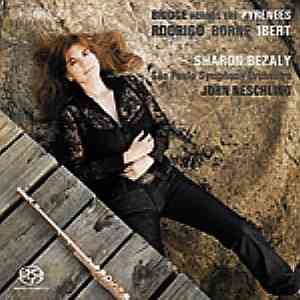
Sharon Bezaly is best known for her performances of the traditional flute repertoire. But she is deeply committed to new music, too. Sofia Gubaidulina, Kalevi Aho, Sally Beamish, Daniel Börtz, Fulvio Caldini, Brett Dean, Carl-Axel Dominique, George Flynn, Hans-Ola Ericsson, Anders Hillborg, Christian Lindberg, Uljas Pulkkis, Ge Gan-ru, Mari Takano, Haukur Tómasson, and Zhou Long have written compositions for her.

Sharon Bezaly
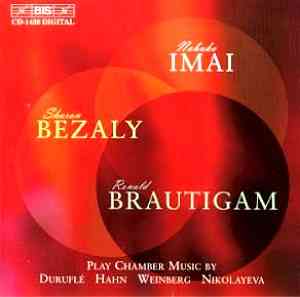
She has also this penchant for time-warping and spell-casting, especially with solo and small-ensemble works. Some of it appears on her CD with pianist Ronald Brautigam and violist Nobuko Imai.

Bezaly’s vibrato and phrasing tell us much about the culture and the expressionistic intent, just as Edith Piaf’s voice belongs to mid-Century French culture and Souzay’s performance of Reynaldo Hahn’s song l’Heure exquise illustrates an overtly erotic vocal intent.

The phrases overlap for a moment, as the viola begins to sing over the piano’s dissolving phrase and the flute’s virtual ascent into heaven, carried away. Over the course of the Romanesque the elements gradually converge toward a subtle synthesis that depends on a progressive ‘dematerialization’ of the flute. The strophic construction of the piece enables us to watch this progression in slow motion.


    [50-sec clip, Reynaldo Hahn, Romanesque, Bezaly-Brautigam-Imai, 1.4MB MP3]

The etherealization of the flute goes hand in hand with the musical processes of sequence, inversion, and motivic fusion. This yields a kind of musical ‘interiority’, exquisitely deliberate on Hahn’s part and elegantly rendered by Bezaly, Brautigam, and Imai. It refutes the exteriority of mere ‘mimesis of Italian 16th and 17th Century dance’—which is where Horst Scholz’s liner notes for the CD leave it.

 Bone Flute, 43,000 years old
 Bone Flute, overlay on Boehm flute
What else is on the Bezaly-Brautigam-Imai CD?
    Bezaly—Chamber Music
  • Maurice Duruflé: Prelude, Recitatif et Variations, Op. 3
  • Reynaldo Hahn: Romanesque; L’Enchanteur; Portraits de peintres; Danse pour une déesse
  • Meiczysław Weinberg: Trio, Op. 127
  • Tatiana Nikolayeva: Trio, Op. 18
Some highlights of Bezaly’s upcoming performance schedule include:
  • 14-15 Feb 2008: Bergen: Mozart: Concerto in D Major; Bernstein: Khalil
  • 23-24 Feb 2008: Den Haag: Rodrigo: Concerto; Borne: Carmen Suite
  • 28 Feb 2008: Norrlands: Rodrigo: Concerto
  • 21 Apr 2008: Amsterdam: Recital with Ronald Brautigam
  • 23-26 May 2008: Zagorje: Slovenian Flute Festival
  • 01-04 Feb 2009: Spain: Tour with London Baroque
 Sharon Bezaly