Showing posts with label mimesis. Show all posts

Wednesday, May 23, 2012

Mara Gibson’s ‘Canopy’: Arboreal/Neuronal soundscape/artscape for viola, percussion, and tape

Sydney Opera House

I  recently had the privilege to experience a new chamber music composition by Mara Gibson at the opening of a new art exhibit in Kansas City. The work was commissioned by the Nelson-Atkins Museum of Art. Premiered in April by Michael Hall, ‘Canopy’ was inspired by ‘Ferment’, Roxy Paine’s (1966-) outdoor installation in the sculpture garden at the Nelson Atkins Museum of Art in Kansas City.

I n the 13-min composition, Gibson meditates on Paine’s conflation of neuronal dendritic architecture and treeness... the multiplicity of meanings of what we perceive in nature is called into question. We all are trees; we all are neurons now.

L arge-scale sculptures and exotic mixed-ensemble chamber music (viola-percussion-tape) aren’t commonly paired with each other. However, in this instance it is an inspired piece of programming, an account that plumbs the depths of the sculpture’s seeming desolation... a melancholy that stems from the constitutional rootedness of a ramifying, arborizing structure that is situated where it is with little prospect of changing its venue (you; the neurons that make up your brain and make you who you are; the tree). And yet the composition culminates in a radiant, nature-affirming performance that leaves the listener-viewer with more than solace—a sense of quiet optimism.

H all takes great care with the score’s myriad directions, resulting in an intensity and beauty that would delight any composer, as well as any audience. There is a brief pause/silent_stasis at about 07:00. The solo_viola/denuded_tree resumes with a soliloquy. Then, with a harrowing climax, the percussion and recorded track of the viola reappear with renewed vigor, and with the live viola layered on top of them—effecting a grieving voice of the solo viola answering its echo and the percussion more quietly, survivors against all odds! The micrometer-precise diminuendo from 11:00 to the end is perfectly realized—and we immediately appreciate why Gibson wrote it in this way.

H all’s technique is superb throughout and manages to sound like 5 different violas, by using combinations of diverse pressures on the bow, bowing near and far away from the bridge, etc.—pensive, taut, with some ‘extended’ viola techniques. Bob Beck’s recording and production values aptly serve the intimacy of this beautiful piece. Few recordings achieve such a level of detailed commitment from the artists and the recording engineer! (I am grateful, too, that Gibson has made digital recordings of ‘Canopy’ available for download on BandCamp.com.)

A nyone who has tried to devise a likeness of a tree—sculpting one as a kid in school, or, with more serious intent as an older person—will recognize how difficult it is to do well. The fractal character of the branch points and the Fibonacci-like decimation of the caliber of the branches as you go further and further out on the limbs is hard to emulate. It is so easy to end up with a ‘fail!’—a crude likeness that looks contrived, a caricature of a tree! But Paine achieves a high level of fractal verisimilitude—a tree representation with enough character-development and complexity and depth to be believable as a tree or as another living organism with moral standing. Gibson’s writing is not ‘representational’ as such, but with equal care and finesse achieves comparable moral weight and attractive, believable, attention-holding verisimilitude.

I n summary, Gibson’s sonic stimuli synergize nicely with Paine’s sculpture’s visual and haptic stimuli. I enjoyed being immersed in both of them at the same time. The visual and musical elements are independent and exciting in their own right and (in the case of Paine’s sculpture, ‘have already stood’ and--) will continue to stand ably on their own. But, together, the two works manifest a cohesion that is evident to listeners/viewers as they encounter the works simultaneously. It is a brilliant success as a tandem installation, and ‘Canopy’ is commendable as a commissioning project. Other galleries and museums should take note of this as an example they can replicate—commissioning companion chamber compositions to accompany major new acquisitions, and organizing gala première performances (with food and wine, as the Nelson did) to cultivate new membership and community involvement! No better way than this to dispel the ignorant museum stereotype of grey-hair elites!

H all is a former president of the Chicago Viola Society and a founding member of the Lake String Quartet. He has performed at numerous summer festivals, including the Grand Teton Festival, the National Orchestral Institute, Kneisel Hall Chamber Music School, and the Aspen Music Festival. Hall serves on the faculties of Illinois Wesleyan University, VanderCook College of Music, and the Chicago Academy for the Arts. He is a graduate of Ball State University, with graduate studies with Peter Kamnitzer and with the LaSalle and Tokyo String Quartets, at the University of Cincinnati Conservatory of Music, and doctoral studies with Michelle LaCourse and Scott Rawls at the UNC, Greensboro.

G ibson graduated from Bennington College and completed her PhD at SUNY Buffalo. She attended London College of Music; l’École des Beaux-Arts, Fontainebleau, France; and the International Music Institute, Darmstadt. She has received grants and honors from the American Composer’s Forum, the Banff Center, Louisiana Division of the Arts, Arts KC, Meet the Composer, the Kansas Arts Commission, the National Endowment for the Arts, the International Bass Society, ASCAP, and the John Henrick Memorial Foundation. She is also founder of the UMKC Composition Workshop for Young Composers and co-director/founder of ArtSounds, now in its seventh year. ArtSounds specializes in “immersive art-music fusion” experiences, similar in spirit to ‘Canopy’.

T   he greatest hindrance in the understanding of life lies in the impossibility of accounting for it by the enumeration of its properties. It must be understood as a unity. But if the organism [tree; neural network] is a unity, in what sense are its component properties its parts? Who is it, really, and why? How does this unity arise? To what extent must it be considered a property of the organization of the organism, as opposed to a property emerging [undeliberated] from its mode of life? These questions remain open....”
  — Humberto Maturana & Francisco Varela.

Tuesday, April 14, 2009

Lera Auerbach: Non cetera desunt (The ‘Rest’ of the Story is Not Missing)

 Lera Auerbach
E    ach of the piece’s eight short movements also carries a Latin title, taken from Ovid, Horace and others, but the relevance of those is neither obvious nor especially important. (According to her program notes, Auerbach is reluctant on principle to say anything concrete about the music or its subject matter, although she’s perfectly happy to spend many, many paragraphs telling listeners [stories] about her reticence.)”
  —  Joshua Kosman, San Francisco Chronicle, 21-MAR-2009.
A    ll theorizing is a form of world-creation and, as such, is ineluctably ‘fictive’. But this does not mean that all modes of imagining tend toward ‘creative possibility’... Fictive forms of thought that efface, negate, and forget their [possibilistic] power in favor of authoritative and, thus, ‘legislative’ and programmatic power.”
  —  Susan McManus, p. 19.
S  ometimes what you want most to hear is a story, well-told. If that is the chamber music craving you are having, you could not do better than to listen to, or play, a piece by Lera Auerbach. The imagery of pianist-poet-composer Lera Auerbach is varied, pluralistic—possessed of multiple ‘facets’ or points of view and simultaneously supportive of two or more of them at a time.


    [50-sec clip, Ksenia Nosikova, Lera Auerbach, Images No. 5, ‘Old Photograph from the Grandparent’s Childhood’, 1.6MB MP3]

B ut that doesn’t mean that Auerbach is a ‘relativist’: some facets or perspectives are more valued or legitimate or commendable than others, and Auerbach provides numerous reasons and musical ‘arguments’ setting forth her own feelings and evolving interpretations.

H er music affords the listener or performer considerable ‘latitude’. But she persuades her performers/audience to her point of view by creating a series of imaginative, fictional roles that she invites us to inhabit. Her composing in some ways resembles the storytelling of highly political authors … an Austen; a Dickens; or a Chekhov or a Dostoevsky, say.

I n that connection, political art is, I believe, most efficacious, not when it advances abstract principles, but when it instead alters listeners’ understanding of their own past and future. Is this a feature of Auerbach’s writing? I think so. The composer creates an account of History or of Time itself—ideally, the ‘center’ of (and not merely an ‘ornament’ of) an account of human nature and politics. We hear it—or play it—and recognize the broad, generalized validity and depth of what has been said. ‘Images from Childhood’, for example—or ‘24 Preludes’—are miniatures, but they are not ‘bon bons’.

S o Lera Auerbach’s politics permeate her compositions and performances, seeking not so much to reform our ethics as to reshape our memories. Lera’s work positions narrative in politics, or narrative as a way of doing politics. It insists on a broad connection between political identity and narrative. I do not know whether major figures in the history of political thought—Locke, Hegel, Marx—have a bearing on Lera’s methods or motivations. But Lera argues that each composition rewrites the past in an explicit attempt to direct the future. It is a ‘redemptive’ approach to the past, insofar as it places responsibility on human freedom and action in the present. How do I retrieve my childhood memories of the scary family photo albums, with the ancient sepia-tint monochrome images of early 20th-Century Evanstas and Østensos and Andersons and Thiedes?

S he confronts the epistemological dilemma of what things we can know and how we can know them. Auerbach closely regulates her musical ‘stories’—defining, expanding, reiterating, delineating them, bar-by-bar, phrase-by-phrase. She grants permission to us performers and listeners, but her cues are so numerous as to make the remit kind of superfluous. Her demonstrativeness and transparent intelligibility are something like ... Prokofiev’s?

A  nd what about ‘Cetera desunt’ [Latin: ‘the rest is missing’]? This title is maybe an ironic joke? This string quartet is not in any respect ‘incomplete’, nor is the sense it conveys tremendously open-ended.

T here are characters, plots, themes, etc.—and Lera’s ‘vocabulary of affect’ is positively ‘narratorly’ and fastidious throughout. The pacing in this, as in other of her compositions, is characteristically narrative. No, the ‘rest’ is not missing. It is all here—right in your mind; right where Lera put it.

 Petersen Quartett, Lera Auerbach, ‘Cetera desunt’
W onderful music to immerse yourself in! Be sure to hear her ‘Cetera desunt’ performed by RTÉ Vanbrugh Quartet on Wednesday 01-JUL at the West Cork Chamber Music Festival and Lera’s account of Mussorgsky’s ‘Pictures at an Exhibition’, if you are able to attend.

 Lera Auerbach, playing Schumann

Saucius ille tamen ‘fer opem. matertera dixitWounded, he cries out
‘Autonoe! moveant animos Actaeonis umbrae!’‘Help, Aunt Autonoe! Save your kin, Actaeon!’
Illa, quis Actaeon, nescit dextramque precantisBut who is this Actaeon? How would she know?
abstulit, Inoo lacerata est altera raptu.She tears off his right arm, and Ino, enraptured, savages the left.
Non habet infelix, quae matri bracchia tendat,He has no arms to reach out to his mother, poor sod,
trunca sed ostendens deiectis vulnera membrisbut shows her his torso with its missing limbs and cries out
‘Adspice, mater!’‘Mom, look!’

—Ovid, Metamorphoses Bk 3

Deucalion lacrimis ita Pyrrham adfatur obortis...Deucalion tearfully perceived the emptiness and desolation...
‘Si sine me tatis erepta fuisses, nunc animus, miseranda foret?’ ‘How would you feel had Fate taken you away without me?’
‘Quo sola timorem ferre modo posses?’‘How would you bear this terror all alone?’

—Ovid, Metamorphoses Bk 1

 Gibson book


Friday, February 8, 2008

Carried Away: Bezaly, Hahn, Déjà vu et l’Heure exquise

 Sharon Bezaly
T  he official conception of the classic was still linked to a holistic, conservative French community... Reynaldo Hahn’s A nos morts ignorés is typical in its economy of means and its search for an expressive style that incorporates learnèd archaisms, such as modal allusions and ars antiqua organum.”
  —  Jane Fulcher, p. 91.
H  is mind is attracted by a vision, by an image; his heart suffers a feeling; his refined sensuality thrills under the contact of an impression; immediately the emotion is translated into a musical formula, fixed in an instant; but soon reverie gains the upper hand, the image becomes general, the overtones of feeling reverberate, hum, and the inconstant dreamer, seduced by their echo, allows himself to be distracted and carried away.”
  —  Reynaldo Hahn, speculating on Fauré’s creative process (but really projecting his own process and imagining it as belonging to Fauré), Journal de l’Université des Annales, July 1914, 8:115-8.
 Sharon Bezaly

    [50-sec clip, Reynaldo Hahn, Romanesque, Bezaly-Brautigam-Imai, 1.5MB MP3]

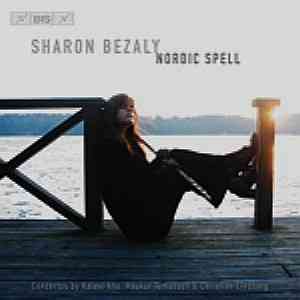
Sharon Bezaly is best known for her performances of the traditional flute repertoire. But she is deeply committed to new music, too. Sofia Gubaidulina, Kalevi Aho, Sally Beamish, Daniel Börtz, Fulvio Caldini, Brett Dean, Carl-Axel Dominique, George Flynn, Hans-Ola Ericsson, Anders Hillborg, Christian Lindberg, Uljas Pulkkis, Ge Gan-ru, Mari Takano, Haukur Tómasson, and Zhou Long have written compositions for her.

Sharon Bezaly
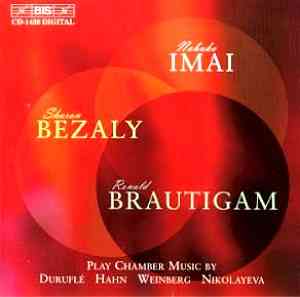
She has also this penchant for time-warping and spell-casting, especially with solo and small-ensemble works. Some of it appears on her CD with pianist Ronald Brautigam and violist Nobuko Imai.

Bezaly’s vibrato and phrasing tell us much about the culture and the expressionistic intent, just as Edith Piaf’s voice belongs to mid-Century French culture and Souzay’s performance of Reynaldo Hahn’s song l’Heure exquise illustrates an overtly erotic vocal intent.

The phrases overlap for a moment, as the viola begins to sing over the piano’s dissolving phrase and the flute’s virtual ascent into heaven, carried away. Over the course of the Romanesque the elements gradually converge toward a subtle synthesis that depends on a progressive ‘dematerialization’ of the flute. The strophic construction of the piece enables us to watch this progression in slow motion.


    [50-sec clip, Reynaldo Hahn, Romanesque, Bezaly-Brautigam-Imai, 1.4MB MP3]

The etherealization of the flute goes hand in hand with the musical processes of sequence, inversion, and motivic fusion. This yields a kind of musical ‘interiority’, exquisitely deliberate on Hahn’s part and elegantly rendered by Bezaly, Brautigam, and Imai. It refutes the exteriority of mere ‘mimesis of Italian 16th and 17th Century dance’—which is where Horst Scholz’s liner notes for the CD leave it.

 Bone Flute, 43,000 years old
 Bone Flute, overlay on Boehm flute
What else is on the Bezaly-Brautigam-Imai CD?
    Bezaly—Chamber Music
  • Maurice Duruflé: Prelude, Recitatif et Variations, Op. 3
  • Reynaldo Hahn: Romanesque; L’Enchanteur; Portraits de peintres; Danse pour une déesse
  • Meiczysław Weinberg: Trio, Op. 127
  • Tatiana Nikolayeva: Trio, Op. 18
Some highlights of Bezaly’s upcoming performance schedule include:
  • 14-15 Feb 2008: Bergen: Mozart: Concerto in D Major; Bernstein: Khalil
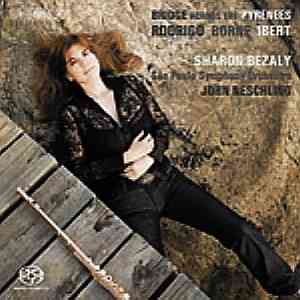
  • 23-24 Feb 2008: Den Haag: Rodrigo: Concerto; Borne: Carmen Suite
  • 28 Feb 2008: Norrlands: Rodrigo: Concerto
  • 21 Apr 2008: Amsterdam: Recital with Ronald Brautigam
  • 23-26 May 2008: Zagorje: Slovenian Flute Festival
  • 01-04 Feb 2009: Spain: Tour with London Baroque
 Sharon Bezaly