Showing posts with label barthes. Show all posts

Friday, April 13, 2012

Jonathan Biss: Proairetic & Hermeneutic Codes In Action, Realtime Beethoven-Janáček Message-Passing Protocol

Jonathan Biss
I  ’ve done all-Mozart, all-Beethoven, all-Schubert programs, but there is always the danger of a stylistic sameness, or rather a lack of confrontation between the pieces. Concerts of works of two composers are great because they still offer enough music of each to create a sense of immersion in the composers’ sonic worlds, and yet the concert becomes a dialogue between the two, which often moves in surprising directions. The question of which composers work well together (and which don’t) is particularly alchemical, and I think it is one of both similarity and difference. The success of Beethoven and Janáček as a pairing relies in part on the terrific intensity that characterizes both... The intensity may be similar, but the language is utterly different... Beethoven’s sonatas are incredibly tightly argued... Janáček, by contrast, is perhaps the greatest master of the musical non-sequitur... Beethoven and Janáček could not be more different, which makes the similarities in temperament between the two all the more fascinating.”
  — Jonathan Biss, 2012 essay.
N ot ‘non-sequiturs’ exactly. More like the worldview of peoples who have for centuries lived along a foggy seacoast and whose language now innately reflects their inability to see or predict what will loom into view in front of them from one moment to the next.

F orgetting, the renunciation of cause-and-effect and the obverse of forgiving. Beethoven afflicted with abject loss and despair (as in the Adagio of Op. 27 No. 2); Janáček surprised by optimism, welling up from where?

I just returned from Jonathan Biss’s Beethoven-Janáček recital at Kansas City’s Folly Theater (Sonata No. 5, Op. 10, No. 1; Sonata No. 14, Op. 27, No. 2; Sonata No. 26, Op. 81a; V mlhách, JW 8/22; Sonata 1.X.1905, Z Ulice, JW 8/19).

T he ‘affective’ content and contrasts of these intense works—both the composers’ affect or psychological state and intentions, and the performer’s affect—are what makes the program spellbinding—emotionally compelling to experience (confirming what Biss has written in his essays; see blockquote above)!

T here may be elements that denote a similar state of mind or parallels in terms of Beethoven’s temperament and Janáček’s temperament, as Biss says. But the orderliness and certitude of Beethoven—contrasted with the randomness and the existential acceptance of doubt and uncertainy, even the recklessness of Janáček—these features make us think about our differences, not just the differences between these composers or their respective eras.

T hese antithetical qualities—and how such personalities or such ‘stances’ that we adopt influence what happens to us in life—are constitutional, innate, inherited styles. Well, they are partly inherited and partly learned/habitual.

E very mixture, every conciliation, every passage through the barrier of our inherited and habitual style is a transgression with self-discovery.

N ot every transgression is transcendent or momentous. Some of them are ironic, trivial, or tame—much like when a belovèd pet cat trips and experiences embarrassment at its clumsiness, so out-of-character and façade-dropping. Sometimes events bring out the best in us. We appear virtuous and do and express commendable things. At other times, our undesirable qualities come out.

A nd some transgressions are outrageous or transformative. Putting these two composers next to each other makes for an intense two-way street—stylistically and emotionally. This program forces/enables the two to ‘mediate’ each other’s views and to rhetorically critique the other.

I t is as though Biss has learned from literary theorist Roland Barthes and reveals the “hermeneutic code” that governs the semantics of each of the two composers’ worldviews, the “semiotic code” of the musical motives of each, the “proairetic code” that governs the formal structure (or, for Janacek, the renunciation of cause-and-effect structure), and the “referential code”—musical abstractions and metaphors and borrowings.

T he ‘next-to-ness’ Biss creates in formulating this program conjures the main forces that drive the narrative—and that drive our own desires to listen attentively.

T he “hermeneutic code” (see links below) refers to those plot elements that raise questions on the part of the reader of a text or the viewer of a film or the listener to a program of music. For example, in the Beethoven Op. 10, we get tragedy—the anxiety becoming mourning, weeping, descending (Movement 1, Theme 1, Phrase 1) leading to violence (Movement 3, Theme 1)—which leads us to wonder about the reasons for these traumatic events. Then, in the Janáček, we get a fatalistic indifference to a world in which cause-and-effect processes break down, or in which some events can’t be prevented or explained. We need the ‘loose ends’ of the narrative ‘tied up’ in order to feel satisfied, like a good detective story—and that is what Biss does for us by the end of the concert. The entire narrative of a story like this operates via hermeneutic encoding. We witness a murder, and we enthusiastically spend the rest of the concert learning answers to the questions that were raised by the initial Beethoven scenes of violence. That is one half of how this concert program works.

P roairetic code”, on the other hand, refers to ordinary actions—those musical phrases or plot events that simply lead to yet other phrases/consequences/actions. Suspense is driven by action rather than by a reader’s or a listener’s desire to have unsolved mysteries solved. This “proairetic code” is the other half of how or why this particular concert program works—event or ‘message-passing’ between the works, in a fashion resembling what happens with remote procedure calls (RPC) and protocol buffers in software systems.

B iss’s idea of programming this seemingly-disparate-but-narratively-confrontational repertoire is really an excellent one—attractive, interest-holding, suspenseful—provoking us to reach a deeper understanding of the human condition, as well as deeper understanding of the mental states of two specific composers and of the nature of the works made to confront each other in this way. One could hardly wish for a higher form of “fun” than this. Bravo!
C  an a piano work convey a bustling ‘severalness’, or the sense of many people congregated in a social gathering, as convincingly as a chamber work? I think so — parts of Schumann’s ‘Carneval’, Mussorgsky’s ‘Marketplace at Limoges’, and Ravel’s ‘La Valse’ spring to mind as trivial examples. One tempting view is that the composer is aiming to depict the entirety of the human condition: everything is in here and, just as in the real world, the profound and the banal are constantly rubbing shoulders. I don’t think this is wrong, but the truth may go further... By presenting a unified work in which the high and the low aspects of humankind are contained together, the composer invites the listener to find these worlds contained inside each other, not merely nearby. The piano sonatas may have a touch of this ‘adjacent’ humor—the riotous trio in the second movement of opus 110, or the manic dotted-rhythm variation in opus 111.”
  — Jonathan Biss, 2012 essay.

Tuesday, April 14, 2009

Lera Auerbach: Non cetera desunt (The ‘Rest’ of the Story is Not Missing)

 Lera Auerbach
E    ach of the piece’s eight short movements also carries a Latin title, taken from Ovid, Horace and others, but the relevance of those is neither obvious nor especially important. (According to her program notes, Auerbach is reluctant on principle to say anything concrete about the music or its subject matter, although she’s perfectly happy to spend many, many paragraphs telling listeners [stories] about her reticence.)”
  —  Joshua Kosman, San Francisco Chronicle, 21-MAR-2009.
A    ll theorizing is a form of world-creation and, as such, is ineluctably ‘fictive’. But this does not mean that all modes of imagining tend toward ‘creative possibility’... Fictive forms of thought that efface, negate, and forget their [possibilistic] power in favor of authoritative and, thus, ‘legislative’ and programmatic power.”
  —  Susan McManus, p. 19.
S  ometimes what you want most to hear is a story, well-told. If that is the chamber music craving you are having, you could not do better than to listen to, or play, a piece by Lera Auerbach. The imagery of pianist-poet-composer Lera Auerbach is varied, pluralistic—possessed of multiple ‘facets’ or points of view and simultaneously supportive of two or more of them at a time.


    [50-sec clip, Ksenia Nosikova, Lera Auerbach, Images No. 5, ‘Old Photograph from the Grandparent’s Childhood’, 1.6MB MP3]

B ut that doesn’t mean that Auerbach is a ‘relativist’: some facets or perspectives are more valued or legitimate or commendable than others, and Auerbach provides numerous reasons and musical ‘arguments’ setting forth her own feelings and evolving interpretations.

H er music affords the listener or performer considerable ‘latitude’. But she persuades her performers/audience to her point of view by creating a series of imaginative, fictional roles that she invites us to inhabit. Her composing in some ways resembles the storytelling of highly political authors … an Austen; a Dickens; or a Chekhov or a Dostoevsky, say.

I n that connection, political art is, I believe, most efficacious, not when it advances abstract principles, but when it instead alters listeners’ understanding of their own past and future. Is this a feature of Auerbach’s writing? I think so. The composer creates an account of History or of Time itself—ideally, the ‘center’ of (and not merely an ‘ornament’ of) an account of human nature and politics. We hear it—or play it—and recognize the broad, generalized validity and depth of what has been said. ‘Images from Childhood’, for example—or ‘24 Preludes’—are miniatures, but they are not ‘bon bons’.

S o Lera Auerbach’s politics permeate her compositions and performances, seeking not so much to reform our ethics as to reshape our memories. Lera’s work positions narrative in politics, or narrative as a way of doing politics. It insists on a broad connection between political identity and narrative. I do not know whether major figures in the history of political thought—Locke, Hegel, Marx—have a bearing on Lera’s methods or motivations. But Lera argues that each composition rewrites the past in an explicit attempt to direct the future. It is a ‘redemptive’ approach to the past, insofar as it places responsibility on human freedom and action in the present. How do I retrieve my childhood memories of the scary family photo albums, with the ancient sepia-tint monochrome images of early 20th-Century Evanstas and Østensos and Andersons and Thiedes?

S he confronts the epistemological dilemma of what things we can know and how we can know them. Auerbach closely regulates her musical ‘stories’—defining, expanding, reiterating, delineating them, bar-by-bar, phrase-by-phrase. She grants permission to us performers and listeners, but her cues are so numerous as to make the remit kind of superfluous. Her demonstrativeness and transparent intelligibility are something like ... Prokofiev’s?

A  nd what about ‘Cetera desunt’ [Latin: ‘the rest is missing’]? This title is maybe an ironic joke? This string quartet is not in any respect ‘incomplete’, nor is the sense it conveys tremendously open-ended.

T here are characters, plots, themes, etc.—and Lera’s ‘vocabulary of affect’ is positively ‘narratorly’ and fastidious throughout. The pacing in this, as in other of her compositions, is characteristically narrative. No, the ‘rest’ is not missing. It is all here—right in your mind; right where Lera put it.

 Petersen Quartett, Lera Auerbach, ‘Cetera desunt’
W onderful music to immerse yourself in! Be sure to hear her ‘Cetera desunt’ performed by RTÉ Vanbrugh Quartet on Wednesday 01-JUL at the West Cork Chamber Music Festival and Lera’s account of Mussorgsky’s ‘Pictures at an Exhibition’, if you are able to attend.

 Lera Auerbach, playing Schumann

Saucius ille tamen ‘fer opem. matertera dixitWounded, he cries out
‘Autonoe! moveant animos Actaeonis umbrae!’‘Help, Aunt Autonoe! Save your kin, Actaeon!’
Illa, quis Actaeon, nescit dextramque precantisBut who is this Actaeon? How would she know?
abstulit, Inoo lacerata est altera raptu.She tears off his right arm, and Ino, enraptured, savages the left.
Non habet infelix, quae matri bracchia tendat,He has no arms to reach out to his mother, poor sod,
trunca sed ostendens deiectis vulnera membrisbut shows her his torso with its missing limbs and cries out
‘Adspice, mater!’‘Mom, look!’

—Ovid, Metamorphoses Bk 3

Deucalion lacrimis ita Pyrrham adfatur obortis...Deucalion tearfully perceived the emptiness and desolation...
‘Si sine me tatis erepta fuisses, nunc animus, miseranda foret?’ ‘How would you feel had Fate taken you away without me?’
‘Quo sola timorem ferre modo posses?’‘How would you bear this terror all alone?’

—Ovid, Metamorphoses Bk 1

 Gibson book


Sunday, November 12, 2006

Janáček’s Urbanism: Inner Frontiers

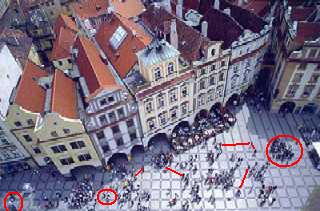
Propinquity Vectors in Prague Zentrum
CMT: Prague is such a beautiful old city. Eastern in its feel. Communitarian, connected. You can walk everywhere, easily.

DSM: But western cities with their ethos of space and powerful cars driving along interstate highways or autobahns at high speeds can be uplifting, too. Melvin Webber called it ‘community without propinquity’. I lived in Houston for ten years. The effect of the city was such that I couldn’t help but feel connected to Los Angeles and New York and London and the whole world. That hyper-mobile city imparted a dream of achieving liberation through mobility, of finding freedom by defeating geographic constraints.

CMT: If I have an argument with the so-called ‘New Urbanists’ it is that they’re too ready to valorize the old city, and too ready to disparage developments of the past 100 years. They have certain legitimate points—objections to the sprawl and wastefulness and sterility of suburbs, for example. But they reject the legitimacy of the psychosocial desire for distance, or seek unilaterally to disenfranchise those of us who have such a need.

DSM: Scientists invent new words as they confront things that are not yet known; they need a language that enables them to talk about them. Foucault once said we inherently and continually need to invent ‘gray language’. We need to make new language to talk about the worlds we’re creating and revising and inscribing—this is what happens in other fields anyhow. It’s just not so common to acknowledge that this same need exists in music.

CMT: Henri Lefebvre used to say, “Urban space is defined as a place where people walk around, finding themselves standing before and inside piles of singular objects, experiencing the intertwining of the threads of activities until they become unrecognizable, entangled situations in such a way that they engender unexpected situations. The definition of this space consists of a null vector. The cancellation of distance haunts the occupants of urban space. They can’t avoid encountering each other.”

DSM: I could paraphrase Lefebvre on sub-urban space: “Suburban space is a domain where people drive around, and find themselves passing singular objects, experiencing activities that are entirely familiar and engaging in situations in such a way that they engender highly predictable situations. The definition of this space is that it has a manifold of vectors. Attenuated distances—abridged and compressed distances—haunt the occupants of suburban space. They scarcely encounter each other.”

Prague Null Vectors and Cliques
CMT: That’s another kind of city. It superficially appears to be a scattered mélange of objects and motifs. But in fact it’s exceedingly organized, textured, perfectly striated, facilitated by mechanization and commerce. If Bob wants to visit Sue, their trip and discourse will be inscribed by the reality of the surrounding infrastructure and the types of activities that it is conducive to—will be inscribed by the roadways and the means of motivic transport that have been set up. He uses a car—or he uses a violin to navigate these Janáček figures.

DSM: At its heart is something that’s thoroughly modern and western. Because I was an engineer at one time, I’m trying to come up with an equation—we overcome distance by increasing our speed, and then we feel too close so we move farther apart, more or less keeping the time between us constant. But the range of how far we can go—the area we can cover in constant time goes up as the square of our maximum speed. So if we increase our speed by a factor of two, the scope of our connectedness is greater by a factor of four...

CMT: That view is, I think, a distinctly ‘American’ or ‘North American’ sense of distance, rather than your broader ‘Western’ characterization of it. Maybe ‘Australian’ and other cultures would own up to it too, but surely not all Western countries.

DSM: Any city or suburb is, in Lefebvre’s view, an interaction of distance and vectors. On one end of the spectrum, it’s crowded and intense and null vectors of negligible length. On the other end of the spectrum, it’s ‘dross space’, pure distance with infrequent interactions, desert-like, desolate.

CMT: There are megaforms, hypermeter, weather systems that are larger than the scale of any motif of composerly devise.

DSM: And there are speed-zones where larger motifs provide strong hints to the listener, as to how to interpret the music. Like a winding parkway through a residential area, or an esplanade with retail stores separated from the main trafficway by adjacent boulevards. There are parts of Paris and Lisbon like this...

CMT: Suburbia establishes this microcosm—an abstracted caricature of who we are. It invites us to ignore or neglect some features of the people and spaces around us. It tends to produce a toxic ecology whose consequences permeate other parts of society and extend to future generations. You can’t expect free-market forces to acknowledge or correct these effects. The private sector wants to make money and imagines that the public sector is there to facilitate commerce. The public sector often feels that it doesn’t have the remit—the authority and resources—to deal with it. But now things are happening in many places—the gentrification and revitalization of older areas—these are inner frontiers. Part of what I hear in Janáček.

DSM: But the upshot of this is that we are never fully ‘ourselves’ in any one environment. Our possibilities are always modulated by our context, by the stimuli that impinge on us. And we ourselves are like prisms. If we don’t seek out different stimuli, different contexts, different illumination—then we’ll have traversed in our lives only a narrow bit of the range, of the totality of who we are.

CMT: Townhouses and gated communities. Memorials to isolation and individualism. Janáček was taking some of those fences and gates down. Janáček explores the familiar and eternal cycle of the seasons in his fantasy, The Cunning Little Vixen—but in all his works the principal element is a positive outlook on humankind and its grip on life.

DSM: Leoš Janáček—his opera, Jenůfa, was performed in Brno with considerable success in 1904. But it was stone-walled until 1916 in Prague—by Kovařovic. The ultimate success it enjoyed in Prague was a tremendous creative spur to Janáček, and in the last 10 years of his life he produced many surprising and masterful pieces, including String Qt. No.1 (Kreutzer Sonata, 1923-4) and String Qt. No.2 (Intimate Letters, Listy důvěrné, 1928).

CMT: The late upsurge of Janáček’s inspiration partly derived from his (unrequited?) fascination with Kamila Stösslová. He met her in 1917, and he wrote more than 600 letters to her over the following 10 years—averaging more than one letter per week every week for 10 years. Amazing! Appalling!

DSM: Yes. And Janáček’s later works typically involve short bursts of melody—rhythmical, provocative and obviously expecting a response, as though they were vocal exclamations, possibly addressed to Kamila. No, I think we could say these are surely epistolary works—musical correspondence—standing in for more direct dialogue, abridging a socially-imposed distance, the distance that existed because Kamila was married to someone else. Janáček collected in sketch-books phrases he overheard in urban and in suburban and rural areas, and he annotated the moods in which they were spoken—these were the sources of his later compositions, and they are mentioned in his letters to Kamila. The melodic fragments exhibit sudden distance-cancelling changes of tonality and mood—and from these he constructs simple but unusual means to his music’s intended climactic ends. Elegant, persuasive.

CMT: What’s most unusual is his spacing and juxtaposition of chords. His orchestration is always striking and unusual, often harsh and raw but invariably apt. He liked to use instruments at the extremes of their range, too, drawing attention to distance and to the collapse of distance. Propinquity without community.


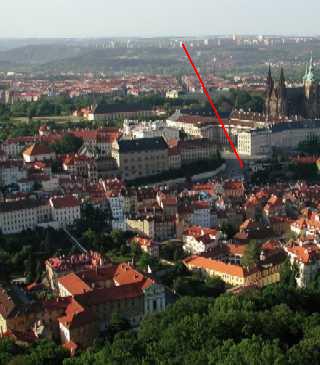
Prague Suburbs: Attenuated Distance