Showing posts with label urbanism. Show all posts

Monday, September 15, 2008

Politics of Politics: Fretwork Recreates the Cosmopolitan Vision of England ca. 1600

Fretwork, photo ©Edward Webb
Humanism believes in a far-reaching program that stands for the establishment throughout the world of democracy, peace, and a high standard of living on the foundations of a flourishing economic order, both national and international.”
  —  Corliss Lamont, Humanism Defined.
In 1540, Henry VIII requisitioned musicians from Italy to compose and perform at his court. Two families came—they were not only Italian but clandestine Jews (marranos, or nominally converted ‘New Christians’). The Lupo and the Bassano families thrived in England and served the monarchy for over a century. Yesterday, the ensemble Fretwork performed a program of their music, ‘Birds on Fire: Jewish Musicians in the English Court,’ at Wigmore Hall in London:
  • Augustine Bassano: Pavan and Galliard No. 1;
  • Heironymus Bassano: Fantasia No. 1 in 5 parts;
  • Joseph Lupo: Pavan in 5 parts;
  • Thomas Lupo: Two Fantasias in 6 parts; Pavan in 3 parts*; Fantasia for three trebles; Fantasy for three basses; Fantasia in 6 parts; Two Fantasias in 6 parts;
  • Van Wilder: Fantasia, con e senza pause (“Emmentaler vs. Gruyere”);
  • Duarte: Two Symphonies in 5 parts;
  • Salmone Rossi: Hashkivenu; Shir hamma’ a lot (Psalm 128);
  • Gough: Birds on Fire;
  • Various: A suite of dances from the Lumley Part Books: Desperada, Pavan and Gallyard, Seconda desperada, Pavan and Gallyard of Albarti, and Terza desperada.

    [50-sec clip, Thomas Lupo, Fretwork Ensemble, ‘Pavan in 3 Parts’, 0.9MB MP3]

The program notes assert that these pieces illustrate the cosmopolitan atmosphere of the Tudor and Stuart courts, drawing upon the idioms of Franco-Flemish or Italian music. Although the Jews had been banished from the kingdom of England since 1290, the Italian-Jewish Bassano and Lupo families became composer dynasties, dominating English music between 1550 and 1650. But this program is, I think, far more than nominally ‘cosmopolitan.’ It is a story of international relations and the perennial pitfalls of international politics. More on that below...

Formed in 1986, the group consists of six players. Its repertoire consists primarily of music of the Renaissance period, in particular that of Elizabethan and Jacobean England, arrangements of the music of Johann Sebastian Bach, plus contemporary music composed for them.
    Fretwork
  • Richard Boothby
  • Richard Campbell
  • Wendy Gillespie
  • Asako Morikawa
  • Richard Tunnicliffe
  • Susanna Pell
with Jeremy Avis singing the Salmone Rossi Ebreo pieces, ‘Hashkivenu’ and ‘Shir hamma’ a lot’.

In 1997 Fretwork won the French Grand Prix du Disque for their recording ‘Lachrimae, or Seven Teares’ by John Dowland. Fretwork performed for the soundtracks of two Jim Jarmusch movies, ‘Coffee and Cigarettes’ (2003) and ‘Broken Flowers’ (2005). Their other film performances include ‘The Da Vinci Code’, ‘Kingdom of Heaven’, ‘The Crucible’, and ‘La Fille d’Artagnan’. Fretwork’s members’ versatility and musicianship are impressive. And last night the warmth of their playing delighted the Wigmore Hall audience of about 500.

The program was bookended with ‘Birds on Fire’, a three-part piece by Orlando Gough composed for Fretwork in 2001 and based on the novel by Aaron Appelfeld ‘Badenheim 1939.’ The novel is about a group of Jews at a spa outside of Vienna in the spring of 1939. With the Nazi regime’s actions the town gradually becomes a ghetto, and the musicians abandon Viennese schmalz and play klezmer tunes (‘Kandel’s Hora’ and ‘Odessa Bulgarish’) in secret. According to Gough’s program notes, they persuade themselves that the sinister changes around them are ‘improvements’, until summer turns to autumn, the food runs out, and they are reduced to eating absurd delicacies from the abandoned hotel pantry. “A pair of twins give a reading—their words were like birds on fire.”

Visiting England from the U.S. as I am, the Fretwork ‘Birds on Fire’ program was especially apropos and poignant. I imagined the precariousness of the Lupos and Bassanos in English society—this was a backdrop to my comprehending these compositions. The Tudor and Stuart courts—and the broader English society—were, I think, hardly congenial to the clandestine cosmopolitan views conveyed in these compositions. Parallels to today abound in them. To this day it is necessary to be clandestine. The recent postures of the U.S. bring into question whether the low-information voter can ever be persuaded to support a humanistic and cosmopolitan international relations: respect for reason, belief in the possibility of a democratic peace based on discourse rather than military might, the peaceful effect of trade, non-provocative defense policies; the obsolescence of conquest and universal respect for human rights.

A cosmopolitan outlook has also though sometimes been associated in the past with an inclination toward ‘messianic’ interventionism. Thomas Walker (then at Rutgers, now at SUNY Albany) wrote an as-it-turns-out ‘premonitory’ paper on this back in 2000 (see link below).

So cosmopolitans may be sophisticated, world-wise, urbane, intrigued by other cultures, and extroverted—but they may be delusional as well. Radical humanists position themselves opposite realism’s fundamental conception of the international system as inherently anarchical. The idea of international anarchy simply provides justification and ‘cover’ for states to pursue selfish national interests to the detriment of international interests, especially those of developing countries. Regrettably, it’s the idea of the sovereign independent state pursuing its own interests that continues to dominate world politics.

An ‘emancipatory’ discourse on international politics, rather than a rationalizing one, ought to critically analyze the conservative stance of foundational International Relations (IR) theories such as realism (the politics of power) and international liberalism. In particular, such discourse ought to analyze their lack of theoretical focus on the oligarchic structure of IR. With regard to the global, anti-democratic nature of current IR, emancipatory discourses such as feminism and radical humanism differ, for example, on how to replace the present (oligarchic) structure with a fairer system.

Realist views embracing the concept of sovereignty (of the state) and opposing anarchy tend to argue for the “inevitability” of today’s world where a small grouping of states are dominant. According to realists, even a state’s external security is safeguarded by the anarchic politics, since it leaves the state free to defend its security either independently or by becoming a member of a multinational alliance. This conservative and pro-status quo ideology of IR runs counter to critics of the oligarchic structure of IR who see a potential for real change; that is, for international democracy where all are equal participants in a democratic world.

The “one world” liberal humanist call for the democratization and empowerment of the U.N. as a first step to toward democratization lacks real emancipatory potential if the unjust international world economic order is left in place. The scholar Jayantanuja Bandyopadhyaya typifies the humanist critique of the prevailing mode of IR–a pro-democratic ideology of IR. Bandyopadhyaya is Professor Emeritus of International Relations at Jadavpur University, Calcutta. Previously he was on the faculty at Columbia University and Professor of International Studies at the American University. The Asiatic Society conferred on him the Biman Bihary Majumdar Award (2006) for his contribution to Political Science and the West Bengal Bangla Academy awarded him the Manas Roy Choudhury Award (2006) for his contribution to Bengalie prose. He has been actively engaged in fighting fundamentalism in India.

T he [realist] paradigm of international anarchy is only an ideological camouflage for the rationalisation, legitimisation and perpetuation of this undemocratic and grossly unjust international sysytem.”
  —  Jayantanuja Bandyopadhyaya, World Government for International Democracy, p. 9.
What makes this perspective a humanistic one? I think it is especially the optimism that human beings possess the power to solve political problems by relying on reason and political will. It also encapsulates humanism’s stress on freedom and development (economic, political, cultural) of all humankind, regardless of nation, ethnicity or religion.

Listen to the music of the Lupos and Bassanos as rendered by Fretwork and you will hear these strains—a cosmopolitan IR stance embodied by Jewish musicians in England in the late 16th and early 17th Centuries. The use of democratic procedures and civil liberties throughout all areas of economic, political, and cultural life is still a feature in humanist discourse today, and the chamber music of the Lupos and the Bassanos contains discursive musical evidence of this. Such humanism today promotes an egalitarian socio-political program and a flourishing economic order. The radicalism of this humanist viewpoint is today positioned outside of liberal internationalism, which is critically viewed as being “blind” to imperialism and its own ethnocentrality. But in 1540, under the auspices of King Henry VIII and others after him, the compositions were not nearly so “blind”.

The virtually unlimited support extended to this oligarchic international system by those very states which proclaim democracy to be a universal principle of political organisation in human society is the most glaring paradox of international relations…The oligarchic international system brought into existence by the ruling classes of the militarily and economically powerful states does not, however, enjoy the support of all sections of world public opinion.”
  —  Jayantanuja Bandyopadhyaya, World Government for International Democracy, p. 22.
Radical humanist ideology shaped by emancipatory rhetoric is today more problematic than ever, particularly so during the reign of the neo-cons in the U.S. Fretwork’s ‘Birds on Fire’ program is historically-informed and commendable for its aesthetic beauty. But it is also apropos in yet more ways because of the relevance of the political context that gave rise to these pieces—relevance to species of IR today. ‘Birds on Fire’ would make an ideal program for fund-raising by IR organizations and NGOs concerned with the current situation in international politics.

Fretwork, Birds on Fire


Friday, August 22, 2008

Recombinant Urbanism of Chou Wen-Chung

Xing book
O  ne must search beyond the procedures of a musical practice, discern its original aesthetic commitments, and trace how its tradition has evolved. If one is blessed with a cross-cultural heritage, one must then regard it as a privilege and obligation to commit oneself to the search in both practices.”
  —  Chou Wen-chung.
The Olympics-related immersion in all things Chinese has been welcome. While commuting to and from work this week I have continued to listen and re-listen to the pieces on the Ying Quartet’s new Dim Sum CD. While the acoustics of a car’s interior are far from ideal for listening to such delicate music, there is a certain poetic rightness in hearing deeply ‘architectural’ compositions while driving through urban spaces, amongst urban traffic and urban pedestrians.

Especially the Chou pieces. With divisi violins and viola on an inner part and cello on a bass line, the balance is critical. The textures imply enclosedness of human spaces, proximity to other individuals, pathways between individuals, purposeful busy-ness of individuals, storeys of office buildings filled with people interacting and not interacting, and contrasts with the non-enclosedness of natural spaces upon which the human spaces abut.

Chou has ‘wiggling’ pitch-bending figures that have a psychological effect of drawing attention to the large amount of pitch-space (or, conversely, the lack of it) that’s available for the part(s) to move in. Some parts wiggle more, and arrogate more space to themselves. Other parts wiggle less, either by choice or because of constraints that arise because of the other wiggling selves.

Rappaport book
The voice-leading in the Chou pieces sometimes produces overlapping ascents and descents. There is a consequent ambiguity to the ear, as each voice progresses into and amongst the other voices. What time and what culture, exactly, is this ‘Larghetto nostalgico’ nostalgic for? Is it a hindsighted nostalgia, or was this composition instead premonitory (‘future nostalgia’) for a time and culture that has now arrived?

Voice-leading, overlapping and non-overlapping
The process for Chou’s ‘fusion’ or, as he calls it, ‘re-merger’ of the musics of the East and the West is one of transformation and recombination—a recombinant urbanism. The orchestration and pitch organization of Chou’s string quartet writing involve recombinant Chinese pentatonic and modal structures and Western chromaticism.

We get segmentations of the octave into polysemous ‘cells’, juxtaposed intervals evoking the ‘yin-yang’ dualism that some of Chou’s essays and scholarly articles refer to.

Chou’s melodic phrases are less melodies than a kind of ambience... Are these really characteristic of traditional Chinese music, or are they Chou confabulating a world that never was? I stop at a stop-light and a crowd of people walks in front of my car in the cross-walk. From the harried looks on their faces, they look like they badly need the excellent story-telling of Chou Wen-chung. The ambience of melodies-that-are-not-melodies would do them good.

Chou Wen-Chung
In order to convey the sonic and instrumental impressions he intends to create, sometimes Chou appends a number of terms such as ‘crystal,’ ‘liquid,’ ‘water burbling,’ ‘leaves rustling,’ ‘whistling’, and ‘air moving’ to his scores. Atoms form molecules, molecules condense into bulk phases of matter, like liquids or solids or gases. Clumps of matter merge and re-merge. People likewise. This is the collectivistic, sonic, social-natural world according to Chou Wen-chung.

Chou-esque ‘re-merging’ of droplet individuals into collective pool
I  am concerned with single tones as musical entities, each endowed with nature by its own acoustic attributes and expressive potential. It is these microcosmic entities in a continual and multi-leveled transformation and interaction that produce the coherent flow of sonic events that we call a composition.”
  —  Chou Wen-chung.
Chou creates a mysterious atmosphere that depicts the “veiled and fractured impression of an ancient city.” Here is a clip, to illustrate the texture and atmospherics that I am describing above:


    [50-sec clip, Ying Quartet, Chou Wen-Chung, Larghetto Nostalgico, 1.4MB MP3]

And here is another clip:

    [50-sec clip, Ying Quartet, Chou Wen-Chung, Leggeriezza, 1.4MB MP3]

What we get is Chou’s essay on recombinant cultural patterns: reinterpretations of traditional living and of new ways of living in the new China. The voice-leading suggests an ‘anthroposphere’ in which people now live in extensively 3-dimensional spaces, almost like fish or birds have done since time immemorial. The ‘architecture’ of his music evokes a ‘hyperarchitecture’ of public and private space—revealing simultaneous increases in the density of the urban fabric by allowing bigger and higher structures and decreases in the density by enforced public (common) space. Chou carves holes in the existing urban fabrics, by digging underground or swooping to above-ground elevations. He extends the conventional boundaries of the built fabrics. The public plane is extended both above-ground and below-ground—creating a public piano nobile (ground-floor atrium or mall or commons) bringing the public into these spaces by operations on the z-axis (pitch excursions)—he creates new qualitative spatial ‘volumes’.

As I have listened and listened to these pieces, I begin to recognize the importance of spaces that are indeterminate—in-between spaces; left-behind previous motifs and developments; anticipated new motifs and developments only hinted at; unintentional motifs whose future or endorsement (by Chou) is unclear. I think of myself as residing in the virtual spaces that Chou creates (and the Yings re-create); these are beautiful places I would want to live. This is an ethical, thoughtful, recombinant urban society in which anyone would like to be a member, no matter how tenuous or indeterminate our status and rights and future might be. To say our future is indeterminate is, after all, only to confess what has been true for humans always. Please give this Ying Quartet CD a listen if you have not already done so. I am sure you will like it.

Chou Wen-chung was born in Yantai and emigrated in 1946 to the U.S. to train with Edgard Varèse. Chou is noted especially for his trans-cultural East-West idioms, with respect for both cultures. His admiration for the art of calligraphy parallels his sense of music’s textual and architectural aspects. He is Fritz Reiner Professor Emeritus of Musical Composition at Columbia University, where he is also Director of the Center for U.S.-China Arts Exchange. Over the years Chou’s engaging teaching style, combined with his brilliant and infectious enthusiasm, have given impetus to many, many students. For example, composers Zhou Long, Chen Yi, Tan Dun, Chinary Ung, Ge Gan-ru, Bright Sheng, and Jing Jing Luo all received part of their training under Chou.

Lim book
T  he architectural approach offered by Jencks’s postmodernism did indeed seduce many architects, as it provided a sense of liberation against modernism’s over-coded design process, its formalism, austerity, and rationality... However, most postmodern projects deteriorated into theme-parkism... The demise of Jencks’s postmodernism has provided new intellectual space for the repositioning of [architectural] theories, particularly those generated with Europe—such as second-modernism, hyper-modernism, and super-modernism. These can now be viewed in the context of the emergence of increasingly important discourses... particularly in the dynamic cities of the East Asian region.”
  —  William Lim, Asian Ethical Urbanism, pp. 69-70.


Sunday, November 12, 2006

Janáček’s Urbanism: Inner Frontiers

Propinquity Vectors in Prague Zentrum
CMT: Prague is such a beautiful old city. Eastern in its feel. Communitarian, connected. You can walk everywhere, easily.

DSM: But western cities with their ethos of space and powerful cars driving along interstate highways or autobahns at high speeds can be uplifting, too. Melvin Webber called it ‘community without propinquity’. I lived in Houston for ten years. The effect of the city was such that I couldn’t help but feel connected to Los Angeles and New York and London and the whole world. That hyper-mobile city imparted a dream of achieving liberation through mobility, of finding freedom by defeating geographic constraints.

CMT: If I have an argument with the so-called ‘New Urbanists’ it is that they’re too ready to valorize the old city, and too ready to disparage developments of the past 100 years. They have certain legitimate points—objections to the sprawl and wastefulness and sterility of suburbs, for example. But they reject the legitimacy of the psychosocial desire for distance, or seek unilaterally to disenfranchise those of us who have such a need.

DSM: Scientists invent new words as they confront things that are not yet known; they need a language that enables them to talk about them. Foucault once said we inherently and continually need to invent ‘gray language’. We need to make new language to talk about the worlds we’re creating and revising and inscribing—this is what happens in other fields anyhow. It’s just not so common to acknowledge that this same need exists in music.

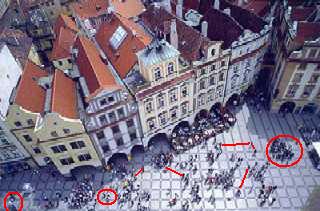
CMT: Henri Lefebvre used to say, “Urban space is defined as a place where people walk around, finding themselves standing before and inside piles of singular objects, experiencing the intertwining of the threads of activities until they become unrecognizable, entangled situations in such a way that they engender unexpected situations. The definition of this space consists of a null vector. The cancellation of distance haunts the occupants of urban space. They can’t avoid encountering each other.”

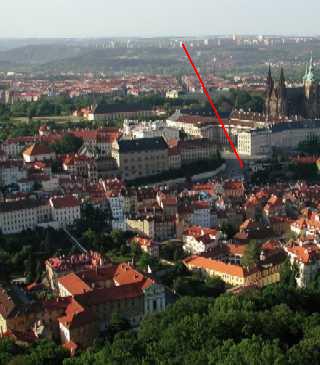
DSM: I could paraphrase Lefebvre on sub-urban space: “Suburban space is a domain where people drive around, and find themselves passing singular objects, experiencing activities that are entirely familiar and engaging in situations in such a way that they engender highly predictable situations. The definition of this space is that it has a manifold of vectors. Attenuated distances—abridged and compressed distances—haunt the occupants of suburban space. They scarcely encounter each other.”

Prague Null Vectors and Cliques
CMT: That’s another kind of city. It superficially appears to be a scattered mélange of objects and motifs. But in fact it’s exceedingly organized, textured, perfectly striated, facilitated by mechanization and commerce. If Bob wants to visit Sue, their trip and discourse will be inscribed by the reality of the surrounding infrastructure and the types of activities that it is conducive to—will be inscribed by the roadways and the means of motivic transport that have been set up. He uses a car—or he uses a violin to navigate these Janáček figures.

DSM: At its heart is something that’s thoroughly modern and western. Because I was an engineer at one time, I’m trying to come up with an equation—we overcome distance by increasing our speed, and then we feel too close so we move farther apart, more or less keeping the time between us constant. But the range of how far we can go—the area we can cover in constant time goes up as the square of our maximum speed. So if we increase our speed by a factor of two, the scope of our connectedness is greater by a factor of four...

CMT: That view is, I think, a distinctly ‘American’ or ‘North American’ sense of distance, rather than your broader ‘Western’ characterization of it. Maybe ‘Australian’ and other cultures would own up to it too, but surely not all Western countries.

DSM: Any city or suburb is, in Lefebvre’s view, an interaction of distance and vectors. On one end of the spectrum, it’s crowded and intense and null vectors of negligible length. On the other end of the spectrum, it’s ‘dross space’, pure distance with infrequent interactions, desert-like, desolate.

CMT: There are megaforms, hypermeter, weather systems that are larger than the scale of any motif of composerly devise.

DSM: And there are speed-zones where larger motifs provide strong hints to the listener, as to how to interpret the music. Like a winding parkway through a residential area, or an esplanade with retail stores separated from the main trafficway by adjacent boulevards. There are parts of Paris and Lisbon like this...

CMT: Suburbia establishes this microcosm—an abstracted caricature of who we are. It invites us to ignore or neglect some features of the people and spaces around us. It tends to produce a toxic ecology whose consequences permeate other parts of society and extend to future generations. You can’t expect free-market forces to acknowledge or correct these effects. The private sector wants to make money and imagines that the public sector is there to facilitate commerce. The public sector often feels that it doesn’t have the remit—the authority and resources—to deal with it. But now things are happening in many places—the gentrification and revitalization of older areas—these are inner frontiers. Part of what I hear in Janáček.

DSM: But the upshot of this is that we are never fully ‘ourselves’ in any one environment. Our possibilities are always modulated by our context, by the stimuli that impinge on us. And we ourselves are like prisms. If we don’t seek out different stimuli, different contexts, different illumination—then we’ll have traversed in our lives only a narrow bit of the range, of the totality of who we are.

CMT: Townhouses and gated communities. Memorials to isolation and individualism. Janáček was taking some of those fences and gates down. Janáček explores the familiar and eternal cycle of the seasons in his fantasy, The Cunning Little Vixen—but in all his works the principal element is a positive outlook on humankind and its grip on life.

DSM: Leoš Janáček—his opera, Jenůfa, was performed in Brno with considerable success in 1904. But it was stone-walled until 1916 in Prague—by Kovařovic. The ultimate success it enjoyed in Prague was a tremendous creative spur to Janáček, and in the last 10 years of his life he produced many surprising and masterful pieces, including String Qt. No.1 (Kreutzer Sonata, 1923-4) and String Qt. No.2 (Intimate Letters, Listy důvěrné, 1928).

CMT: The late upsurge of Janáček’s inspiration partly derived from his (unrequited?) fascination with Kamila Stösslová. He met her in 1917, and he wrote more than 600 letters to her over the following 10 years—averaging more than one letter per week every week for 10 years. Amazing! Appalling!

DSM: Yes. And Janáček’s later works typically involve short bursts of melody—rhythmical, provocative and obviously expecting a response, as though they were vocal exclamations, possibly addressed to Kamila. No, I think we could say these are surely epistolary works—musical correspondence—standing in for more direct dialogue, abridging a socially-imposed distance, the distance that existed because Kamila was married to someone else. Janáček collected in sketch-books phrases he overheard in urban and in suburban and rural areas, and he annotated the moods in which they were spoken—these were the sources of his later compositions, and they are mentioned in his letters to Kamila. The melodic fragments exhibit sudden distance-cancelling changes of tonality and mood—and from these he constructs simple but unusual means to his music’s intended climactic ends. Elegant, persuasive.

CMT: What’s most unusual is his spacing and juxtaposition of chords. His orchestration is always striking and unusual, often harsh and raw but invariably apt. He liked to use instruments at the extremes of their range, too, drawing attention to distance and to the collapse of distance. Propinquity without community.


Prague Suburbs: Attenuated Distance