Showing posts with label space. Show all posts

Saturday, April 17, 2010

Quadrivium Novum: Unity with Autonomy

Quadrivium Novum
A    [filmic] image combined with a sound placed in a context--none of which matches expectations--creates a metaphor and invites an individual search for meaning at a physical, emotional and psychological level (in that order).”
  —  Paul Rudy, UMKC Conservatory.
T he performance last night at Unity Temple by the electroacoustic quartet Quadrivium Novum was the final event of the 2009-2010 season for the Kansas City Electronic Music & Arts Alliance, KCEMA.

Q uadrivium is comprised of Rebecca Ashe (flute), Kari Johnson (piano), Cheryl Melfi (clarinet), and Mark Stauffer (cello). [‘Quadrivium’ may not only allude to their quartetness but also to each member’s equal, autonomous role in bringing new, disruptive repertoire and techniques to the ensemble’s collaborations—much as though each member were a canonical ‘subject’ to be studied, learned, mastered?] Each of Quadrivium’s members is associated with the UMKC Conservatory’s Community Music & Dance Academy.

  • Daniel Eichenbaum: Orbit (flute, clarinet, live electronics; 20 min)
  • Jason Bolte: Scrap Metal (prepared piano solo, fixed media; 10 min)
  • Mara Gibson: E:Vespers (flute, clarinet, piano, digital audio; 8 min)
  • Andrew Seager Cole: A Slow Unraveling (flute, clarinet, cello, piano, electronics, video; 8 min)
  • William Lackey: The World Falls Asleep (cello, digital recording of cello; 10 min)
  • Christopher Biggs: Bioluminescence (flute, clarinet, piano, digital audio, video; 12 min)
E ach of the works was rewarding, and I should apologize for not commenting here on each of them. Let me at least offer a few impressions of the three pieces that were world premieres: ‘E:Vespers’, ‘Orbit’, and ‘A Slow Unraveling’.

M ara Gibson’s ‘E:Vespers’, a ‘fantasie’ or tone-poem composed on the occasion of observing an eclipse, was remarkable for the organic, natural way in which the digital audio functions as an equal to the three live performers. The partitioning of human assistants and digital tracks programs all the tasks into one application, run by a single assistant at the console workstation in the center of the performance space. This approach does not ‘reduce’ the interpretation to ‘assistant vs. trio’ duality, nor does it risk dichotomizing the technology and the performers at the front of the performance space. Rather, with the house lights dimmed, the effect is one of a thoroughly integrated ‘whole’ in which the individual parts reveal their character and ideas—beginning with the tolling of delicate, repeated notes by the piano.

T he technology actually helps to maintain the textural and timbral cohesion of the other parts (clarinet, flute, piano), whose acoustic spectra are otherwise diverse. Unlike some electroacoustic works in which the technology is intrusive or merely ornamental; unlike works where the digital tracks, having been laid down and sequenced in advance, are inflexible and impose too much determinism on the live executants. In the case of Gibson’s ‘E:Vespers’, the composer is still the creator, and the 3 performers and 1 assistant are the directors in charge of interpreting the musical elements of the work, whether they are for an acoustic instrument or combined with a computer sequencer. The performers are responsible to recreate the world the composer has envisioned: here, a contemplative, reverent, panoramic one—punctuated with worries but ultimately beneficent—captured in the twilight of the eclipse and return of the sun after 'totality'.

W    e orbit and float in our space gondola and watch the oceans and islands and green hills of the continent pass by at five miles per second. We move silently and effortlessly past the ground. I want to say ‘over the ground’ as I write this, but remember: in space, your sense of up or down is completely gone and my description must reflect this fact. In addition, the breathtaking speed of the ship is an odd and confusing contrast to the feel of perpetually floating within the spaceship. You do not sit before the window to view the passing scene, certainly not down upon it. Are you speeding past oceans and continents, or are you just hovering and watching them move beside you?”
  —  Joseph Allen, U.S. astronaut.
D aniel Eichembaum’s ‘Orbit’ is an antiphonal piece for flute, clarinet, and electronics. Rebecca Ashe and Cheryl Melfi are dressed in black, in near-total darkness, barefoot. They perform Orbit’s several movements as a duo, gliding anticlockwise between the four ‘stations’ that are set up on-stage. The stations are separated around the perimeter of a 10-meter circle whose perigee is closest to the audience and apogee farthest away.

T he ephemeral, ambient quality of electroacoustic elements is abundant, at times dominant. But it is important to note that the digital tracks are derived entirely from recordings of Rebecca’s and Cheryl’s own playing, breathing, moving—not from Eichenbaum’s digital waveform library or independent geek artistry in a vacuum. Extensive digital signal-processing (DSP) and editing have been done to produce what are now rendered by the sequencer in performance as, say, massive, rocket-like, spine-shaking ‘rumbles’ [from the multiple studio monitor speakers that are arrayed around the performance space, controlled from the assistant’s digital audio workstation console] or celestial chirps or high-energy quantum particle ‘tweets’. We had no idea of this in advance. But when Rebecca and Cheryl remarked after the performance that all of the electroacoustic effects we had just heard during this piece had begun from sounds that they themselves had made, and that Eichenbaum had recorded and processed and sequenced them as the three of them sat together at the DAW console in the studio, it was heartwarming evidence of a deeper sort of collaboration between performers and composer. Composer/DAW-artist/engineer as performer; performers as engineers/editors/co-composers. There is something profoundly ‘right’ about this.

W hat I mean is, composers, performers, computer musicians/DAW-artists have accepted, for the most part, the progressive abstractions from older analog and now-obsolete digital hardware into software modules and sequencer patches... not just ‘miniaturization’ per se but now total automation and virtuality, including software to manage the multiple applications and equipments and software to insert random aleatorics and emulate human-like variability effects. These abstractions are motivated by reliability, by productivity for the composer, by aesthetic considerations—all valid and admirable. But the abstractions have incrementally impoverished the electroacoustic performance experience, I think—compared to, say, my first experience of a Moog Synthesizer as a child of 10 at the Minneapolis Symphony (now Minnesota Orchestra) in 1963, teeming with patch-cables and wires and mad-scientist musician (I regret I cannot remember who, or which composers’ works were performed) at the keyboard, clearly *not* in complete control.

Moog synthesizer, ca. 1964

B ut in Eichenbaum’s ‘Orbit’ we have a focused assimilation of the digital and acoustic environments, in which the digital realization is a cohesive part--‘gluey’ elements that hold the entire composition together. The live performers are not ‘bystanders’. They are confronted, yes, by their own DSP-processed previously-recorded sounds. They are reacting to the aleatoric expressions of the DAW assistant who is reincarnating the sequences at one remove, so to say. And they know this, even though we in the audience did not, until the remarks following the performance.

H aving heard Rebecca’s and Cheryl’s post-performance commentary on ‘Orbit’, though, we now comprehend aspects of the performer-electronics interactions that we hadn’t grasped at first hearing: the intimacy of the part that you are now playing, live; the musical subtleties of rediscovering the state-of-mind you were in when you made the sounds that you are now hearing emanate from these electronics; the expressive stimulation of being re-reminded now, of how that sequencer patch was co-edited by you and Daniel not so long ago. This can be a truly productive process—and a provocative montage of active, creative roles and meta-roles for performers in their interpretations of electroacoustic music, as it was with the Quadrivium performance last night!

W hat else? The noise gradations range from total silence (a bus is heard faintly, passing by outside Unity Temple on 47th Street) to 100 dB butt-shaking. ‘Really Noisy’ (what Stockhausen would call ‘sehr geräuschaft’)–filtered ‘pink’ noise and rumbling ‘red’ noise, convolved with other signals on the track to the point where it pervades the space and progressively washes out and obscures Rebecca’s flute and Cheryl’s clarinet. ‘Sort of Noisy’ (‘etwas geräuschaft’) – square and sawtooth waves convolved with the rest, but with enough high-frequency spectral content to meld with and preserve the listener’s attentiveness to upper-register activity in the flute and clarinet parts... A dense polyphony, reminiscent of György Ligeti’s writing for the score of the film ‘2001: A Space Odyssey’: a choir of myriad voices; the mixing and intermingling and asynchronous entries and departures of thousands of voices; microtonal voices, sounding notes a quarter-tone higher or lower than their neighbors; cosmic cacophony tending toward pantheism.

A ndrew Seager Cole’s ‘A Slow Unraveling’ applies combinatoric permutations to tiny musical elements to generate large [fractal?] structures. The fast-tempo elements that begin the piece devolve into slower ‘child’ elements that enclose and subsume the ‘parents’ until the music completely unravels, finally coming to a rest. The music was genuinely interesting and admirably executed, regardless of its formal compositional methods and inspiration. Kari Johnson’s piano and Mark Stauffer’s cello were especially compelling, as regards imbuing the piece with vivid kinesthetic impressions of velocity and depth/space. The piece has narrative; a story unfolding among the performers. It is intimate ‘chamber music’, yes. But it is the paradoxical ‘intimacy’ of space itself, on an astronomical scale.

B ravo!


Thursday, September 25, 2008

Lisa Gerrard’s Chamber Music: Tribal World-Music, Wordless Ambient Hymns

Lisa Gerrard
W   hat the music I love expresses to me is not thought too indefinite to put into words but, on the contrary, too definite.”
  —  Felix Mendelssohn, letter to Marc-André Souchay, 15-OCT-1842.
W   hen you make strange music like we do, there aren’t many people with whom you can talk about it. When [Lisa Gerrard] says, ‘Music is sacred,’ try to explain that to a ‘normal’ human being.”
  —  Klaus Schulze, Farscape.
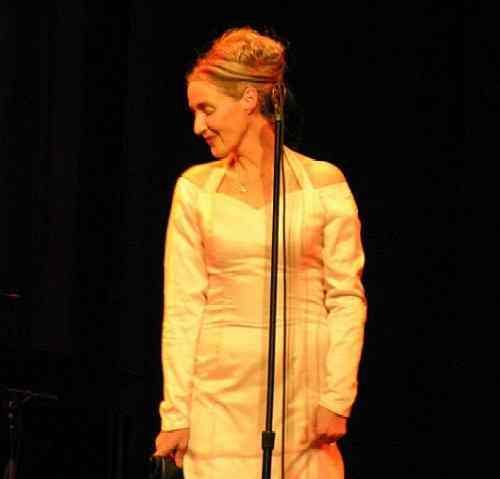
Lisa Gerrard, born in Melbourne in 1961, is a musician, singer and composer who was a co-founder of the group ‘Dead Can Dance’ with former music partner Brendan Perry. Gerrard’s versatile vocal range (contralto to mezzo-soprano) and song-writing are what she’s best known for, but she also provides instrumentals on many of her recordings, most frequently playing yangqin (Chinese hammered dulcimer). Since the break-up of ‘Dead Can Dance’ she has been doing solo work plus selective collaboration—for most of the past ten years. Gerrard received a Golden Globe award and an Academy Award nomination for the score for the 2000 film ‘Gladiator’, her collaboration with Hans Zimmer. Her soundtrack for the 2003 film ‘Whalerider’ was also widely acclaimed.

The release (about 2 months ago) of her wonderful new CD ‘FarScape’—ethereal original space-music chamber compositions, accompanied by German keyboardist Klaus Schulze—led me to recently revisit her work.

Klaus Schulze and Lisa Gerrard
But, in fact, it was a series of emails yesterday in response to the previous two CMT blog posts about watery, atmospheric character pieces—Debussy’s Arabesque No. 1 and Saint-Saëns’s, Carnival of the Animals VII, ‘Aquarium’—that caused me to key up Gerrard’s cover of the larghetto aria in Handel’s opera ‘Serse’, from Gerrard’s 1995 CD ‘The Mirror Pool’.


    [50-sec clip, Lisa Gerrard and John Bonnar, George Friderick Handel, Serse (Xerxes) HWV 40 [1738], ‘Larghetto’ aria [‘Largo’], 1.2MB MP3]

L isa has an incredible voice. She can go down so low! When I ask her ‘Where do you get this from?’ she tells me about [Tuvan throat singers]. She can sing two voices at the same time using her belly and the overtones using chest voice.”
  —  Klaus Schulze, Farscape.
Chamber works on that recording were arranged by John Bonnar and performed by members of the Victorian Philharmonic Orchestra in Melbourne.

Having now immersed myself in that disc, how could I not notice/remember ‘Sanvean’!


    [50-sec clip, Lisa Gerrard and members of Victoria Phil, Andrew Claxton, ‘Sanvean’, 1.2MB MP3]

Andrew Claxton
Sanvean’, composed in 1993 by Andrew Claxton, has been used on many film soundtracks, and between 1998 and 2003 served as theme music for the U.K. NHS MMR immunization campaign. Over the past 15 years it is increasingly frequently used for weddings, funerals and other ceremonies. Soprano Sarah Brightman recorded ‘Sanvean’ with the London Symphony Orchestra early in 2008. Have a listen to a clip from that…


    [50-sec clip, Sarah Brightman and members of LSO, Andrew Claxton, ‘Sanvean’, 1.2MB MP3]

The main point of my posting this today is to share with you my delight at ‘re-discovering’ how much I had enjoyed Lisa and her DCD and earlier solo work—in the belief that you, too, may like being reminded of Lisa Gerrard and enjoy revisiting these things as well.

But secondary reasons for posting are:
  1. to draw your attention to the new 2-disc recording of Lisa with Klaus Schulze;
  2. to provide a link (below) to Andrew Claxton and point to Brightman and others who are doing ‘covers’ of his classical vocal writing;
  3. to suggest that these miniatures might be intriguing to insert into your own ensemble’s programs, or to use as encore material;
  4. to initiate a thread on extended/exotic singing technique (including overtone-singing, wordless singing, countertenor, etc.);
  5. to remind us that authenticity is what really matters, and that the Truly Authentic is sometimes Exotic/Esoteric/Extreme; and
  6. to continue the previous CMT thread on ‘atmospheric’ chamber music, in response to those of you who emailed me about this topic.
A common piece of advice given to performers has tended to be along the lines of ‘make the piece your own.’ This is similar to the notion of Eigentlichkeit in Heidegger. To be eigentlich for Heidegger is not simply to be authentic but to ‘be yourself’. In one sense, both of these bits of advice (‘make it your own’ and ‘be yourself’) are perfectly sensible and even desirable. But one of the difficulties that performers have in approaching a piece of music that is unfamiliar is that it is difficult to ‘feel at home’ with the piece... When Heidegger says that ‘understanding is either authentic, arising out of one’s own Self as such, or inauthentic,’ it is hard to distinguish this sense of authenticity from Kant’s account of autonomy. In both cases, the Self is not merely supposed to be the principal but the sole determining factor.”
  —  Bruce Benson, Improvisation of Musical Dialogue, p. 165.
The beauty and expressiveness of Lisa Gerrard’s voice—particularly with the wordless, ambient, hymn-like pieces—are unique in the corpus of vocal chamber music. Regarding #5 above, the wordlessness defamiliarizes us and, consequently, our ordinary linguistic habits for understanding vocal music are put on holiday. The timbral changes associated with wordfulness are all there, the gestural semantic representations are there, but not the veneer of words. We perceive the meaning, but with only pre-verbal, timbral, and gestural syntax elements! We are treated to different sources of interpretation—the ordinary surface of word-processes stripped away, the once-subliminal becomes the new liminal.

Those of us who use Finale® or other programs for our composing have of course the routine experience of the sampled-waveform libraries of ‘ahhs’ and other vowels, for the instant playback of the pieces we work on. So the textures of wordless voices that regular people so seldom hear—we hear synthetic incarnations of these every day, and they ‘grow’ on us.

L isa had only two conditions: huge reverb spaces and no headphones. Now, I’m a lover of reverb, but this was almost a bit too much even for me.”
  —  Klaus Schulze, Farscape.
However, to hear live performances and recordings like Lisa’s: this is distinctly unusual. And highly authentic! Not many chamber music presenters organize programs of ‘wordless’ vocal material; not many chamber ensembles with singers offer ‘wordless’ repertoire. But there is no reason why that situation should not change. For its novelty and exoticness, it’s plausible that there would be an eager market for this...

W   e had recorded about five hours of music straight without any breaks… Lisa sang everything only once. There were only maybe two minutes that could not be used. She only said, ‘Well, at 10:22 on that one track you must cut about 30 seconds, as the intonation there was not precise.’ When Lisa works, she is completely captured in her own world.”
  —  Klaus Schulze, Farscape.
Tell you what: I will begin to assemble a list of wordless vocal music and put it up on CMT... Shostakovich’s ‘Songs on Verses by Dolmatovsky’ (for voice, wordless chorus & piano) Op. 86 comes to mind. Not instrumental ‘Lieder ohne Worte’ (Mendelssohn’s Songs without Words, [Opp. 19,30,38,53,62,67,85,102; 1830-1845]) but vocal music that is wordless. Charles Alkan, Anton Rubinstein, Ignaz Moscheles, Edvard Grieg? John Gibson’s ‘Judith and Holofernes’? Chaya Czernowin’s ‘Pnima... ins Innere’? Wolfgang Rihm’s ‘Donaueschinger Musiktage 2006 Etudes’? Other ‘New Music’ vocal compositions that are wordless lieder? Please feel free to email me or add a comment below if there are some wordless vocal chamber music pieces that you especially admire.

And we will then have more words on ‘wordless’ repertoire.

Thank you, Lisa and Klaus, for this nice new ‘FarScape’ and for your earlier atmospherics and spontaneity, which continue to please and inspire after all this time.

S pontaneity matters a lot. Many people think good music has to do with sweat and hard work, which must be continual and last for months. My opinion, however, is that if this is the case the music is [sure to be] bad.”
  —  Klaus Schulze, Farscape.


Wednesday, September 24, 2008

More Encores: Debussy’s Arabesque No. 1 in E Major

Bavouzet
Thiollier
Fiercely energised yet superfine, [Jean-Efflam Bavouzet’s] performances are not for those with comfortable ‘drawing-room’ notions of Debussy.”
  —  Gramophone Magazine, JUL-2008.
F rançois-Joel Thiollier’s soft-grained virtuosity taps into the music’s alluring sonorities and harmonic beauty, bringing out plenty of color with no more aid from the sustain pedal than necessary. As a technician, Thiollier doesn’t offer the bedrock security that typifies Pollini’s double notes, Uchida’s firmly-centered rhythms, or Gieseking’s utterly-even fingerings in ‘Pour Les Huits Doigts’. Yet while his timid chord-to-octave leaps in the daunting 12th etude slow down when the going gets tough, Thiollier compensates with as sexy and curvaceous a middle section as you’ll ever hear. He also plays the three-against-two rhythm during the opening etude’s introduction as-written, rather than slightly rushing the right-hand triplet as nearly everyone else does... Thiollier’s gentle touch and keen ear for nuance also inform the sundry short works filling out this disc.”
  —  Jed Distler, Grammophone Magazine.
I’m not quite sure why the previous CMT post elicited a flurry of responses/requests, regarding ‘atmospheric’ miniatures. Anyhow, here is another favorite of mine, a solo piano one.


    [50-sec clip, Jean-Efflam Bavouzet, Debussy, ‘Arabesque No. 1’, 0.9MB MP3]

    [60-sec clip, François-Joel Thiollier, Debussy, ‘Arabesque No. 1’, 1.2MB MP3]

François-Joel Thiollier studied in France with Robert Casadesus and faculty of the Paris Conservatoire and with Sascha Gorodnitzki at the Juilliard School of Music. He won eight Grands Prix in international piano competitions. His recordings include the complete piano music of Debussy, the complete piano music of Ravel, and works by de Falla, d’Indy, and Franck. In 2003, Thiollier was named Officier des Arts et Lettres by the French Ministry of Culture and Communication.

Jean-Efflam Bavouzet was a student of Pierre Sancan at the Paris Conservatoire, as well as Alexander Edelman and Dimitri Bashkirov. He has won Grans Prix in various international competitions, including the International Beethoven Competition in Cologne in 1986, the Honens International Piano Competition in Canada in 1992, and the Steven de Groote Chamber Music Prize at the Van Cliburn Competition. With a style that some critics have called ‘mercurial’, Bavouzet has performed with many international orchestras. In 2002 he performed with the Boston Symphony Orchestra under the direction of Ingo Metzmacher, and in 2003 he appeared with the Berliner Sinfonie Orchester. He is presently with Orchestre de Paris and Professor in the Piano Department of the Hochschule für Musik in Detmold, Germany.

Juxtaposing these two clips gives a good idea of the performance possibilities. Jean-Efflam Bavouzet’s version averages a faster tempo, but with wider variations than Thiollier’s. And the texture Bavouzet creates in this delicate piece exhibits a more ‘restrained’ pianissimo control than Thiollier’s, but Bavouzet alternates between understatement and exuberant reverie, and the sense of Bavouzet’s account is more one of solitary reminiscence—compared to Thiollier’s recording, which comes across as more ‘story-telling-to-intimate-partner’ rather than ‘solitary-meditation-to-onesself’. Your possibilities for reasonable tempi, accents, dynamics, and balances are endless—as illustrated by these two masterful examples.

The balance of the ‘3-against-2’, RH vs. LH, is risky—heck, the entire piece is so delicate that it’s quite a ‘gauntlet’ to run, aesthetically.

Enjoy!

Debussy, Arabesque No. 1 motif, ‘3-against-2’ RH-LH rhythm
I am fascinated by Debussy’s ability to use tones and sounds to paint the colours of nature and convey its moods registering all its nuances of varying light, the elusiveness and boundlessness of it all.”
  —  Marie Bengtsson.