Showing posts with label extreme. Show all posts

Thursday, September 25, 2008

Lisa Gerrard’s Chamber Music: Tribal World-Music, Wordless Ambient Hymns

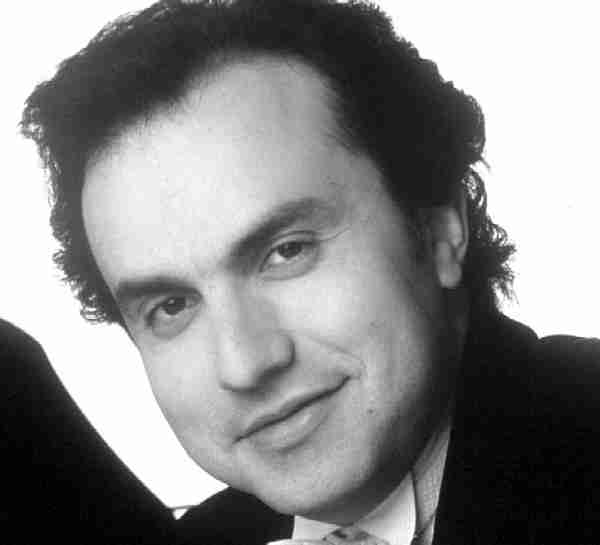
Lisa Gerrard
W   hat the music I love expresses to me is not thought too indefinite to put into words but, on the contrary, too definite.”
  —  Felix Mendelssohn, letter to Marc-André Souchay, 15-OCT-1842.
W   hen you make strange music like we do, there aren’t many people with whom you can talk about it. When [Lisa Gerrard] says, ‘Music is sacred,’ try to explain that to a ‘normal’ human being.”
  —  Klaus Schulze, Farscape.
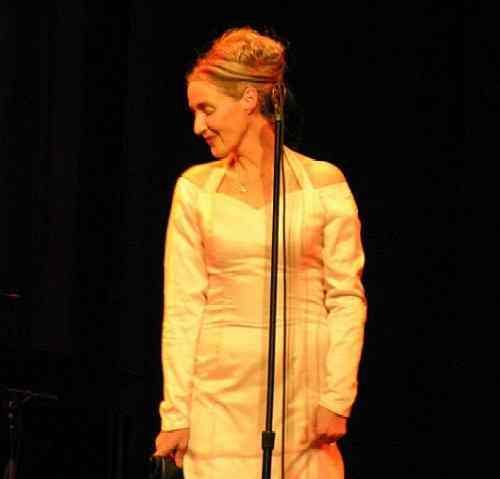
Lisa Gerrard, born in Melbourne in 1961, is a musician, singer and composer who was a co-founder of the group ‘Dead Can Dance’ with former music partner Brendan Perry. Gerrard’s versatile vocal range (contralto to mezzo-soprano) and song-writing are what she’s best known for, but she also provides instrumentals on many of her recordings, most frequently playing yangqin (Chinese hammered dulcimer). Since the break-up of ‘Dead Can Dance’ she has been doing solo work plus selective collaboration—for most of the past ten years. Gerrard received a Golden Globe award and an Academy Award nomination for the score for the 2000 film ‘Gladiator’, her collaboration with Hans Zimmer. Her soundtrack for the 2003 film ‘Whalerider’ was also widely acclaimed.

The release (about 2 months ago) of her wonderful new CD ‘FarScape’—ethereal original space-music chamber compositions, accompanied by German keyboardist Klaus Schulze—led me to recently revisit her work.

Klaus Schulze and Lisa Gerrard
But, in fact, it was a series of emails yesterday in response to the previous two CMT blog posts about watery, atmospheric character pieces—Debussy’s Arabesque No. 1 and Saint-Saëns’s, Carnival of the Animals VII, ‘Aquarium’—that caused me to key up Gerrard’s cover of the larghetto aria in Handel’s opera ‘Serse’, from Gerrard’s 1995 CD ‘The Mirror Pool’.


    [50-sec clip, Lisa Gerrard and John Bonnar, George Friderick Handel, Serse (Xerxes) HWV 40 [1738], ‘Larghetto’ aria [‘Largo’], 1.2MB MP3]

L isa has an incredible voice. She can go down so low! When I ask her ‘Where do you get this from?’ she tells me about [Tuvan throat singers]. She can sing two voices at the same time using her belly and the overtones using chest voice.”
  —  Klaus Schulze, Farscape.
Chamber works on that recording were arranged by John Bonnar and performed by members of the Victorian Philharmonic Orchestra in Melbourne.

Having now immersed myself in that disc, how could I not notice/remember ‘Sanvean’!


    [50-sec clip, Lisa Gerrard and members of Victoria Phil, Andrew Claxton, ‘Sanvean’, 1.2MB MP3]

Andrew Claxton
Sanvean’, composed in 1993 by Andrew Claxton, has been used on many film soundtracks, and between 1998 and 2003 served as theme music for the U.K. NHS MMR immunization campaign. Over the past 15 years it is increasingly frequently used for weddings, funerals and other ceremonies. Soprano Sarah Brightman recorded ‘Sanvean’ with the London Symphony Orchestra early in 2008. Have a listen to a clip from that…


    [50-sec clip, Sarah Brightman and members of LSO, Andrew Claxton, ‘Sanvean’, 1.2MB MP3]

The main point of my posting this today is to share with you my delight at ‘re-discovering’ how much I had enjoyed Lisa and her DCD and earlier solo work—in the belief that you, too, may like being reminded of Lisa Gerrard and enjoy revisiting these things as well.

But secondary reasons for posting are:
  1. to draw your attention to the new 2-disc recording of Lisa with Klaus Schulze;
  2. to provide a link (below) to Andrew Claxton and point to Brightman and others who are doing ‘covers’ of his classical vocal writing;
  3. to suggest that these miniatures might be intriguing to insert into your own ensemble’s programs, or to use as encore material;
  4. to initiate a thread on extended/exotic singing technique (including overtone-singing, wordless singing, countertenor, etc.);
  5. to remind us that authenticity is what really matters, and that the Truly Authentic is sometimes Exotic/Esoteric/Extreme; and
  6. to continue the previous CMT thread on ‘atmospheric’ chamber music, in response to those of you who emailed me about this topic.
A common piece of advice given to performers has tended to be along the lines of ‘make the piece your own.’ This is similar to the notion of Eigentlichkeit in Heidegger. To be eigentlich for Heidegger is not simply to be authentic but to ‘be yourself’. In one sense, both of these bits of advice (‘make it your own’ and ‘be yourself’) are perfectly sensible and even desirable. But one of the difficulties that performers have in approaching a piece of music that is unfamiliar is that it is difficult to ‘feel at home’ with the piece... When Heidegger says that ‘understanding is either authentic, arising out of one’s own Self as such, or inauthentic,’ it is hard to distinguish this sense of authenticity from Kant’s account of autonomy. In both cases, the Self is not merely supposed to be the principal but the sole determining factor.”
  —  Bruce Benson, Improvisation of Musical Dialogue, p. 165.
The beauty and expressiveness of Lisa Gerrard’s voice—particularly with the wordless, ambient, hymn-like pieces—are unique in the corpus of vocal chamber music. Regarding #5 above, the wordlessness defamiliarizes us and, consequently, our ordinary linguistic habits for understanding vocal music are put on holiday. The timbral changes associated with wordfulness are all there, the gestural semantic representations are there, but not the veneer of words. We perceive the meaning, but with only pre-verbal, timbral, and gestural syntax elements! We are treated to different sources of interpretation—the ordinary surface of word-processes stripped away, the once-subliminal becomes the new liminal.

Those of us who use Finale® or other programs for our composing have of course the routine experience of the sampled-waveform libraries of ‘ahhs’ and other vowels, for the instant playback of the pieces we work on. So the textures of wordless voices that regular people so seldom hear—we hear synthetic incarnations of these every day, and they ‘grow’ on us.

L isa had only two conditions: huge reverb spaces and no headphones. Now, I’m a lover of reverb, but this was almost a bit too much even for me.”
  —  Klaus Schulze, Farscape.
However, to hear live performances and recordings like Lisa’s: this is distinctly unusual. And highly authentic! Not many chamber music presenters organize programs of ‘wordless’ vocal material; not many chamber ensembles with singers offer ‘wordless’ repertoire. But there is no reason why that situation should not change. For its novelty and exoticness, it’s plausible that there would be an eager market for this...

W   e had recorded about five hours of music straight without any breaks… Lisa sang everything only once. There were only maybe two minutes that could not be used. She only said, ‘Well, at 10:22 on that one track you must cut about 30 seconds, as the intonation there was not precise.’ When Lisa works, she is completely captured in her own world.”
  —  Klaus Schulze, Farscape.
Tell you what: I will begin to assemble a list of wordless vocal music and put it up on CMT... Shostakovich’s ‘Songs on Verses by Dolmatovsky’ (for voice, wordless chorus & piano) Op. 86 comes to mind. Not instrumental ‘Lieder ohne Worte’ (Mendelssohn’s Songs without Words, [Opp. 19,30,38,53,62,67,85,102; 1830-1845]) but vocal music that is wordless. Charles Alkan, Anton Rubinstein, Ignaz Moscheles, Edvard Grieg? John Gibson’s ‘Judith and Holofernes’? Chaya Czernowin’s ‘Pnima... ins Innere’? Wolfgang Rihm’s ‘Donaueschinger Musiktage 2006 Etudes’? Other ‘New Music’ vocal compositions that are wordless lieder? Please feel free to email me or add a comment below if there are some wordless vocal chamber music pieces that you especially admire.

And we will then have more words on ‘wordless’ repertoire.

Thank you, Lisa and Klaus, for this nice new ‘FarScape’ and for your earlier atmospherics and spontaneity, which continue to please and inspire after all this time.

S pontaneity matters a lot. Many people think good music has to do with sweat and hard work, which must be continual and last for months. My opinion, however, is that if this is the case the music is [sure to be] bad.”
  —  Klaus Schulze, Farscape.


Saturday, July 12, 2008

The Air from Other Planets: How Much Is Too Much?

 Eye
P  enderecki, that reliable old post-Schoenberg standby, evoking buzzing bees in the basement. I did not really like these pieces, but I would put them on every few months to see if the bizarre might one day morph into the familiar. I’ve been doing that for forty years now, and the compositions continue to sound harsh, unpleasant, gloomy, post-nuclear. It is not the composers’ fault that they wrote uncompromising music that was a direct response to the violence and stupidity of the 20th Century. But it is not my fault that I would rather listen to Bach. That is my way of responding to violence and stupidity.”
  —  Joe Queenan, ‘Admit It! You’re As Bored As I Am’, The Guardian, 09-JUL-2008, Arts, p. 24.
The afternoon and evening programming at the recent West Cork Chamber Music Festival in Bantry, Ireland, was initially a delight. I crave new music—even pieces that are hard to warm up to, hard to comprehend—and the program for this Festival was notable for the sheer number of recent compositions on the docket.

 Screen Test: Minions (Photo: Linus Gelber, 2008)
But 5 consecutive days into the Festival, I had reached the point of saturation. All of the inharmonic sawings and screechings from countless viols; all of the gnashings that can be elicited by knocking the bow against the bodies or tailpieces of violins; all of the scrapings of piano strings with coins and other hardware and bangings of keyboards with fists; all of the noteless, tempoless, ad hoc, arbitrary scratchings of nebulous pitch-envelope “suggestions” on the music staves—all of these eventually became too much for me.

 Chamber music al fresco, somewhere in Northern Italy
I am pretty sure I was not alone. The majority of the audiences at Bantry were conservative, middle-aged people, hoping and praying for some Baroque or Classical relief. Some people annoyedly folded and refolded their programs; others stared listlessly at their shoes through entire pieces. The performance of Schoenberg’s ‘Pierrot Lunaire’ which ran 35 minutes past the scheduled time was something of a ‘last straw’ in terms of trying the audience’s (and other ensembles’) patience.

While I very much admire Francis Humphry’s bravery and enthusiasm (and while I will gladly return to the West Cork Chamber Music Festival in future years), I do hope that future years’ Bantry programming will be devised so as to have more genre variation within-program, so as not to exceed so many audience-members’ appetites for new music.

With his setting of Stefan George’s poem “Ich fühle Luft von anderem Planeten” (‘I feel the air of another planet’) in the Second String Quartet, Op. 10 (1908), Arnold Schoenberg launched us into space, into new acoustical, mostly-musical realms. We continue on extra-terrestrial musical journeys because we want to, even to this day.

But the fact is, the amount of publicly offered music often has little relation to the quality of that music, let alone to the quality of the context in which it is presented. The quality of the context—and by this, I mean programming—is a crucial factor in the reception of any kind of repertoire. Programming (Irish: eagraithe) is a form of composing. The word ‘compose’ literally means ‘to put together’. I suggest that good programming consummates the composing process by arranging the elements so that they reinforce instead of oppose or beleaguer each other, preferably reinforcing in a way that’s conducive to reassessing and calibrating and illuminating—for us listeners, and for the performers. That way, each new piece is given a fair chance at a favorable reception. Ideally, a programmer/presenter is open to anything that leads to intriguing combinations. Ideally, a programmer/presenter aims to present the listener with ‘Happy New Ears!’, as John Cage calls them.

Healthy ‘fish’ (audience members; musicians) swim against the stream, but not obsessively or to the point of starvation. Healthy presenters do not program streams (Irish: an liosta casaidh) that torrentially roar down miles and miles of steep mountain slopes, in which even hardy fish cannot thrive.

 Ashby book


Saturday, December 8, 2007

Bronfman: Is Virtuosity ‘Necessary’? Is Sublimity ‘Measurable’?

Yefim Bronfman
I t is not true that the entire evening will be as hard as you say. There is one easy part in tonight’s program. I think you call it the interval, the intermission?”
  — Yefim Bronfman, jesting repartee with audience, in reply to Cynthia Siebert’s words introducing him, 07-DEC-2007, Kansas City.
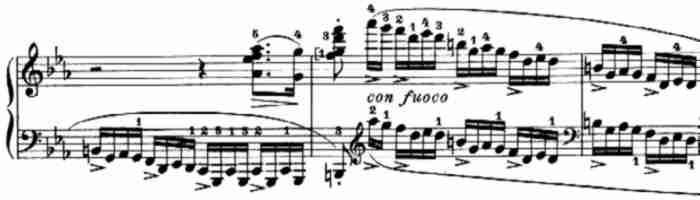
There are many instances of virtuosic writing in these pieces and, with Yefim Bronfman, many instances of virtuosic playing. The profusion of dazzle makes apprehending the pieces even harder—we find ourselves wanting to press a ‘◄’ button and hear each passage again. Even the asynchrony in the second movement of the Beethoven Sonata No. 13 (Op. 27, No. 1) is texturally and rhythmically complex—it resists decomposition or deconstruction. But Bronfman’s account of Balakirev’s ‘Islamei’ may be the first time when I had to set aside the whole process of comprending the music, step back from it, throw up my hands and just marvel: How did he do that? ... Intricate sets of nonlinear relationships such that only certain aspects of them can be grasped at a time, to use Paul Cilliers’ phrase, defining complexity.

Look below — think of all the cognition and neurophysiology needed to absorb all that’s happening even in this short little introductory bit: the rhythmic and contrapuntal complexity, and how these link up so seamlessly with what has come before and what is yet to come, not only within these 6 bars but within the next 29 pages. I’m impatient, not a fan of protracted development. Very few composers can pull long thematic developments off gracefully and, even when they do, the listener thinks, ‘Okay, that was impressive, but — was it necessary?’ But with Yefim Bronfman the virtuosic passages not only ‘work’ — we glimpse how the passages are necessary to the expressive goals of the piece. We suspend our disbelief and immerse ourselves in the thing, and we take it to heart and rapidly accept the composer’s/Bronfman’s goals as our own.

I should like now to play something easy: Chopin… Now, Prokofiev, something that is, finally, easy… The Schumann Romance and Intermezzo: at last, easy!”
  — Yefim Bronfman, remarks to audience, winking puckishly, prior to performing encores #1, #2, and #3 [Chopin Etude Op. 10 No. 12; Prokofiev, Finale from Sonata No. 7 Op. 83; and Schumann Op. 26, respectively], 07-DEC-2007, Kansas City.
Balakirev, Islamei, mm. 9 - 14
How, then, would we measure virtuosity? Could musical virtuosity be quantified? I think the answer is ‘yes’. A good ‘virtuosity metric’ would not only be longitudinal—a velocity correlate of the number of notes per unit time. Velocity or longitudinal complexity is not enough to capture what we routinely mean by the word ‘virtuosic’.

Virtuosity is also related to the degree of rhythmic irregularity and vertical harmonic complexity and pitch span, the slew rate (how fast the span is traversed, in individual jumps; how long is the cumulative duration that such rapid jumps, hand-crossings, etc., are sustained), the jump rate (how many jumps per minute), the degree of multi-processing and rendezvousing between the parallel processes (in the right and left hands of the pianist, in regard to Bronfman’s playing), and the precision required in all of these moves. This last part—the precision—is important. It’s closely related to ‘system identification’: our intuitive ‘Can you detect a mistake or not?’ criterion.

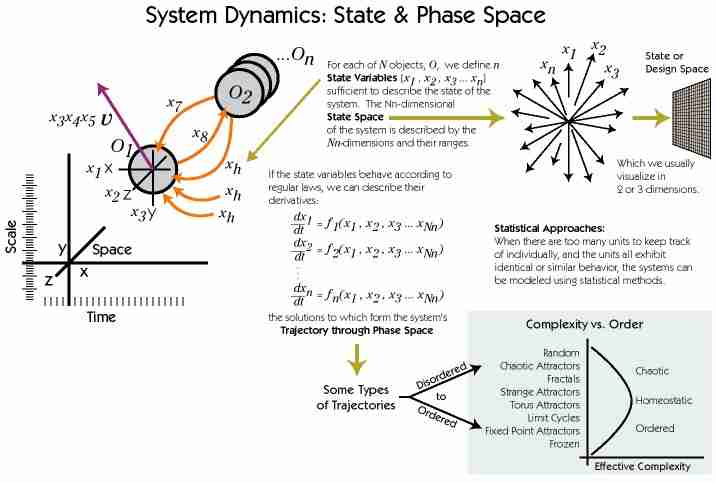
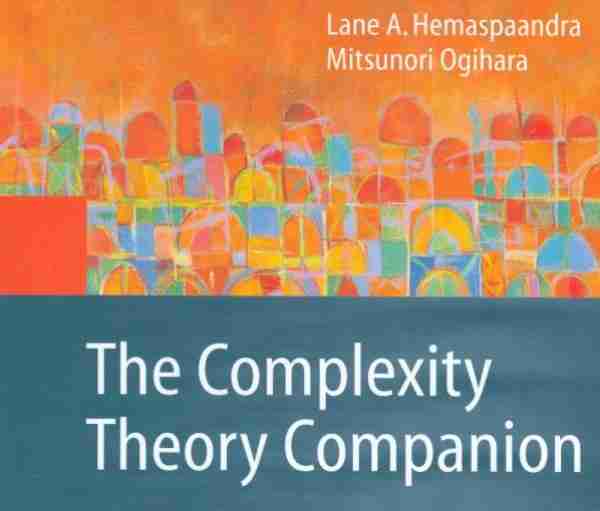
In regard to these factors, I think ‘processual’ musical virtuosity (or a virtuosic composition) would be measured like complexity in nature is measured—and how it is mathematically measured in computer science: pi algebras, minimum description length, Hausdorff fractal measure, and Kolmogorov complexity measure. So far, only a few have looked at applying Kolmogorov complexity to music (Paul Vitányi; Ming Li; handful of others), but I think it will be a fruitful avenue to pursue further ...

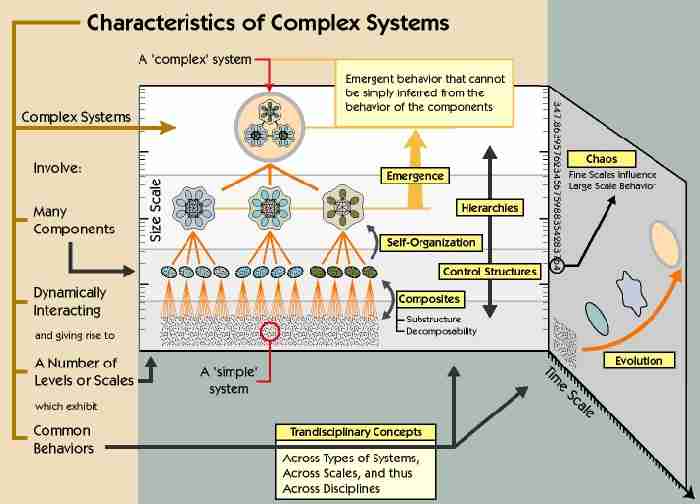
A  complex system is one that is thermodynamically open (participates in a matter and energy budget and exchange) and operates away from equilibrium. A complex system is one whose history matters; whose present and future behavior are, in part, determined by its past.”
  —  J. Ricard, Complexity and Dynamics of Life Processes.
C omplexity results from the interaction between the components of a system, and therefore complexity is manifested at the level of the system itself.”
  —  Gregoire Nicolis & Ilya Prigogine, Exploring Complexity.
A  complex system is one in which there are far more possibilities than can be actualized.”
  —  Niklas Luhmann, Sociological Theory of Law.

It’s also related to philosophy-of-mind and artificial intelligence and Turing Machines and Searle’s Chinese Box: can a listener tell whether the performer hidden inside the machine/box is human or not? If the sounds emitted are implausibly complex in terms of their cognitive and motor nervous system implications and the composition is syntactically well-formed and precisely ordered, then we ordinarily deduce that the box may contain either a very good synthesizer and a very good software-driven sequencer attempting to deceive us to believing it is a live human, or it may contain a new super-human being whose virtuosic skill is simply beyond anything that we’ve ever before encountered or imagined. (I close my eyes and listen to Bronfman... My conclusion, especially in view of his casualness and humor, is that he must be super-human.)

(On the other hand, if a composition is implausibly complex but doesn’t consist of syntactically ‘well-formed’ expressions——is instead comprised of random sounds whose structure strikes us as arbitrary, chaotic, and imprecise, as, say, in a piece by the late Karlheinz Stockhausen——then we can’t make any such deduction.)

Schumann, Faschingsschwank, Intermezzo, mm. 1-2
In the case of a human performer—Yefim Bronfman, last night—whose sounds, virtuosic in their precision and in their emotional aptness, were beyond our imagining, we experience a sublime sense of wonder: sheer wonderment at possibilities not thought to be humanly achievable. Virtuosity like this is empowering of all humankind. It doesn’t only redound upon the individual virtuoso. And that is really why we find it sublime. Our witnessing such virtuosity can be transcendent, in much the way that gazing through a large telescope on a clear cold night can be so … gazing abjectly into the chasm of possibility.

What I mean to say is that virtuosity and unearthly complexity are psychologically connected with the innate human drive for awe and spirituality. Tonight, Bronfman’s cosmic playing forced me to confront this fact.

Yefim Bronfman
K olmogorov complexity is a notion of randomness dealing with the quantity of information in individual objects; that is, pointwise randomness rather than average randomness as produced by a random source. Known as ‘descriptional complexity’, ‘shortest program length’, ‘algorithmic entropy’, and others. Martin-Loef tests for randomness and Gödel’s incompleteness are related to this.”
  —  Ming Li & Paul Vitanyi, Introduction to Kolmogorov Complexity and Its Applications.


T raditional wisdom has it that the better a theory compresses evidence, the better the theory predicts unknown data. With the advent of Kolmogorov complexity this was rigorously proved in a general setting. Making these ideas rigorous involves the length of the shortest effective description of an individual object: its Kolmogorov complexity. Ray Solomonoff invented the notion of universal prediction using Kolmogorov complexity-based universal distribution. Universal prediction is related to optimal effective compression.”
  —  Jorg Rothe, Complexity Theory and Cryptology.

D   efine it by example—societies, governments, corporations, the stock market, families, the body, an organ system, memory, a cell, an organelle, the weather, ecosystems, flow in a river, the snap of a whip: these are undeniably complex. Chief properties of such systems include: components, modularity, spatial dispersion, interactions among components across space and time, self-organization, multiple relevant spatial and time scales of formation and operation, diversity, instability, nonlinearity, variability, functional activities and the existence of objectives. The latter properties confer autonomy, anticipativeness, and adaptiveness. In other words, complexity admits of degrees and types.”
  —  Yaneer Bar-Yam. Dynamics of Complex Systems.
S ome systems have a very large number of components but can be analyzed in the full sense of the word. Such systems are merely complicated. Other systems are constituted by intricate sets of nonlinear relationships such that only certain aspects of them can be analyzed at a time. Such systems are properly termed complex.”
  —  Paul Cilliers, Complexity and Postmodernism.
D   istinction between simple and complex is a function of our distance from the system.”
  —  Roberto Serra & Gianni Zanarini, Complex Systems and Cognitive Processes.
P eople stare contemplating the ocean as it swells and crashes on a rocky shore. They gaze fixedly into a fire until the sting of smoke raises their awareness. People lie on their backs and follow passing clouds or marvel at the glittering of the stars. There are many things that fascinate us, that mesmerize us, that cause us to forget ourselves and our situations as we become lost in a timeless appreciation. ...Kant introduces the dynamically sublime as relating to encounters with the ferocity of nature and the sense of vulnerability this entails, coupled with the triumph of reason over fear. And in his own writings on the sublime, Edmund Burke takes the view that the sensation of incomprehensibility, the fear of hopelessness, coupled with the knowledge that one is able to reason about something beyond one’s senses... causes a kind of delight through internal conflict: a sublime experience.”
  —  Alan Dorin, Wonder and The Sublime in Art and Nature, in Adamatzky & Komosinski, Artificial Life in Software.


Chopin, Etude No. 12 Op. 10, mm. 3 – 4