Showing posts with label ireland. Show all posts

Saturday, July 12, 2008

The Air from Other Planets: How Much Is Too Much?

 Eye
P  enderecki, that reliable old post-Schoenberg standby, evoking buzzing bees in the basement. I did not really like these pieces, but I would put them on every few months to see if the bizarre might one day morph into the familiar. I’ve been doing that for forty years now, and the compositions continue to sound harsh, unpleasant, gloomy, post-nuclear. It is not the composers’ fault that they wrote uncompromising music that was a direct response to the violence and stupidity of the 20th Century. But it is not my fault that I would rather listen to Bach. That is my way of responding to violence and stupidity.”
  —  Joe Queenan, ‘Admit It! You’re As Bored As I Am’, The Guardian, 09-JUL-2008, Arts, p. 24.
The afternoon and evening programming at the recent West Cork Chamber Music Festival in Bantry, Ireland, was initially a delight. I crave new music—even pieces that are hard to warm up to, hard to comprehend—and the program for this Festival was notable for the sheer number of recent compositions on the docket.

 Screen Test: Minions (Photo: Linus Gelber, 2008)
But 5 consecutive days into the Festival, I had reached the point of saturation. All of the inharmonic sawings and screechings from countless viols; all of the gnashings that can be elicited by knocking the bow against the bodies or tailpieces of violins; all of the scrapings of piano strings with coins and other hardware and bangings of keyboards with fists; all of the noteless, tempoless, ad hoc, arbitrary scratchings of nebulous pitch-envelope “suggestions” on the music staves—all of these eventually became too much for me.

 Chamber music al fresco, somewhere in Northern Italy
I am pretty sure I was not alone. The majority of the audiences at Bantry were conservative, middle-aged people, hoping and praying for some Baroque or Classical relief. Some people annoyedly folded and refolded their programs; others stared listlessly at their shoes through entire pieces. The performance of Schoenberg’s ‘Pierrot Lunaire’ which ran 35 minutes past the scheduled time was something of a ‘last straw’ in terms of trying the audience’s (and other ensembles’) patience.

While I very much admire Francis Humphry’s bravery and enthusiasm (and while I will gladly return to the West Cork Chamber Music Festival in future years), I do hope that future years’ Bantry programming will be devised so as to have more genre variation within-program, so as not to exceed so many audience-members’ appetites for new music.

With his setting of Stefan George’s poem “Ich fühle Luft von anderem Planeten” (‘I feel the air of another planet’) in the Second String Quartet, Op. 10 (1908), Arnold Schoenberg launched us into space, into new acoustical, mostly-musical realms. We continue on extra-terrestrial musical journeys because we want to, even to this day.

But the fact is, the amount of publicly offered music often has little relation to the quality of that music, let alone to the quality of the context in which it is presented. The quality of the context—and by this, I mean programming—is a crucial factor in the reception of any kind of repertoire. Programming (Irish: eagraithe) is a form of composing. The word ‘compose’ literally means ‘to put together’. I suggest that good programming consummates the composing process by arranging the elements so that they reinforce instead of oppose or beleaguer each other, preferably reinforcing in a way that’s conducive to reassessing and calibrating and illuminating—for us listeners, and for the performers. That way, each new piece is given a fair chance at a favorable reception. Ideally, a programmer/presenter is open to anything that leads to intriguing combinations. Ideally, a programmer/presenter aims to present the listener with ‘Happy New Ears!’, as John Cage calls them.

Healthy ‘fish’ (audience members; musicians) swim against the stream, but not obsessively or to the point of starvation. Healthy presenters do not program streams (Irish: an liosta casaidh) that torrentially roar down miles and miles of steep mountain slopes, in which even hardy fish cannot thrive.

 Ashby book


Thursday, July 3, 2008

Patricia Kopatchinskaja & Friends: Tigran Mansurian’s Four Serious Songs

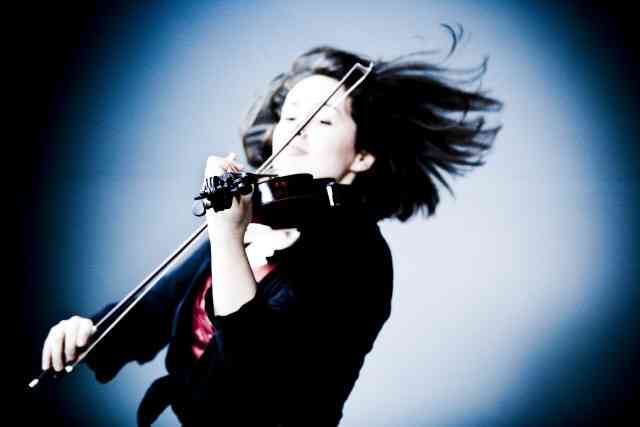
 Patricia Kopatchinskaja, performing barefoot at St. Brendan’s
F  or that which befalleth the sons of men befalleth beasts also.
Even one thing befalleth them all;
The one dieth, so dieth the other,
Yea, they have all one breath so that a man has no preeminence above a beast,
For all is vanity.
All go unto one place;
All are of the dust,
And all return to dust again.”
  —  Ecclesiastes 3:19-22.
Last night violinist Patricia Kopatchinskaja gave a brilliant Irish premier performance of the 2006 concerto by composer Tigran Mansurian entitled ‘Four Serious Songs’.

    Four Serious Songs (vioin concerto, after Brahms, Vier ernste Gesänge, Op. 121)
  • For that which befalleth (Eccl. 3:19-22), 6-min
  • So I returned and considered all the oppressions (Eccl. 4:1-3), 7-min
  • O Death, how bitter is the remembrance of thee to a man that lives in his possessions (Eccl. 41:1-2), 2-min
  • I am become as sounding brass or a tinkling cymbal (1 Cor 13:1-3,12-13), 5-min
This concerto is way beyond ‘serious’: it is full-blown tragedy. The first movement is haunted with foreboding: ominous half-note chromatics in the double-bass and eery glisses in the other strings. The second movement is hemmed-in, expectant of the unrelenting oppressions that the Ecclesiastes text suggests. The third movement is genuinely bitter, more or less renouncing the rest of humanity in its addiction to materialistic pursuits; defiant strings give an angry-despondent recitative.

Finally, the concluding fourth movement: in the beginning, it is ethereal, vaporescent. Violins and violas in ultra-high registers; close encounters at the upper extremities of their fingerboards. The cellos hold forth with whisperings that emulate a cold wind, utterly heartless—strings damped by the fingers so as to produce a pitchless sound, gray noise of the bow drawn lightly, on-edge against the string. Law of the Universe, the die has been cast; things in motion tend to stay (heartlessly) in motion; no reprieves. A more desolate, time-beyond-humankind effect would be hard to imagine.

Then the strings, together as a choir, respond in a subdued major key. Maybe there is hope after all, for humans and for other species as well…

But, no, it’s not to be. The major-key chordal writing gives way to impassioned, violent atonal passages and a resolution in a dour, uncertain minor. Agonal gasps; the length of the bow is consumed, millisecond by millisecond: kinesthetically an analogue of lung capacity, the bow with its limits to inspiration (up-bow) and expiration (down-bow). Struggling for breath, exhausting what little is left of the length of your bow-stroke. All species may go down together, but that does not mean that no one is guilty, that no one is to blame for this destruction. We humans are irredeemably at fault: thus spake the prophet Mansurian.

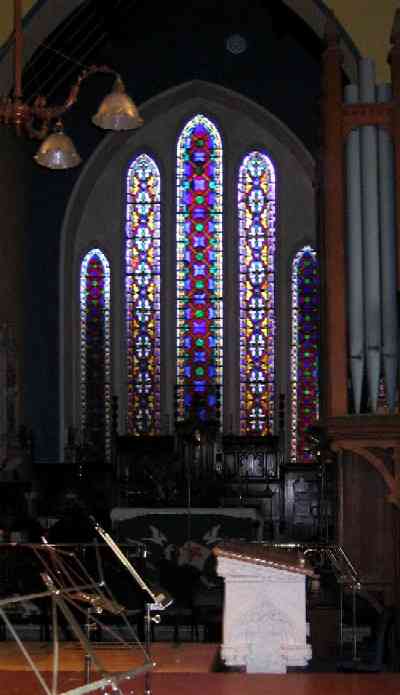
 St. Brendan’s, Bantry, Co. Cork, Ireland
Kopatchinskaja’s treatment was superb. The bare feet under Patricia’s red gown were a bit unconventional, although I can readily understand how the sensation of the cold floor under the soles and toes may be crucial to informing her interpretation. If one wants to be forcibly grounded in the decumbent, ascetic, prostratory mood of this apocalyptic ecopolitical Mansurian piece, then one should play one’s violin barefoot on a cold floor in an old, cold church!

 St. Brendan the Navigator
Kopatchinskaja has recently served as guest director and soloist with the Australian Chamber Orchestra. She was born in Moldova.

 Tigran Mansurian
Born in Beirut in 1938, in 1947 Mansurian’s family moved to Armenia. Mansurian took his PhD at the Yerevan State Musical Conservatory where he later taught contemporary music analysis. Now prominent among Armenian composers, Mansurian’s output includes orchestral works, seven concerti for strings and orchestra, sonatas for cello and piano, three string quartets, madrigals, chamber music and works for solo instruments.

 Patricia Kopatchinskaja
  • Violins: Katherine Hunka, Karl Sweeney, Róisin Walters, Ionana Petcu-Colan, Maria Ryan, David O Leary, Siún Milne
  • Violas: Joachim Roewer, Ruth Gibson, Lucy Nolan
  • Cellos: Eoin Quinlan, Peggy Nolan
  • Double-bass: Malachy Robinson

 Durrus, County Cork


Sunday, March 16, 2008

St. Patrick’s Mass Away from Home: Eric Sweeney, Minimalism, and Migrancy

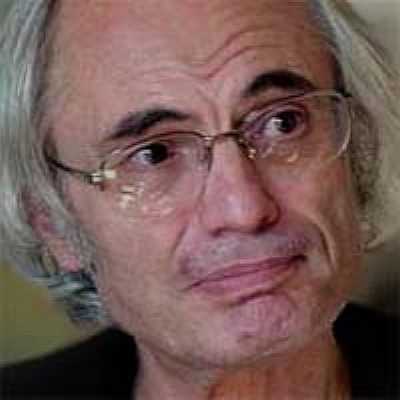
 Eric Sweeney, photo ©  CMC 2001, Eugene Langan
I  like the percussive nature of keyboards. A lot of the techniques I use are contrapuntal: the idea of phasing different rhythms against one another ... that’s what attracted me to some of the minimalist techniques—which of course are derived from eastern music, which is about as far away as you can get from Darmstadt. More recently, I’ve written a lot of organ music. I’ve written a lot of orchestral music as well, but I think a lot of composers find writing for orchestra fairly frustrating, in that orchestras are geared towards playing the standard repertoire. As a performer, I like to live with a work, let it sink in, and maybe in a month or six months time get round to performing it. Obviously, orchestras can’t work like that. But I don't think it does much for contemporary music when you’re sitting on the edge of your chair wondering, ‘Are they going to be able to play the notes?’ ”
  —  Eric Sweeney, interview with Jonathan Grimes, Contemporary Music Centre Ireland, 22-JUN-2004.
T  he term minimalism, as John McLachlan correctly points out, has become outmoded as a means of stylistic definition&$151;and if we think of composers as diverse as John Adams, Arvo Pärt, Michael Nyman and John Tavener it is difficult to see what, if any, shared language their music illustrates... Interestingly, minimalist music is far from easy to write, and eager composers with their fingers poised on the Copy/Paste commands of Finale or Sibelius will find it is a technique that makes surprising demands. Yes, of course it’s easy to produce limitless streams of musical sounds at the touch of a button, but, to make musical sense, to create pieces which are well structured, to engage and to sustain the listener’s interest—is as difficult, if not more difficult, than ever. Minimalism is no easy cop-out: it demands a rigorous command of the composer’s self-limited material as well as a radically different approach from the listener, who must be prepared to delve below the surface of ‘seemingly similar’ patterns of sound to find out what really is going on. The importance of minimalism is that it has radically altered the way we create, assess, and listen to music—as well as the fact that it has pointed to a new, liberating way forward for so many composers who had found themselves in a creative cul-de-sac.”
  —  Eric Sweeney, letter, JMI, October 2007.
Eric Sweeney’s Mass of St. Patrick, performed on 16-MAR, at Christ Church Cathedral in Waterford is an excellent illustration of new music in the context of old. Sweeney’s Mass of St Patrick is a ‘minimalist’ SATB setting of the Mass with organ accompaniment, commissioned by the Friends of Saint Patrick’s Cathedral in Dublin in 2006.

In fact, there’s an inherent attraction to automatic compositional techniques and using structuring to constrain the range of possible choices for setting sacred texts like the Mass: cantus firmus melodies based on vowels in the text, transcendence beyond the literal text. Of course, all formal systems, whether they’re procedural or structural, are ways of externalizing some of the decision-making processes. The compositional forms—canon, fugue, rondo, sonata, cantata, etc.—are a framework for automating some decisions. They’re all generative forms. Sweeney’s choral writing here contains particularly beautiful ‘seeming similarities’.

But it’s clear that the Mass is also a vehicle for Sweeney’s personal world-view: the contemporary evolution of percussive cross-cultural dialogue in an Ireland that is engaged in the trans-national public sphere; the magisterial qualities in the organ part; a vision of a distinctly Irish utopia. In Sweeney’s erudite treatment, the traditional Roman Catholic liturgy harmonizes with new humanistic universalism; contingencies of dialogue, translation, and travel all participate in the construction of Irish national identity. The effect is reminiscent of Edward Said’s notion of the contrapuntal—‘contrapuntal reading’, ‘contrapuntal awareness’, the ‘contrapuntal exile’. (Sweeney himself has spent considerable time abroad: in North America he served variously as composer-in-residence at The Newport Festival, Rhode Island; at Memorial University in St John’s, Newfoundland; at the University of Illinois; at Indiana State University in Terre Haute; and at the University of Portland, Oregon. Hardly ‘exiles’, these experiences. But they were valuable nonetheless in informing his sense of difference and alterity.) Now well-ensconced in Waterford, Sweeney and his minimalistic tendencies as a composer are fully ‘at-home’ in setting the Mass.

For those of us experiencing Sweeney’s compositions while far from our own homes, the effect is vivid, animating, heart-warming. The effect is one of austerity and migrancy, unexpectedly abated. Home, away from home.

[Eric is organist and choirmaster of Christ Church Cathedral in Waterford. A native Dubliner, Sweeney has made Waterford his home since 1981. He is chairman of the Music Department at Waterford Institute of Technology. Previously he was a member of the faculty of Dublin Institute of Technology and Trinity College. Before that, he was Choral Director at RTE from 1978-1981. Eric is a member of Aosdána, the academy of creative artists in Ireland.]

C omparison of chant texts with the original scriptural texts shows that in a great number of cases—as much as half of the chants of the Mass Proper—the original is altered in order to provide a suitable chant text. This is the phenomenon of ‘textual adjustment’. The discrepancies are not just a matter of conflicting versions of the biblical text but are clearly deliberate adaptations on the part of those fashioning the chant texts. The changes range from some that transform an entire text, to others involving a single word or two. The most frequently encountered major change is the omission of a segment of the original.”
  —  James McKinnon, The Advent Project: 7th-Century Creation of the Roman Mass Proper, p. 103.


Friday, March 14, 2008

Horn Trio: Ian Dakin and Brahms’s Fractured Family, Fractured Idea of Requiem

 Johannes Brahms, Christiane’s son
H  orn: the perfect emblem of distance and disembodiment.”
  —  John Daverio.
Ian Dakin (French horn), Elaine Clark (violin), and David Clark (piano) will perform horn trios by Brahms and Wood on Sunday, 30-MAR, at 12:00 noon at Hugh Lane Gallery in Dublin. The Brahms Horn Trio in particular merits more frequent performance than it receives. And it merits more analysis too, I think, along the lines Daverio pursues in his recent book.

Brahms’s Horn Trio Op. 40 in E-flat major (1865) was composed in memory of Brahms’ mother. She had been an older mom: at her death following a stroke in January, he was 32; she was 76.

As a child, Johannes had spent lots of time with his mother. Too much probably, to the exclusion of his developing other social skills and relationships. The maternal bond was maybe excessive: Christiane obsessed over him, broke into tears when reading newspaper accounts of his successes, and eventually despaired of the idiosyncrasies of her husband, Jakob, 17 years her junior. Jakob and Christiane separated in mid-1864, and Johannes got his father to move in with him. Try as he might, Johannes was unable to patch up his parents’ relationship. Christiane died 18 months later.

Brahms wrote the Trio for natural horn rather than valve horn despite the fact that the modern valve horn was already common. The natural horn has a frailer personality more given to intimating mourning: it lends a darker timbre than could reasonably be achieved with a valve horn. Of course! Natural horn: perfect choice!

But timbre was not the only reason. As a child Brahms had learned natural horn from his father. In view of the associations of the horn with his early life, Brahms’s choice of this instrumentation for the Horn Trio is symbolic as an autobiographical elegy for a mother by her son. It is also uniquely evocative in view of what is known of their relationship—and the disparity between their temperaments (her kindness, admixed with Lutheran piety, simplicity and logorhea; his sensitivity, admixed with a bit too much intellect and reticence; his father’s impulsiveness and incontinence, running roughshod over everything and everyone).

The work’s four movements:
  • Andante
  • Scherzo (Allegro)
  • Adagio mesto
  • Allegro con brio
carry the constitutional earnestness and cheerfulness of the tonic E-flat. But Brahms dispenses with sonata form and substitutes rhapsodic essay sections. Brahms also uses Early Baroque ‘church’ [chiesa] sonata form with the movements sequenced slow-fast-slow-fast. To me, this alternation has a gestural automaticity or reflexive ‘masking’ quality, like the ‘going-through-the-motions’ dynamic of one who has lost a loved one and is distracted by interior thoughts about that person and who manages to get through the passing days by putting on a stoic ‘front’ and going about the daily routine, no matter how incongruous the somber thoughts and the cheerful tempo might be.

 John Daverio, Crossing Paths
Or maybe the interpolation of the disparate tempi is an ‘unpacking’ of Brahms’s pent-up feelings about the disparities between himself and Christiane—her cloying, kind-but-obsessive ways; her focus on superficialities and her inability to comprehend what really made him ‘tick’—disparities that were now things of the past, to be sorted and registered as part of his life’s experience and to be honored in memory.

The Scherzo is contemplative but still cheerful, in the way that E-flat characteristically is. Do we hear Kübler-Ross’s stages of mourning embodied in these four movements? Only as refracted by family dynamics!

The playfulness of the Scherzo tempo is maybe the most schizoid, mendacious, dissembling part of this Trio. Or, no, it’s the Adagio mesto, which opens with four measures of solo piano in the low register. Solemn, yes, as the violin and horn guilefully confirm. The Adagio: impassioned and genuine, but as if at arms’ length—as if Brahms is idealizing or mythologizing something that was never quite so, not really; brooding: as if he is still resisting the mother’s overt efforts to control his identity, to say through her praise and fawning what he was and what he was not. The Finale, incarnate in E-flat major, again up-tempo. Strange for a Requiem! The Finale—exuberant, joyful E-flat—gives us acceptance, the End of Mourning? Or is it instead the end of a life of masked conflict between pious mother and diverging son: an inescapable incompatibility of temperaments chronically collided under the compulsion of 19th-Century familial sense of duty, now finally over?

Fascinating drama. We look forward to Ian Dakin’s and the Clarks’ account of this beautiful, mysterious Trio-Riddle later this month.

[FYI, Kourakata and colleagues at Niigata University published an interesting paper in 2001 about dynamic perioral muscle biomechanics in French horn players. The lip valve function was studied by measuring contact pressure at the teeth-buccal interface during playing. Elite players used the depressor angulioris and levator angulioris muscles extensively, especially for high notes. The contraction of these muscles achieves smaller lip aperture, facilitating accuracy in high-register passages and enabling greater endurance control during long performances.]