Showing posts with label liturgy. Show all posts

Sunday, March 16, 2008

St. Patrick’s Mass Away from Home: Eric Sweeney, Minimalism, and Migrancy

 Eric Sweeney, photo ©  CMC 2001, Eugene Langan
I  like the percussive nature of keyboards. A lot of the techniques I use are contrapuntal: the idea of phasing different rhythms against one another ... that’s what attracted me to some of the minimalist techniques—which of course are derived from eastern music, which is about as far away as you can get from Darmstadt. More recently, I’ve written a lot of organ music. I’ve written a lot of orchestral music as well, but I think a lot of composers find writing for orchestra fairly frustrating, in that orchestras are geared towards playing the standard repertoire. As a performer, I like to live with a work, let it sink in, and maybe in a month or six months time get round to performing it. Obviously, orchestras can’t work like that. But I don't think it does much for contemporary music when you’re sitting on the edge of your chair wondering, ‘Are they going to be able to play the notes?’ ”
  —  Eric Sweeney, interview with Jonathan Grimes, Contemporary Music Centre Ireland, 22-JUN-2004.
T  he term minimalism, as John McLachlan correctly points out, has become outmoded as a means of stylistic definition&$151;and if we think of composers as diverse as John Adams, Arvo Pärt, Michael Nyman and John Tavener it is difficult to see what, if any, shared language their music illustrates... Interestingly, minimalist music is far from easy to write, and eager composers with their fingers poised on the Copy/Paste commands of Finale or Sibelius will find it is a technique that makes surprising demands. Yes, of course it’s easy to produce limitless streams of musical sounds at the touch of a button, but, to make musical sense, to create pieces which are well structured, to engage and to sustain the listener’s interest—is as difficult, if not more difficult, than ever. Minimalism is no easy cop-out: it demands a rigorous command of the composer’s self-limited material as well as a radically different approach from the listener, who must be prepared to delve below the surface of ‘seemingly similar’ patterns of sound to find out what really is going on. The importance of minimalism is that it has radically altered the way we create, assess, and listen to music—as well as the fact that it has pointed to a new, liberating way forward for so many composers who had found themselves in a creative cul-de-sac.”
  —  Eric Sweeney, letter, JMI, October 2007.
Eric Sweeney’s Mass of St. Patrick, performed on 16-MAR, at Christ Church Cathedral in Waterford is an excellent illustration of new music in the context of old. Sweeney’s Mass of St Patrick is a ‘minimalist’ SATB setting of the Mass with organ accompaniment, commissioned by the Friends of Saint Patrick’s Cathedral in Dublin in 2006.

In fact, there’s an inherent attraction to automatic compositional techniques and using structuring to constrain the range of possible choices for setting sacred texts like the Mass: cantus firmus melodies based on vowels in the text, transcendence beyond the literal text. Of course, all formal systems, whether they’re procedural or structural, are ways of externalizing some of the decision-making processes. The compositional forms—canon, fugue, rondo, sonata, cantata, etc.—are a framework for automating some decisions. They’re all generative forms. Sweeney’s choral writing here contains particularly beautiful ‘seeming similarities’.

But it’s clear that the Mass is also a vehicle for Sweeney’s personal world-view: the contemporary evolution of percussive cross-cultural dialogue in an Ireland that is engaged in the trans-national public sphere; the magisterial qualities in the organ part; a vision of a distinctly Irish utopia. In Sweeney’s erudite treatment, the traditional Roman Catholic liturgy harmonizes with new humanistic universalism; contingencies of dialogue, translation, and travel all participate in the construction of Irish national identity. The effect is reminiscent of Edward Said’s notion of the contrapuntal—‘contrapuntal reading’, ‘contrapuntal awareness’, the ‘contrapuntal exile’. (Sweeney himself has spent considerable time abroad: in North America he served variously as composer-in-residence at The Newport Festival, Rhode Island; at Memorial University in St John’s, Newfoundland; at the University of Illinois; at Indiana State University in Terre Haute; and at the University of Portland, Oregon. Hardly ‘exiles’, these experiences. But they were valuable nonetheless in informing his sense of difference and alterity.) Now well-ensconced in Waterford, Sweeney and his minimalistic tendencies as a composer are fully ‘at-home’ in setting the Mass.

For those of us experiencing Sweeney’s compositions while far from our own homes, the effect is vivid, animating, heart-warming. The effect is one of austerity and migrancy, unexpectedly abated. Home, away from home.

[Eric is organist and choirmaster of Christ Church Cathedral in Waterford. A native Dubliner, Sweeney has made Waterford his home since 1981. He is chairman of the Music Department at Waterford Institute of Technology. Previously he was a member of the faculty of Dublin Institute of Technology and Trinity College. Before that, he was Choral Director at RTE from 1978-1981. Eric is a member of Aosdána, the academy of creative artists in Ireland.]

C omparison of chant texts with the original scriptural texts shows that in a great number of cases—as much as half of the chants of the Mass Proper—the original is altered in order to provide a suitable chant text. This is the phenomenon of ‘textual adjustment’. The discrepancies are not just a matter of conflicting versions of the biblical text but are clearly deliberate adaptations on the part of those fashioning the chant texts. The changes range from some that transform an entire text, to others involving a single word or two. The most frequently encountered major change is the omission of a segment of the original.”
  —  James McKinnon, The Advent Project: 7th-Century Creation of the Roman Mass Proper, p. 103.


Sunday, March 9, 2008

Tallis Scholars: Historically-Informed Alterity Causes Ecstatic Shivering and Paroxysmal Tearing

 Tallis Scholars
T   wo stanzas, and the tune is done. Silence hangs over the hall. It drifts above the seats like a balloon across the horizon. For two downbeats, even breathing is a crime. Then there’s no surviving this surprise except by applauding it away. The noisy gratitude of hands starts time up again, sending the dart to its target and my brother on to the things that will finish him.”
  —  Richard Powers, The Time of Our Singing, p. 4.
M   usical liturgical life does unquestionably contain this potential [to elicit a thrill of existential elation and fear and longing]: its legacy even now supplies much of the repertoire for secularized concert-goers; and its visual art stocks our galleries and continues to inspire... The phenomenon of ‘edge’ experience certainly links worship to universal human apprehension. It does more: it directs worship itself back to an original evocative power, a force which seems mostly to have been overtaken by the mundanity it was supposed to overcome.”
  —  Graham Hughes, Worship as Meaning, p. 276.
L   iturgical theology for late modern times must show how worship can make sense for people shaped within the modern paradigm... Worship’s recognizability lies in its coherence with other human ‘boundary’ experiences. Worship cannot be simply coextensive with generalized human experience. ‘Meaning,’ hence liturgical meaning, lies in the play on one another of similarity and difference. Characteristic of ‘edge’ experiences is that these heighten or intensify—and in this way disclose—what has always been the case. Perturbation can range in intensity from the annoyance of missing my train, to a disbelieving discovery that my job no longer exists. And elation can be either the joy of a spring morning or beaing head-over-heels in love. But this sliding scale between normalcy and the extraordinary also means that there are infinite degrees according to which I will allow the ‘alterity of the edge’ to assert itself... The sensed security can be illusory: it is possible to be hurled from assured self-determination to uttermost dread in seconds. Even should I be so fortunate in life as never to have been plunged in crisis my equanimity conceals the fact of my ‘thrownness’: that I had no say in whether and in which circumstances I would be born, nor about my eventual departure. At the borders, exposed and concealed, I am anything but in-control. And at these edges—whether of disaster or of fortune—it will not be uncommon to use language such as ‘undone’, ‘coming to pieces’, ‘at my wits’ ends’. In a word, alterity which had been kept at bay in ordinariness is now terrifyingly (or wonderfully) real.”
  —  Graham Hughes, Worship as Meaning, p. 276.
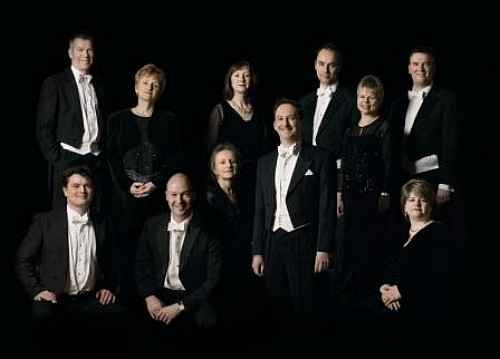
It’s usually two singers per part (SSATB), donning the surprise of flesh and emitting celestial notes here on earth. And so it was this evening in Kansas City when The Tallis Scholars performed.

Peter Phillips and colleagues presented a concert of works from Spain and Portugal, including:
  • Mendes - Asperges me
  • Cardoso - Lamentations; Magnificat
  • Lobo - Pater peccavi; Audivi vocem
  • Melgas - Ajuva nos; Domine hominem
  • Victoria - Requiem.
 Peter Phillips
The Victoria six-voice Requiem was particularly novel. Like all Requiem settings, the music is predominantly dramatic in character and intent—taking off with the introspective/hermetical Requiem æternam, ascending through the ecstatic and terrifying vision of a furious and wrathful God, and coming in for a feather-light ‘landing’ with a subdued Kyrie, singers on the brilliantly-lit altar platform at Cathedral of the Immaculate Conception, audience in the dark. The Spanish mystical brand of Catholicism communicated in this piece seems oddly premonitory of present-day self-styled liturgies.

A   fter seeing the Tallis Scholars, the Renaissance doesn’t seem remote at all.”
  —  Chicago Sun Times, August 2006.
This superb recital gave us an aerial view of religious conviction as ‘acting-out’—aspirations toward an innocence and goodness that would not only be acceptable to God but also quieting to one’s own conscience, enacted in public. The appeal that this had in Renaissance times—and that it still has today—cannot be overestimated; not just the innocence and expiation as motives, but the seductiveness and popularity of institutionalizing it as public ritual.

The counterpoint alternating with homophony is especially dramatic and evocative of other-worldliness, in support of the liturgical ‘acting-out’ of conviction and supplication.

In fact, the evocativeness is so powerful and profoundly moving that it boggles my mind: how one can sing this music without tears rolling down one’s cheeks the whole while? How can one not come undone? Rehearsing and performing it repeatedly cannot possibly immunize one against its power!

The magic of it is that music can do this at all. The terror of it lies in the fact that music is so potent, that it works so well, and that it can make us go where we don’t necessarily want to go. (That may have been the whole liturgical ‘point’ ... )

Thyrotropin-Releasing Hormone (TRH; (pyro)Glu-His-Pro-NH2 ) when suddenly released in large amounts (by the hypothalamus, into the pituitary’s hypophyseal portal system) can produce this shaking and shivering and the spine-tingling qualitative sensations that are associated with experiencing ecstatic awe. It does this by direct action of TRH on receptors in the brain. And 1-[2-hydroxyphenyl]-4[3-nitrophenyl]-1,2,3,6-tetrahydropyrimidine-2-one, an experimental drug, can do this too—it has been used as an experimental model to try to understand spine-tingling—but the drug has a peripheral site of action instead of only in the brain, so its mimicry of TRH’s action on the pituitary is not exact.

And after the TRH hits its receptors, then the multi-faceted signalling cascade begins. How does this work?! Shaking and shivering and spine-tingling sensations are elicited by a variety of stimuli. The sensations can be inhibited by central administration of drugs that act as agonists on opiate receptors, muscarinic cholinergic receptors, and alpha-adrenergic receptors. We know that from experiments with laboratory animals, plus anecdotal accounts by anesthesiologists—whose practice in the operating room and in the PACU involves administering drugs that potently affect those receptors; and whose practice also involves recovering patients as they emerge from anesthesia and those medications are washed out or metabolized away. [Bear in mind that the neurophysiology of how ‘spine-tingling’ emotional reactions happens is different from the cell biology of nerve synapses—a scientific field that recently has co-opted the phrase ‘spine-tingling’ as a colorful way of referring to spiny structural changes and variations in nerve cell synaptic membranes. See Huettner and Spires and Hyman and others (Spine-tingling excitement from glutamate receptors. Science STKE 2003; 210:53; Neurobiol Aging 2007; 28:687). Keep in mind, too, that there is a lot of appallingly incorrect disinformation/bullshit (via YahooAnswers.com and other web sources) about the physiology of spine-tingling. Needless to say, spine-tingling has not been a heavily funded area of research, insofar as it is (a) not related to an important medical problem or disease {not even Reflex Sympathetic Dystrophy (RSD) or neuropathic pain or Familial Dysautonomia} and (b) it is transient {each paroxysm unpredictably comes and goes in seconds} and would therefore be very difficult to study.] A considerable amount is known about the neurophysiology of spine-tingling in general, but not a lot is known about the neurophysiology of spine-tingly music specifically.

At any rate, for me in Saturday night’s Tallis Scholars performance there was no pharmaceutical protection from spine-tingling, no remedy in sight at all. Just a few bars into the 6-voice Requiem (Tomás Luis de Victoria, 1605) and here come the shivers—up and down the whole length of the spine, uncontrollably, continuously, my dorsomedial hypothalamus (DMH) and brainstem going wild.


You must realize I didn’t go there expecting this to happen; I did not attend this concert with the aim of being moved to tears in this way by the singing. Nor do you attend concerts with this aim, with some exceptions. And yet it does happen, this reflex, this shivering tearing neurophysiology of the ancient hind-brain of our mammalian prehistory. The rest of our Saturday had been ‘normal’, and now this—in this darkened cave of a cathedral, full of echoes and faintly redolent of Saturday 2:30 p.m. and 4:30 p.m. Masses and a funeral held here earlier in the day, for a dear 88.9 year-old someone we did not know. But we now see that we are just tiny bystanders, ceremoniously hurled into emotional depths on a cold March evening; bystanders undone by sacred music written by clever Lusitanians and Spaniards some 400 years ago. Hyperhedonic existential adventure! Acoustically-evoked hyperautonomia! Syncopal musical psychotourism! You need to read Phillips’s book, What We Really Do, to better understand their art. Better still, go to one of The Tallis Scholars’ performances and get your spine tingled yourself. Don’t understand Latin? Doesn’t matter. Deist, or atheist, or somewhere in between? Doesn’t matter. The cosmic beauty—and the shivers—induced by Tallis Scholars are universal.


 What We Really Do, Peter Phillips
T   he embellishments that the soprano sings on the way down from the top C [in Allegri’s Miserere] were not composed by Allegri but were instead improvised by generations of singers in the Sistine Chapel. These embellishments were guarded even more jealously than the written music…”
  —  Peter Phillips.

 Graham Hughes, Worship as Meaning
C   onvinced that people shape their meanings from those available to them, Graham Hughes inquires into liturgical constructions of meaning, within the larger context of late twentieth-century meaning theory. Drawing particularly upon the work of Charles Peirce, Hughes employs semiotic theory to analyze the construction, transmission and apprehension of meaning within the worship service.”
  —  Jacket blurb, Hughes book.