D on Quixote,’ Menard explains, ‘interests me profoundly, but it does not seem to me to have been—how shall I say it?—inevitable. I cannot imagine the universe without the interjection of Edgar Allen Poe’s ‘Ah, bear in mind this garden was enchanted!’ or without the ‘Bateau ivre’ or the ‘Ancient Mariner’, but I know that I am capable of imagining the universe without ‘Don Quixote’... ‘Don Quixote’ is an accidental book; it is ‘unnecessary’. I can premeditate writing, I can write it, without incurring a tautology... My memory of Cervantes’s ‘Don Quixote’, simplified by forgetfulness and indifference, is much the same as the imprecise, anterior image of a book not yet written. Once this image has been postulated, my problems are undeniably considerably more difficult than those which Cervantes faced. My precursor did not refuse the collaboration of fate: he went along composing his immortal work a little ‘a la diáble’, swept along by inertias of language and invention. I, on the other hand, have contracted the mysterious duty of reconstructing his spontaneous work. My game is governed by two polar laws. The first permits me to attempt variants of a formal and psychological nature. The second obliges me to sacrifice them to the ‘original’ text and irrefutably to rationalize this annihilation. In spite of these obstacles, the ‘Don Quixote’ of Menard [Savall] is more subtle than the one by Cervantes. The latter indulges in a rather coarse opposition between tales of knighthood and the meager, provincial reality of his country; Menard [Savall] chooses as reality the land of Carmen during the century of Lepanto and Lope.”
— Jorge Luis Borges, ‘Pierre Menard, Author of Don Quixote’.
Romances y Músicas de Don Quijote’—performed Friday night by Jordi Savall and Hespèrion XXI with F. Murray Abraham in Kansas City at the
Friends of Chamber Music Early Music Series—includes ballads, songs, madrigals and other musical forms quoted and mentioned by the various characters or otherwise described at various points in Cervantes’s book. Each is matched with its corresponding passage from the Quixote text. The majority of the ballads and songs are ones that were preserved in songbooks, and treatises of the period but, in all those cases in which there is no extant documentary record of the music to which the poems were sung, Savall uses a ‘contrafactum’ approach—widely used in Cervantes’s time—selecting melodies of the period that closely match the mood and metre of the poems. All the musical pieces are integrated with the narrative, as recited by F. Murray Abraham, and performed according to the indications given in the novel.
 W
What does it mean to provide narrative history under the sign of Cervantes? It cannot mean to speak from within a reanimated 16
th-Century society with the voice of Cervantes—remember Borges’s Pierre Menard story about the inauthenticity of attempting to write ‘Don Quixote’ as if one were Cervantes. It must instead mean to speak as oneself, as an historically-informed musician/actor, using period instruments and period text, but from one’s own contemporary vantage point.
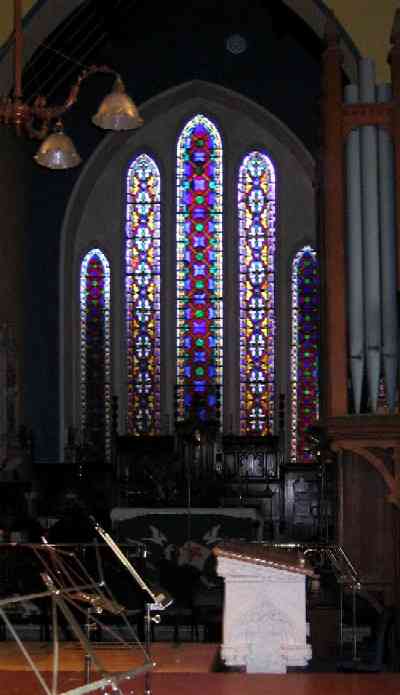
And that is precisely what Jordi Savall and Hespèrion XXI and F. Murray Abraham gave to us. There was a constant interplay between an ‘addressive’ mode and a ‘performative’ mode—from narratives about the self and others, to narratives to the self and to others. The mimetic, performative acts of the artists called for corresponding mimetic, performative acts by the audience members. At several points during the performance, Abraham and Savall extemporaneously addressed a young girl in the front row of the audience with her mother, who responded appreciatively. Abraham descends the 1-meter stairs—from the stage set up for the performers in front of the altar, to the floor of the church—and strolls down the aisle into the audience, and then bounds back up on-stage. On several occasions, he emerges from behind the harp and tenor viola da gamba, wending his way to center-stage as he delivers his peripatetic Quixotic recitation. In other words, this is a participatory, improvisatory production, not a recital/reading passively received. Musicians and actor-reader proposing, exposing the Self… selves, patterned after or assimilating qualities and stances of the characters created by Cervantes. Life into story, story into life.

[50-sec clip, Jordi Savall and Hespèrion XXI, 1.14. Primera Parte - Arde La Biblioteca, Capítulos V-VI: Romance De Don Beltrán, ‘¿Los Dolce Pares?’ (Juan Vasquez), 1.2MB MP3]
[50-sec clip, Jordi Savall and Hespèrion XXI, 2.01. Segunda Parte - Llegada Al Toboso, Capítulo IX: Pavana I, ‘Arpa’ (Alonso Mudarra), 1.2MB MP3]
[50-sec clip, Jordi Savall and Hespèrion XXI, 2.20. Segunda Parte - En La Entrada De Barcelona, Capítulos LXI-LXII: Conde Claros / Recitado, ‘¿En Fin, Por Caminos Desusados?’ [In the end, we travel by abandoned/disused roads?!] (Alonso Mudarra / Cervantes), 1.2MB MP3]
Savall’s program notes meditate on the fact that Cervantes’s literary accomplishments brought him little worldly success during his lifetime. Cervantes, thwarted and humiliated, found that the music and the ballads provided some respite; they transported him (and us) to a utopia in which cultural affirmations and myths inspire and encourage us to endure. Cervantes’s narrative, according to Savall, is designed to take us into a magical realm of imagination that goes beyond what can be expressed or suggested by words alone.
The whole of ‘Don Quixote’ is full of exotic illusions of the kind that, during the 20
th Century, Jorge Luis Borges became famous for. It is meta-fiction. In fact, in Savall’s ingenious hands, it is transformed into high ‘meta-meta fiction’: musico-theatrical fiction about fiction about fiction.
Meta? Meta-meta? Well, Cervantes tells us in Volume 1 that the original story of Don Quixote was written in Arabic by some Muslim Moor named Sidi Hamid Benengali, and that Cervantes is merely a ‘translator’ or intermediary rendering it in Spanish. This isn’t true, of course—it was a narratorly ruse by Cervantes. Cervantes tells us that Benengali isn’t the most accurate of historians. But Cervantes does call Benengali an historian—suggesting that Don Quixote/Alonso Quixana was real and that the narrative is a documentary worthy of the regard that we give to things that are real. Later, The story is narrated by ‘Cervantes’—but this time a fictional Cervantes: the meat-world Cervantes’s virtual-reality representation of himself. The SecondLife in-world character ‘Cervantes’ claims he has uncovered the translated manuscripts of Sidi Hamid Benengali and proceeds to tell us the story of Don Quixote, not as Benengali ‘wrote it down’ (because Benengali’s story has errors) but to cure Benengali’s unreliability and fix the errors and fill in the gaps. So by now we have been four times removed from the original author/narrator and nothing—Nothing!—is certain. With Savall’s and Hespèrion XXI’s and Abraham’s added interpretations, make that five times or six times! By this time, Cervantes’s unreliability as a narrator makes us hold in abeyance everything he says; makes us wonder what
is reliable, if anything. Click
here to have a look at
Dissociative Identity Disorder DSM-IV 300.14. Does Cervantes’s familiarity with this psychiatric condition inform the way that he writes what he writes here?
To Cervantes, the world is this multivalent, polysemous, polyphonic, multi-layered, hybridized, impossibly pluralistic thing—very different from the teachings of the Roman Catholic Church at the time. Cervantes tries to link things, to map things (in what some analysts say is a
‘Neoplatonic’ way?)—microcosmos to macrocosmos;
explicatio (unfolding) to
complicatio ([re-]folding). The ‘Don Quixote’ novel is this way and, musically, ‘Romances y Músicas de Don Quijote’ is this way as well. It is as though it is an early 17
th Century
mash-up.
I t has become a commonplace to typify modernity as both intrinsically sociological and reflexive, and to cite modernism’s self-consciousness as one of its direct results... an increased anxiety about what it means to render oneself, and to affect others, narratively. What does it mean to assume (or defy) the responsibilities which storytelling perforce assigns? ... It is the rise of the modern city or the invention of abstract labor by a market-driven economy or the legal and philosophical redefinition of personhood which underpins modern narrative... [In a realist novel] the autonomous individual continues to pursue an idealism he/she recognizes as no longer tenable, positing an immanent ‘return to itself’ in a world permeated by metaphysical homelessness. In contrast, modernist fiction disembeds the self [and substitutes instrumentalizing societal power] and, by abandoning the tempered irony which enables the self to be deployed as a fictive construction in the first place, breaks faith with ‘the only home the novel has ever known’.”
— Adam Newton, Narrative Ethics, p. 31.
The mashup juxtaposes conflicts, contradictions, jokes, tensions, post-Reformation accomodations of authority and defiances of authority. We experience blending of Biblical narratives and traditions of Church Fathers, colliding with Islamic/Moorish concepts and tensions ... with the
Jewish Conversos culture of Cervantes’s family, with pagan myths, with humor, with post-Copernican science—and with restlessness as a way of modern life.
What I’m saying is that Jordi Savall et al. have concocted far more than a beautiful, historically-informed musical-theatrical production. This is not your typical
‘Early Music’. They are rendering a multi-cultural, post-modern new-music multi-media mashup that concomitantly is authentic Spanish Renaissance early music ... that is to say, a work that’s positively brilliant as post-modern Web 2.0 culture and, as such, is as fresh and radically ‘meta’ as any artistic work you’ll find anywhere. The literary and musical effect is, much as Cervantes once wrote, ‘exemplary’—the elements juxtaposed in this way enable us to contemplate many thoughts, different interpretations, roll them around in our minds.
‘Exemplary’ fictions, told in a light-handed, exemplificatory, ‘meta-meta’ way—the reader-listener turned out on her/his own, to figure out what to make of the mashup’s meaning.
M enard’s aim was never to produce a mere mechanical transcription of the original ‘Don Quixote’; he did not propose to copy it. His ambition was instead to produce a work that would coincide—word for word, line for line—with those of Miguel de Cervantes... The initial method he conceived was relatively simple: to know Spanish exceedingly well; to re-embrace the Catholic faith; to fight against Moors and Turks; to forget European history between 1602 and 1918; and ultimately to be Miguel de Cervantes... Shall I confess that I often imagine that he finished it and that I am reading Don Quixote—the entire work—as if Menard [Savall] had conceived it? Several nights ago, while leafing through Chapter XXVI—which Menard had never attempted—I recognized our friend’s style and, as it were, his voice in this exceptional phrase: ‘The nymphs of the rivers, mournful and humid Echo’.”
— Jorge Luis Borges, Pierre Menard, Author of Don Quixote.
Hespèrion XXI’s account conveys this sort of uncertainty and cross-cultural mashup. The theme of surviving culture wars and other adversities through self-reliance—a [post-]modernistic sense of this is well-represented in these pieces. So also is Cervantes’s rejection of doctrinaire superstition and magic while still nurturing hope in things unseen. Savall and the ensemble musicians deliver animated, convincing performances. And Abraham (perhaps best known for his Academy Award for Best Actor in 1984 for his portrayal of Antonio Salieri in ‘Amadeus’) has stage presence and dramatic skills that are magnetic, riveting—ideally suited to this historically-informed production. The poetic urgency of Abraham’s delivery is wholly compelling, especially when evoking the Renaissance Jesuit’s skeptical regard for faith as a way to explain events in the physical world; when evoking Cervantes’s ironies; when rendering his humor and ruses.
We were 100% captivated by this superb performance—diverted by it, yes, but also led to reflect on the ambiguities and conflicts that the elements that were juxtaposed in the meta-meta-mashup conjure … to decide what they mean for us in the audience, and what they signify to Cervantes and to Jordi and his colleagues. [Jordi’s trick faux-encore to surprise Murray Abraham by having the ensemble sing ‘Happy Birthday’ to him—before the group did their real encore—was a nice, impromptu touch. Abraham was genuinely moved by this gesture, and so, too, were we in the audience. Bravo!]
T o make the world plausible [the playwright; the composer] has to create someone with a substantial ego, someone who would recognize the existence of many other egos, but subdue them sufficiently by the sheer size of his own generous, charming, overwhelming confidence—someone who would believe himself to be the center of any universe—in other words, an actor. ... Inventing worlds is our stock in trade.”
— F. Murray Abraham, Midsummer Night’s Dream: Actors on Shakespeare, p. 2.
- Savall and Hespèrion XXI page at Aaron Concert Artists Inc
- Hespèrion XXI page at Alia Vox
- Jordi Savall & Hespèrion XXI. Miguel de Cervantes, Don Quijote de la Mancha: Romances y Músicas. (Alia Vox Spain, 2006.)

- Don Quixote, Hespèrion XXI (Jordi Savall, director; Murray Abraham, narrator) at Friends of Chamber Music, Kansas City
- McDonald T. Jordi Savall and ensemble display timelessness in honoring Don Quixote. KC Star, 25-OCT-2008.
- Oestreich J. Improvisation and encores in a search for Don Quixote. NY Times, 22-OCT-2008.
- Trussell R. Ensemble, with F. Murray Abraham, to present the music of Don Quixote. Kansas City Star, 16-OCT-2008.
- Trussell R. Actor F. Murray Abraham once again finds himself engulfed in music. Kansas City Star, 16-OCT-2008.
- Universidad de Alcalá (Madrid)
- Centro de Estudios Cervantinos
- Cervantes Society of America
- Daniel Eisenberg Cervantes page at Indiana University-Purdue, Ft. Wayne
- Eisenberg D. A Study of Don Quixote: 'IV. The humor of Don Quixote.' Working Paper, 1987. [1MB pdf]
- Borges J. Ficciones. Grove, 1994. [‘Pierre Menard, Author of Don Quixote’, pp. 45-56]
- Abraham FM. A Midsummer Night's Dream: Actors on Shakespeare. Faber & Faber, 2005.
- Bal M. Narratology: Introduction to the Theory of Narrative. 2e. Univ Toronto, 1997.
- Booth W. The Rhetoric of Fiction. Univ Chicago, 1983.
- Duran M, Rogg F. Fighting Windmills: Encounters with Don Quixote. Yale Univ, 2006.
- Echevarria R, ed. Cervantes' Don Quixote: A Casebook. Oxford Univ, 2005.
- El Saffar R, Wilson D, eds. Quixotic Desire: Psychoanalytic Perspectives on Cervantes. Cornell Univ, 1993.
- Fletcher R. Moorish Spain. 2e. Univ California, 2006.
- Graf C. Cervantes and Modernity: Four Essays on Don Quijote. Bucknell Univ, 2007.
- Harvey L. Islamic Spain, 1250-1500. Univ Chicago, 1992.
- Jehenson Y, Dunn P. The Utopian Nexus in Don Quixote. Vanderbilt Univ, 2006.
- Johnson C. Don Quixote: The Quest for Modern Fiction. Waveland, 2000.
- Nerlich M. Ideology of Adventure: Studies in Modern Consciousness, 1100-1750 C.E. Univ Minnesota, 1987.
- Newton A. Narrative Ethics. Harvard Univ, 1995.
- Presberg C. Adventures in Paradox: Don Quixote and the Western Tradition. Penn State Univ, 2001.
- Punday D. Narrative Bodies: Toward a Corporeal Narratology. Palgrave Macmillan, 2003.
- Swinford D. Through The Daemon’s Gate: Kepler’s Somnium, Medieval Dream Narratives, and the Polysemy of Allegorical Motifs. Routledge, 2006.
- Google Mashup editor
- Microsoft Mashup editor
I t seems to me that the situation we find ourselves in today because of fundamental interpretations of religions has steered us into violence, which is what most religions suggest they are against. The point is that it’s not true. If Christians really practiced what Christ suggests, which I believe is great and revolutionary, and if people really followed the tenets of Mohammad, which embraces many religious ideas… But they’re not. … People who are suffering because of religions still cling to their religions. I don’t quite understand that. It’s possible they don’t want to think for themselves. It’s possible they prefer to give over their responsibilities as thinking sentient human beings to some ‘powers that be’, [prefer] to relinquish their responsibilities to their children, their families, their future.”
— F. Murray Abraham, interview in Gothamist, 21-APR-2008.