T he earth died screaming,
While I lay dreaming—
Dreaming of you.”
— Tom Waits, ‘Earth Died Screaming’.
I f you’re standing ‘outside’ [the community of brass-band players] looking in, [brass band] music could be misread as being aesthetically naïve. But those composers are fulfilling a function by providing well-crafted scores for a community that really wants them.”You may wonder what exactly Nero played while Rome burned. You may equally well wonder why he played it and what he was thinking and feeling as he did so. Sometimes there’s nothing that one can do. Never mind Nero and his nonfeasance. As the financial markets continue on their incendiary way, may I suggest that you will enjoy the unusual collection of ‘new music’ on the CD just released on NMC Records, by the Foden’s Richardson Brass Band, conducted by Bramwell Tovey? The 30-member ensemble explores fascinating territory that goes far beyond the idioms normally associated with ‘brass band’. And, in a way that I can only regard as ironic or clairvoyant or both, the music is perfectly matched to the ‘tropes’ that are in-play in the world of financial markets and central banking. Here on this superb CD is a kind of emotional catharsis that can only be found in brass band repertoire.
— Philip Clark, Review of Foden’s Brass Band ‘New Music for Brass Band’ CD, Gramophone, OCT-2008.

- ‘While Rome Burns’ trope
Something awful is happening. The world is ending, there’s an earthquake, there’re people leaping from buildings, there’s rioting in the streets. The ‘While Rome Burns’ person couldn’t care less. You’re still reading a book, playing or listening to music, posting and looking at blogs, whatever. Not that you approve of what’s going on—far from it; you just see the situation as futile. ‘While Rome Burns’ is the supertrope of ‘Dissonant Serenity’. Compare with ‘Holding Out For A Hero’ trope. - ‘Dissonant Serenity’ trope
There’s maiming and killing afoot. Screaming and cursing, clatter of swords, bang of guns. Faces distorted with pain and hate, collective despair, fear and loathing. It’s terrifying, but it is to be expected. But you see peace in the middle of horror. You are smiling; not vicious, not insane, not stoic—but calm, gentle—almost enlightened. As the throats are slit left and right, you are in the eye of the storm, the calm center of destruction, and your serenity is so ‘off’ that it’s more terrifying than any fury. Villains and heroes can be dissonantly serene in battle mode, but it’s rarely the main character who does that. A closely related state of mind: the uncomprehending ‘Psychopathic Man-child’. The ‘Tranquil Fury’ trope seems similar but is very different in practice.
This new CD has 14 wonderful tracks, with compositions by Richard Bennett, Kenneth Hesketh, and George Benjamin, Philip Wilby, Elgar Howarth, Michael Ball, Edward Gregson, plus Judith Bingham’s character pieces on Prague (St. Wenceslas Chapel, Wenceslas Square, Charles Bridge, Rabbi Low Creates the Golem). Righteous antidotes to our present societal terror.

Most interesting to me are the 6 variations on a theme by Michael Tippett—pieces composed by Philip Wilby, Elgar Howarth, Michael Ball, Edward Gregson, and Bramwell Tovey. These meditations reveal the astonishingly wide range of timbres and expressions of which brass band is capable. They reveal a surprising variety of communitarian and pacifistic views, for which Tippett was famous and which the composers of these variations/meditations here have honored. They additionally reveal a phlegmatic, unflappable attitude toward adverse events and toward authorities and elites that resonates deeply with the current state of affairs in the world. Having played in a brass band many years ago, I feel this is characteristic of idiomatic brass band literature—and of brass band members’ sociology and musicianship in-ensemble. Foden’s display this to the nth degree.
N o one could have guessed from looking at the score—and thinking of the thing [dismissively] as a ‘toccata’ for brass band—how beautiful and serious this work is, as abstract music.”So turn off the sound on your CNBC or BBC or whatever, and put on this disc at high-volume as you watch the financial catastrophe ‘crawl’ across the bottom of your television screen. Foden’s Richardson Brass Band is just the thing to ‘buck up’ your spirits.
— George Bernard Shaw, remark to Edward Elgar, upon hearing Elgar’s Severn Suite in competition on 27-SEP-1930.

During his lifetime Sir Michael Tippett (1905–1998) composed 5 string quartets, 4 piano sonatas, a sonata for 4 horns, and several other chamber works. He also composed a number of oratorios and cantatas. As a composer, Tippett was a late bloomer; he completed his compositions slowly. At age 30, he studied composition with Reginald Owen Morris at the Royal College of Music (after Morris’s return to London from his stint at Curtis Institute in Philadelphia).
Tippett was imprisoned as a conscientious objector/pacifist in WWII. Tippett’s mother was a charity-worker; her influence led him to have a lifelong identification with oppressed people and suffering. Tippett’s gayness probably figured in there as well...
Melismas—ones more ornate than are reasonable or practicable for voice, but entirely feasible for brass—plus rapid mensural/rhythmic changes where the metre is continually cast and recast—outside the norms that are set up in the rest of the work: these are here in abundance.
Mikhail Bakhtin’s dialogical conception of language—conceits like a ‘polyphonic novel’ and ‘double-voiced discourse’? In this wonderful Foden’s Richardson Brass Band CD we find that all of our utterances must be polyglot—syncretisms of every language that we’ve assimilated since birth. Just as the least stable kind of tonality has the strongest anti-tonal tendencies, so the least stable atonality is the kind that’s most inclined to abandon sound-mass totality in favor of a lyrical, neo-tonal individualism. Redefinition, deconstruction, and reconstruction of language out of its ashes. Bingham’s apocalyptic ‘Prague - St Wenceslas Chapel’; Wilby’s elegiac ‘Shadow Songs’.
Brass band repertoire is, I have felt, frequently conflictual—at the boundary of ‘us’ and ‘the other’; the music often explicitly points out this boundary. But brass band music is also frequently pacifistic or communitarian—displaying the emblems of class identity and ‘tutti’ solidarity with community. (Frank Bridge; Benjamin Britten; other pacifists? Granville Bantock; Harrison Birtwistle; Arthur Bliss; Derek Bourgeois; Arthur Butterworth; Simon Dobson; Edward Elgar; Edward Gregson; Hans Werner Henze; Gustav Holst; Herbert Howells; George Lloyd; William Mathias; John McCabe; Edmund Rubbra; Robert Simpson; Phyllis Tate; Ralph Vaughan Williams?) The ensemble may be ‘instrumental’, but its gestures and social behaviors are essentially ‘choral’…
T ippett has everyday words ‘Let’s go!’, sung by the disenfranchised Man and Woman characters, interrupting the madrigalian setting of lines borrowed from Milton’s Paradise Lost (‘This was the everlasting place of dreams.’). [And Tippett’s compositions for brass came from the same pen and they manifest this same world view. dsm].”As Julian Johnson has written, the Enlightenment, which conferred autonomy on humans, also produced a “model of man that was cut-off from the world around him,” alienated “by the mechanistic and atomistic implications of Enlightenment theory.” Was Tippett cut off? (Am I feeling [financially] ‘cut off’? Is brass band repertoire necessarily the language of aesthetically capable phlegmatic stalwarts?)
— David Clarke, Music and Thought of Michael Tippett, p. 162.
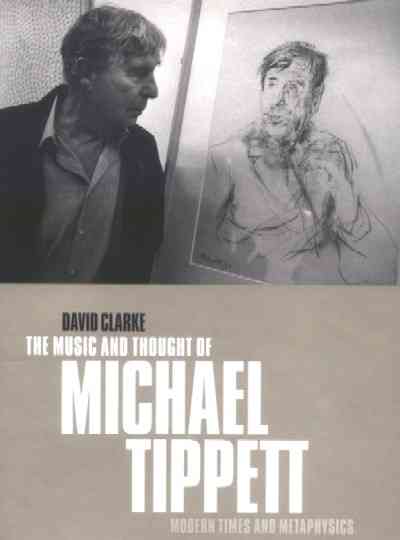
David Clarke (see book links below) holds that Michael Tippett was composing in a post-Enlightenment mode, embracing a ‘romantic, humanistic agenda’ not unlike that of Kant, Hegel, and other philosophers who aimed to restore a oneness with Nature. But Tippett, according to Clarke, also engaged in life-long relentless self-criticism and, in his operas and other compositions, created parts that enabled ‘post-humanist’ voices to speak—uniquely highlighting the limitations and failures of romanticism. Tippett repeatedly collides classical ideals with materialist realities.
Music historian Arnold Whittall once referred to Tippett as a ‘post-romantic modern’ (‘Is there a choice at all?: King Priam and motives for analysis,’ in Tippett Studies, Cambridge Univ, 2006, p. 77). But, in this Foden’s-Bramwell Tovey outing, maybe Tippett is closer to a ‘post-modern anti-romantic’. Yes, that is why this music feels so compelling, so poignant and timely right now.
W hile we would need to be cautious about positing a postmodern dimension to Tippett’s thinking, the kind of connections I have been exploring [in this book] suggest that the aesthetic mutations of his late works are not unrelated to certain of the more radical and fruitful avenues of that problematic cultural paradigm.”What especially pleases me in listening to this CD during this awful, catastrophic week are these works’ expression of an ineffable soundworld that is simultaneously tonal and post-tonal—full of melodic tonal writing, but with fragmentation, textural strata, and purpose-built melodic disjunctions that match my dark mood—miraculously healing it. There are ruptures with the premises of tonality, but the departures from tonality turn out not to be permanent—they eventually return us to orderly, diatonic lyricism. So, by implication, we sense that, regardless what happens to our collieries in one decade, our motor works in another decade, our financial institutions and markets in this decade, our cities, our governments, our environment, and so on in future decades—human beings (and brass bands, and the arts, and civilized culture in general) will somehow survive.
— David Clarke, Music and Thought of Michael Tippett, p. 269.
Up-coming performances by Foden’s Richardson Brass Band include:
- 04-OCT concert at Morley Town Hall, Queen Street, Morley, Leeds;
- 10-OCT concert at Regent Hall in London; and
- 11-OCT performance in the National Brass Band Championship, Royal Albert Hall, London.
- Foden’s Richardson Brass Band website
- NMfBB CD at NMC
- 4 Bars Rest (brass band website)
- BritishBandsman.com
- BrassBander.co.uk
- BritishBrass.co.uk
- TheMouthpiece.com
- National Association of Brass Band Conductors
- European Brass Band Association
- North American Brass Band Association
- Ken Gloag, Tippett scholar at Cardiff Univ
- Foden's Richardson Band. New Music for Brass Band. (NMC, 2008.)
- Berkeley M. One must have a chaos inside. The Guardian, 18-DEC-2004.
- Clarke D. Tippett Studies. Cambridge Univ, 2006.
- Clarke D. The Music and Thought of Michael Tippett: Modern Times and Metaphysics. Cambridge Univ, 2001.
- Clark P. Bold as brass: Review of NMfBB CD. Gramophone, OCT-2008, pp. 26-7.
- Eickelmann A, Nelson E, Lansford T, eds. Justice and Violence: Political Violence, Pacifism, and Cultural Transformation . Ashgate, 2005.
- Gloag K. Tippett: A Child of Our Time. Cambridge Univ, 1999.
- Odello D. (UC-Santa Barbara). Music as social organizer: The brass band movement of Nineteenth-Century Britain. North American British Music Studies Association, 18-JUN-2004, Oberlin College.
- Scoggin L. ‘To Fight or Not to Fight: Michael Tippett’s ‘A Child of Our Time’ as a case study for definitions of pacifist music.’ paper at the Society for Music Theory - Scholars for Social Responsibility joint meeting, Los Angeles, 2006.
- Whittall. A. The Music of Britten and Tippett: Studies in Themes and Techniques. Cambridge Univ, 1990.
- Brassed Off, 1996 film (imdb)