Showing posts with label schoenberg. Show all posts

Saturday, November 14, 2009

Berliner Philharmoniker: Schoenberg’s ‘Accompaniment’, Op. 34

Schoenberg discursively playing chamber pingpong in 1930

Schoenberg discursively plays ‘chamber pingpong’ in 1930


H    ow words are understood is not told by words alone. How music is understood is not told by music alone. [How films are understood is not told by film alone.]”
  —  Arnold Schoenberg quote.
T    hough originality is inseparable from personality, there exists also a kind of originality which does not derive from profound personality. Products of such artists are often distinguished by uniqueness that resembles true originality… Certainly there was inventiveness at work when the striking changes of some subordinate elements were accomplished for the first time. Subsequently, they achieved an aspect of novelty not derived profoundly from basic ideas. This is ‘mannerism’, not originality. The difference is that mannerism is ‘originality in subordinate matters’. There are many, and even respectable, artists whose success and reputation are based on this minor kind of originality… The moral air of such products is rather for success and publicity than for enriching mankind’s thoughts.”
  —  Arnold Schoenberg, Criteria For the Evaluation of Music (1946), quoted by Tom Myron.
T  onight the Berliner Philharmoniker, under conductor Sir Simon Rattle, performed Schoenberg’s 1929 ‘Begleitungsmusik zu einer Lichtspielscene (Drohende Gefahr, Angst, Katastrophe) ‘ [Accompaniment to a Cinematographic Scene], Op. 34, at Carnegie Hall. What, if anything does Op. 34 have to do with ‘chamber music’, you ask?

W  ell, if ‘intimacy’ is the defining quality of ‘chamber’ music idioms, then Op. 34 has considerable to do with ‘chamber’ collaborative motivations and expressive qualities. Hive-like sectional playing so ‘tight’ and in-tune that a whole section sounds like one person… ‘Open’ orchestration that accentuates individualism of parts… Parts covered by one musician (e.g., timpani; flute flutter-tonguing; heavily muted/smothered trumpet; clarinet near the end of the piece)… A spirit of ‘mutual discovery’ among the ensemble’s parts, instead of orchestral ‘exposition’…

A  gainst those ‘chamber’ features you have the fact that the ensemble has a conductor, has 100+ members, and is playing in this large unchamber-like hall. So, go ahead and throw out my fascination with chamber-ness if you want.

J  ust the same, maybe the writing does manifest chamber music idioms. Does any modest-size chamber orchestra ever perform this Op. 34, I wonder?

I  n 1929 Schönberg was commissioned by the Heinrichshofen Verlag in Magdeburg to write music for films. The autocratic Schoenberg was not about to relinquish his artistic control, contract or no contract, and so he focused on the eponymous ‘threatening danger, fear, catastrophe.’

A  s a result, Op. 34 is only loosely an instance of ‘program music’. It does not specifically address any particular film’s scenes or characters. The film was hypothetical, imaginary, never produced. The sections that comprise the work (Introduction; 12-tone theme; Song form; Ostinato; Four Contrasting Episodes; Subdivision into Tetrachords; Climax; Reflection on the Beginning of the Work) are fragments. They are idealizations of features that might occur in music intended to be coupled with a film—it’s a kind of meta-film score, a score about future film scores.

A  ctually, Schönberg constructs the climax of ‘Begleitungsmusik’ by colliding a succession of tiny components without predetermining a ‘victor’. The 8-min piece is a series of ideas that enter and enter and enter, intruding upon other ideas that are still being articulated by other parts. New material that unexpectedly eclipses other material—that is a gesture that in 1930 was revolutionary but that we today recognize as a frequent element of film music: overlapping and occluding parts is a way to convey/reinforce that the ‘action’ is changing.

M  ore than this even, Op. 34 has an amorphous pattern of rapidly altering meter. The tempo is ‘elastic’, changing on a timescale that is very short—several seconds only—in a manner that palpably means action. This piece feels decades ahead of its time, introducing gesture after gesture that we today recognize as ‘cinematic’.

A  ccompaniment’/‘Begleitungsmusik’ is a term that evidently bothered Schoenberg. It’s such a politically ‘loaded’ term, connoting subjection of musicians and abandonment to some larger fate that is beyond their control...

B  ut the accurate word for the film composer’s relationship to a director/producer is ‘abandonment’. It must surely be the rare film scoring gig where the director/producer is open to deep collaboration—open to the film’s aesthetic’s being seriously modulated or diverted by what the composer comes up with on her/his own recognizance, like what iconoclast Schoenberg was doing. In a highly competitive world where composers are required to deliver commercial results on tight deadlines, producers and directors do everything that they can to de-risk their projects, with carefully constructed contracts and scene-lists and storyboards. They restrict the budgets and the support in such a way as to preempt novel spiritual discernments and mental awakenings to deep creativity that might extraneously occur. They usurp the composerly role, as Moorefield puts it (link below), and the composer takes a subordinate one... For most film composers, their intimate, chamber Truths lie undiscovered and, if detected, unexamined or edited-away. Exceptions to this exist, of course; but still…

S  o here, in the Berlin Philharmoniker’s beautiful, inspired account of Schoenberg’s Op. 34, we heard a singular, intimate Truth that refused to be subdued by film contracts, producers, commissions. It was a performance so dramatic and unusual that I wanted to put these few thoughts about it down here, even though it’s a bit OT for CMT…

A  ccompaniment’ is difficult, isn’t it? Tough, in part, because it must sound ‘easy’ and not ‘ask too much’. The listener is to be shielded from the difficulties that arise from constraints that require the composer to shorten or prolong each phrase to match the film’s action, at whatever pace that action unfolds. The music suffuses us generously with deliberation and control that originate in the film but only tenuously so. The film’s action can ‘lean’ on the music if it wishes, like a cushion. The film can fall back onto the music if it needs to, like a trapeze artist’s safety-net. These are the cognitive assurances that the music suffusing us makes. Conventional ‘score-as-accompaniment’ is the epitome of supportiveness and of the absence of surprise and obtrusiveness/iconoclasm.

A  nd yet, in Op. 34, sudden viola warmth floods the music—inviting but untrustworthy. There are bassoonistic surprises. Seeping drohende Gefahr, existential Angst.

T  remulous cellos, holding the first two pitches in the 12-tone row, are joined by the bassoon and bass who are preoccupied with pitches 3, 4, 5, and 6. Pitches 6 through 12 enter precipitously in staccato fusillades. The score progressively explores violence and estrangement, via col legno bow-ballistics and brass and flute flutter-tonguing.

O  kay, so maybe Schoenberg’s temperament was not well-suited to composing to commission ‘spec’ on short deadlines. But the duress illuminates so much about the composer as individual, and about small-ensemble perspectives! Originality is, after all, not necessarily something deeply ‘new’ but often the result of looking askance—an averted gaze that looks at the familiar in a fresh, detached way.

R  ainer Seegers (timpani) was particularly skillful in animating Schoenberg’s averted-gaze existential feeling in Op. 34. Large-ensemble orchestration, yes; but still chamber-like sensibility.

I  f you're a software programmer or a mathematical linguist, you might like to read Gorbman (link below) on what today we would call refactoring and code hierarchies... film music as cognitive refactoring of codes contained in the film's action/imagery, simplifying complex relationships between object classes and subclasses and/or confirming or refuting provisional concept bindings that the viewer has made based on the film's imagery.

Wake book, refactoring in Ruby


Saturday, November 15, 2008

BMOP: Always Lots New to Say

Martin Boykan, Robert Erikson, Elliott Schwartz, Ken Ueno
I  think of the concerto in terms of a musical narrative … [unfolding] as a dialogue between the individual (represented by the solo) and the crowd.”
  —  Martin Boykan, notes for Concerto for Violin & Orchestra, 2003.
The Boston Modern Orchestra Project BMOP presented a concert of new string concertos (plus Schoenberg’s 1933 concerto for string quartet and orchestra) last night at Jordan Hall in Boston, conducted by BMOP Artistic Director Gil Rose.

  • Martin Boykan: Concerto for Violin and Orchestra (Curtis Macomber, violin)
  • Robert Erickson: Fantasy for Cello and Orchestra (Rafael Popper-Keizer, cello)
  • Elliott Schwartz: Chamber Concerto VI: Mr. Jefferson (Charles Dimmick, violin)
  • Ken Ueno: Talus, Concerto for Viola and Orchestra (Wendy Richman, viola)
  • Arnold Schoenberg: Concerto for String Quartet and Orchestra
Gil Rose, photo © Liz Linder
This exciting program reaffirmed that the concerto continues to thrive as an expressive idiom even today. These ingenious composers continue to find new ways to match the timbre and rhythmic and melodic capabilities of a solo instrument to the sonorities of an orchestra. The virtuosity of a concerto soloist always fascinates us; our appetite for soloists is boundless.

But it’s de rigeur in western cultures to focus on the soloist. What about the orchestra (vis à vis the Boykan blockquote above), the ‘society’ in which the soloist appears?

T here’s nothing wrong with interpreting concerto form socially. That’s not too subversive, interpreting this music in the context of these composers’ social views … Schwartz’s postmodernism; Erikson’s veganism; the inconstancy of Schoenberg’s quantum Judaism and regard for apocalypse; Boykan’s fascination with the textuality and temporality of everything; Ueno’s cheerful anarchism that considers anarchy as a ‘greenfield enterprise’.

Ueno says “Should justice and love not be observed also toward a stranger? The answer is that this, too, is according to a ‘just’ principle of public order, that regular citizens and subscribers are honored beyond outsiders and strangers, lest everything be uniform and ridiculously equal.” Honor the concerto soloist, then, but not in a topsy-turvy way that does injustice to ‘regular-anybody’ else.

There are indications in the music served up last night that each of these composers considers (and that the BMOP considers, as a matter consequent upon its charter and founding principles) the figuration of the orchestra in Ueno-ian conditional-egalitarian terms. (The Schwartz piece, explicitly ‘Jeffersonian’, in fact.) Their conceptions of the orchestra do not have to be understood as ‘representational art’—as literal depictions of contemporary society. Instead think of it this way: our social structures and story-telling processes come from certain habits of thinking, our predispositions, our political and moral stances. These habits and social processes and their consequences are (partly) what the composers—what these concertos—reveal.

I don’t imagine that these composers (or BMOP as sponsor-provocateur) advocate or foresee ‘revolutionary’ action against contemporary social hierarchies any more than Bach anticipated or agitated for revolutionary social justice with his concertos in Leipzig. These concertos are not tame, but they are accessible, listenable. But there can be little doubt that in last night’s concert Ueno, Schwartz, Erikson, Boykan, and Schoenberg ‘reminded’ the listeners and performers—of lively issues in controversial/revolutionary relations between the individual (‘soloist’; or, in Schoenberg’s case, ‘quartet’) and the society (orchestra) as a whole.

T he Ueno piece, for example, has toward the end of it a beautiful section where the viola part becomes immersed in the orchestral waves, and then the texture of the orchestra parts becomes progressively sparser until the solo viola once again emerges, pure and whole. This ‘restoration’ was elegant and convincing—indicating the resilience of the traumatized individual, so long as there is an effective social support network in operation, plus a modicum of good luck and good protoplasm that’s able to heal.

Reminded whom? These engaging concertos are works designed mostly for fellow new-musickers. Not historiographic time-capsules addressed to unknown future generations, nor narratives for audiences desiring to be told comfortable musical stories they already know oh so well, nor urgent pleas put in bottles and set afloat on distant seas against the improbable chance of discovery and rescue by somebody, anybody. No, these concertos are manifestos for the parties pro-tem, powerful incantations for new congregants already here.

One tendency defining the American works could, I think, be fairly labeled ‘classicism’. The ‘turn’ to traditional concerto form is a kind of classicism, and these works do each display a strong retrospective awareness, an historical consciousness. But they display this as Schoenberg did, believing in “Art as a profound instrument of ethical transportation and moral transformation”: we can_has futures that are really new, and we can go places really different from the past.

Now in its 13th year, BMOP provides a valued public service by aiding and abetting new, notorious, transportable and non-transportable things. What a wonderful start to the new 2008-2009 season! Bravo!

The next BMOP event is a Club Concert on 09-DEC-2008 (Tuesday, 19:00) at the Moonshine Room at Club Cafe Bistro & Lounge, 209 Columbus Ave, in Boston.

I  n the spring of 2006, my friend Wendy Richman fell off the stage at MassMoCA during rehearsals for a David Lang opera, ‘Anatomy Theater’, and broke her ankle (the talus, tibia and fibula bones). [The opening of the concerto begins in a most surprising way (which I will not divulge here), before Wendy addresses her viola with the bow.] When Wendy sent around a jpg of her foot x-ray [by email to her friends], the horizontal lines of the bolts in her ankle immediately suggested harmonic possibilities to me. Some of the harmonies in this piece are, in fact, generated from spectral analysis that I did of the digitized x-ray. Seeing Wendy’s courage as she worked to recover from this severe injury reminded me of my mother’s courage during her recovery after tearing three ligaments in her knee from a skiing accident (I deferred a semester of college to take care of her during that time). My mother was determined go back and ski down the same hill in Park City where she was injured and accomplished this feat in two years’ time. A spectrogram that I made from the jpg of Wendy’s ankle x-ray is here:”
  —  Ken Ueno, interview with David Bruce, CompositionToday.com, 29-OCT-2008.
Ken Ueno’s digital spectrogram of digitized x-ray of Wendy Richman’s ankle, ca. 2006, the basis for Ueno’s composition ‘Talus’
A  major focus of my work has been trying to reconcile the grammatological distance between ‘transportable’ and ‘non-transportable’ sounds. Transportable sounds are those elements that usually comprise the grammar of western music: rhythm, melody, and harmony. Non-transportable sounds are those sounds that have to be produced on a specific instrument in a specific way, which, in the West, have often been labeled as noise. Takemitsu’s compositions have helped to convince the world of the validity of non-transportable sounds, in that they are beautiful and worth listening to ... silence as expressive of the Japanese aesthetic principle of ‘ma’... I hope to have prepared the listener to focus on a [really] wide rubric of timbres.”
  —  Ken Ueno, interview with Brian Sacawa, 2005.
T he history of music from Haydn to Mahler, via Beethoven and Wagner, was a narrative of obfuscation. The logical conclusion to all this was Schoenberg’s: harmonic form ceases to function, and the diatonic scale is no longer a reliable reference point. Each note is as important as the others, and this ideal is ensured by prohibiting the resounding of a pitch until its eleven colleagues have been allowed to speak. The Galileis, père and fils, are circumscribed: we’re out of orbit, we’ve escaped the pull of tonal gravity, we’re in the floating, directionless heaven of Schoenberg’s beloved Swedenborg. That was in 1908. He had converted to Lutheranism ten years before. He fled Christianity and returned to Judaism in 1933, when he composed the peculiar ‘Concerto for String Quartet and Orchestra’— the same year as he fled Berlin for Paris and, finally, Los Angeles.”
  —  Joshua Cody, ‘10 + 5 = Gott’: Die Macht der Zeichen, 2004.
T he thesis of ‘violin in the age of shopping’ is that musical— ] content as a recognizable idea has anymore ceased to exist because all ‘the content’ has become interchangeable: it doesn’t matter what is going on, provided there is evidence that something is going on—a merely quantitative world of mass copies and fakes. All music—whatever its origin, status or supposed function—would now exist in a digital ‘dreamtime’ that the originators of ‘muzak’ could never have imagined.”
  —  Jon Rose, Violin in the Age of Shopping.


Saturday, July 12, 2008

The Air from Other Planets: How Much Is Too Much?

 Eye
P  enderecki, that reliable old post-Schoenberg standby, evoking buzzing bees in the basement. I did not really like these pieces, but I would put them on every few months to see if the bizarre might one day morph into the familiar. I’ve been doing that for forty years now, and the compositions continue to sound harsh, unpleasant, gloomy, post-nuclear. It is not the composers’ fault that they wrote uncompromising music that was a direct response to the violence and stupidity of the 20th Century. But it is not my fault that I would rather listen to Bach. That is my way of responding to violence and stupidity.”
  —  Joe Queenan, ‘Admit It! You’re As Bored As I Am’, The Guardian, 09-JUL-2008, Arts, p. 24.
The afternoon and evening programming at the recent West Cork Chamber Music Festival in Bantry, Ireland, was initially a delight. I crave new music—even pieces that are hard to warm up to, hard to comprehend—and the program for this Festival was notable for the sheer number of recent compositions on the docket.

 Screen Test: Minions (Photo: Linus Gelber, 2008)
But 5 consecutive days into the Festival, I had reached the point of saturation. All of the inharmonic sawings and screechings from countless viols; all of the gnashings that can be elicited by knocking the bow against the bodies or tailpieces of violins; all of the scrapings of piano strings with coins and other hardware and bangings of keyboards with fists; all of the noteless, tempoless, ad hoc, arbitrary scratchings of nebulous pitch-envelope “suggestions” on the music staves—all of these eventually became too much for me.

 Chamber music al fresco, somewhere in Northern Italy
I am pretty sure I was not alone. The majority of the audiences at Bantry were conservative, middle-aged people, hoping and praying for some Baroque or Classical relief. Some people annoyedly folded and refolded their programs; others stared listlessly at their shoes through entire pieces. The performance of Schoenberg’s ‘Pierrot Lunaire’ which ran 35 minutes past the scheduled time was something of a ‘last straw’ in terms of trying the audience’s (and other ensembles’) patience.

While I very much admire Francis Humphry’s bravery and enthusiasm (and while I will gladly return to the West Cork Chamber Music Festival in future years), I do hope that future years’ Bantry programming will be devised so as to have more genre variation within-program, so as not to exceed so many audience-members’ appetites for new music.

With his setting of Stefan George’s poem “Ich fühle Luft von anderem Planeten” (‘I feel the air of another planet’) in the Second String Quartet, Op. 10 (1908), Arnold Schoenberg launched us into space, into new acoustical, mostly-musical realms. We continue on extra-terrestrial musical journeys because we want to, even to this day.

But the fact is, the amount of publicly offered music often has little relation to the quality of that music, let alone to the quality of the context in which it is presented. The quality of the context—and by this, I mean programming—is a crucial factor in the reception of any kind of repertoire. Programming (Irish: eagraithe) is a form of composing. The word ‘compose’ literally means ‘to put together’. I suggest that good programming consummates the composing process by arranging the elements so that they reinforce instead of oppose or beleaguer each other, preferably reinforcing in a way that’s conducive to reassessing and calibrating and illuminating—for us listeners, and for the performers. That way, each new piece is given a fair chance at a favorable reception. Ideally, a programmer/presenter is open to anything that leads to intriguing combinations. Ideally, a programmer/presenter aims to present the listener with ‘Happy New Ears!’, as John Cage calls them.

Healthy ‘fish’ (audience members; musicians) swim against the stream, but not obsessively or to the point of starvation. Healthy presenters do not program streams (Irish: an liosta casaidh) that torrentially roar down miles and miles of steep mountain slopes, in which even hardy fish cannot thrive.

 Ashby book


Monday, June 18, 2007

Coherent Symphonism: Paul Leenhouts and The Royal Wind Music Recorder Ensemble

Paul Leenhouts
Presentation is the performer’s task, and to divine and interpret to a modern audience the intentions of baroque [and earlier] composers.”
  —  John Mansfield Thomson and Anthony Rowland-Jones, 1995.


  • The Gods’ Flute Heaven
  •  Royal Wind Music, Paul Leenhouts, Director
  •  Boston Early Music Festival, 17-JUN-2007, Jordan Hall, Boston
  • Sweelinck (1562-1621), Est-ce Mars*
  • Susato (1500-1561), Pavane ‘Wenn durch Leiden’*
  • Adriaensen (1550-1604), Almande Prince*
  • Brade (1560-1630), Courante XXIV
  • van Eyck (1590-1657), Amarilli mia bella
  • R. Dowland (1591-1641), Amarilli mia bella*
  • Anon., ‘When Daphne’
  • J. Dowland (1563-1626), Lachrimae Antiquae
  • Anon., ‘En m’en Revenant de Sainct Nicolas’
  • Philador (1647-1730), Bourée d’Avignone
  • van Eyck (1590-1657), Boffons
  • Mainero (1535-1582), Salterello
  • V. Schumann (1520-ca.1559), Vater unser im Himmelreich
  • Steigleder (1593-1635),Vater unser im Himmelreich*
  • Praetorius (1571-1621), Vater unser im Himmelreich*
  • Scheidt (1587-1654), Vater unser im Himmelreich*
  • Bach (1685-1750), Vater unser im Himmelreich*
  • Schuyt (1557-1616), Padovana del secondo modo
  • de Cabezón (1510-1566), Tiento I*
  • de Arauxo (1577-1663), Glosada LXVI sobre la canción de Tomás Crequilion*
  • del Encina (1468-1529), Triste España sub ventura
  • Flecha el Joven (1530-1604), Ay que bino in tierra estrana
  • Lunenberg (1981-), Recercada sobre Mille regretz
  • Desprez (1450/5-1521), Mille regretz, de vous abandonner
  • de Morales (1500-1553), Agnus Dei III de la Misa ‘Mille Regretz’
  • Weck (1495-1536), Spanyoler Tancz*
  • Flecha el Viejo (1481-1553), Ensalada
  • Praetorius (1571-1621), Spagnoletta XXVII*
  • * - arrangement & diminutions by Paul Leenhouts

DSM: Some professional recorder groups provide programs that consist predominantly of arrangements and transcriptions of works originally written for different instruments — possibly because they feel that the baroque recorder repertoire is too limited? But in the case of the Royal Wind Music, Paul Leenhout’s programming makes no such admission. Arrangments are included so as to perfect the orchestration and to better illustrate the timbral range and choral textures of the ensemble.

CMT: We have little written record of these composers’ compositional ideas or techniques, in their surviving correspondence. And relatively few sketches of their compositions have been preserved, so attempts to reconstruct their compositional thought and formal logic must rely on evidence drawn from close analyses of the works themselves. It takes great effort to discover how these composers employed compositional principles to structure their forms; it takes careful scholarship to account for specific details of individual movements as well as the relationships between the movements. But the effort is worth it, and the analyses can have a larger purpose: to fully appreciate that compositions can’t be analyzed in a meaningful manner if the analysis is divorced from the works’ historical contexts.

DSM: And part of ‘context’ is how the acoustical physics of the instruments and the available 16th and 17th century performers’ abilities constrained the writing. We can know something of the former from examining surviving historical instruments. But it’s hard to deduce the latter; hard to do history when the written record is so thin.

CMT: And, of course, social forces and biographical realities are fundamental elements of any historical situation. From their performance, one gets the sense that Leenhouts and his RWM colleagues have a deep understanding of this.

DSM: The insightfulness of their scholarship is clear from the sound that they produce. And all of their arrangements and performances rest on careful analysis. We can ask of their analyses: Does it tell us something that we didn’t know before? Is that ‘something’ a recognizable component in the piece? Does the analysis account for anomalies in the composition? Does the analysis provide a rationale or justification for what we understand and feel about the piece? Listening to this concert, the answers are emphatically “Yes!” to these questions.

CMT: Think, too, about the orchestration of these pieces. These 12 recorder voices—I would say they correspond almost literally to an organist’s 10 fingers and two feet. Beyond recorder literature-proper, RWM performs arrangements that closely reproduce some of the organ repertoire, except with more independent motion and cadential structure than one human being could execute at one time. Besides instrumental works, a recorder choir like this may also perform arrangements of vocal literature.

DSM: In the opening measures of Robert Dowland’s Amarilli mia Bella there are successive statements of a melodic motive that foreshadows and then later accompanies the arc of the piece. This motive emerges from silence, swells through the bass recorders, ascends into the tenor and alto recorders, and then sinks into the stillness from which it came. Although our first inclination is to regard these various statements as “the same”, there are actually some expressive differences among them. The change in instrumentation contrasts with the distinct timbral quality that the motive has in the opening measures. There’s a diversity in the pitches through which successive statements are given voice. And, although there’re similarities in the rhythmic figuration used for the recurring statements, there’s a latitude of duration and accentuation to all of them as well. In sectional playing, one of the most important things is to try to achieve and maintain a common tone within the section. This can be difficult due to different levels of playing skill and different acoustical qualities, especially in the tenor and bass recorders. It’s important in sectional playing to come together in agreement on how the tone should be presented in the ensemble. RWM does this consistently.

CMT: To understand this music — to make sense of the sonic textures — requires us to be able to integrate these phrases into a coherent idea and hold that idea and turn it round and round in our minds.

DSM: Yes. There’s a contemplative, meditative aspect to many of these pieces, and that’s consistent with the process of conceptual integration and round-and-round reflection that you’re alluding to. It’s partly why applauding after these pieces seems to do violence to them — applauding obliterates our zen-like state, abruptly ending the reflection. The rhythmic contour is destroyed by applause.

CMT: I think that the motives in these pieces hang together not simply because their constituent parts are connected in time but because the connections emphasize similarities to other motives. So the musical coherence that we perceive reflects the attributes of whole collections of motives. The coherence isn’t a property of any one motive in isolation. These are sentences and paragraphs. This whole 2-hour concert that Royal Wind Music performed for us was something like a book-length anthology or novella, don’t you think? And, although skill in evoking coherence does matter to the composer or arranger, our apprehending coherence in these pieces fundamentally depends upon the performers’ incarnating that coherence.

The substance of ‘symphonism’ will make itself felt in the stratification of the qualitative element of diversity and the novelty of perception within the limits of the increase of sound, but not in confirming the conditions tested earlier. Therefore, diversity in unity — the emergence of new intonations with new significations and meanings — forms the substance of symphonism.”
  —  Asaf'ev, O Simfonizme, 1921, quoted in Tarasti, Musical Signification, p. 147.


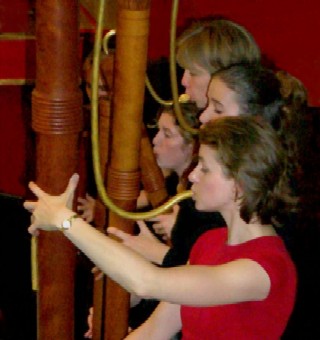
DSM: In that regard, these pieces have what I would say is an ‘orchestral’ or ‘symphonic’ texture, a mass of sound, with RWM’s individual players’ egos mostly sublimated to serve the aims of the section or the orchestra as a whole. It’s almost homophonic, but the coherence isn’t ‘coerced’. There are ‘free’ exchanges between the sections of recorders in different registers. And there are the contrapuntal lines assigned to specific voices within the sections. But these are not individualistic dialogues like the ones we find in chamber music. It feels like the expression of one unified organism. The effect is orchestral or ‘organ-like’—which I suppose is fitting, considering the shapes of the recorders and the similarities that they bear to pipe organ pipes; in terms of the means of sound production and the geometry of their air columns and apertures; and so on. The voicing and balancing of melodies and inner voices are also organ-like and contribute to the coherence of the overall effect. But RWM’s performance is organ-like in another way. The effect is unified, as though there were one consciousness behind it, just as there is one organist seated at an organ. The coherence between RWM’s members is very high. But it is a happy, enthused, ‘assenting’ sublimation by the various members. You can see it in their body language—as they play, and as they search for the proper recorder in the rack-like stands and mats on the floor in between pieces. Each one joyfully relinquishes her/his individual diversity, for the duration of the performance.

Royal Wind Music Bass Section
CMT: Symphonic, orchestral playing may sublimate individual egos and pre-judgments to a degree, yes. But, still, aren’t those egos and pre-judgments nonetheless necessary for a vibrant, meaningful, ‘whole’ performance? Gadamer, for example, once showed that our pre-judgments or prejudices are necessary and even desirable — a precondition for our understanding and communicating. New texts have to collide with meanings and ideas we already have, for new meaning to be produced. Dialogue and comprehension don’t occur if we merely suspend our ideas and passively accept another idea; they occur by a collision of ideas, our own and those expressed in the music.

DSM: Well, there’s clearly room for the individual, even in a symphony of recorders, with their sine-wave, flute-like timbres—so compliant and self-effacing as these instruments’ sounds are. The voices of the recorders in RWM are, I think, like ‘solute’ molecules that dissolve into a solvent, where the ‘solvent’ is the symphonic composite of all of the voices together. And you might say there is a ‘cratic’ entropy of acoustical mixing, much in the way that physical chemists speak of ‘cratic entropy’ of liquid and gaseous solutions. In ensemble performance, if the voices are the same ‘size’ and the interactions between them are identical, then the ‘entropy change’ for forming the ‘mixture’ (symphony) is smaller than it is if the voices are of different sizes, or have dramatically disparate energetics, or engage in dramatically different interactions. In this statistical mechanics analogy, some of the ‘particle’ differences (or lack thereof) inhere in the instruments themselves, and other of the differences (or lack thereof) are in the individual performers who play those instruments. The ‘particle’ is simply the voice that results from the ‘composite’: the player, plus the instrument, plus the text that the player executes. The tenor and bass recorders have inherently dark tones, while the alto and higher recorders are brighter, because of their geometry and acoustical physics. But the ‘player-plus-instrument-plus-text’ combinations that RWM represents have a much lower ‘cratic entropy’ than your typical ensemble . . .

CMT: That’s an interesting and novel notion—applying statistical mechanics concepts to sonic textures, treating polyphony as a physical mixing process—quantitatively accounting for musical textures in terms of ‘particle’ properties and energetics, as one would do in thermodynamics. Quite an exotic analogy. But, coming back down to earth, how can communication occur if the historical conditions separating us from these old texts are so wide as to preclude much of any common language or common base of ideas, between us and the composer? We’re talking not only of the player-particles’ submitting to a collective superego under the Leenhouts’ direction, but also of our own submission, aren’t we? Are we listeners not all sentient “particles” too—all of us endowed with somewhat different ‘sizes’, different ‘energetics’, different ‘interactions’?

DSM: I think so. And the answer emerges when we realize that our contextuality consists of more than just ‘fixed’, static, ‘horizontal’ cultural positions. There are also ‘vertical’ cultural contexts. Gadamer talks about synchronic and diachronic positions. Diachronic relationships are what we call ‘tradition’. Gadamer in fact tries hard to legitimize the concept of tradition. He says that our position in history entails our deliberate participation in evolving and creating traditions. A tradition is not merely a passive accumulation of artifacts; it’s something we cultivate actively. We produce it and further determine what it will become, regardless what it was that we’ve received. Tradition isn’t a permanent precondition that constrains us. It’s the awareness of historical conditions that influence our present understanding. Gadamer calls this the ‘wirkungsgeschichtliches Bewusstsein’, or ‘consciousness-of-being-affected-by-history.’ Gadamer sees interpretation as a single process, one that’s coextensive with understanding. It’s never achieved by subjectifying a text, but rather by ongoing societal mediation and interactions with each of us.

CMT: That sounds more mystical than sensible. How can we possibly ‘engage’ a musical text in conversation? In what sense can we ‘converse’ with a composer who’s long dead?

DSM: Well, a solution becomes plausible when we understand that ‘interaction’ in the hermeneutic sense is a bigger concept than the narrow linguistic activity we normally think of. A dialogue begins with the recognition that there’s another voice ‘out there’ (in the guise of a score or musical text). We try to reconstruct the thick ‘cultural web’ in which the text originated — to discover the questions and problems to which it served as an answer in its own time, and to discover the nuances of language and rhetoric that the text ‘pinged’ in its original community. We become receptive to new meanings by projecting ourselves against an historical ‘horizon’. None of this diminishes the role of the individual performer or listener. None of this reduces the range of textural ambiguity or timbral ambiguity that a performance may contain. What is striking about a homogeneous instrumentation such as RWM represents—what is striking about Paul Leenhouts’ conception of this music—is the very low amount of textural and timbral ambiguity in their performance. The distinctive meanings that RWM conveys are largely a consequence of their unique homogeneity in poetically rendering and coupling the motivic material in this repertoire; a consequence of their ‘cratic’ mixing of similar voices of recorders across the plurality of registers; and a consequence of the RWM members’ superb and consistent, shared vision of the historical horizon that’s pertinent to each composition. A beautiful and extraordinary kind of historical coherence is what RWM delivers! Kudos to Paul Leenhouts! Without someone of great vision, great ears, great interpretations, and great depth like his, you could have the greatest musicians on the earth and you wouldn’t achieve a great orchestral effect like this. We in the audience witness the inspired fascination that the created musical object exerts upon its creators. We experience a beauty compelling enough to cause RWM’s members to set aside their own individuality in service of this transcendent collective creation. What musicianship! What drama!

M otive is at any one time the smallest part of a piece or section of a piece that, despite change and variation, is recognizable as present throughout.”
  —  Arnold Schoenberg, The Musical Idea, in Carpenter & Neff, p. 169.


Royal Wind Music