Showing posts with label originality. Show all posts

Saturday, January 15, 2011

James Mulcro Drew and the Creation of Meaning

James Mulcro Drew, photo ©2005 by Kelly Drew Baskett
S   ome years, ago I addressed an audience at an International Webern Society Festival ... The point of my talk was that although Anton Webern was a renowned master, his influence created a ‘dead end’ for countless academic composers who didn’t really know earlier traditions very well, let alone understand Webern’s immense steps. The ability to count to 12 was of no value whatsoever. That was not where the Music was... I was designated a controversial speaker, but no one disagreed with my assessment, as far as I know. When I finished my talk, there was total silence—until George Rochberg yelled out, ‘I think they believe you, Jimmy.’ Organization alone is not a sufficient condition to create a symphony or a painting or any kind of Art work. Somewhere behind the resonating shapes, textures and temporal connections, exists the Music. The task of any artist is to find something that has personal meaning, something to Believe in—that’s the beginning. This has nothing to do with style. It has to do with flashes of light and with contemplation.”
  — James Mulcro Drew, Intention in the Arts, 2009.
A  fter God was assumed to be dead and no one any longer seemed to be in control, the new twentieth century, with the bang of World War I, was well on its way to what was soon to be a series of disastrous human errors. Certainly it is common for both individuals and nations to engage in competitive rhetoric of a political or artistic nature, but the breakdown, instead of the strengthening, of values that occurred in the nineteenth and twentieth centuries, an age of spiritual disinheritance, was a collapse characterized by a kind of tittering hysteria... But, to confuse matters even further, the same general philosophy somehow managed to be understood, by many, as representing a ‘modern’ point of view and, therefore, sowing the seeds that equate ‘modern’ with the idea of ‘meaningless.’ The modernness of Monteverdi was not based upon meaninglessness, nor are the black paintings of Ad Reinhardt ‘meaningless.’ Meaningless needs no explanation, but the term ‘modern’ is another matter. Modern is anything that makes us feel new or renewed... As Eliot pointed out, ‘I can make nothing with nothing.’ Art, however, is dangerous—dangerous because, if its subject matter is crucial, it will reflect a doctrine of moral values and therefore will pose a threat to other ideologies. The moral and ethical battle in Art continues. The existential crisis, to quote Lloyd Rodgers, is yours.”
  —  James Drew, liner notes for Mirecourt Commissions CD, 1978.
J ames Mulcro Drew, beloved contemporary composer, died on 23-DEC-2010, aged 81, following a brief illness. He studied with Wallingford Riegger and Edgard Varèse and subsequently taught at Northwestern University, Yale University, UCLA, Cal State, and other institutions. He performed with and co-founded several musical groups, including Crossfire Mission Orchestra in the 1960s in New Haven, Connecticut. Drew combined superb technique and earnestness with humor and insight, to create a variety of original works that will last.

D rew’s style included subtle tonality and voice-leading, along with innovative figures that are challenging and, at the same time, illuminating to play. His contributions and honesty are perhaps most vividly remembered by his students, who experienced Drew’s energetic pedagogy first-hand. His enthusiasm was absolutely remarkable. Music was not a ‘subject’ to be ‘taught’; teaching music was something you did, in an up-close participative way. Nowhere to hide, you must own who you are.

I n a way, Drew’s prescience—his gravitation toward unusual topics and his investment of tremendous personal energy in them, years before other of his colleagues could grasp the point of it and decades before the topics grew to be popular—and his deep interest in Nature and in physics were characteristic features of his personality, ones that propelled the fascination that he held for many of his friends. The compositions of ‘Animating Degree Zero’ (link below) were manifestations of those life-long tendencies.

I n this respect, Drew was not unlike one of my old teachers, Rufus Lumry, a physical chemist at University of Minnesota, who intuited the importance of ionic liquids back in the late 1970s, long before the subject changed from a small, academic curiosity into a vibrant and popular industry.

E ven in his later years, Drew kept pace with the fast-moving areas his innovations had helped to create. With such prodigious activity comes a lot of fatigue and a lot of hype. But with it too comes a peculiar, memorable, enviable brand of perpetual youth. He will be greatly missed.

I   nsisting that the meaningfulness of a work of art depends on its having been created exposes us to an objection: Surely, it may be suggested, the meaningfulness of a work of art can only depend on its having been created if what is there to be understood is the reason why it has been created as it is. That is, we will be driven to suppose that the meaning of a work of art is to be explained (1) by explaining the intentions of the artist or (2) by explaining the historical circumstances which gave rise to the work, and which the work may be understood to express. It may be very useful for understanding the life and mind of the artist to work out her intentions, and it may be important for understanding the history of a period to understand what is shown in a work about the circumstances of its production, but neither of these things—the objection goes—is understanding the work of art itself. As it happens, [to a degree] I agree with the objector... [but] the crucial point is that, at the time of the creation of any given work of art, there are properties of the medium which are there independently of the intentions and beliefs of the would-be creator.”
  — Michael Morris, Doing Justice to Musical Works, in Philosophers on Music, 2010, p. 67.

Mirecourt Trio CD


Saturday, November 14, 2009

Berliner Philharmoniker: Schoenberg’s ‘Accompaniment’, Op. 34

Schoenberg discursively playing chamber pingpong in 1930

Schoenberg discursively plays ‘chamber pingpong’ in 1930


H    ow words are understood is not told by words alone. How music is understood is not told by music alone. [How films are understood is not told by film alone.]”
  —  Arnold Schoenberg quote.
T    hough originality is inseparable from personality, there exists also a kind of originality which does not derive from profound personality. Products of such artists are often distinguished by uniqueness that resembles true originality… Certainly there was inventiveness at work when the striking changes of some subordinate elements were accomplished for the first time. Subsequently, they achieved an aspect of novelty not derived profoundly from basic ideas. This is ‘mannerism’, not originality. The difference is that mannerism is ‘originality in subordinate matters’. There are many, and even respectable, artists whose success and reputation are based on this minor kind of originality… The moral air of such products is rather for success and publicity than for enriching mankind’s thoughts.”
  —  Arnold Schoenberg, Criteria For the Evaluation of Music (1946), quoted by Tom Myron.
T  onight the Berliner Philharmoniker, under conductor Sir Simon Rattle, performed Schoenberg’s 1929 ‘Begleitungsmusik zu einer Lichtspielscene (Drohende Gefahr, Angst, Katastrophe) ‘ [Accompaniment to a Cinematographic Scene], Op. 34, at Carnegie Hall. What, if anything does Op. 34 have to do with ‘chamber music’, you ask?

W  ell, if ‘intimacy’ is the defining quality of ‘chamber’ music idioms, then Op. 34 has considerable to do with ‘chamber’ collaborative motivations and expressive qualities. Hive-like sectional playing so ‘tight’ and in-tune that a whole section sounds like one person… ‘Open’ orchestration that accentuates individualism of parts… Parts covered by one musician (e.g., timpani; flute flutter-tonguing; heavily muted/smothered trumpet; clarinet near the end of the piece)… A spirit of ‘mutual discovery’ among the ensemble’s parts, instead of orchestral ‘exposition’…

A  gainst those ‘chamber’ features you have the fact that the ensemble has a conductor, has 100+ members, and is playing in this large unchamber-like hall. So, go ahead and throw out my fascination with chamber-ness if you want.

J  ust the same, maybe the writing does manifest chamber music idioms. Does any modest-size chamber orchestra ever perform this Op. 34, I wonder?

I  n 1929 Schönberg was commissioned by the Heinrichshofen Verlag in Magdeburg to write music for films. The autocratic Schoenberg was not about to relinquish his artistic control, contract or no contract, and so he focused on the eponymous ‘threatening danger, fear, catastrophe.’

A  s a result, Op. 34 is only loosely an instance of ‘program music’. It does not specifically address any particular film’s scenes or characters. The film was hypothetical, imaginary, never produced. The sections that comprise the work (Introduction; 12-tone theme; Song form; Ostinato; Four Contrasting Episodes; Subdivision into Tetrachords; Climax; Reflection on the Beginning of the Work) are fragments. They are idealizations of features that might occur in music intended to be coupled with a film—it’s a kind of meta-film score, a score about future film scores.

A  ctually, Schönberg constructs the climax of ‘Begleitungsmusik’ by colliding a succession of tiny components without predetermining a ‘victor’. The 8-min piece is a series of ideas that enter and enter and enter, intruding upon other ideas that are still being articulated by other parts. New material that unexpectedly eclipses other material—that is a gesture that in 1930 was revolutionary but that we today recognize as a frequent element of film music: overlapping and occluding parts is a way to convey/reinforce that the ‘action’ is changing.

M  ore than this even, Op. 34 has an amorphous pattern of rapidly altering meter. The tempo is ‘elastic’, changing on a timescale that is very short—several seconds only—in a manner that palpably means action. This piece feels decades ahead of its time, introducing gesture after gesture that we today recognize as ‘cinematic’.

A  ccompaniment’/‘Begleitungsmusik’ is a term that evidently bothered Schoenberg. It’s such a politically ‘loaded’ term, connoting subjection of musicians and abandonment to some larger fate that is beyond their control...

B  ut the accurate word for the film composer’s relationship to a director/producer is ‘abandonment’. It must surely be the rare film scoring gig where the director/producer is open to deep collaboration—open to the film’s aesthetic’s being seriously modulated or diverted by what the composer comes up with on her/his own recognizance, like what iconoclast Schoenberg was doing. In a highly competitive world where composers are required to deliver commercial results on tight deadlines, producers and directors do everything that they can to de-risk their projects, with carefully constructed contracts and scene-lists and storyboards. They restrict the budgets and the support in such a way as to preempt novel spiritual discernments and mental awakenings to deep creativity that might extraneously occur. They usurp the composerly role, as Moorefield puts it (link below), and the composer takes a subordinate one... For most film composers, their intimate, chamber Truths lie undiscovered and, if detected, unexamined or edited-away. Exceptions to this exist, of course; but still…

S  o here, in the Berlin Philharmoniker’s beautiful, inspired account of Schoenberg’s Op. 34, we heard a singular, intimate Truth that refused to be subdued by film contracts, producers, commissions. It was a performance so dramatic and unusual that I wanted to put these few thoughts about it down here, even though it’s a bit OT for CMT…

A  ccompaniment’ is difficult, isn’t it? Tough, in part, because it must sound ‘easy’ and not ‘ask too much’. The listener is to be shielded from the difficulties that arise from constraints that require the composer to shorten or prolong each phrase to match the film’s action, at whatever pace that action unfolds. The music suffuses us generously with deliberation and control that originate in the film but only tenuously so. The film’s action can ‘lean’ on the music if it wishes, like a cushion. The film can fall back onto the music if it needs to, like a trapeze artist’s safety-net. These are the cognitive assurances that the music suffusing us makes. Conventional ‘score-as-accompaniment’ is the epitome of supportiveness and of the absence of surprise and obtrusiveness/iconoclasm.

A  nd yet, in Op. 34, sudden viola warmth floods the music—inviting but untrustworthy. There are bassoonistic surprises. Seeping drohende Gefahr, existential Angst.

T  remulous cellos, holding the first two pitches in the 12-tone row, are joined by the bassoon and bass who are preoccupied with pitches 3, 4, 5, and 6. Pitches 6 through 12 enter precipitously in staccato fusillades. The score progressively explores violence and estrangement, via col legno bow-ballistics and brass and flute flutter-tonguing.

O  kay, so maybe Schoenberg’s temperament was not well-suited to composing to commission ‘spec’ on short deadlines. But the duress illuminates so much about the composer as individual, and about small-ensemble perspectives! Originality is, after all, not necessarily something deeply ‘new’ but often the result of looking askance—an averted gaze that looks at the familiar in a fresh, detached way.

R  ainer Seegers (timpani) was particularly skillful in animating Schoenberg’s averted-gaze existential feeling in Op. 34. Large-ensemble orchestration, yes; but still chamber-like sensibility.

I  f you're a software programmer or a mathematical linguist, you might like to read Gorbman (link below) on what today we would call refactoring and code hierarchies... film music as cognitive refactoring of codes contained in the film's action/imagery, simplifying complex relationships between object classes and subclasses and/or confirming or refuting provisional concept bindings that the viewer has made based on the film's imagery.

Wake book, refactoring in Ruby


Thursday, June 4, 2009

Knowledge Unspoken: How Much of Xenakis’s ‘Morsima-Amorsima’ Was Really Computer-Generated?

 IBM 7090, circa 1960
B    ut of what essence are these materials made? This essence is the intelligence of man solidified in a way: intelligence that seeks, questions, infers, reveals, and foresees at all levels. Music and the arts in general seem necessarily to be a solidification—a ‘materialization’—of intelligence. Naturally, this intelligence, though humanly universal, is diversified by the individual: by talent that distances one individual from the others. Talent is therefore a kind of qualification—a gradation of the vigor and richness of intelligence. For intelligence is, fundamentally, the result—the expression of billions of exchanges, of reactions, of transformations of energy in the cells of the brain and the body. One could, taking astrophysics as a visual aid, say that intelligence is the form taken by the minimal acts of cells in their condensations and their movement—as happens with the particles of the suns, planets, galaxies, and clusters of galaxies born of or turned back into cold interstellar dust... To think up music as composer, craftsman, and creator, it is first necessary to study solfège, notation, music theory, and even an instrument over a long time. And since, in addition, musical creation is considered superfluous, very few people are able to attain it. Thus the individual and the society are deprived of the formidable power of free imagination that musical composition offers them. We are able to tear down this ‘iron curtain’, thanks to the technology of computers and their peripherals. The system that has succeeded at this ‘tour de force’ is the UPIC (Unité Polyagogique Informatique du CEMAMu)...”
  —  Iannis Xenakis in a typically ‘expansive’ moment in the 1970s, quoted in ‘The Art of Music: Tradition and Change’ by William Christ and Richard DeLone.
T  he performance by International Contemporary Ensemble and Steve Schick of five major works—‘Psappha’, ‘Echange’, ‘Akanthos’, ‘Palimpseste’, and Xenakis’s final composition, ‘O-Mega’—is an opportunity not to be missed. It’s at Chicago’s Museum of Contemporary Art, tonight at 19:30. Anticipating this ICE performance got me to listening to the recordings I have of Xenakis’s music. I have never been lucky enough to hear a ‘live’ performance like this...

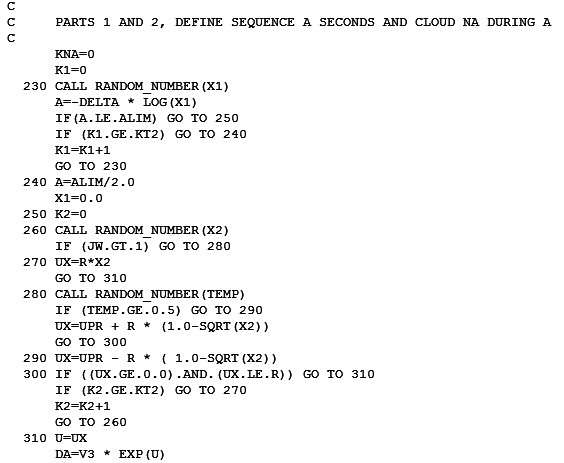
Source-code:
 Xenakis FORTRAN code
Output:
 FORTRAN code output
X  enakis’s ‘Morsima/Amorsima’ score says that ‘moros’ = ‘fate’ and ‘amorsima’ = ‘that which does not come from fate’. It was composed on an IBM 7090 in Paris, in increments/revisions between 1956 and 1962, and it was, like Xenakis’s ‘Achorripsis’, supposedly entirely stochastic (random, computer-generated). To me, this beggars belief.

F  ew have ever performed a deep-dive source-code review of what Xenakis programmed, nor compared what the 7090 generated to what Xenakis actually wrote down as a published score. Oh, yes, there are people who have ported the FORTRAN code in Xenakis’s book to FTN95, and, yes, the code does run—it does produce things. It has calls to the built-in FORTRAN random-number function; it modifies global variables and accesses the system clock to accomplish a modest degree of runtime indirection and aleatorics, in the limited ways that the FORTRAN language was (and is) able to support.

B  ut these source-codes do not produce things that have any close resemblance to any composition that Xenakis actually published. And the in-line commenting of the source code is terrible. The rats' nests of GOTO statements upon GOTO statements are nearly impenetrable-incomprehensible, even by the not-so-great software engineering standards of his day. A static analyzer would be the thing to use with this wild-hare code, not manual ‘desk analysis’! PRQA used to sell an analyzer called QAfortran™. I don’t know whether this is still available. I don’t see it on their website...

W  e have lots of software things today that serve as composition-aids... PWGL, Vielklang, Max/MSP, Jitter, harmonization plug-ins in Finale® and other notation applications… all sorts of things. And in the 2000s [almost] nobody goes around touting their use of composition software in the way that Xenakis did. By the same token, [almost] nobody is embarrassed to say that they do use them, or to forthrightly confess the methods by which the tools contribute to the compositional process.

X  enakis’s code supposedly causes the [specifications for the scored—] sounds to be generated as a directed-graph (digraph). First the [random] sequence of pitches is generated, with each note’s time of specified onset—it’s time coordinate. Then its timbre is generated (the instrument that is to play it; and its articulation: arco, pizzicato, glissando, and so on). Then the velocity of attack. Then the gradients in loudness (dynamic changes in loudness during the time interval the note is sounded... legato, accent, marcato ^, staccato, slur, portato/martelé ... sforzando, subito whatever) and in pitch (vibrato or not, glissando beginning and ending, shakes’ frequency and pitch-width). Then the duration. Not sure whether the program had anything in it to specify the (random) mode of releasing each note.


    [50-sec clip, austraLYSIS, Iannis Xenakis, ‘Morsima/Amorsima’, 1.6MB MP3]


    [50-sec clip, austraLYSIS, Iannis Xenakis, ‘Morsima/Amorsima’, 1.6MB MP3]

T  he 7090 was a room-sized $3M, 36-bit single-CPU machine, with 32K words of magnetic-core RAM (144 KB) and a clock cycle of 2.18 μs (459 KHz). It computed at about 0.2 MIPs, 0.03 MFLOPs. [The little laptop on which I am now writing this blog, is 64-bit, 8 GB, over-clocked 3.06 GHz dual-CPU, 46.7 MIPS (Dhrystone ALU), 35.2 MFLOPS (Whetstone iSSE3).]

B  ut the probabilities in ‘Morsima-Amorsima’ fate-vs-nonfate are highly unlikely. And this piece and others are too, too beautiful to be ‘lightly edited’ output from any of Xenakis’s FORTRAN source-codes that are available. Instead, there are the hallmarks of the human ear, the human hand, the Xenakisian mind. I am betting that this ‘Morsima/Amorsima’ is maybe 80% Xenakis traditional compositional method-produced and only 20% Xenakis algorithms on IBM 7090-produced—20% Fate and 80% Non-Fate, by one way of thinking about random events and chance. The score only costs €50. We should take a detailed statistical look and see!

 IBM 7090, circa 1960
I  am not saying that Iannis Xenakis deceived anyone, exactly, regarding how his compositions were produced. He was a brilliant, flamboyant character and a wonderful and entertaining speaker, and I experienced these qualities of his, first-hand. I attended a lecture series he gave in 1972… I had been taking Computer Science courses at University of Minnesota at the time. The exuberance and expansiveness he exhibited when speaking were fabulous.

B  ut I think that not enough detailed consideration has been given to the stories he told about his compositional methods—comparing his writings and interviews and software source-codes against his finished scores, to see how well (or not) Xenakis’s remarks about his methods are supported by the evidence.

X  enakis’s famous book ‘Formalized Music’ and the FORTRAN source-code fragments that have been published obfuscate more than they reveal. Was he unsatisfied with the musicality of the results of his algorithms? Did he feel that he needed to extensively rewrite the computer-produced compositions to achieve a more aesthetically appealing, defensible work? What motives would lead him to withhold so many of the details? Did he have a sense of obligation to IBM Paris, who had provided resources and upon whom he depended? Was it pride? The François Bernard Mâche and the James Harley biographies are well worth studying! But none of the biographers to-date have been software engineers capable of performing detailed code-reviews, to ascertain whether or not Xenakis actually did things in the ways he claimed that he did.

I  f you have views about these things—about the roles of computational composition and interactions between algorithms and human composers; and about Xenakis’s evasiveness about his actual methods—please add a comment below or send me an email. If you knew Xenakis personally and think my speculation is a bunch of hooey, please write and tell me so. If you yourself delegate to Vielklang or PWGL or other software tools part of your composerly work, I’d be delighted to hear from you, too, to learn how you use these tools to generate ideas and edit them.

O  f course, if you’re able to attend the Steven Schick—ICE performance tonight in Chicago, please put a comment here, too! Thanks!

 Temperley book

 Smith-Dean book