Showing posts with label australia. Show all posts

Sunday, May 27, 2012

Chamber Music Repertoire for Didgeridoo?

T here are a few orchestral works that include didgeridoo (Sean O’Boyle and others), but for conservatory recital or chamber performances there are currently only about 3 dozen chamber music compositions that are readily available. Most of these are indexed at the Australian Music Centre (Duos, Quartets, Quintets, Sextets, Octets; Solo with vocal ensemble). You may also want to consider Peter Sculthorpe’s String Quartet No. 12 with didjeridu, and ‘Lorin’s Piece’ for didjeridu and voice; Neal Corwell’s ‘Aboriginal Voices’ trio for tuba, didgeridoo, and voices; Philip Glass’s ‘Voices’ for organ, didgeridoo, and narrator; and Dubravko Lapaine’s ‘Rescribi’ trio for piano, didgeridoo, and percussion.


    [50-sec clip, Dubravko Lapaine, ‘Kosmopterix’, ‘Rescribi’, 1.6MB MP3]

and ‘Putnik’:

    [50-sec clip, Dubravko Lapaine, ‘Kosmopterix’, ‘Putnik’, 1.6MB MP3]

T  he aboriginal people have a great deal to teach the western world about wind playing in general and lip reeds in particular. The trombone may seem old when compared to western orchestral instruments, but it is only a five hundred year-old baby when compared to the possible forty thousand-year-old tradition of the didjeridu.”
  — Stuart Dempster, 1979.

V irtuosic double- and triple-tonguing in the didgeridoo repertoire have parallels to ‘cursus’ in classical Latin oratory and medieval chant (see Eklund, link below), and you might consider that idea in preparing a program. Rhythm—the patterning of accents in speech or singing—establishes expectations; it entrains the listener and the speaker, phase-locking them to the pattern. Accents in Latin fall on at least one out of every three syllables. But in English and other languages the gaps are longer—you can often go for five or six syllables between accents. The didge literature tends to emphasize prosody and oratorical aspects—not only because of your vocalizations into the didge, but also because you have just the fundamental (and pedal), plus a few harmonics (‘toots’, ‘trumpets’) to work with. (Years ago, Juilliard professor Ivan Galamanian famously drew an analogy between instrumental (violin) playing and speech, in which he asserted that attacks are consonants and the sustained notes are vowels, and performers should treat them as such. The analogy is true enough for strings and other instruments, but it’s hardly even an ‘analogy’ in didgeridoo playing: given all of the tongue, jaw, and vocal tract technic involved in didge performance, the vowels-consonants assertion is a self-evident fact of how the didge sounds are produced.)

V  ocal and instrumental rhythms are sometimes direct translations of a poetic meter. In other words they may be sung or played, interchangeably. Far more often than not, however, vocal and instrumental rhythms create what we might call ‘rhythmic counterpoint’ when heard with reference to the poetic meter—the interplay among two or more rhythmic threads or voices. By continually altering the durational relationships and varieties of accent in a succession of syllables, musicians can elicit the close attention of listeners.”
  — Michael Tenzer, p. 43.

I n thinking about other instrumental repertoire that might be suitable as-is or transcribable for chamber didge recital, you might explore pieces whose articulation and accents entail sound-envelopes that are marcato ‘thrust-followed-by-decay’, an accent that resembles a plucked string instrument like a double-bass. With the didge, the decay is because the outflow of air from the cheeks that occurs while you are inhaling through the nose in circular breathing can’t be as forceful or sustained as the outflow of air when supported by the diaphragm. In general, highly rhythmic, marcato pieces in low register are likely to be feasible and stylistically coherent with didge performance practice, regardless whether they are for winds, strings, or percussion. There are pieces for tympani (for example, Daniel Jenkyn Jone’s ‘Sonata for Unaccompanied Kettledrums’) that could be performed as-is or transcribed for didgeridoo. And there are a number of chamber pieces for bass clarinet or low brass that are plausible. More links that you may find useful follow.

DSM bari sax didge standpoetry feeDSM and didj

Saturday, May 12, 2012

Australian Brandenburg Orchestra: ‘Bach Eternal’ & Eternal Success

Australian Brandenburg Orchestra

I t’s always a good sign when a music performance sends shivers down your spine… as last night’s Australian Brandenburg Orchestra program did. In fact, for the artistic director of any ensemble or presenter organization, it is, I think, vital that you program and perform works that are capable of doing this to the spines of your audience. The released endorphins, enkephalins, and other natural neuropharmacology of this primitive reflex of joy and emotion are part of what gets butts in seats and keeps money flowing in, year after year. Challenge us with new works, yes, but make sure they are ones that give us shivers down our spines!

  • Bach – Sinfonia from Cantata ‘Wir danken dir, Gott’, BWV 29
  • Bach – Chorale from Cantata ‘Herz und Mund und Tat und Leben’, BWV 147
  • Bach – Orchestral Suite No. 1 in C major, BWV 1066
  • Bach – Chorus from Cantata ‘Unser Mund sei voll Lachens’, BWV 110
  • Zelenka – Kyrie from ‘Misa Sancti Josephi’, ZWV 14
  • Telemann – Concerto for Two Horns in D major, TWV 51:D1
  • Handel – Coronation Anthem No. 2, ‘My heart is inditing’, HWV 261
  • Handel – Coronation Anthem No. 4, ‘Let thy hand be strengthened’, HWV 259

O ne aspect that is especially impressive about the ABO’s first-rate performance excellence is its personnel—a majority of the performers in ABO are part-time and are employed in other professions outside of music. This, and the fact that members hail not only from Sydney, but also from Melbourne, Brisbane, Canberra, and other places that are a considerable distance from ABO’s Sydney home-base. Rehearsals and logistics no doubt present challenges. With the logistical and geography issues, performing in this ensemble is more than the usual ‘labor of love’. Yet ABO, founded in 1989 by its director, harpsichordist Paul Dyer, has endured, has performed worldwide, and has 16 recordings on the ABC Classics label, including 5 ARIA Award winners for ‘Best Classical Album (1998, 2001, 2005, 2009, 2010).

Paul Dyer
P   ut another way, the provision of full-time orchestral work for graduates [would require] one quarter of Australia’s full-time orchestral musicians to retire every year. It also requires that no existing musicians, previous graduates, or overseas players apply for the positions. Even if this were to occur, four years later it will be [today’s] graduates’ turn to retire. In this context [of oversupply], part-time/seasonal orchestras rate special mention. In Australia, most part-time orchestras were founded by musicians... Most of the players in part-time orchestras come from academic institutions and from the pool of quality freelance players who engage in a number of different roles both inside and outside of music.”
  — Dawn Elizabeth Bennett, Understanding the Classical Music Profession, 2011, p. 83.

D espite challenges for the many who have day-jobs outside of music, the approximately 30 period-instrumental musicians and approximately 30 members of the choir maintain this tremendously high standard of musicianship—the technical fluency and enthusiasm and spine-tingling crispness that projected to our ears last night. They achieve warmth, joy, and musical intimacy that might plausibly and paradoxically be nourished by the challenges and part-timeness that dog their members’ hard-won individual commitments to music—á la “that which does not kill you makes you stronger”, or something like that. The Australian Chamber Orchestra and other ensembles here likewise thrive relying on part-time personnel.

C ould ABO’s music business model be replicated in the U.S. and elsewhere? The facts that ABO’s personnel come from more than one city and ABO’s performances are regional or national and not geographically bound to one city help to ensure that ABO’s sources of philanthropic financial support and corporate donors can be sought in a variety of cities and catchment areas, so that support from a small set of donors in a particular city doesn’t get tapped-out over a period of years and so that the cyclical economic ups-and-downs that disproportionately affect leading donors in one city don’t become an Achilles heel or point of latent financial instability for the organization. Each city and its donors feel strong attachment to the organization and its brand. Market diversity and de-concentration are sensible aims for any arts organization that aspires to sustainability and long-term financial success to have.

Australian Brandenburg Orchestra

S uffice it to say, this wonderful ABO performance gave me quite a lot to think about besides the endorphins and shivers. Eleven ABO Board members, all effective at fund-raising, none of them ‘figurehead’ material. Fifteen experienced staff members—with development and media relations firing on all cylinders. A charismatic artistic director known for affability and bridge-building and inclusive attitude. Lessons here for all of us! A few links below, for your interest.

Australian Brandenburg OrchestraAustralian Brandenburg Orchestra

Thursday, May 10, 2012

Andreas Haefliger: Beethoven Piano Concerto No. 2, Op. 19, in Sydney

Sydney Opera House

W ithout doubt, there is something you are doing profoundly right in your interpretation as a soloist when a yellow Labrador retriever in Row 1 listens attentively, head raised and up on her/his elbows, throughout your Beethoven concerto performance. (I do not know whether the same holds true of cats, except possibly Siamese—a point about which Christopher O’Riley and other cat-owning pianists may be able to comment.) Labradors are kindly, good-natured, and take a lot of things in stride. As a breed, the Labrador is notable for being steady-tempered but does display impatience with human pretension in all its manifestations. If she finds your expressions burdensome, the Labrador will sigh or adjust her posture, clunking her bony forearms on the wood floor loudly. But Andreas Haefliger’s account of Beethoven’s second piano concerto was true enough, and the Labrador looked thoroughly pleased as Andreas took his bows. We were well pleased too. (The probity of the cellos was periodically a matter of some doubt, though.)

Sydney Opera House

T his concerto offers many dramatic moments—some Mozartian figures; some prodigious cadenzas that Beethoven only wrote down when the piano part was published in 1809, because up until that time he used the piece as a promotional vehicle for his own career as a concert pianist and did not wish other pianists to co-opt the work or eclipse him. And in that regard the interaction in this concerto between the soloist and the ensemble has been the subject of considerable scholarly writing—some authors opining that Beethoven had not by the early date of this concerto’s birth yet mastered the composerly skills of constructing the arcs that define soloist-orchestra narrative.

B ut Haefliger takes this material and masterfully does with it what can only be viewed as authentic completion of Beethoven’s meaning and intent. He knows how to take the measure of the concertmaster and first violins behind him, and gaze at the oboes as they speak, and then deliver his own lines in a manner that the others accept as truthful—an honest account to which they must respond in-kind. The brass, characters not known for tender sensibilities, wait for the completion of Haefliger’s pianissimo figure, a deep contemplation evident in the piano’s right hand, and are made visibly more humane and introspective by it. Haefliger finishes a burst of activity, leans backward, left hand falling to his side, right hand rising in a flourish, and looks earnestly to his left at the orchestra to see what their answer will be. He imparts a magisterial, conductorly relish to the meaning; to use a cinematic or theatrical phrase, he ‘pulls focus’ beautifully onto and off of himself in a way that makes the ‘character’ of the solo part believable and engaging and which enhances the overall flow of the story, including the part of it that belongs to the ensemble to tell.

T he cadenza was full of bravado; the recitative passages, aptly confessional. When the tempo is slow enough, the shorter notes were played softer, without loss of clarity... which, as I understand, is a ‘bebung’ clavichord technique that Beethoven sometimes used in his piano writing for dramatic expressive purposes. In fact, the whole performance yesterday embodied the best qualities of excellent drama and interplay between soloist and orchestra. Bravo!

Sydney Opera House
I   was consumed with sheer terror. How, how, how? How does this start? The silence lengthened, ominously. When you’re on-stage, a few seconds of silence feels like an eternity. This was considerably more than a few seconds, and I felt it pressing down on my shoulders. Finally, in panic, I had an idea: maybe if I just put my fingers up on the keyboard, they’d know what to do. I lifted my hands slowly to the keyboard. The audience was surely, by this point, deeply impressed. And, by a miracle, it worked. By themselves, on their own, my fingers found the right configuration of black and white keys, and I let them go. Before I knew it, they had jumped into the opening theme [of the third movement of Op. 19], and the orchestra soon came galloping up behind them.”
  — Leon Fleisher, p. 24.
Sydney Opera House

Monday, May 7, 2012

Evgeny Sorkin & Gerard Willems: Beethoven Sonatas for Piano & Violin (& Cocktails)

Sydney Conservatorium
A   re we as performers always bound to execute Beethoven’s ornamentation as he consciously intended when we believe that there is a more convincing possibility? This is a subject to which a whole conference could be devoted, as it involves aesthetic, philosophical and even moral dilemmas. My own short answer is ‘Yes!’ There are certain works where it is obvious that a convincing manner of execution took decades to discover. It is reasonable to think that we are still today discovering it.”
  — Daniel Herscovitch, Professor of Piano, Univ Sydney Conservatorium of Music.

T he faculty recital given last night by Sydney Conservatorium faculty members Evgeny Sorkin and Gerard Willems was exciting. The program featured the ‘Spring’ Sonata (Op. 24) and the ‘Kreutzer’ Sonata (Op. 47). The conservatory’s ‘Cocktail’ programs—starting at 19:30, with 65- to 80-min of performance and a snap 5-min intermission—are very popular. It is clearly a very effective marketing/programming concept… the recital hall was nearly completely filled up on this cool Fall Monday evening. Attendees seemed mainly to be 30s to 60s business people who work in Sydney’s central business district, who attend these concerts before taking the train home to the suburbs.

Abundant sturm und drang… lots of passion and gravity-defying force… yet tremendous intimacy, with both performers probing emotionally far beyond the notes. Such joy in this ‘Spring’! Really beautiful to see two artists enjoy performing together this much. Thrilling performance, plus 60 seconds of amusing historical/explanatory remarks from Gerard and Evgeny prior to beginning each piece. No ‘museum’, this!

Sydney ConservatoriumSydney Conservatorium

Wednesday, May 2, 2012

Mozart’s Requiem Down Under

Sydney Opera House
M   ozart’s ‘Requiem’ brings a shift in mood—with the terror, the sorrow, and the sheer drama of Life … and Death.”
  — Sydney Symphony, program notes, MAY-2012.

T he performance of Mozart’s Requiem in D minor, K.626, by members of the Sydney Symphony led by [guest] conductor David Zinman challenged our patience last night. The Süssmayr completion of the Requiem is something that many ensembles perform in 57 min or longer, full of pathos. But speeding it up more than 15%, to come in at less than 49 min, is aesthetically not a great idea. Specifically, it’s not a good idea when the acoustic delay of the stage that is more than 14 meters deep from the conductor to the rearmost chorister makes the performers sound as though they are not ‘together’.

A lthough I’ve been in Australia previously, this was the first time I’d heard a performance in the Sydney Opera House… a very warm, responsive hall.

T he vocal parts were ably performed by Jennifer Welch-Babidge, soprano; Fiona Campbell, mezzo-soprano; Paul McMahon, tenor; Paul Whelan, bass; and the Sydney Philharmonia Choirs.

A nd a diverting and expansive pre-concert talk was given by singer and musicologist Natalie Shea, who cued up more than a dozen clips of recordings to illustrate the points she was making.

T o me, I hear this Dies Irae as an ‘appogiatura’ within a Lacrimosa-esque life; or Mozart saying, in full view of his own fast-approaching death, “Life is hard, and then you (and we all—) die.” In that kind of frame of mind, I’m troubled by Robert Levin’s view that Mozart scholar Simon Keefe is asserting that accurately understanding the Requiem necessarily requires an historically-informed sense of context or that late 18th-Century judgments of the work are ‘privileged’ or somehow more valid than anything we might grasp or express. It just seems that the work is more naturally accessible than that. (I do like Levin’s own completion of the Requiem, though—complete with a fugue ending of the Lacrimosa.)

U  nsanctimonious’ to the point of ‘willfulness’... like musically rendering a [personal] prayer, not a Mass.”
  — Natalie Shea, pre-concert remarks, 03-MAY-2012.

T he mystery of how much of the Requiem was Süssmayr’s and how much was Mozart’s will maybe never be resolved. But ultimately, the nature of the piece seems to me to be more individual/idiosyncratic—an individualistic expression of what it is to be mortal; a personal ‘music-of-the-soul’—than requiem-idiomatic or ‘normative’ of what a requiem should be or say.

P .S.—I’m looking forward to the release later this year of Professor Keefe’s new book, which reevaluates the nature of the incomplete manuscript and its context. Keefe covers the history of the work and extensively reviews the accumulated criticism, analysis, and performance practices that pertain to it. Keefe particularly focuses on the autograph score and on Franz Süssmayr’s 1792 completion, which is the one that the Sydney Symphony and Philharmonia Choirs performed tonight. Keefe recommends that evidence that is confined only to records of Mozart’s life and correspondence and notations in the incomplete manuscript are not enough—understanding the Requiem instead requires broader, hermeneutics-based methods of analysis.

Keefe book

Thursday, June 4, 2009

Knowledge Unspoken: How Much of Xenakis’s ‘Morsima-Amorsima’ Was Really Computer-Generated?

 IBM 7090, circa 1960
B    ut of what essence are these materials made? This essence is the intelligence of man solidified in a way: intelligence that seeks, questions, infers, reveals, and foresees at all levels. Music and the arts in general seem necessarily to be a solidification—a ‘materialization’—of intelligence. Naturally, this intelligence, though humanly universal, is diversified by the individual: by talent that distances one individual from the others. Talent is therefore a kind of qualification—a gradation of the vigor and richness of intelligence. For intelligence is, fundamentally, the result—the expression of billions of exchanges, of reactions, of transformations of energy in the cells of the brain and the body. One could, taking astrophysics as a visual aid, say that intelligence is the form taken by the minimal acts of cells in their condensations and their movement—as happens with the particles of the suns, planets, galaxies, and clusters of galaxies born of or turned back into cold interstellar dust... To think up music as composer, craftsman, and creator, it is first necessary to study solfège, notation, music theory, and even an instrument over a long time. And since, in addition, musical creation is considered superfluous, very few people are able to attain it. Thus the individual and the society are deprived of the formidable power of free imagination that musical composition offers them. We are able to tear down this ‘iron curtain’, thanks to the technology of computers and their peripherals. The system that has succeeded at this ‘tour de force’ is the UPIC (Unité Polyagogique Informatique du CEMAMu)...”
  —  Iannis Xenakis in a typically ‘expansive’ moment in the 1970s, quoted in ‘The Art of Music: Tradition and Change’ by William Christ and Richard DeLone.
T  he performance by International Contemporary Ensemble and Steve Schick of five major works—‘Psappha’, ‘Echange’, ‘Akanthos’, ‘Palimpseste’, and Xenakis’s final composition, ‘O-Mega’—is an opportunity not to be missed. It’s at Chicago’s Museum of Contemporary Art, tonight at 19:30. Anticipating this ICE performance got me to listening to the recordings I have of Xenakis’s music. I have never been lucky enough to hear a ‘live’ performance like this...

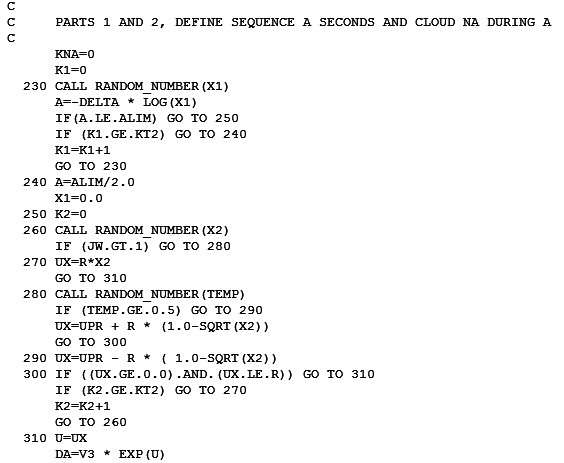
Source-code:
 Xenakis FORTRAN code
Output:
 FORTRAN code output
X  enakis’s ‘Morsima/Amorsima’ score says that ‘moros’ = ‘fate’ and ‘amorsima’ = ‘that which does not come from fate’. It was composed on an IBM 7090 in Paris, in increments/revisions between 1956 and 1962, and it was, like Xenakis’s ‘Achorripsis’, supposedly entirely stochastic (random, computer-generated). To me, this beggars belief.

F  ew have ever performed a deep-dive source-code review of what Xenakis programmed, nor compared what the 7090 generated to what Xenakis actually wrote down as a published score. Oh, yes, there are people who have ported the FORTRAN code in Xenakis’s book to FTN95, and, yes, the code does run—it does produce things. It has calls to the built-in FORTRAN random-number function; it modifies global variables and accesses the system clock to accomplish a modest degree of runtime indirection and aleatorics, in the limited ways that the FORTRAN language was (and is) able to support.

B  ut these source-codes do not produce things that have any close resemblance to any composition that Xenakis actually published. And the in-line commenting of the source code is terrible. The rats' nests of GOTO statements upon GOTO statements are nearly impenetrable-incomprehensible, even by the not-so-great software engineering standards of his day. A static analyzer would be the thing to use with this wild-hare code, not manual ‘desk analysis’! PRQA used to sell an analyzer called QAfortran™. I don’t know whether this is still available. I don’t see it on their website...

W  e have lots of software things today that serve as composition-aids... PWGL, Vielklang, Max/MSP, Jitter, harmonization plug-ins in Finale® and other notation applications… all sorts of things. And in the 2000s [almost] nobody goes around touting their use of composition software in the way that Xenakis did. By the same token, [almost] nobody is embarrassed to say that they do use them, or to forthrightly confess the methods by which the tools contribute to the compositional process.

X  enakis’s code supposedly causes the [specifications for the scored—] sounds to be generated as a directed-graph (digraph). First the [random] sequence of pitches is generated, with each note’s time of specified onset—it’s time coordinate. Then its timbre is generated (the instrument that is to play it; and its articulation: arco, pizzicato, glissando, and so on). Then the velocity of attack. Then the gradients in loudness (dynamic changes in loudness during the time interval the note is sounded... legato, accent, marcato ^, staccato, slur, portato/martelé ... sforzando, subito whatever) and in pitch (vibrato or not, glissando beginning and ending, shakes’ frequency and pitch-width). Then the duration. Not sure whether the program had anything in it to specify the (random) mode of releasing each note.


    [50-sec clip, austraLYSIS, Iannis Xenakis, ‘Morsima/Amorsima’, 1.6MB MP3]


    [50-sec clip, austraLYSIS, Iannis Xenakis, ‘Morsima/Amorsima’, 1.6MB MP3]

T  he 7090 was a room-sized $3M, 36-bit single-CPU machine, with 32K words of magnetic-core RAM (144 KB) and a clock cycle of 2.18 μs (459 KHz). It computed at about 0.2 MIPs, 0.03 MFLOPs. [The little laptop on which I am now writing this blog, is 64-bit, 8 GB, over-clocked 3.06 GHz dual-CPU, 46.7 MIPS (Dhrystone ALU), 35.2 MFLOPS (Whetstone iSSE3).]

B  ut the probabilities in ‘Morsima-Amorsima’ fate-vs-nonfate are highly unlikely. And this piece and others are too, too beautiful to be ‘lightly edited’ output from any of Xenakis’s FORTRAN source-codes that are available. Instead, there are the hallmarks of the human ear, the human hand, the Xenakisian mind. I am betting that this ‘Morsima/Amorsima’ is maybe 80% Xenakis traditional compositional method-produced and only 20% Xenakis algorithms on IBM 7090-produced—20% Fate and 80% Non-Fate, by one way of thinking about random events and chance. The score only costs €50. We should take a detailed statistical look and see!

 IBM 7090, circa 1960
I  am not saying that Iannis Xenakis deceived anyone, exactly, regarding how his compositions were produced. He was a brilliant, flamboyant character and a wonderful and entertaining speaker, and I experienced these qualities of his, first-hand. I attended a lecture series he gave in 1972… I had been taking Computer Science courses at University of Minnesota at the time. The exuberance and expansiveness he exhibited when speaking were fabulous.

B  ut I think that not enough detailed consideration has been given to the stories he told about his compositional methods—comparing his writings and interviews and software source-codes against his finished scores, to see how well (or not) Xenakis’s remarks about his methods are supported by the evidence.

X  enakis’s famous book ‘Formalized Music’ and the FORTRAN source-code fragments that have been published obfuscate more than they reveal. Was he unsatisfied with the musicality of the results of his algorithms? Did he feel that he needed to extensively rewrite the computer-produced compositions to achieve a more aesthetically appealing, defensible work? What motives would lead him to withhold so many of the details? Did he have a sense of obligation to IBM Paris, who had provided resources and upon whom he depended? Was it pride? The François Bernard Mâche and the James Harley biographies are well worth studying! But none of the biographers to-date have been software engineers capable of performing detailed code-reviews, to ascertain whether or not Xenakis actually did things in the ways he claimed that he did.

I  f you have views about these things—about the roles of computational composition and interactions between algorithms and human composers; and about Xenakis’s evasiveness about his actual methods—please add a comment below or send me an email. If you knew Xenakis personally and think my speculation is a bunch of hooey, please write and tell me so. If you yourself delegate to Vielklang or PWGL or other software tools part of your composerly work, I’d be delighted to hear from you, too, to learn how you use these tools to generate ideas and edit them.

O  f course, if you’re able to attend the Steven Schick—ICE performance tonight in Chicago, please put a comment here, too! Thanks!

 Temperley book

 Smith-Dean book


Saturday, April 25, 2009

Australian Chamber Orchestra, Epitome of ‘Embodiment’

 ACO, L.A. Times, 22-APR-2009
O    ne of the foremost composers of the French Baroque operatic tradition, Rameau is often cited for his struggle to steer lyric tragedy away from its strict Lullian form, inspired by spoken tragedy, and toward a more expressive musical style… In his compositions, Rameau tried to highlight music’s potential for dramatic meanings. But his listeners, who understood lyric tragedy to be a ‘poetic’ rather than ‘musical’ genre, were generally frustrated by these attempts. In fact, some described Rameau’s music as ‘monstrous’—using an image of deformity to represent the failure of reason and communication.”
  —  Charles Dill, 1998, Professor of Musicology, Univ Wisconsin-Madison.
L  isten to that, will you?” the person next to me could not help but say to me during the intermission. “Have you ever heard an ensemble so in-tune? or so ‘tight’, rhythmically? Each section is playing like they were one person!”

Y  are right. I couldn’t disagree,” I said. “And to see them pivoting and rotating left and right, each by as much as 90 degrees, to see each other and physically gesture directly at each other! Their knee-flexing and expressive leaning and swaying... Their stretching of the dynamics, decibels quieter (with mutes on) and louder, beyond the usual interpretation of the as-written dynamics... How intriguing to see instrumentalists do this! It’s like they are opera singers, singing to each other.”

T  he Australian Chamber Orchestra performance in Kansas City tonight was exceptionally good. And the exchange above occurred after the Haydn and Mozart before they got to the Suite from the opera ‘Dardanus’.

E nglish pianist Paul Lewis (who trained with Alfred Brendel, among others) joined the Orchestra for the Mozart Piano Concerto No. 12, K. 414... “A lush yet ‘crystalline’ tone... rhythmically ultra-synchronized with the ACO members... Amazing!”

  • Haydn: Symphony No. 44 ‘Trauer-Sinfonie’
  • Mozart: Piano Concerto No. 12 in A Major, K. 414
  • Rameau: Suite from ‘Dardanus’ (1739, 1744, 1760; RCT 35)
  • Haas: String Quartet No. 2, Op. 7, Monkey Mountains Suite (‘Zopicich hor’)
T  he Rameau after the intermission was especially dramatic. Sans recorders and flutes but equipped with antiphonally-distributed horns, we were treated to six short movements with wonderfully rich acoustic colors and textures. Oboes cohabited with violas, the bassoon communed among felicitous cellos, and Lions laid down peaceably with Lambs. The textural and spatial novelty is not gimmicky—it’s innovative, aesthetically defensible in the context of Baroque sensibilities, and stimulates more drama and interest than the music might otherwise do. Very cool. And an excellent way to illuminate Rameau’s complex sense of the interplay between the narrative arc of the libretto and the associated arc of the instrumental music for the opera.

R  ichard Tognetti became Artistic Director and Lead Violin in 1990, and under his leadership the ACO has embarked on ever more flexible ensemble configurations: small chamber group; small symphony orchestra; electro-acoustic chamber group; and so on. In ‘live’ performances, only the cellists are seated. The energetic interactions that this deployment encourages are nice—the visual gestures amongst the artists tend to be more demonstrative than when ensemble members are all seated. The standing ensemble members and the antiphonal positioning of some of the instruments add substantially to the excitement of the experience for audience members—these directorial/production decisions were especially appropriate for the dramatic Rameau. Oboes, far far stage-left, their backs to the shell, behind the violins; horn, center-rear; bassoon, far stage-right. These parts speak to each other across the distance, while the strings play with tight precision, as though they were one! Not just stretched dynamics, but dramatically accentuated spatial depth. Uncanny!

T  hese decisions and variations also help tremendously realize and vividly accentuate Rameau’s physicality. These directorial/production decisions draw attention to the metaphorical ‘embodiment’ that Golan Gur and other Rameau scholars have written about. ‘Embodiment’ in the field of cognitive science refers to understanding the role of an agent's (character’s; performer’s) own body in its situated interactions with other agents in context—the role that the body has in the agent’s comprehending the situation and those interactions. For example, Dardanus “can’t stand to see” his future relationship with Iphise reduced to questions of pre-arranged nuptials and political alliances—his physical experience of standing, or failing to remain standing, or failing to endure the situation—is an example of cognitive ‘embodiment’, of physicality, which colors Dardanus’s cognition of the situation. His impulsive decision to go kill the monster could hardly arise from anything less than a powerful emotion, mediated by ‘embodied’ cognition.

A  CO’s production values are fabulous throughout, but this Rameau really captured my imagination… Richard Tognetti is the Dardanus character! We are so not accustomed to instrumental players physically ‘acting’! These are not a Baroque ensemble performing a Suite ‘from’ Rameau’s opera; they are playing and moving physically on-stage as though they are the opera singers.

I  n Greek mythology, Dardanus was a son of Zeus and Electra. The name ‘Dardanus’ in Greek (Δάρδανος) is forboding: it means ‘burnt to a shrivet’, from the verb δαρδάπτω (dardapto)—to grind down utterly, to burn up completely, to vaporize. In the Rameau opera, Dardanus is feuding with King Teucer. Teucer has promised to marry his daughter Iphise to King Anténor, done deal, so much for women’s rights. King Anténor is sucking in his attempts to defeat the monster that’s terrorizing Teucer’s kingdom. Dardanus and Iphise meet, through the probably-superfluous intervention of the magician Isménor, and fall hopelessly in love. An ‘army of one’ and now properly/amorously motivated, Dardanus then single-handedly defeats the terror-monster, saving Anténor’s life. Teucer and Dardanus make peace, and Dardanus finagles Teucer’s release of Iphise from her betrothal to Anténor. Anténor’s happy enough just to be alive, so Dardanus and Iphise marry and live happily ever after, so far as we or Rameau know. So, embodiment, yes; burnt shrivets, no—at least not in this opera or this Suite for chamber ensemble.

  • Ouverture (Lent)
  • Premier air (Grave)
  • Ritournelle
  • Premier menuet; Deuxième menuet en rondeau
  • Air de triomphe
  • Bruit de guerre pour Entr’acte
T  he piece by Pavel Haas—Tognetti’s arrangement of String Quartet No. 2 for the larger ACO ensemble—pushed the dramatics up a notch. A dark, dissonant work, filled with punctate staccatos and percussive effects; very ‘cinematic’. Once again, the rhythmic crispness of the ensemble lent extra energy and excitement to the endeavor. The synchronicity of each section was astonishing—every player’s vibrato starting simultaneously, executing with identical width and periodicity, and ending simultaneously; every sautille, identical. To paraphrase Butch Cassidy & The Sundance Kid, who are those guys!??! ACO’s unprecedented dramatics and beautiful physicality brought the audience to its feet.

I  f you haven’t previously encountered it, you may like to look at Charles Dill’s book on Rameau from about 10 years ago. Also, as relates to the inter-relationships between text and music, have a look at Peter Kivy’s new book. Several sources regarding ‘embodiment’ and theory of aesthetics and cognition are also included in the links below, for your interest.

 ACO on Beach in Sydney
The Australian Chamber Orchestra was founded in 1975 in Sydney. Their performances have been very popular at home (more than 10,000 Australian subscribers to their concert series) and heavily attended abroad, too. The ACO’s repertoire ranges from baroque and classical pieces to 20th-Century and new music. ACO has in recent years commissioned quite a few compositions. The financial sponsorship of the Australia Council for the Arts and the Australian Music Office have contributed significantly to ensuring ACO’s success and sustainability. Would that ACA and AMO examples were emulated by other countries, particularly during the current economic down-turn! (As Tognetti said to the audience, maybe in a more affluent time ACO will not have to conserve on expenses so much and once again tour with their percussionist. That way, Julian Thompson will not need to treat the body of his cello so severely/pugilistically, to create the knocks, bangs, paper-in-the-strings buzzes, and other percussive effects called-for in works like the Haas.)


[ACO, Surfing Chamber Music ‘Musica Surfica’]


 Dill book