W hen a string is plucked, the ones which are an octave or a fifth higher vibrate and sound audibly of their own accord. Music thus tightens its ties with sympathy.”
— Descartes, Compendium Musicae, 1618
 DSM:
DSM: Giuliano Carmignola’s playing was positively
cinematic!
CMT: His attacks were fierce! Ferocious! The improvisatorial license he exercised was not only with the phrasing and baroque ornamentation, but also with the tempi and dynamics! Vivaldi can so often be merely innuring. But this! This! Carmignola gave us theater! Did you see his suffering? Did you see his ‘argument’ with the Venice Baroque first violins? The alternate bowings, the detaché notes, the arpeggios on each of the strings, the double stops, the dervish figurations in the upper register!
DSM: He put himself entirely into the music! He really made these pieces stand up, made them 3-dimensional—made them living, breathing things! It was ‘anamorphic Vivaldi’!
 CMT:
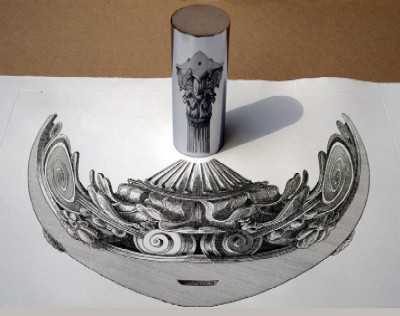
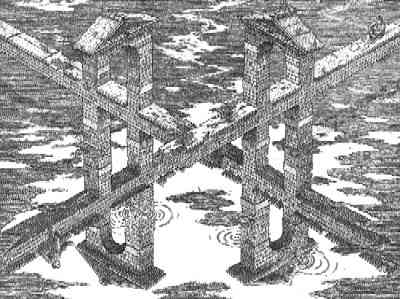
CMT: Anamorphic rendering—this means a distortion in the spatial dimensions of a work, correct? In anamorphic graphical art, there are two or more images of the same object in the field of view that simultaneously compete for the viewer’s perception and belief. You have a trompe l’oeil perspective that compels you to work to understand what’s being represented and resolve the conflicts or contradictions in it. This is what you are saying when you use this fancy word ‘anamorphic’?
DSM: Yes. István Orosz and Julian Beever and Kurt Wenner and others are artists who recently having been working in this idiom. The tradition dates back at least to the early Renaissance.

But ‘anamorphic’ also is a term in cinematography—optical lens transformation developed in the 1950s in connection with widescreen formats, to fully utilize the 35mm film surface. If shooting in widescreen picture format, without an anamorphic lens, the available film area is not used completely; some of the film surface is wasted (top and bottom).

But if you shoot with an anamorphic lens, the picture is optically stretched in the vertical dimension to cover the entire film frame, and the inverse projection of this has a much better picture quality. When projecting the film, the projector must use an inverse lens to stretch the image horizontally back to its widescreen 2.40 aspect-ratio.

When I said that Carmignola’s playing seemed ‘anamorphic’ to me, what I mean is that he is compressing the timbral range of the Vivaldi and Tartini. He is also dramatically stretching the rhythmic space of the music, accelerating or retarding tempi as he animates the character. His ferocity and passion arouse in us an identification with his character—a strong sympathy that is really quite unique for an account of Vivaldi. That is what I mean by ‘anamorphic’.
 CMT:
CMT: Žižek describes Lacan’s view of the Subject—that the Subject is signaled by whatever “perturbs the smooth engine of symbolization and throws it off balance, an anamorphic entity that gains its consistency only in retrospect, viewed from within the symbolic horizon.” This is precisely how Carmignola comes across in live performance. He achieves his authenticity exactly
because he throws Vivaldi’s smooth engine of symbolization off-balance. And Carmignola capitalizes on the fact that our mass-culture exposure to flatter Vivaldi
has innured us! The slow movements for me were romantically milked too much by Carmignola and were nowhere close to an historically ‘proper’ reading. Some of the double-stopping by Carmignola was out of tune. And, just when I’m about to worry about those things, here comes Carmignola with another cinematic revelation, an entirely authentic and passionate utterance from his violin that makes me forgive and rethink all of my ridiculous quibbles. The point about the consistency that is evident only in hind-sight—the retrospective reflection of my forgiving, forgetting, and understanding anew—is basically this rethinking. A hind-sighted coherence. I think you are right—Carmignola is doing an anamorphic rendering of Vivaldi. In fact, Vivaldi is a perfect vehicle for Carmignola’s character. By the way, you know of course that your use of the 50-cent word ‘anamorphic’ is not at all novel. The literary theorists have been using it for years!
DSM: Well, fine. The term just seemed apt to me, that’s all. I don’t care whether the notion is new or not, or whether others in poetics and literary theory have appropriated it before. Musically, these pieces Carmignola performed in Kansas City are unique among Vivaldi’s output. The Vivaldi echoes Tartini and later Italian composers. Several of the pieces offer the soloist notes higher on the staff than we usually hear from Vivaldi. As for the romantic-sounding slow movements, I don’t think that Carmignola’s treatment of them was necessarily ‘romantic’ per se. They certainly were emotional, as they should be. Nobody knows exactly how these were performed in Vivaldi’s time, but I think that Carmignola presents viable and excellent interpretations. His playing is certainly consistent with the dictum that musicians should on one hand try to come as close as possible to the composer’s intentions, but on the other hand should live with the music they play and put their own personality into it. Carmignola has more than a fair share of personality!
CMT: Throughout the allegros were lively, vivacious and clean. But the temptation to take too swift a tempo was carefully avoided. Carmignola’s superbly virtuosic playing extended to the adagio/largo movements. The Venice Baroque ensemble performed with considerable control, I thought, offering calmness and serenity—a dramatic foil for the mercurial Carmignola. I loved the way the expressive playing from Carmignola provides an air of mystery.
DSM: I especially liked hearing Carmignola in the warm ambience of the small Folly Theater. It added nicely to the coloristic palette of the period instruments and was especially congenial to Carmignola’s dynamics. Nothing clinical or astringent about it!
CMT: But what about Carmignola’s character? What about the voice of the subject that Carmignola breathes life into. You know, Plutarch once told the story of a man who plucked a nightingale and finding but little to eat exclaimed: ‘You are just a voice and nothing more.’ Deconstructing the layers of meaning that cover the voice and concentrating on ‘the voice and nothing more’ is something that philosopher Mladen Dolar does.
 DSM:
DSM: Ah, up again pops our other mutual interest! In ‘A Voice and Nothing More’ Dolar goes beyond Derrida’s idea of ‘phonocentrism’ and revives and develops Lacan’s claim that the voice is one of the fundamental embodiments of the self, of the psychoanalytic object. Dolar says that, apart from the two commonly understood uses of the voice as a vehicle for meaning and as a source of aesthetic value, there is a third level of understanding: the voice as an object that can be seen as a ‘lever’ of thought. The voice is a ‘prime mover’. Carmignola is the epitome of a prime mover!
CMT: It takes a certain intrepid curiosity to pick up a book like the ones that Dolar or Žižek write. But the payoff can be huge: a new meaning, a new resonance accruing to something we previously paid barely any attention to—this inquiry into the nature of voice and its role as a bridge between nature and culture, Subject and Object, Self and Other, Body and Mind/Language, the personal and the political, the liminal and the pelagic.
DSM: Ruth HaCohen, a musicologist at Hebrew University of Jerusalem, has written about this, too. And Foucault and Deleuze. And Adorno. And Derrida in his brilliant essay ‘Memoirs of the Blind: The Self-Portrait and Other Ruins’. And Schopenauer long before that. Sympathy, in the sense of the ability to suffer with or for the other, entered English usage toward the end of the sixteenth century. This artistic sensibility nourished by the Aristotelian notion of poetic compassion has everything to do with ‘voice’. Max Scheler distinguished sympathy from emotional fusion—empathic states or experiences of total identification with another subject. He insisted instead on the exclusivity of sympathy as a moral and aesthetic principle stemming from the unequivocal recognition of the separateness of another human existence.
CMT: ‘Another existence’ in the sense of ‘other’? Other human beings, or other perspective on one’s self?
DSM: I see what you’re getting at. The normal sense would be in terms of subjectivity of other selves. But there is an aspect of Carmignola’s playing—the character he inhabits in his performance—that is self-referential. I suppose it’s possible to have sympathy with yourself, to identify with oneself as a subject, including one’s former self. Carmignola’s minor-key passages’ reflectiveness makes me think of this.
CMT: And Aristotle can be read as viewing real pity and theatrical pity as partially antithetical to each other—the first as encouraging moral action while precluding over-involvement, the second as related only indirectly to moral action while demanding emotional participation. Bifurcated between life and art, the Aristotelian
eleos became a challenge for literary theorists—they tried to overcome it without relegating pity to an imaginary or lower moral sphere. The outpouring that Carmignola delivers is clearly real, convincing, morally binding! We listeners were pulled from our seats, down to the stage, and grabbed by the collars!
DSM: Peter Greenaway achieved an effect quite like this in his 1982 movie, The Draughtsman’s Contract, set in the England of the Restoration, when tensions between artistic representation and social norms precipitated new appraisal of artist-beholder relations.
CMT: Okay, anamorphic. Have you got any other exotic neologisms in you today? More over-loose associations you wish to share?
DSM: Well, there are Carmignola’s fierce ‘Lombardic’ rhythms. And Carmignola’s ‘terraced’ dynamics. What about the ‘vocal’ tradition of ‘Venetian’ sound? Could we not say that Carmignola makes ‘bravura’ instrumental works out of works that were not written in a bravura manner? How about virtuoso ornaments as ‘insinuations’? The minor keys in Carmignola’s hands seemed to me to be ‘confessions à l’amore’—chromatic ‘incursions’ or ‘irruptions’ into lyric drama. There you are! Satisfied? Enough theoretical neologisms to suit you?
- Giuliano Camignola website
- István Orosz website
- Julian Beever website
- Kurt Wenner website
- Carmignola G. Vivaldi. (Arkiv, 2006.)

- Carmignola G. Late Vivaldi Concertos. (Sony, 2002.)
- Carmignola G. Late Vivaldi Concertos. (Sony, 2001.)
- Dolar M. A Voice and Nothing More. MIT, 2006.
- Gombrich E. Art and Illusion. Princeton Univ, 2000.
- Gombrich E. Meditations On a Hobby Horse and Other Essays On the Theory of Art. Phaedon, 1994.
- Habib I. Shakespeare's Pluralistic Concepts of Character: A Study in Dramatic Anamorphism. Susquehanna Univ, 1993.
- HaCohen R. The Music of Sympathy in the Arts of the Baroque; or, the Use of Difference to Overcome Indifference. Poetics Today. 2001;22:607-50.
- Leeman F. Hidden images: Games of perception, anamorphic art, illusion : from the Renaissance to the present. Abrams, 1976.
- Žižek S, Critchley S. How to Read Lacan. Norton, 2007.
- Žižek S. Interrogating the Real. Continuum, 2006.
- Žižek S, Dolar M. Opera's Second Death. Routledge, 2001.