Showing posts with label dynamics. Show all posts

Tuesday, September 4, 2007

Soly: Saving a Shy Graupner from Obscurity

Geneviève Soly
DSM: The dynamics that Geneviève Soly achieves on the harpsichord are tremendous. The instrument that she performed on in Utrecht last week is maybe more heavily strung than most—and the resonance in its bass register is exceptional. But what impressed me especially was the dynamic range that she lent to each of the pieces she played. Her playing acoustically resembled a pianistic treatment—although her fingering and aspects of her posture were clearly those of a harpsichordist.

CMT: At the Yale University library Soly found an old collection of eight partitas for harpsichord by Christoph Graupner (1683-1760). Graupner was a retiring character—so modest that he never allowed a portrait to be made. And he turned down the job that Bach eventually got in Leipzig because his then-employer, the Landgrave of Hesse-Darmstadt asked him to do so. He spent the rest of his life in that job.

DSM: He also instructed his heirs to destroy his manuscripts upon his death. But the City of Darmstadt, where he had been court composer for over fifty years, challenged this in the courts and, after a legal battle that lasted decades, they won the rights to the manuscripts which have been preserved there.

CMT: A small publication of Graupner works was made in the early 1900s, but it didn’t attract much attention. Graupner was virtually lost. Soly’s efforts are a remarkable project to revive and conserve his work.

DSM: Soly’s five-octave harpsichord—a 2002 Hubbard copy of a 1730 double manual harpsichord by Haas—has a deep, richly-colored tone.

CMT: The instrument is well-suited to Soly—and to the music of Graupner, for that matter. You know, Maffei distinguished two kinds of dynamics—on one hand, a binary contrast of loud and soft in linked phrases, and, on the other hand, a more finely graded dynamics, where ‘by artful degrees diminishing, the voice little by little becomes soft and then suddenly returns to full power.’ That’s what Geneviève Soly was illustrating in her Utrecht performance of the Graupner.

DSM: It’s just this capacity that the piano has for graduating dynamics that excited Maffei. He in fact wrote that such gradations are impossible on harpsichord.

CMT: He in fact wrote that some professional musicians complained that the tone of Cristofori’s innovative harpsichord was too soft and indistinct (troppo molle, e ottusa) and its voice less powerful than that of ordinary harpsichords. There is a negative tendency in human nature: complaints are remembered more vividly than praise, bad news gets more airplay than good. In keeping with this principle, Maffei’s negative statements have been misrepresented as the gist of his report. But if you actually read him, Maffei doesn’t endorse these objections: on the contrary, they are voiced, he says, by persons who have not taken the trouble to learn to play the new instrument (Maffei. Giornale de’ letterati d’Italia. Venice, 1711, pp. 144-59; in Pollens on pp. 238-43, 57-62).

DSM: And so Soly refutes the myth, and so too did Maffei. Keep in mind that harpsichord keys are generally slimmer than modern piano keys, so that an octave on the piano is about a 9th on a harpsichord. This is enough of a difference to give you some useful options on certain passages—options that wouldn’t be feasible on a piano…

CMT: But the skinny keys can give more chances for errors, too—especially with interpretations so exuberant as Soly gives. The distance from the end of the white key to the end of the black key is shorter than on piano. In effect, you have a smaller target for white keys. The risks are huge!

DSM: And each note must be articulated individually. You cannot ‘throw your fingers at’ the harpsichord’s keyboard, as you can sometimes do (and get away with) on the piano. On the harpsichord, you will create only a smear. Each finger and each note must be played individually. The harpsichord is an instrument of subtlety. It’s in general less forgiving than piano.

CMT: What about playing with high knuckles? My impression is that you must curve your fingers much more when you play a harpsichord than when you play the piano. This is well-illustrated by Soly’s dramatic playing. It is less obvious in the technique of Mortensen or Belder, say.

DSM: Soly puts to rest the notion that there are no dynamics possible on the harpsichord. To make the instrument louder, you must add another ‘rank’ of strings.

CMT: Alternative ways to get a bigger sound (especially if you have only one rank of strings on your instrument!) are to arpeggiate chords, double roots and fifths of chords (even in both hands), add ornaments that emphasize the notes you wish to be louder (the multiple, repeated plucking of a string put more energy per unit time into the note and mitigate the string’s decay), extend ornaments (trill the entire measure, for example).

DSM: And to reduce the volume if you cannot shut off a rank of strings, you eliminate notes in a chord, do not play octaves in the bass, and trim your ornaments. We saw Soly implementing each of these techniques in her beautiful performance in Utrecht last week. Superb.

Geneviève Soly, Lutherse Kerk, 30-AUG-2007

Swan Rampant, Church in Utrecht


Sunday, September 2, 2007

Hantaï and Harpsichord: Declamatory Leonhardtism

Pierre Hantaï
S tart the tone spontaneously by impulse through correct action; in doing so, think and feel as though the tone placed and reflected at the same instant, forward against the roof of the mouth and on the chest—as though the contact or impingement of the tone were felt at both places simultaneously. Of course the high forward placing in mouth and face is the true placing, and the sensation on the chest is the action or reflection of the true placing. This can be done through flexible vitalized action alone. With a tight throat or local muscular effort it is impossible. This is perfect attack, and in this way all force and push are avoided. In this way freedom and inflation are secured, that condition which unites head and chest resonance.”
  —  Edmund Myer, Renaissance of the Vocal Art, 1902.

DSM: This year’s Utrecht Festival included a remarkable performance of Scarlatti sonatas by Pierre Hantaï. In 1985 Hantaï founded the chamber group Le Concert Français with his brothers Marc Hantaï and Jérome Hantaï and violinist François Fernandez. He’s also performed extensively with conductors Philippe Herreweghe and his former teacher Gustav Leonhardt.

CMT: Today Hantaï mostly performs as a soloist. He often appears as a guest with Jordi Savall.

DSM: Hantaï’s recordings of works of J.S. Bach have won him critical acclaim, in particular his two recordings of the Goldberg Variations (BWV 988), made in 1992 and 2002, respectively. His performance of one of these Variations as an encore at the Geertekerk in Utrecht the other night was truly inspired.

CMT: Scarlatti, a contemporary of Bach and Handel, around age 35 moved himself from Italy to Portugal. He went there to teach harpsichord to Princess Maria Barbara and, when she married the future King of Spain, Scarlatti followed her to Spain, where he lived the rest of his life. There are particular guitaristic sounds in his harpsichord sonatas from this period, and Hantaï renders these nicely. Scarlatti wrote an astonishing 555 sonatas for harpsichord. With such prolific composing one might anticipate a formulaic quality...

DSM: The term sonata for Scarlatti is not at all like the later, classical definition. Scarlatti’s sonatas are brief, most just a few minutes long. They have intense rhythms; they are all based on dance movements, as were most baroque harpsichord pieces, and Scarlatti rarely composed introspective music, slow sonatas that gave time to think. Scarlatti is Mr. Energy, Mr. Unremitting Verve and Liveliness.

CMT: Hantaï’s phrasing is wonderful. His legato is superb. He imparts balance to the voices in each hand. He provided inflected tempo and rhythm to these sonatas, fully humanizing them.

DSM: I think this performance surpassed even Horowitz’s famous interpretations. The music at the Geertekerk in Utrecht unfolded as a totally fresh experience. Hantaï made every moment meaningful, and every moment convincing.

CMT: ‘Anything goes’ was the order of the evening. And it all arose directly and naturally out of the Scarlatti musical scores—nothing seemed contrived. It sounds as if Hantaï’s having a great time. From his facial gestures, it looks as if he’s having a great time. Without doubt, he is having a great time.

DSM: This declamatory approach suits him—and it also seemed a good fit for the Scarlatti. I suppose there may be some who assert that the approach is not necessarily historically proper, not sufficiently dry and objective—but who’s to say?

CMT: I think we can deduce the effects of Leonhardt in Hantaï’s Scarlatti performance. The breakthrough was Leonhardt’s transformation of harpsichord technique from undifferentiated, monotonous dynamics—to colorful, delicate, rich, differentiated dynamics. He really transformed harpsichord tone, refined ornaments, redefined chord technique, and so on. Through his students, the ‘Leonhardt style’ continues to make headway against its competitors.

Gustav Leonhardt
DSM: Leonhardt’s analytical way of playing—sensitive to detail, mindful of the musical and formal perspective of the music’s historical origins, but flexible to variant interpretations—has brought about a revival of harpsichord performance art.

CMT: The large Franco-Flemish harpsichord (about 93 x 37 inches, with Swiss Pine soundboard and lime wood case) that Hantaï played was also conducive to the effectiveness of his performance. In the candle-lit church sanctuary, the tone he achieved was confessional, highly personal.

Aligned & Unaligned Harpsichord Keyboards
DSM: You know, after more than 100 years ‘Tone Placement’ is still a controversial concept. In singing pedagogy, it refers to the arrangement of facial and pharyngeal and other anatomical structures so as to project a musically pleasing and effective tone. But it’s a concept that’s meaningful in instrumental performance practice, too. Learning the facts about tone placement and resonance makes a huge difference in the abilities of a singer and in the abilities of an instrumentalist. In simple terms, a singer has various body cavities (nasal cavity, chest cavity, etc.) and conductors (bones, ligaments, etc.) that each have acoustic spectral properties—resonances and impedances. Focusing the vocal tone through favorable resonating chamber(s) with proper support is important with regard to controlling and developing your tone as a singer. The instrumentalist does the same, but with an eye toward the acoustic spectral properties of the anatomy of the instrument, not the anatomy of the body. The keyboardist knows the particular acoustic qualities of the soundboard in various registers; knows the acoustic spectrum of the strings under different conditions of attack velocity and force; knows the timbres of the instrument throughout its range. The keyboardist knows how to manage tone placement through touch—finger and pedal technique—to achieve the desired tone. Hantaï does this as though by second nature. Superb.

I n searching for tone quality—the second most difficult factor in playing—it is helpful to think of the instruments of the orchestra... if one thinks of the quality or the sonority of the various instruments, one is helped to play more beautifully.”
  —  Vladimir Horowitz, Technic: The Outgrowth of Musical Thought, Etude, MAR-1932.


Tuesday, February 27, 2007

Anamorphosis: Carmignola’s Lacanian Violin Playing

W  hen a string is plucked, the ones which are an octave or a fifth higher vibrate and sound audibly of their own accord. Music thus tightens its ties with sympathy.”
  — Descartes, Compendium Musicae, 1618

Carmignola
DSM: Giuliano Carmignola’s playing was positively cinematic!

CMT: His attacks were fierce! Ferocious! The improvisatorial license he exercised was not only with the phrasing and baroque ornamentation, but also with the tempi and dynamics! Vivaldi can so often be merely innuring. But this! This! Carmignola gave us theater! Did you see his suffering? Did you see his ‘argument’ with the Venice Baroque first violins? The alternate bowings, the detaché notes, the arpeggios on each of the strings, the double stops, the dervish figurations in the upper register!

DSM: He put himself entirely into the music! He really made these pieces stand up, made them 3-dimensional—made them living, breathing things! It was ‘anamorphic Vivaldi’!

x
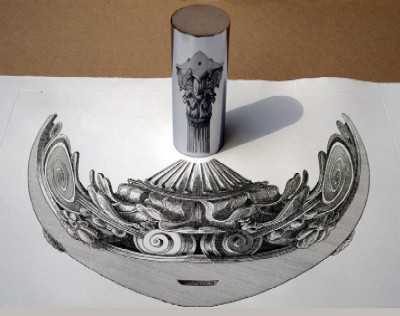
CMT: Anamorphic rendering—this means a distortion in the spatial dimensions of a work, correct? In anamorphic graphical art, there are two or more images of the same object in the field of view that simultaneously compete for the viewer’s perception and belief. You have a trompe l’oeil perspective that compels you to work to understand what’s being represented and resolve the conflicts or contradictions in it. This is what you are saying when you use this fancy word ‘anamorphic’?

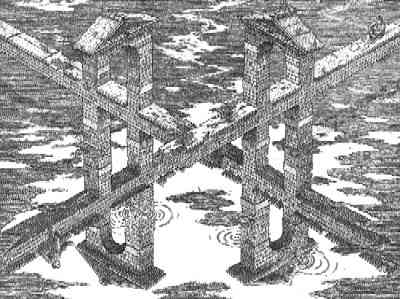
DSM: Yes. István Orosz and Julian Beever and Kurt Wenner and others are artists who recently having been working in this idiom. The tradition dates back at least to the early Renaissance.

Beever, Make Poverty History, Edinburgh
But ‘anamorphic’ also is a term in cinematography—optical lens transformation developed in the 1950s in connection with widescreen formats, to fully utilize the 35mm film surface. If shooting in widescreen picture format, without an anamorphic lens, the available film area is not used completely; some of the film surface is wasted (top and bottom).

Orthomorphic frame, No stretching
But if you shoot with an anamorphic lens, the picture is optically stretched in the vertical dimension to cover the entire film frame, and the inverse projection of this has a much better picture quality. When projecting the film, the projector must use an inverse lens to stretch the image horizontally back to its widescreen 2.40 aspect-ratio.

Anamorphic frame, With stretching
When I said that Carmignola’s playing seemed ‘anamorphic’ to me, what I mean is that he is compressing the timbral range of the Vivaldi and Tartini. He is also dramatically stretching the rhythmic space of the music, accelerating or retarding tempi as he animates the character. His ferocity and passion arouse in us an identification with his character—a strong sympathy that is really quite unique for an account of Vivaldi. That is what I mean by ‘anamorphic’.

Carmignola
CMT: Žižek describes Lacan’s view of the Subject—that the Subject is signaled by whatever “perturbs the smooth engine of symbolization and throws it off balance, an anamorphic entity that gains its consistency only in retrospect, viewed from within the symbolic horizon.” This is precisely how Carmignola comes across in live performance. He achieves his authenticity exactly because he throws Vivaldi’s smooth engine of symbolization off-balance. And Carmignola capitalizes on the fact that our mass-culture exposure to flatter Vivaldi has innured us! The slow movements for me were romantically milked too much by Carmignola and were nowhere close to an historically ‘proper’ reading. Some of the double-stopping by Carmignola was out of tune. And, just when I’m about to worry about those things, here comes Carmignola with another cinematic revelation, an entirely authentic and passionate utterance from his violin that makes me forgive and rethink all of my ridiculous quibbles. The point about the consistency that is evident only in hind-sight—the retrospective reflection of my forgiving, forgetting, and understanding anew—is basically this rethinking. A hind-sighted coherence. I think you are right—Carmignola is doing an anamorphic rendering of Vivaldi. In fact, Vivaldi is a perfect vehicle for Carmignola’s character. By the way, you know of course that your use of the 50-cent word ‘anamorphic’ is not at all novel. The literary theorists have been using it for years!

DSM: Well, fine. The term just seemed apt to me, that’s all. I don’t care whether the notion is new or not, or whether others in poetics and literary theory have appropriated it before. Musically, these pieces Carmignola performed in Kansas City are unique among Vivaldi’s output. The Vivaldi echoes Tartini and later Italian composers. Several of the pieces offer the soloist notes higher on the staff than we usually hear from Vivaldi. As for the romantic-sounding slow movements, I don’t think that Carmignola’s treatment of them was necessarily ‘romantic’ per se. They certainly were emotional, as they should be. Nobody knows exactly how these were performed in Vivaldi’s time, but I think that Carmignola presents viable and excellent interpretations. His playing is certainly consistent with the dictum that musicians should on one hand try to come as close as possible to the composer’s intentions, but on the other hand should live with the music they play and put their own personality into it. Carmignola has more than a fair share of personality!

CMT: Throughout the allegros were lively, vivacious and clean. But the temptation to take too swift a tempo was carefully avoided. Carmignola’s superbly virtuosic playing extended to the adagio/largo movements. The Venice Baroque ensemble performed with considerable control, I thought, offering calmness and serenity—a dramatic foil for the mercurial Carmignola. I loved the way the expressive playing from Carmignola provides an air of mystery.

DSM: I especially liked hearing Carmignola in the warm ambience of the small Folly Theater. It added nicely to the coloristic palette of the period instruments and was especially congenial to Carmignola’s dynamics. Nothing clinical or astringent about it!

CMT: But what about Carmignola’s character? What about the voice of the subject that Carmignola breathes life into. You know, Plutarch once told the story of a man who plucked a nightingale and finding but little to eat exclaimed: ‘You are just a voice and nothing more.’ Deconstructing the layers of meaning that cover the voice and concentrating on ‘the voice and nothing more’ is something that philosopher Mladen Dolar does.

Carmignola
DSM: Ah, up again pops our other mutual interest! In ‘A Voice and Nothing More’ Dolar goes beyond Derrida’s idea of ‘phonocentrism’ and revives and develops Lacan’s claim that the voice is one of the fundamental embodiments of the self, of the psychoanalytic object. Dolar says that, apart from the two commonly understood uses of the voice as a vehicle for meaning and as a source of aesthetic value, there is a third level of understanding: the voice as an object that can be seen as a ‘lever’ of thought. The voice is a ‘prime mover’. Carmignola is the epitome of a prime mover!

CMT: It takes a certain intrepid curiosity to pick up a book like the ones that Dolar or Žižek write. But the payoff can be huge: a new meaning, a new resonance accruing to something we previously paid barely any attention to—this inquiry into the nature of voice and its role as a bridge between nature and culture, Subject and Object, Self and Other, Body and Mind/Language, the personal and the political, the liminal and the pelagic.

DSM: Ruth HaCohen, a musicologist at Hebrew University of Jerusalem, has written about this, too. And Foucault and Deleuze. And Adorno. And Derrida in his brilliant essay ‘Memoirs of the Blind: The Self-Portrait and Other Ruins’. And Schopenauer long before that. Sympathy, in the sense of the ability to suffer with or for the other, entered English usage toward the end of the sixteenth century. This artistic sensibility nourished by the Aristotelian notion of poetic compassion has everything to do with ‘voice’. Max Scheler distinguished sympathy from emotional fusion—empathic states or experiences of total identification with another subject. He insisted instead on the exclusivity of sympathy as a moral and aesthetic principle stemming from the unequivocal recognition of the separateness of another human existence.

CMT: ‘Another existence’ in the sense of ‘other’? Other human beings, or other perspective on one’s self?

DSM: I see what you’re getting at. The normal sense would be in terms of subjectivity of other selves. But there is an aspect of Carmignola’s playing—the character he inhabits in his performance—that is self-referential. I suppose it’s possible to have sympathy with yourself, to identify with oneself as a subject, including one’s former self. Carmignola’s minor-key passages’ reflectiveness makes me think of this.

CMT: And Aristotle can be read as viewing real pity and theatrical pity as partially antithetical to each other—the first as encouraging moral action while precluding over-involvement, the second as related only indirectly to moral action while demanding emotional participation. Bifurcated between life and art, the Aristotelian eleos became a challenge for literary theorists—they tried to overcome it without relegating pity to an imaginary or lower moral sphere. The outpouring that Carmignola delivers is clearly real, convincing, morally binding! We listeners were pulled from our seats, down to the stage, and grabbed by the collars!

DSM: Peter Greenaway achieved an effect quite like this in his 1982 movie, The Draughtsman’s Contract, set in the England of the Restoration, when tensions between artistic representation and social norms precipitated new appraisal of artist-beholder relations.

CMT: Okay, anamorphic. Have you got any other exotic neologisms in you today? More over-loose associations you wish to share?

DSM: Well, there are Carmignola’s fierce ‘Lombardic’ rhythms. And Carmignola’s ‘terraced’ dynamics. What about the ‘vocal’ tradition of ‘Venetian’ sound? Could we not say that Carmignola makes ‘bravura’ instrumental works out of works that were not written in a bravura manner? How about virtuoso ornaments as ‘insinuations’? The minor keys in Carmignola’s hands seemed to me to be ‘confessions à l’amore’—chromatic ‘incursions’ or ‘irruptions’ into lyric drama. There you are! Satisfied? Enough theoretical neologisms to suit you?


Orosz, Crossroads


Sunday, October 22, 2006

The Once & Future Underground

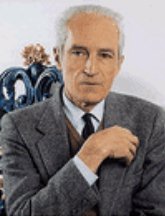
Vladimir Feltsman

DSM: What makes an artist an “underground artist”? What is avant garde, and what's the difference between underground and avant garde?

CMT: I suppose as long as “culture” has existed, there has been underground culture. There have always been those who were different, those who refused to conform to the “received norms” of their culture. It's also a divergent way of perceiving reality—a perception that separates the artist from others in society, and references the society or context that the artist stands apart from—the underground position. Dostoyevsky, Tolstoy, and Shostakovich all represent the underground tradition, the underground personality.

DSM: Would we say, then that the avant garde, on the other hand, tends barely to refer to the dominant culture? That it innovates new aesthetics, new expressions, new reality all together? That the avant garde is more universal and cosmopolitan in its nature, while underground is always connected to a certain culture within which it exists? Debussy and Stravinsky, Kandinsky, Prokofiev, Chekhov are, to me, avant garde artists. But both categories—underground and avant garde—are forces that constantly move culture forward. It's a kind of triangular dance in which partners are constantly moving and changing their respective positions. Underground becomes officially accepted, avant garde becomes a new norm, a new standard, and creates its own establishment and official culture—until the next dance, until the next round of re-invention. Vladimir Feltsman—is an artist who is constantly moving, re-inventing, re-interpreting in dramatic new ways.

CMT: Every pianist does and should bring her/his own individual personality and ideas. But I think there are certain factors (an idiomatic rubato, tempos, pianistic color, string portamentos) that are important to the style and can be heard in others’ performances and recordings. It seems that Vladimir Feltsman’s recent style is both freer and stricter than it was previously. Like other pianists today, he tends to have a deliberately and constantly flexible approach. When he plays, his first subjects tend to be in tempo—no rubato at all; but later subjects are amazingly free, like improvisations. Today this contrast is less often heard. The later subjects tend to become an occasion of lyrical repose with a subdued narrative intimacy. I tend to put Feltsman in the ‘underground’ camp, based on his recent performances. His innovations are novel and surprising, but they still always ‘refer’ to his native Russian context.

DSM: I'm always very suspicious of labeling artists! They are not static! Every artist is unique and evolving—How is Richter or Gilels ‘Russian’ per se? These two are polar opposites and two individual artists whose lives and careers had very different arcs. Who is more ‘German’, Gieseking or Schnabel? Is Horowitz ‘Russian’ or ‘American’?

CMT: A superb Bach and Haydn and Beethoven and Schubert stylist doesn't necessarily make a first-class Mozart interpreter, you know, although Feltsman carries it off beautifully.

[Haydn’s pieces— ] “None of them talks of serious, cheerful, or witty things, but all are seriousness, good cheer, and wit … the fashionable disease of Sturm und Drang did not touch him.” —Alfred Einstein, On Music, 1951, p. 258-9.

DSM: Feltsman performs this Friday in Kansas City—Haydn’s Sonata in E-flat major, Hob. XVI:49 among other things ( Master Pianists Series, FCM ). It's interesting to compare his older performances and recordings with those of past years.

CMT: Yes. He's been getting further and further from his dramatic, pyrotechnical Russian roots by leaving the grand piano and performing on the fortepiano. His evolution adds to the debate about authenticity and historically-informed or period-appropriate instrumentation: he refocuses us on the musical text. The two types of keyboard instruments produce vastly different sort of sound. The fortepiano has, as you know, a modest dynamic range, a more “bell-like” tone—the sound is fast and the duration of the notes is shorter, so players naturally adjust their interpretation to concentrate on shorter expressive details—you have to exert yourself more to achieve a given level of expressive impact. By contrast, the dynamically more powerful concert grand, with its richer sonority and sustained notes, completely changes the music's ideas. It isn’t quite as demanding to drive meaning, beauty and subtlety in phrasing and articulation—if anything, the grand requires a bit of expressive restraint.

DSM: The fortepiano forces the player to think much more about the narrative flow of the work, doesn't it? But I’m not sure that that leads everyone to deeper understanding or more freedom in interpretation. Surely it's increased Feltsman’s expressive range, but the experiment might not turn out as well for others. His melody lines in the slow movements give a graceful, songlike quality—showing that, while the fortepiano’s dynamic range is smaller than the piano’s, it’s enough still to allow a line abundant shape and nuance. In fact, part of the drama is in anticipating how Feltsman will handle each passage on this instrument.

CMT: It’s obvious, too, though that Feltsman’s range continues to evolve in his performances on the piano as well. There's a more pointedly narrative quality in his recent piano performances. But I think we are just seeing different dimensions of Vladimir that were always there. I do not get the sense that his views and interpretations are fundamentally changing as he continues his evolution on the piano or experiments with the fortepiano. After all, the Russian pyrotechnical authors—Nabokov, Gogol, Turgenev, Tolstoy—they did not turn into Chekhovs as their styles evolved.

DSM: Or Shostakovich—the pyrotechnical Futurist style so loathed by the proletarians—happened then not to be “acceptable”. For Tolstoy, the paradigm of dramatic method was the ‘problem’ play with complex intrigues and overt action. But Chekhov was satisfied just to create ‘mood’, which he argued was more suitable in a lyric poem:

“Dramatic forms serve, and ought to serve, quite different aims. In a dramatic work the author ought to deal with some problem that has yet to be solved and every character in the play ought to solve it according to the idiosyncrasies of his own character. It is like a laboratory experiment. But you won’t find anything of the kind in Chekhov.”

Tolstoy’s objections to Chekhov’s plays are, I think valid. The lack of problem-solving and plot or theatrical pyrotechnics in Chekhov plays is nailed by Tolstoy. Anyone who has had to sit through a production of a Chekhov play where only the surface realism is evident knows how untheatrical Chekhov can be.

CMT: With regard to Haydn’s Piano Sonata in E-flat Major, Hob. XVI:49, and the works immediately preceding it, it’s interesting that Haydn was more or less re-inventing himself during that period. In other words, the later Haydn Sonatas seem entirely coherent with Feltsman’s innovative intent and flexibility. These were composed after Haydn’s discovery of Bach’s Essay on the True Art of Playing Keyboard Instruments, after the impact of that had registered on Haydn. There were a variety of novel and playful devices that Haydn created—ones that are amenable to Feltsman's interpretive latitude. For example, there is a beautiful reading of Haydn’s Piano Sonata in G Minor, Hob. XVI:44, first movement, in which much of the bridge and all of the second theme—from the eighth-note upbeat to m7 until the cadence in m20—is read as a huge parenthesis. That is, C5 in m6 resolves to B-flat4 in the cadence at m20. At that point the ascending sequence begun in m5-6 is resumed, as though nothing lay in between. It was—and is—a very innovative interpretation.

Haydn Sonata in G mi, Hob. XVI:44, m7

DSM: In Haydn, as I believe is common in parenthetical expressions in Beethoven and others in the Classical style, there tends to be a rhetorical barrier at the beginning of parenthetical passages: the dominant of B-flat major (m6) fails to resolve as expected, and C5 fails to follow the sequence by resolving down to B-flat4. The end of the parenthesis in m20 has no comparable rhetorical signal, except for resuming the theme abandoned earlier.

CMT: While I appreciate the validity of the metaphor, I think there's a hazard in calling musical passages “parenthetical.” It's striking that the gesture in m5-6 is broken off and later picked up again. But we should take care not to undervalue the intervening expressions. The F3 reached in m6 and beautifully sustained and elaborated through m12 supports prominent D-flats in several octaves—which I hear as echoes of the early C# in m1. The dramatic arpeggios of the “second theme” (upbeat to m13), like the accompaniment of the main theme, don't achieve a real bass register, and so I find the wait for B-flat2 in m20 adds to the drama. Haydn withholds the B-flat1 until the final bar of the exposition. In other words, the “parenthetical” passage contains important links to what comes before and after, and we should be careful not to view the intervening parenthetical passage as somehow less worthy.

Haydn Sonata in G mi, Hob. XVI:44, m12

DSM: I appreciate your point. Parenthesis may not be a perfect term for music, but it does correspond to a sense of suspending and resuming—a change of gesture, often a confiding or revealing or clarifying one. The sense I'm intending is just such a revealing, confiding tone—which is obviously important in any narrative. Not something to be undervalued, instead it is where the most important dramatic things are said. It is a part of Feltsman's innovation and “underground-ness,” I think.

Here are some good sources to look at: