Showing posts with label parenthesis. Show all posts

Monday, October 6, 2008

William Coble’s ‘Autumn Elegy’: Parentheticals and Implicature

Cherry leaves
I recently had occasion to hear a recording of William Coble’s beautiful 1983 chamber composition, ‘Autumn Elegy for solo guitar’. Coble is a two-time winner of the Davenport Orchestral Composition competition (1990, 2002) at SUNY New Paltz and has received commissions from eighth blackbird and Pacifica Quartet, among others. His chamber music works have been performed at Merkin Hall, Weill Hall, CAMI Hall, Harvard Musical Association, Northwestern University’s Music Marathon, Society for New Music, Cincinnati’s Music-2004 Festival, and the BSO at Tanglewood.

Coble trained initially at Boston University School of Music, with graduate work at Harvard University and Curtis Institute of Music. His teachers have included Ned Rorem, David DelTredici, Mario Davidovsky, Gunther Schuller, Steve Albert, John Eaton, Kotoka Suzuki, and Howard Sandroff.

W hile a fellow at the Macdowell Colony, he recently completed a setting of sacred music for baritone, violin, cello, and piano. He also worked on vocal chamber music for an upcoming festival in Austria and on Variations for the Richmond Symphony. Coble is currently a graduate student in composition at the University of Chicago.

Coble’s music is honest and free of pretension. It is intent on creating coloristic effects from a wide palette. Its performance does call for ‘repose’, reserve, and great subtlety of phrasing. ‘Autumn Elegy’ is characteristic in that regard...

In fact, in view of Coble’s output to date, including his ‘Parenthetical Phrases for Flute, Oboe, and Bassoon’, he seems especially interested in inter-part adverbial constructions and parentheticals. Various of his compositions have to do with encapsulating one passage within a constrasting ‘wrapper’ structure. The enclosed passage is generally a sort of ‘aside’ or reminder——not so much subordinate to the surrounding material as expressing a rebuttal or rejoinder to it.

Musical parenthetical expressions correspond to a sense of suspending and resuming——a change of gesture, confiding or revealing some intimate detail. Parentheticals are not ‘incidental’ or ‘accessory’; instead they are often where the most important dramatic things are said.

W hat I notice in Coble’s ‘Autumn Elegy’ is these variations’ demand for spontaneity. Too often, at chamber music master classes and lessons, when the teacher addresses interpretation and the timing of transitions (‘No, wait a little longer here. Try to end this up in the air,’ etc.) it seems to focus too much on the superficial ‘syntactic’ features of the piece and too little on how to make each performance fresh.

Now, I don’t find ‘Autumn Elegy’ sad as such–—its overall emotional mien is wonderfully abstract—–but the phrase to which the low B in measure 5 leads is desolate. You feel a kind of inner call towards contemplation rather than playing and engagement. A few bars of minor are absorbed within the larger arc; a bubble of minor floating in the major.

William Coble, Autumn Elegy for guitar
The low notes have their distinctive ‘litoral’ colors: they are dark, forsaking and forsaken; uncertain what they will do now——now that they, and we, have fallen to the ground.

Coble controls his materials well, including his clauses that Diane Blakemore and others might call ‘adverbial parentheticals’. But he does so with a deliberate aim to allow/demand improvisatory interpretive ‘implicature’ by the performer(s). Implicature does not succeed if it’s an over-rehearsed ‘talking-point’, ‘too smooth’. Implicature only works if it’s spontaneous and real. Coble clearly has the mechanics of implicature ‘nailed’.

The term ‘parenthetical’ covers a disparate range of phenomena only some of which have been regarded as falling within the domain of syntax—which is possibly why master classes and lessons seldom to justice to parenthetical idioms. It’s been argued by Haegeman that adverbial parenthetical clauses, which have been treated by other writers as syntactic phenomena, must be analyzed as syntactic ‘orphan’ that are integrated into the utterance at the level of utterance interpretation. If this approach is right, then it would raise the question of how we could justify a distinction between grammatical parentheticals and pragmatic or discourse parentheticals.

But recently research linguist Christopher Potts at UMass Amherst has argued against this approach in favor of an integrated syntactical analysis. In Potts’s analysis, the ‘otherness’ of parentheticals is best characterized semantically by treating them as inserting ‘implicatures’. The difference between these approaches to adverbial parenthetical clauses basically concerns what relationship the parentheticals have with the material that encloses them.

Have a look at the linguistics references below to see how compositions like William Coble’s (and, say, Beethoven’s Opp. 109 and 111) are supported by these two very different conceptions of the distinction between grammar (syntax) and pragmatics (performance practice; rhetoric). I myself favor the Potts-Blakemore view, which emphasizes pragmatics, spontaneity, and implicature. Their linguistics analytical methods have much to offer, I think, to music theory and to composers who find analysis helpful during the process of composing/orchestrating…
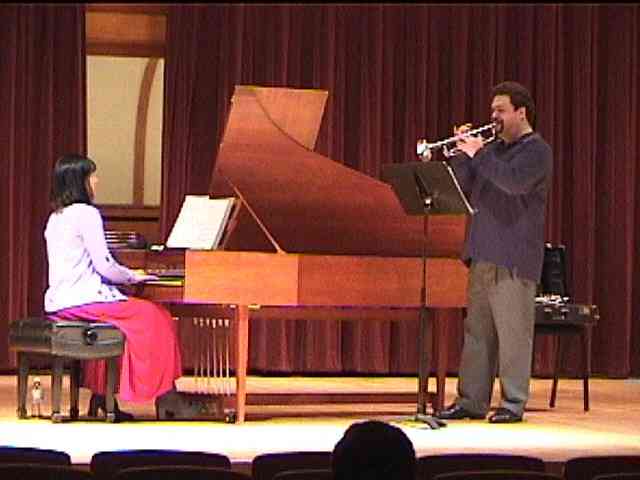
William Coble, trumpet recital


Sunday, October 22, 2006

The Once & Future Underground

Vladimir Feltsman

DSM: What makes an artist an “underground artist”? What is avant garde, and what's the difference between underground and avant garde?

CMT: I suppose as long as “culture” has existed, there has been underground culture. There have always been those who were different, those who refused to conform to the “received norms” of their culture. It's also a divergent way of perceiving reality—a perception that separates the artist from others in society, and references the society or context that the artist stands apart from—the underground position. Dostoyevsky, Tolstoy, and Shostakovich all represent the underground tradition, the underground personality.

DSM: Would we say, then that the avant garde, on the other hand, tends barely to refer to the dominant culture? That it innovates new aesthetics, new expressions, new reality all together? That the avant garde is more universal and cosmopolitan in its nature, while underground is always connected to a certain culture within which it exists? Debussy and Stravinsky, Kandinsky, Prokofiev, Chekhov are, to me, avant garde artists. But both categories—underground and avant garde—are forces that constantly move culture forward. It's a kind of triangular dance in which partners are constantly moving and changing their respective positions. Underground becomes officially accepted, avant garde becomes a new norm, a new standard, and creates its own establishment and official culture—until the next dance, until the next round of re-invention. Vladimir Feltsman—is an artist who is constantly moving, re-inventing, re-interpreting in dramatic new ways.

CMT: Every pianist does and should bring her/his own individual personality and ideas. But I think there are certain factors (an idiomatic rubato, tempos, pianistic color, string portamentos) that are important to the style and can be heard in others’ performances and recordings. It seems that Vladimir Feltsman’s recent style is both freer and stricter than it was previously. Like other pianists today, he tends to have a deliberately and constantly flexible approach. When he plays, his first subjects tend to be in tempo—no rubato at all; but later subjects are amazingly free, like improvisations. Today this contrast is less often heard. The later subjects tend to become an occasion of lyrical repose with a subdued narrative intimacy. I tend to put Feltsman in the ‘underground’ camp, based on his recent performances. His innovations are novel and surprising, but they still always ‘refer’ to his native Russian context.

DSM: I'm always very suspicious of labeling artists! They are not static! Every artist is unique and evolving—How is Richter or Gilels ‘Russian’ per se? These two are polar opposites and two individual artists whose lives and careers had very different arcs. Who is more ‘German’, Gieseking or Schnabel? Is Horowitz ‘Russian’ or ‘American’?

CMT: A superb Bach and Haydn and Beethoven and Schubert stylist doesn't necessarily make a first-class Mozart interpreter, you know, although Feltsman carries it off beautifully.

[Haydn’s pieces— ] “None of them talks of serious, cheerful, or witty things, but all are seriousness, good cheer, and wit … the fashionable disease of Sturm und Drang did not touch him.” —Alfred Einstein, On Music, 1951, p. 258-9.

DSM: Feltsman performs this Friday in Kansas City—Haydn’s Sonata in E-flat major, Hob. XVI:49 among other things ( Master Pianists Series, FCM ). It's interesting to compare his older performances and recordings with those of past years.

CMT: Yes. He's been getting further and further from his dramatic, pyrotechnical Russian roots by leaving the grand piano and performing on the fortepiano. His evolution adds to the debate about authenticity and historically-informed or period-appropriate instrumentation: he refocuses us on the musical text. The two types of keyboard instruments produce vastly different sort of sound. The fortepiano has, as you know, a modest dynamic range, a more “bell-like” tone—the sound is fast and the duration of the notes is shorter, so players naturally adjust their interpretation to concentrate on shorter expressive details—you have to exert yourself more to achieve a given level of expressive impact. By contrast, the dynamically more powerful concert grand, with its richer sonority and sustained notes, completely changes the music's ideas. It isn’t quite as demanding to drive meaning, beauty and subtlety in phrasing and articulation—if anything, the grand requires a bit of expressive restraint.

DSM: The fortepiano forces the player to think much more about the narrative flow of the work, doesn't it? But I’m not sure that that leads everyone to deeper understanding or more freedom in interpretation. Surely it's increased Feltsman’s expressive range, but the experiment might not turn out as well for others. His melody lines in the slow movements give a graceful, songlike quality—showing that, while the fortepiano’s dynamic range is smaller than the piano’s, it’s enough still to allow a line abundant shape and nuance. In fact, part of the drama is in anticipating how Feltsman will handle each passage on this instrument.

CMT: It’s obvious, too, though that Feltsman’s range continues to evolve in his performances on the piano as well. There's a more pointedly narrative quality in his recent piano performances. But I think we are just seeing different dimensions of Vladimir that were always there. I do not get the sense that his views and interpretations are fundamentally changing as he continues his evolution on the piano or experiments with the fortepiano. After all, the Russian pyrotechnical authors—Nabokov, Gogol, Turgenev, Tolstoy—they did not turn into Chekhovs as their styles evolved.

DSM: Or Shostakovich—the pyrotechnical Futurist style so loathed by the proletarians—happened then not to be “acceptable”. For Tolstoy, the paradigm of dramatic method was the ‘problem’ play with complex intrigues and overt action. But Chekhov was satisfied just to create ‘mood’, which he argued was more suitable in a lyric poem:

“Dramatic forms serve, and ought to serve, quite different aims. In a dramatic work the author ought to deal with some problem that has yet to be solved and every character in the play ought to solve it according to the idiosyncrasies of his own character. It is like a laboratory experiment. But you won’t find anything of the kind in Chekhov.”

Tolstoy’s objections to Chekhov’s plays are, I think valid. The lack of problem-solving and plot or theatrical pyrotechnics in Chekhov plays is nailed by Tolstoy. Anyone who has had to sit through a production of a Chekhov play where only the surface realism is evident knows how untheatrical Chekhov can be.

CMT: With regard to Haydn’s Piano Sonata in E-flat Major, Hob. XVI:49, and the works immediately preceding it, it’s interesting that Haydn was more or less re-inventing himself during that period. In other words, the later Haydn Sonatas seem entirely coherent with Feltsman’s innovative intent and flexibility. These were composed after Haydn’s discovery of Bach’s Essay on the True Art of Playing Keyboard Instruments, after the impact of that had registered on Haydn. There were a variety of novel and playful devices that Haydn created—ones that are amenable to Feltsman's interpretive latitude. For example, there is a beautiful reading of Haydn’s Piano Sonata in G Minor, Hob. XVI:44, first movement, in which much of the bridge and all of the second theme—from the eighth-note upbeat to m7 until the cadence in m20—is read as a huge parenthesis. That is, C5 in m6 resolves to B-flat4 in the cadence at m20. At that point the ascending sequence begun in m5-6 is resumed, as though nothing lay in between. It was—and is—a very innovative interpretation.

Haydn Sonata in G mi, Hob. XVI:44, m7

DSM: In Haydn, as I believe is common in parenthetical expressions in Beethoven and others in the Classical style, there tends to be a rhetorical barrier at the beginning of parenthetical passages: the dominant of B-flat major (m6) fails to resolve as expected, and C5 fails to follow the sequence by resolving down to B-flat4. The end of the parenthesis in m20 has no comparable rhetorical signal, except for resuming the theme abandoned earlier.

CMT: While I appreciate the validity of the metaphor, I think there's a hazard in calling musical passages “parenthetical.” It's striking that the gesture in m5-6 is broken off and later picked up again. But we should take care not to undervalue the intervening expressions. The F3 reached in m6 and beautifully sustained and elaborated through m12 supports prominent D-flats in several octaves—which I hear as echoes of the early C# in m1. The dramatic arpeggios of the “second theme” (upbeat to m13), like the accompaniment of the main theme, don't achieve a real bass register, and so I find the wait for B-flat2 in m20 adds to the drama. Haydn withholds the B-flat1 until the final bar of the exposition. In other words, the “parenthetical” passage contains important links to what comes before and after, and we should be careful not to view the intervening parenthetical passage as somehow less worthy.

Haydn Sonata in G mi, Hob. XVI:44, m12

DSM: I appreciate your point. Parenthesis may not be a perfect term for music, but it does correspond to a sense of suspending and resuming—a change of gesture, often a confiding or revealing or clarifying one. The sense I'm intending is just such a revealing, confiding tone—which is obviously important in any narrative. Not something to be undervalued, instead it is where the most important dramatic things are said. It is a part of Feltsman's innovation and “underground-ness,” I think.

Here are some good sources to look at: