
W here a rhythm is heard as anacrustic, moving from upbeat to downbeat, the downbeat exerts a kind of gravitational force, attracting notes of the upbeat to it. Since human beings experience gravity as a downward pull, [the rhythm] is readily felt as a downward fall or slide to the bottom of something. Downward slides are not constant in speed; they accelerate. And since any physical medium contains some friction, the rate of acceleration will not be constant, either; it will increase until the effect of friction is largely overcome.”Basically, polyphonic music is an emulsion. It is an ‘emulsion’ of the parts or voices that comprise it. And its physics closely resembles the physics of complex fluids in general. It has viscosity: the rhythmic rate at which the parts unfold and the rate at which rhythmic change can occur are not infinite. As a ‘liquid’, music has internal friction. And that friction or viscosity is not constant. It varies with tempo, with rhythmic velocity in individual parts, and with the biophysical possibilities and limitations of the interactions between the human flesh and the real-world instrument/voice.
— William Rothstein.


Individual musical parts embody shear contours and rhythmic isopleths in the composition—in the larger shear field that is comprised of the union of all of the parts. Layers in that sonic emulsion have different viscosities and velocities and shear rates, and the layers “slip” against each other, just as disparate layers in a physical liquid would slip.

Yes, music is a liquid—it flows like blood. (The pulsatility of attractive compositions and performers’ interpretations is also subconsciously informed by the pulsatility of our hearts, our circulation?) A fancy word for the study of this sort of flow is ‘non-Newtonian rheology’. I realize that others have thought some of these thoughts before: William Rothstein comes to mind. But I think that no physicist or chemical engineer who specializes in rheology of complex liquids has ever done so—or, at least, has never done so and written about it. Why are there musician-mathematicians and musician-EEs but no musician-ChemEs?

There is shear-thinning or thixotropy in BWV 1052. (I suppose the converse, shear-thickening [‘rheopexy’], is also possible in music—although it must be rare, just as rheopexy is rare in physical liquids.)
Sometimes music is less like blood and more like paint—with lots of reverb (or, equally well, with lots of minimalist composers’ written short-timescale recapitulations of motifs), it flows and creeps after the performer (the ‘paint brush’) has passed that motif, onward to the next measure. The ‘relaxation time’ for viscoelastic effects in musical fluids can be similar to a nice latex paint.

Sometimes music is like whipped cream—its viscosity is high enough to hold a “peak”? Maybe I am generalizing this idea of musical rheology further than I ought to do. But it seems empirically to be valid within some bounds. For example, the idea of accelerating through an anacrustic motive is a prevalent interpretation of much baroque and nineteenth-century music, if and only if the motive itself is frictionless. Rothstein said something that amounted to this, in one of his papers some years ago.
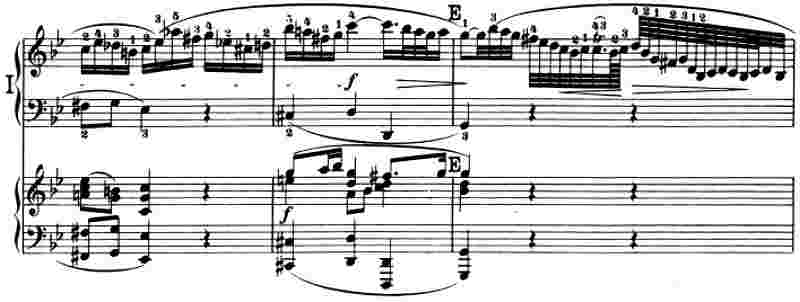
And our psychological response to ritardandos and fermatas—the rubato of the harpsichord in BWV 1052, for example, juxtaposed as it is with the rhythmic consistency of the other parts—is empirically an apprehension of vortices and rhythmic slippage.

Thixotropic liquids exhibit a time-dependent response to the shear strain rate over a longer period than that associated with the actual changes that occur in the shear strain rate. They may liquefy on being shaken and then solidify when the shaking has stopped. The analogous thing happens in music—at least in tonal music of the 20th Century and earlier. The shaking stops at the fermatas between the movements in BWV 1052. Liquefaction upon commencing the next movement amounts to a kind of psychic relief—resolution of a dramatic tension.
Linear and nearly-linear polymer liquids are predictable in the relationship of their viscosity to their structure and the polymer molecules’ conformation. In dilute solutions this relationship depends on the microscopic volume ‘swept out’ by the molecules as they tumble in the solution (their ‘hydrodynamic volume’). At low concentrations where there is minimal interaction between molecules, the viscosity may be about the same as water.

Starches and other biopolymers are like this. Although attaching short sugar oligomers as branch-points to linear polysaccharides does increase their rigidity as the molecules are extended, this increases the molecular weight a lot. The effect of the molecular weight on the viscosity is dramatic as the hydrodynamic volumes of compact molecules increase approximately as the cube root of the molecular weight while the hydrodynamic volumes of branched/extended molecules increase about linearly with molecular weight.
The relationship between the intrinsic viscosity η and the relative molecular mass (Mw) is given by η = K ∙ Mw ∙ a , the Mark-Houwink equation where K and a are constants. Amylose and carboxymethylcellulose, for example, have exponents (a) of about 0.7. Knowledge of these constants allows the viscosity-averaged molecular weight to be calculated from viscosity data. A similar metric, it seems to me, could be calculated for music, such as this Bach Concerto in D minor.
Viscosity increases with solute concentration [multi-voice sixteenth-note pattern concentration transversely across parts and longitudinally, on a per-bar basis] until the shape of the volume occupied by the molecules [the rhythmic patterns] becomes elongated under stress causing some overlap between molecules [patterns] and a consequent reduction in the overall molecular volume with the consequent effect of reducing the amount that viscosity increases with further increases concentration (under non-zero stress across the bulk solution [across the polyphonal score] ). At higher concentrations (above some critical concentration C*) all the polymer molecules in the solution effectively overlap and interpenetrate (that is, their total hydrodynamic volume appears greater than the volume of the bulk liquid) even when the liquid is not under shear. When this happens, the solution behavior changes from predominantly-viscous to predominantly-elastic with the viscosity (η0 at zero stress) now governed by the small-scale rotational and vibrational mobility of the polymer molecules. This is the source of the individuality that is implied by the harpsichord ornamentations in BWV 1052: small-scale mobility in the larger ensemble-gel matrix.
C* is itself not a constant: it depends on the shear strain rate. At high shear strain rates, the rotational tumbling of the molecules sweeps out less volume. At higher concentrations the viscosity increases as about the fifth power of the concentration and this can cause synergistic behavior of mixtures, especially if there are phase separations with the attending concentration increases in some phases. Compare the highly motoric, high strain rate passages of the third movement of BWV 1052 with those in the Adagio second movement.

At high shear strain rates, molecules tend to become more ordered (oriented with respect to the direction of stress and flow, and oriented with respect to each other) and they tend also to become more elastic. Shear flow causes the molecules [the rhythmic patterns in each voice in a polyphonic composition] to become stretched and compressed (at right angles to the stretch) ... and what started out as an isotropic solution becomes anisotropic—physical properties are now strongly direction-dependent. After release from such conditions, the molecules ‘relax’ back to their unstressed configurations with a characteristic time-constant or relaxation time. Coordination within ensemble, especially in passages where there are rapid rhythms in most of the parts or all of the parts.
At low concentrations below the critical value (C*), the shear modulus of hydrocolloid solutions is mainly determined by the loss modulus at low frequencies (that is, G'' is relatively high for viscous materials). As G'' depends on the frequency but G' depends on the square of the frequency, G' becomes more important at higher frequencies. At higher concentrations in viscous solutions G' is generally greater than G'' throughout a wide frequency range. This difference is very large for strong gels when the frequency has almost negligible effect (in other words, G' is high for elastic materials). The continuo and some of the sectional writing in BWV 1052 amounts to a gel, in which the r.h. of the harpsichord part is embedded and from which it separates in various passages.
It’s convenient to express the relationship between the shear stress, the elastic stress, and the viscous stress (resulting from changing stress) in terms of a complex number ( (-1)1/2 = i) where the viscous stress is ‘in-phase’ and the elastic stress is out-of-phase and oppositely-directed:
- shear stress = viscous stress - i ∙ elastic stress
- complex viscosity = viscosity - i ∙ elasticity
- tan(φ) = elasticity / viscosity

The shear modulus (resulting from changing strain in the liquid) is the ratio of the shear stress to the shear strain. It follows from the complex relationship similar to the above that:
G* = G' + i G''
where G* is the complex shear modulus, G' is the in-phase ‘storage’ modulus and G'' is the out-of-phase ‘loss’ modulus; G* = Φ(G'2 + G''2). The frequency where these parameters cross over corresponds to a relaxation time (t) specific for the material [specific for the musical composition].

It follows that,
tan(δ) = G'' / G'
where tan(δ) quantifies the balance between energy loss and storage in the liquid.

As tan(45°) = 1, a value for tan(δ) greater than unity indicates more ‘liquid’ properties, whereas one lower than unity means more ‘solid’ properties, regardless of the viscosity. In the motoric first movement of BWV 1052, δ ~ 0.7. And, in the Adagio δ ~ 1.3. Look at the slippage of those 64th notes. Look at the slippage between on-beat rhythms mutating to anacrustic rhythms. Turns and mordents and appogiaturas as eddies.
Here is a spreadsheet that illustrates some of the complex nonlinear functions that characterize the interrelation of viscosity and shear in a biofluid, human blood. It would be interesting to develop a quantitative theory of ‘viscosity’ in music. I myself do not have the time to do so, but maybe some music theoretician or PhD student will take it up as a dissertation topic. ( Music theory, it seems to me, needs more cross-pollination with other analytical/mathematical disciplines. Bill Sethares is one icon. ) Some links that may be helpful are provided below . . .


- William Rothstein page at CUNY Graduate Center
- William Sethares page at Univ Wisconsin
- Society of Rheology
- Journal of Colloid and Interface Science
- Buryachenko V. Micromechanics of Heterogeneous Materials. Springer, 2007.
- Canuto C, Hussaini M, Quarteroni A, Zang T. Spectral Methods: Evolution to Complex Geometries and Applications to Fluid Dynamics. Springer, 2007.
- Chhabra R, Richardson J. Non-Newtonian Flow and Applied Rheology. Butterworths, 2008.
- Dhanjoo N. Ng E. Cardiac Perfusion and Pumping Engineering. World Scientific, 2007.
- Epstein D. Shaping Time: Music, the Brain, and Performance. Wadsworth, 1995.
- Erdemir A, Martin J-M, eds. Superlubricity. Elsevier, 2007.
- Graebel W. Advanced Fluid Mechanics. Academic, 2007.
- Graessley W. Polymeric Liquids & Networks: Dynamics and Rheology. Garland, 2008.
- Larson R. The Structure and Rheology of Complex Fluids. Oxford Univ, 1998.
- Lerdahl F, Jackendoff R. A Generative Theory of Tonal Music. MIT, 1983.
- Lyklema J, ed. Fundamentals of Interface and Colloid Science, Volume I: Fundamentals. Academic, 2000.
- Lyklema J, ed. Fundamentals of Interface and Colloid Science, Volume III: Liquid-Fluid Interfaces. Academic, 2000.
- Morrison F. Understanding Rheology. Oxford Univ, 2001.
- Pal R. Rheology of Particulate Dispersions and Composites. CRC, 2006.
- Phan-Thien N. Understanding Viscoelasticity. Springer, 2004.
- Rao K, Nott P. An Introduction to Granular Flow. Cambridge Univ, 2008.
- Rothstein W. Phrase Rhythm in Tonal Music. Musicalia, 2007.
- Sethares W. Rhythm and Transforms. Springer, 2007.
- Stein D. Engaging Music. Oxford Univ, 2005.
- Steinhauser M. Computational Multiscale Modeling of Fluids and Solids: Theory and Applications. Springer, 2007.
- Thiriet M. Biology and Mechanics of Blood Flows: Part II: Mechanics and Medical Aspects. Springer, 2007.
- Waite L, Fine J. Applied Biofluid Mechanics. McGraw-Hill, 2007.
- Witten T, Pincus P. Structured Fluids: Polymers, Colloids, Surfactants. Oxford Univ, 2004.
- Yanovsky Y. Polymer Rheology. Springer, 2007.
- DSM. Ornamentation, Paradox and Temporality in Bach's BWV 1052. CMT blog, 05-APR-2008.
- DSM. Ringing in the New Year: Hypermeter & Ontology of Minimalism. CMT blog, 03-JAN-2007.
- DSM. Michael Nyman: Successful Minimalist. CMT blog, 22-JAN-2007.
- Rheologics.com
- YouBeats.com


