Showing posts with label xenakis. Show all posts

Saturday, November 10, 2012

Xenakis Matters

 Xenakis, photo (c)1999 Ulf Andersen/Getty Images
T   he Demiurge (1) creates from an intuition of Good; (2) takes disorder and friction and waste and makes it orderly and efficient, so far as is possible to do; (3) places Reason within the soul, and the cosmic soul within the cosmic body; (4) models the cosmos on the form of a generalized sentient lifeform, i.e., an animal with moral standing; (5) creates the cosmic body on principles of geometric proportionality; (6) creates the world soul out of population-level sameness and difference; (7) blends these into a durable alloy; and (8) divides the alloy into useful, value-generating harmonic intervals.”
  — Plato’s ‘Timaeus’, quoted by Eric Lewis in Kanach, p. 81.
U   nlike Schoenberg, who controls and organizes his music at the level of the individual note, Xenakis works at the level of the whole population [of all notes, taken together, as a sound-mass].”
  — Brian Kane, in Kanach, p. 97.

T he new book, ‘Xenakis Matters’, the latest in the multi-author, multi-volume series edited by Sharon Kanach and published by Pendragon, provides a superb and many-faceted view of the enduring impacts of composer-artist-architect-engineer Iannis Xenakis, who died in 2001. Sharon Kanach is Vice-President of Centre Iannis Xenakis in France and Founder and President of the Xenakis Project of the Americas of the Brook Center at CUNY. She served as Xenakis’s assistant for two decades prior to his death in 2001.

 Sharon Kanach

X enakis was an iconic, formative influence on me, even though I encountered him and his teaching only for a short while in 1972. Xenakis was then still on the faculty at Indiana University at Bloomington in 1972... IU with its beautiful-and-powerful-and-then-new Control Data 6600 computer, sylvan wooded paths of the campus, and its quiet, clear-flowing limestone creek so incongruous with the intensity of the University and the minds gathered there.

S pringtime 1972 was, I suppose, before many of us recognized that the Sixties were over. It was when students at the University of Minnesota were protesting the War and barricading Washington Avenue with piles of lumber set on fire, an incendiary deconstructionist action undertaken not far from the School of Architecture where I attended Xenakis’s lectures.

S pring 1972 was when my life still straddled music and engineering equally—and when Xenakis, his music, his cross-disciplinary, fusion-avid compositional methods and materials, and his talks and writings were the epitome of innovation—his compelling, unifying vision a convergence of nature, science, engineering, and art.

H is mathematical models as automatic generating functions—not only for making music but for representing it—where equations accomplished this in a manner so much more compact than mere notes on paper could ever do: so crystalline, the beauty of this.

T   he idea becomes the machine that makes the art .”
  — Sol Lewitt.

H is programmatic transformations of acoustic forms and found-sounds—embodying a mode of creativity beyond pitch and rhythm and traditional music pedagogy—a random and happenstantial process can nonetheless have statistical self-similar or fractal properties across the ensemble of parts/voices and across time, and can manifest and evoke specific, real meanings.

C   an order be established from noise? Well, your music was the first to discover this.”
  — philosopher Michel Serres, remark during Xenakis’s PhD thesis defense.

H is physicality and love of ‘immersive’ media and sonic productions—in which the raw and elemental and cranked-up challenged us to (re-)discover the boundaries between Nature and the human.

H is famous book, ‘Formalized Music’, wherein he referred to some of his work as the musical equivalent of the “phenomena of a political crowd... protesters forming a human ‘river’, and their shouted messages propagating from front to back, comprehensible to an observer situated at a distance from the crowd but often not coherent, as such, to individuals within the crowd”.

I ’ve spent the 40 years since then in very different ways than I would have imagined, most of them doing software engineering. But the maieutic* debt that I owe to Iannis Xenakis as an important teacher in my life is great. [*uncovering through analysis; eliciting knowledge by provoking or questioning; assisting-in-coming-into-being; midwifing]

I  suppose only as we get older do we really begin to appreciate/apprehend the entire cycle of Life. There is a sense of totality to life and its review, a summing-up. The emphasis is on the ‘examined life’, on how we assess our life and how we have lived it, and assess what truth we have synthesized from the events that have accumulated, from our own efforts and decisions, and from the acts of others and how they have filled and inhabited our lives.

A  powerful mixture of emotions—happy memories; regret; guilt; 40 years’ longing and loss—is part of what this book caused to well-up in me—part of what will lead me to read and re-read this volume in years to come. The poignancy of what is remembered so vividly across the decades is staggering. I become reattached to my past as it is reanimated by these authors on these pages.

S ignificant for many readers besides me, though, is how this book works as historiography—revealing how life crystallizes itself in the artifacts that remain in us, emblems of the impact that others have had on us.

I n hindsight, it’s impossible to exaggerate Iannis’s importance to my development, as a person and as an engineer. While insisting on holding students to high standards, he also took an active, personal interest in each one’s well-being. Puckish and provocative, but always seeming to accurately gauge the limits of each. Xenakis’s legendary generosity/hospitality/charity is part of his legacy and, no doubt, a major reason why he is remembered so vividly by so many people, even ones like me who only encountered him briefly.

R emembering now Iannis Xenakis’s smiling face, remembering his exuberance and enthusiasm—how he confided his uncertainties about what some of his music meant, while he simultaneously professed that each motive and pattern did have meaning(s), however ineffable those meanings may be; how he excitedly expressed his ideas and showed his students how to make them work, or, at a minimum, how to believe sufficiently in the possibility so that they fearlessly strived to make it happen—redeems me a bit from my long history of sinning by transience and forgetting.

G   enuine problems are... both necessary and impossible. Possibility arrives right when you no longer expect it. That is what an ‘event’ really is.”
  — Alain Badiou, quoted by Olga Touloumi in Kanach, p. 101.

I n summary, reminiscence can be dynamic and creative—it can be productive of new discoveries; reminiscence does not have to be reductionistic or static—and I thank Sharon Kanach and her co-authors for this gift.

A ll of the essays in ‘Xenakis Matters’ are engaging and a joy to read. Each essay advances the scholarship regarding the composer’s ideas and influence. And each conveys the kindness, humanity, and something of the humor and kindly nature that are what I remember of him. Robert Wannamaker’s chapter (pp. 127-141), especially, on math exhorts composers to emulate Xenakis’s use of ‘discretion’ in humanizing the combination of mechanical/programmatic musical elements with human ones, to achieve a synthesis that can touch the heart and move us in valuable or even life-changing ways.

M   usic is a mathematical exercise, disguised in such a way that the mind does not realize it is counting.”
  — Gottfried Wilhelm Leibniz.

I  love this book—for reasons noted above, universal as well as personal. Whether or not you have personal memories of Xenakis as an excellent human being, you will, I’m confident, love the book too.

Recording of Pianist Yuji Takahasi performance of Xenakis’s ‘Herma’
I   n 1963 I became [Xenakis’s] composition student. When I showed him my piano piece, he pointed to two sections in the piece and offered me a big eraser... I can still feel the notes of ‘Herma’ at my fingertips. Performing ‘Herma’, I discovered the gravity-free state of sound. It was the feeling of lightness, rather than the violent movement other people surmise from the pianistic virtuosity of the work... I hear through those hundreds of notes—and I sense from them at unexpected moments—something like a voice of the inexplicable.”
  —  pianist Yuji Takahashi, quoted by Roger & Karen Reynolds in Kanach, p. 13.
 Takahashi album cover

Sunday, June 7, 2009

Early-Music Aleatorics: Mozart’s Macrogranular Minuet Generator

T    he piece starts with a recognizably Mozartean voice, but as different versions of the minuet are superimposed, the textures become complex and passingly dissonant. Soaring themes, too, and bits of poignancy, rise. There’s much to arrest the ear.”
  —  Scott Cantrell, Dallas Morning News, 21-APR-2006, review of Robert Rodriguez’s ‘Mozart Dice Game’.
A    nleitung:
Walzer oder Schleifer mit 2 Würfeln zu componieren,
ohne Musikalisch zu seyn,
noch von der Composition etwas zu verstehen.”

[Instruction:
To compose a waltz or a schleifer / landler with two dice,
without being musically gifted,
nor knowing anything about composition.]
  —  W.A. Mozart.
S ometime around 1775—when is not known with certainty—Mozart wrote the measures and instructions for a musical compositional method using dice, a table of numbers, and a set of cards. On each card was printed one measure of music and a number to identify that measure. You randomly select from these pre-written measures of music based on rolls of the dice. With each dice roll, you do a table look-up to find out what card (measure) you are to select from the deck. Then you put the cards together to create new Menuets. It was possibly the first [published] algorithmic stochastic composition.

T here are 176 possible Menuet measures and 96 possible Trio measures to choose from. The results of the 32 dice rolls and the pretty large set of pre-written measures give a quite large number of different compositions that could be generated by Mozart’s rules.

B ut there are not 1116 + 616 = 4.6 * 1016 possible compositions as some claim. [My god, there is an error on the internets!]

N or is it 272C32 (176 + 96 things, taken 32 at a time) = 4.6 * 1041 possible menuets.

I nstead, what you have with Mozart’s menuet generator are 1116 * 616 = 1.3 * 1029 possibilities. That’s because his rules specify a menuet as a segmented number (string-vector) comprised of 16 base-11 (undecimal [Babylon5 ‘minbari’]) digits concatenated with 16 base-6 (hexal) digits, where each digit indexes into a separate list of permitted measures. Only members of the specific subset of measures that Mozart enumerated in a given roll’s list are permitted (table column look-ups), not just any from the whole set of all 176 Menuet measures or all 96 Trio measures.

I    f you fail to preserve it [the sequence of 32 numbers from your dice rolls, or the sequence of measures you get], it will be a menuet that will [probabilistically speaking—] never be heard again.”
  —  Martin Gardner, Scientific American, 1970.
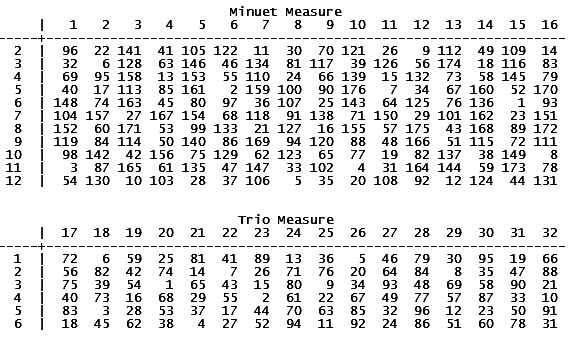
 Mozart K. 516f ‘Wurfelspiel’
  • The Menuet section is in the tonic key and the Trio section is in subdominant.
  • Measure numbers are indicated in the top row.
  • Outcome of each dice roll is indicated in the left-most column (2 to 12 for the Menuet roll with two dice; 1 to 6 for the Trio single-die roll).
  • For example, for the first measure (Menuet) if you rolled “snake-eyes” you would play measure #96 of the 176 possible Minuet measures. If in bar 17 (Trio) you rolled a “6” you would play measure #18 of the 96 possible Trio measures.
I n 2005, the Dallas Symphony Orchestra commissioned a ‘new version’ of K. 516f in honor of the 250th anniversary of Mozart’s birthday.

 Robert X. Rodriguez, photo (c) Schexnyder
M    usical Dice Game’ begins with the first solo quartet playing the first half of one minuet; both quartets then join to play all eleven versions of those bars at once; the second solo quartet continues with the second half of the minuet, followed by all eleven versions of those bars, again played by all forces simultaneously. Eleven continuous variations follow, based on the harmonies and principal melodic motifs of the original dice game. I most often used the game’s versions for throwing a five, six, eight, nine or, particularly, a seven. Since, by the laws of probability, those numbers are the most likely to be thrown, they have the most melodically distinctive variants. In the first few variations, the themes and harmonies are given in their simple, original forms; then, as the piece progresses, the minuets are disguised, and the music grows more and more chromatic, complex and rhythmically asymmetrical. In the final variation, a synthesis is reached between the Mozartean themes and their transformed versions, as the original minuets return, superimposed over the varied material in a festive musical layer cake.”
  —  Robert Xavier Rodriguez, score notes, 2005.
B eautiful! Having been persuaded/challenged by the DSO to go where angels fear to tread, Rodriguez created a composition guided by Mozart’s stochastic wurfelspiel rules that is notable for its novelty and sheer musicality. It does not have too much emphasis on ‘bar-lines’, despite the ‘measure-wise’ macro-granularity of the stochastic engine (dice-rolling selection of single measures by table look-up). It’s superbly constructed... a moving piece of music in its own right, and one that also invites us to critically rethink Mozart’s own compositional methods and computational composition in general.

I n light of the Schick/ICE Xenakis concert in Chicago earlier this week and my previous CMT post speculating about algorithmic composition methods’ begging for human editing/finishing, I thought I’d mention Mozart’s own experiments, as well as Robert Rodriguez and his Mozart Reloaded.

M    usic is meaningless noise unless it touches a receptive mind.”
  —  Paul Hindemith.
P    otential for banality, or beauty

What are avatars of impendingness?
After Verdi died in 1901 (January, in Milan, of complications from a single, deterministic stroke), Italy suffered a cardiac/cultural arrest of confidence.
After Xenakis died in 2001 (February, in Paris, of complications from multiple stochastic ailments he had been enduring), Greece suffered nothing, at least not right away.
But soon after each event, the protean exuberance of the respective century collapsed; emergent self-absorption papered over with frenzied ornamentation.
No such country as “Homeland”... non-existence hardly ameliorates its artistic self-glorification.
You know, things that happen according to Markovian rules can be changed without loss of overall meaning, and likewise without gain of overall meaning.

What are Markov melody engines?
Stochastic algorithms who have had a recurring, salacious role in western music composition for more than 200 years...
Who do not want the listener to be aware of their forms and metabolisms.
Mozart’s ‘Musikalisches Wurfelspiel’ K.516f is well-known. But other composers, including Haydn and C.P.E. Bach, fooled around here.
Recombining humanly-composed motifs in random orders, first for the novelty of it, but then as friends/accomplices, then as crutches/co-dependents, and finally as addictions.
Mozart wrote (or [at least] Peter Welcker published in 1775, in London) a ‘Tabular System Whereby Any Person without the Least Knowledge of Musick May Compose Ten Thousand Different Menuets in the Most Pleasing and Correct Manner’.
‘Pleasing’, maybe, sometimes. ‘Correct’, leave it for the first violin to say.”


Thursday, June 4, 2009

Knowledge Unspoken: How Much of Xenakis’s ‘Morsima-Amorsima’ Was Really Computer-Generated?

 IBM 7090, circa 1960
B    ut of what essence are these materials made? This essence is the intelligence of man solidified in a way: intelligence that seeks, questions, infers, reveals, and foresees at all levels. Music and the arts in general seem necessarily to be a solidification—a ‘materialization’—of intelligence. Naturally, this intelligence, though humanly universal, is diversified by the individual: by talent that distances one individual from the others. Talent is therefore a kind of qualification—a gradation of the vigor and richness of intelligence. For intelligence is, fundamentally, the result—the expression of billions of exchanges, of reactions, of transformations of energy in the cells of the brain and the body. One could, taking astrophysics as a visual aid, say that intelligence is the form taken by the minimal acts of cells in their condensations and their movement—as happens with the particles of the suns, planets, galaxies, and clusters of galaxies born of or turned back into cold interstellar dust... To think up music as composer, craftsman, and creator, it is first necessary to study solfège, notation, music theory, and even an instrument over a long time. And since, in addition, musical creation is considered superfluous, very few people are able to attain it. Thus the individual and the society are deprived of the formidable power of free imagination that musical composition offers them. We are able to tear down this ‘iron curtain’, thanks to the technology of computers and their peripherals. The system that has succeeded at this ‘tour de force’ is the UPIC (Unité Polyagogique Informatique du CEMAMu)...”
  —  Iannis Xenakis in a typically ‘expansive’ moment in the 1970s, quoted in ‘The Art of Music: Tradition and Change’ by William Christ and Richard DeLone.
T  he performance by International Contemporary Ensemble and Steve Schick of five major works—‘Psappha’, ‘Echange’, ‘Akanthos’, ‘Palimpseste’, and Xenakis’s final composition, ‘O-Mega’—is an opportunity not to be missed. It’s at Chicago’s Museum of Contemporary Art, tonight at 19:30. Anticipating this ICE performance got me to listening to the recordings I have of Xenakis’s music. I have never been lucky enough to hear a ‘live’ performance like this...

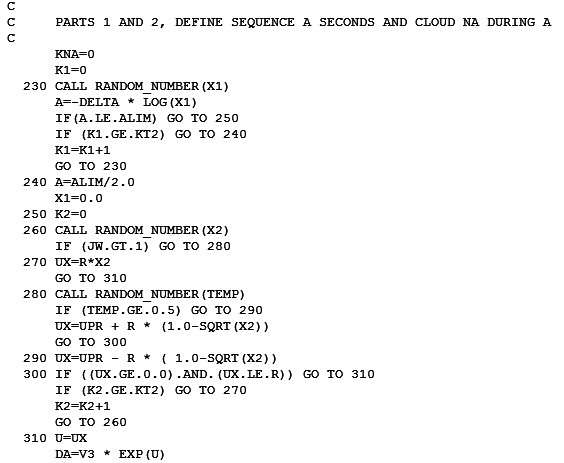
Source-code:
 Xenakis FORTRAN code
Output:
 FORTRAN code output
X  enakis’s ‘Morsima/Amorsima’ score says that ‘moros’ = ‘fate’ and ‘amorsima’ = ‘that which does not come from fate’. It was composed on an IBM 7090 in Paris, in increments/revisions between 1956 and 1962, and it was, like Xenakis’s ‘Achorripsis’, supposedly entirely stochastic (random, computer-generated). To me, this beggars belief.

F  ew have ever performed a deep-dive source-code review of what Xenakis programmed, nor compared what the 7090 generated to what Xenakis actually wrote down as a published score. Oh, yes, there are people who have ported the FORTRAN code in Xenakis’s book to FTN95, and, yes, the code does run—it does produce things. It has calls to the built-in FORTRAN random-number function; it modifies global variables and accesses the system clock to accomplish a modest degree of runtime indirection and aleatorics, in the limited ways that the FORTRAN language was (and is) able to support.

B  ut these source-codes do not produce things that have any close resemblance to any composition that Xenakis actually published. And the in-line commenting of the source code is terrible. The rats' nests of GOTO statements upon GOTO statements are nearly impenetrable-incomprehensible, even by the not-so-great software engineering standards of his day. A static analyzer would be the thing to use with this wild-hare code, not manual ‘desk analysis’! PRQA used to sell an analyzer called QAfortran™. I don’t know whether this is still available. I don’t see it on their website...

W  e have lots of software things today that serve as composition-aids... PWGL, Vielklang, Max/MSP, Jitter, harmonization plug-ins in Finale® and other notation applications… all sorts of things. And in the 2000s [almost] nobody goes around touting their use of composition software in the way that Xenakis did. By the same token, [almost] nobody is embarrassed to say that they do use them, or to forthrightly confess the methods by which the tools contribute to the compositional process.

X  enakis’s code supposedly causes the [specifications for the scored—] sounds to be generated as a directed-graph (digraph). First the [random] sequence of pitches is generated, with each note’s time of specified onset—it’s time coordinate. Then its timbre is generated (the instrument that is to play it; and its articulation: arco, pizzicato, glissando, and so on). Then the velocity of attack. Then the gradients in loudness (dynamic changes in loudness during the time interval the note is sounded... legato, accent, marcato ^, staccato, slur, portato/martelé ... sforzando, subito whatever) and in pitch (vibrato or not, glissando beginning and ending, shakes’ frequency and pitch-width). Then the duration. Not sure whether the program had anything in it to specify the (random) mode of releasing each note.


    [50-sec clip, austraLYSIS, Iannis Xenakis, ‘Morsima/Amorsima’, 1.6MB MP3]


    [50-sec clip, austraLYSIS, Iannis Xenakis, ‘Morsima/Amorsima’, 1.6MB MP3]

T  he 7090 was a room-sized $3M, 36-bit single-CPU machine, with 32K words of magnetic-core RAM (144 KB) and a clock cycle of 2.18 μs (459 KHz). It computed at about 0.2 MIPs, 0.03 MFLOPs. [The little laptop on which I am now writing this blog, is 64-bit, 8 GB, over-clocked 3.06 GHz dual-CPU, 46.7 MIPS (Dhrystone ALU), 35.2 MFLOPS (Whetstone iSSE3).]

B  ut the probabilities in ‘Morsima-Amorsima’ fate-vs-nonfate are highly unlikely. And this piece and others are too, too beautiful to be ‘lightly edited’ output from any of Xenakis’s FORTRAN source-codes that are available. Instead, there are the hallmarks of the human ear, the human hand, the Xenakisian mind. I am betting that this ‘Morsima/Amorsima’ is maybe 80% Xenakis traditional compositional method-produced and only 20% Xenakis algorithms on IBM 7090-produced—20% Fate and 80% Non-Fate, by one way of thinking about random events and chance. The score only costs €50. We should take a detailed statistical look and see!

 IBM 7090, circa 1960
I  am not saying that Iannis Xenakis deceived anyone, exactly, regarding how his compositions were produced. He was a brilliant, flamboyant character and a wonderful and entertaining speaker, and I experienced these qualities of his, first-hand. I attended a lecture series he gave in 1972… I had been taking Computer Science courses at University of Minnesota at the time. The exuberance and expansiveness he exhibited when speaking were fabulous.

B  ut I think that not enough detailed consideration has been given to the stories he told about his compositional methods—comparing his writings and interviews and software source-codes against his finished scores, to see how well (or not) Xenakis’s remarks about his methods are supported by the evidence.

X  enakis’s famous book ‘Formalized Music’ and the FORTRAN source-code fragments that have been published obfuscate more than they reveal. Was he unsatisfied with the musicality of the results of his algorithms? Did he feel that he needed to extensively rewrite the computer-produced compositions to achieve a more aesthetically appealing, defensible work? What motives would lead him to withhold so many of the details? Did he have a sense of obligation to IBM Paris, who had provided resources and upon whom he depended? Was it pride? The François Bernard Mâche and the James Harley biographies are well worth studying! But none of the biographers to-date have been software engineers capable of performing detailed code-reviews, to ascertain whether or not Xenakis actually did things in the ways he claimed that he did.

I  f you have views about these things—about the roles of computational composition and interactions between algorithms and human composers; and about Xenakis’s evasiveness about his actual methods—please add a comment below or send me an email. If you knew Xenakis personally and think my speculation is a bunch of hooey, please write and tell me so. If you yourself delegate to Vielklang or PWGL or other software tools part of your composerly work, I’d be delighted to hear from you, too, to learn how you use these tools to generate ideas and edit them.

O  f course, if you’re able to attend the Steven Schick—ICE performance tonight in Chicago, please put a comment here, too! Thanks!

 Temperley book

 Smith-Dean book


Friday, April 10, 2009

Cross-cultural Sympathies: Priscilla Lee’s Account of Alan Smith’s ‘Vignettes: Covered Wagon Woman’

 Priscilla Lee, cello
A    t the mountain-summit pass,] the wagons halted. At last Robert and I got to the top with the mules and their burdens. I was utterly exhausted. I took a buffalo robe from the packs and wrapped myself in it, and I lay myself down [almost involuntarily] by the side of the road on top of the mountain and fell into a deep sleep [or, more accurately, withdrew behind my eyelids]. I told Robert to keep watch over me and the mules.”
  —  Margaret Frink, 1850, in Holmes, ‘Covered Wagon Women’, Vol 2, p. 152.
I t feels to me like I am about to break one of the rules in Rahn’s famous multi-author edited book, ‘Going Too Far in Musical Essays’. Alan Smith’s ‘Vignettes: Covered Wagon Woman’ was performed on Tuesday evening in Kansas City by members of Chamber Music Society of Lincoln Center. Cellist Priscilla Lee, mezzo-soprano Stephanie Blythe, violinist Ani Kavafian, and pianist Warren Jones’s account of this 13-movement/scene piece was superb—dramatic and engaging throughout—all the way to a touching denouement in the hummed-lullaby ‘Epilogue’.

B ut, honestly, there was a tiny feature of the performance that, for me, held great importance and fascination; one which genuinely impressed me and led me to do some thinking and learning—so I think there can be no big sin in writing something about it here. (Really, for a thematic and representational composition of such a size it would take several hearings and a close examination of the score, to win any chance of properly commenting on the overall work... which I do not have the possibility to do right now. So I rationalize my attention to the “tiny” feature.)

W hat my imagination was captivated by was the wonderful Chinese characteristics of the cello part in ‘The Sioux Tribe and the White Squaw’, the seventh movement/song.


    [30-sec clip, Priscilla Lee et al., Smith, ‘Vignettes: Covered Wagon Woman’, VII-Sioux Tribe & White Squaw, 0.6MB MP3]

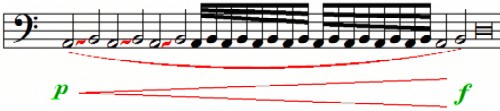
I n this movement, Lee performs a series of rapid, sighing glissandos, damping the strings with her [left] hand as she goes. These are not whiny or clichéed glissandi. These are troubling glissandi that literally freeze us in our tracks...

A lan’s program notes indicate that the cello part ‘represents Mr. Robert Ledyard Frink, while the violin part most often represents his wife, Margaret Frink,’ the author of the 1850 Indiana-to-Sacramento 111-page diary that this composition sets. This seventh song derives from a traditional Sioux melody that Smith found in a book of transcribed native wooden flute pieces.

A ctually, my apprehending Chinese qualities in this ‘Sioux’ song—its rendering by Alan, and its interpretation by Priscilla—is maybe not too deviant... Native American flutes are generally tuned to a variation of the minor pentatonic scale, which lends a plaintive sound to it. And much traditional Chinese music uses a pentatonic scale, with the intervals (in lǜ) almost the same as those of a major pentatonic scale. The notes of this scale are called gong, shang, jue, zhi, and yu.

T he more ‘directly acoustic’ the expressive constructs in the score are (timbre and pitch, contrasted with, say, ‘density’, or speed of execution of some process), the more powerfully evocative the result is likely to be. A simple example is Iannis Xenakis’s ‘Pithoprakta’ (1956) for strings [plus a couple trombones and other interlopers]. The epitome of abstraction, it emulates the dynamics of gas-phase molecular physics. How emotionally evocative could that be? Ah, but the glissando speed of individual instruments corresponds to the momentum (velocity) of individual molecules. The glissandi are sampled from a Gaussian statistical distribution, and Xenakis’s notations in the score embody this explicitly. As the physics of gases specifies only momentum (a function of particle velocity), not position, the endpoints of each glissando are—and must be—defined by other means, with the notation allowing ample discretionary latitude for the performer. Likewise, Xenakis’s cello piece ‘Nómos α’ is ‘directly acoustic’ in its notation and design. The composition has the cello emulate parameter values from the mathematical structure of the Lie group of symmetries of the cube. Abstract, yet evocative. Another example of abstract, formal constructs that are nonetheless highly evocative: Stockhausen’s ‘Mikrophonie I’ effectively embodies 33 ‘moments’, which are distinct patches of rhythmic/timbral/harmonic texture. These moments’ patterns derive from constructing triplets from three sets: similar/different/opposite; supporting/neutral/opposing; increasing/constant/decreasing (Maconie 1976/2005). Oddly enough, the ‘Sioux Tribe and White Squaw’ song reminds me of these...

M ost conventional music notation is ‘prescriptive’ (‘Do this!’). But these pieces are salted with descriptive annotations: ‘Make it sound like this!’ Way beyond Italian adjectives and imperatives. And, frankly, a fun change for the performer. Cool.

G lyphs and spatial indicators in Priscilla’s marked-up music? Alan’s expanding the pitch-sets and stretching the harmonies while at the same time preserving the foundation or a skeletal form—sometimes more ‘imagined’ than written? The musical surface suggested by the score then becomes a “sketch”, at best—and a possibly dodgy one at that, like an old, dilapidated treasure map, complete with Terra Incognita. Here there be Dragons!

T he pulse that’s set up has a solid, reliable-but-striated time-sphere that’s amenable to acceleration/deceleration, which you hear in the 30-sec MP3 clip above. The cello pairs with the mezzo-soprano in lyrical ascents, while the piano and violin protest in short outbursts.

T here are allusions to alienation—of the pioneers from their former lives and from all means of social support during their journey, now among the Sioux people. There is plaintive, solitary playing... The tenuousness of the covered-wagon caravan and its people is palpable; a masterful acoustic portrayal. The piece is alternately atonal, with showy/theatrical declamation, then melodic, diaristic and tender.

T he rate of decay during Priscilla’s execution of her damped glisses is under only partial scalar control—during the damping of the strings, it is driven by the tension of the damping fingers positioned transversely across the strings/fingerboard. The amount of damping changes during each gliss, as the position of the fingers sweeps bridgeward or nutward. The deflection of the strings by the glissing-damping fingers changes continuously, and the fingers make adjustments on-the-fly.

 Gliss-to-Trill, major second
T he uncertainty in this is considerable, no matter how much rehearsal may have been done and no matter how much muscle-memory may have been built up. Technical mastery confronts vagaries of human flesh and neurophysiology, plus the multi-dimensional physics idiosyncrasies of the bowed [stopped] string(s). The string-damping is, to compound the physics further, pitch-dependent. The very low latency with which Priscilla accomplished this reminded me of a very fine pipa or zheng player—or of the impressive synchrony of large flocks of thousands of birds in simultaneous flight, never bumping into each other. Wings beating in branches, immediately damped as they take to the air. Accelerating slides, giving way to airborne trills when lift exceeds drag. She uses the left hand to bend the string to form a mode of two, three, four, five, or six—conveying a solemn, wistful feeling.

S he may have been born in California, but Priscilla must have some innate intuition of huayin! (Or else she has trained on pipa or zheng?)

 Shang Huayin portamento
I n the pipa-like or zheng-like passages, the movements of Priscilla’s left-hand resemble inside-to-outside (in the case of cello, A-string to C-string) finger movements executing a pipa tremolo (‘lun’ in Chinese).

 Li Mei, quoted in Haiqiong Deng thesis, FSU, 2006
I n some of these portamento/glissando passages, the interval to traverse is too narrow (seconds) for conventional cello ‘smooth-shift’ (slide initial finger, land by stopping with next finger) techniques to be practicable. Priscilla produces an exotic, soft, dissonant glissando—almost siren-like—punctuated by Kavafian’s pizzicato, and relieved by mezzo Stephanie Blythe’s resumption of her part. Jones binds the narrative whole of it together...

I n various passages, Priscilla played some delicate, exquisite harmonics. Both natural and artificial harmonics are possible, and, as I do not have the score available to me at the present time, I’m not sure which are indicated in this piece. Natural harmonics do not require any special notation; in a pipa or zheng score, one would specify the note with a ‘°’ above it. On each string one can obtain partial numbers 2, 3, 4. Artificial harmonics on a zheng are created by placing the edge of the left palm on a harmonic node while fingering the string as the pitch requires. Almost any note can be obtained, but not too quickly. Likewise, the cello. Ask what you will in the score, but don’t make these harmonics passages rhythmically impractically complex or fast. Zheng notation has artificial harmonics with the desired note and a ‘°’ above it, plus the abbreviation ‘artif.’ or similar. I will have to think more about that...

 Portamento, minor thirds
E    xtramusical models: “…What properties are possessed by an arithmetical progression, for example, which make it appropriate for interpretation as a metrical or ordinal pitch, or durational, or dynamic, or timbral, or density determinant? What data in the field of musical perception determine the rules of correlation?”
  —  Milton Babbitt, Past and present concepts of the limits of music, Boretz & Cone, 1972, p. 7.
P riscilla Lee trained at Curtis Institute of Music and at Mannes College of Music, and is a member of Lincoln Center’s ‘Chamber Music Society Two’. She has received an Avery Fisher Career Grant, a Gregor Piatigorsky Scholarship, a John Williams Scholarship from the Young Musicians’ Foundation, and the Barnett Family Foundation Chamber Music Competition. She has appeared at the Marlboro Music Festival, Bargemusic, Caramoor, and the Santa Fe Chamber Music Festival, among others. She is a founding member of the piano trio, Trio Cavatina, at the New England Conservatory.


Sunday, July 29, 2007

Rolf Wallin: How to Build an Audience Through More Iconoclasm, Not Less

Attacca Quartet
CMT: ‘Concerning King’ (2006), by the 50-year-old Norwegian composer Rolf Wallin, was performed last week by Attacca Quartet in New York. This Wallin composition originates in a mathematical analysis of serial time-samples of the acoustic frequency spectrum of a recording of an antiwar speech given by the Rev. Dr. Martin Luther King Jr. at Riverside Church in 1967. Edgy staccato passages, without much lyricism. Challenging to listeners and performers alike!

DSM: Fractious. A long musical exhortation, like the best of King’s civil rights speeches, for the listener to personally do something to make things better in the world.

CMT: Yes. Wallin’s music has the blunt forthrightness, innocence, and stark beauty that are characteristic of a Norwegian temperament and outlook. It’s music that’s insistent in asserting discordant facts, but simultaneously expansive and optimistic. It strongly indicates reasons for hope, if only you will act! Rolf studied in Oslo at the Norgesmusikkhøgskole (Norwegian Academy of Music) with Finn Mortensen and Olav Anton Thommessen and later at the University of California where he studied under Roger Reynolds and Vinko Globokar. Wallin’s music combines an intuitive gestalt with mathematics, such as his use of fractal algorithms in his compositional technique, which results in music that sometimes resembles Xenakis or Berio. In 1987, Wallin received Norwegian Society of Composers Award for ‘…though what made it has gone’. He currently still resides in Oslo.

Rolf Wallin
DSM: With a performance such as the Attacca Quartet just gave, I think each faction of the audience hears what they already knew about. But they can’t help but learn something new, too. And when they leave the performance venue, they are aware of a whole different kind of music; whole new meanings. Older folks like me can see the art, musicianship and virtuosity that are part of new music at its best. This stuff makes you think, but it also makes you feel! Ideally, it may motivate you to Do, rather than just Consume or Experience. The aleatoric and other effects—they just propel and demand a greater degree of listener ‘investment’ in deriving the meaning than more canonical pieces typically do. The balance between the performers and the audience is more like jazz, that’s all.

CMT: And aleatory and electronica didn’t spring de novo from the heads of Kraftwerk or Brian Eno; they grew out of a century of musical experimentation. That’s part of what younger audience members find out in this. Fifty to a hundred years ago, Varèse was searching for, and finding, new sounds long before electronics could provide them. Cage more or less invented industrial music, using found industrial objects. Those and a legion of less well-known and under-appreciated members of the avant-garde. Wallin and others younger than he are merely carrying that banner forward and innovating entirely new banners!

DSM: Reading the New York Times’ reviewer Vivien Schweitzer’s comments, I wonder whether we were hearing the same performance! Attacca’s performance of Wallin was vibrant and thrilling and unsettling, not ‘long-winded’! And it’s seldom that we in the U.S. have the privilege of experiencing this kind of inspired aesthetic cross-pollination. Marketers and presenters are understandably uncomfortable with crossing boundaries and can hardly risk doing anything other than stick their music, and their audience, in easily identified, familiar, sanctioned categories. They dread offending those touchy patrons who will tolerate nothing that is unfamiliar or unproven, nothing that is uncomfortable. So the repertoire gets constricted—regardless how innovative the performances of canonical works may be. But we need more new music and more category-busting events if we are to evolve a new music that is both artful and speaks to growing audiences looking for bespoke ‘experiences’ rather than shrinking audiences looking for uncontroversial balm.

CMT: Outreach programs and ‘Young People's Concerts’ á la Bernstein clearly don’t ‘work’ in terms of increasing audience and paid butts in seats. The London Sinfonietta’s ‘Ether’ concerts do to a degree succeed in bridging the gap between yesterday’s avant-garde and tomorrow’s.

DSM: But much, much more quantity—and much, much more varied offerings than are currently on offer—are needed. In other words, one solution to an already over-crowded classical music market is not ‘less’ product but ‘more’! Just not necessarily more of the same canon.

CMT: One solution is to leverage the famous Chris Anderson ‘long tailed’ distribution—the economical packaging and wider accessibility and ‘push’ marketing of performances tailored to ever-narrower market segments and ever-more-specialized affinities.

DSM: We’ve talked several times in months past in this blog, about the relationship of musical composition and nonlinear systems—Roger Reynolds, Iannis Xenakis, Milton Babbitt, and others. Is Rolf Wallin using things like strange attractors (Lorenz Attractor algorithms) or Mandelbrot sets to generate his motives—surtout dans la phase “précompositionnelle”?

CMT: Well, go email him! Go to Oslo and ask him!


 [Wallin, ‘… though what made it has gone’, Hilde Torgersen, mezzo;
   Kenneth Karlsson, piano; from CD ‘MOVE’ 1.4MB MP3]

Ondaavstand Fractal
C ette notion que des ‘instructions de travail’ simples peuvent générer une musique imprévisible au niveau des détails, mais qui néanmoins corrèle avec les procédures, m’a beaucoup fascinée, en tant qu’alternative plus ‘liquide’ à la notion d’œuvre, alors que l’œuvre au sens traditionnel est ‘cristallisée’ ou ‘coagulée’.”
  —  Rolf Wallin.