
A t the mountain-summit pass,] the wagons halted. At last Robert and I got to the top with the mules and their burdens. I was utterly exhausted. I took a buffalo robe from the packs and wrapped myself in it, and I lay myself down [almost involuntarily] by the side of the road on top of the mountain and fell into a deep sleep [or, more accurately, withdrew behind my eyelids]. I told Robert to keep watch over me and the mules.”I t feels to me like I am about to break one of the rules in Rahn’s famous multi-author edited book, ‘Going Too Far in Musical Essays’. Alan Smith’s ‘Vignettes: Covered Wagon Woman’ was performed on Tuesday evening in Kansas City by members of Chamber Music Society of Lincoln Center. Cellist Priscilla Lee, mezzo-soprano Stephanie Blythe, violinist Ani Kavafian, and pianist Warren Jones’s account of this 13-movement/scene piece was superb—dramatic and engaging throughout—all the way to a touching denouement in the hummed-lullaby ‘Epilogue’.
— Margaret Frink, 1850, in Holmes, ‘Covered Wagon Women’, Vol 2, p. 152.
B ut, honestly, there was a tiny feature of the performance that, for me, held great importance and fascination; one which genuinely impressed me and led me to do some thinking and learning—so I think there can be no big sin in writing something about it here. (Really, for a thematic and representational composition of such a size it would take several hearings and a close examination of the score, to win any chance of properly commenting on the overall work... which I do not have the possibility to do right now. So I rationalize my attention to the “tiny” feature.)
W hat my imagination was captivated by was the wonderful Chinese characteristics of the cello part in ‘The Sioux Tribe and the White Squaw’, the seventh movement/song.
[30-sec clip, Priscilla Lee et al., Smith, ‘Vignettes: Covered Wagon Woman’, VII-Sioux Tribe & White Squaw, 0.6MB MP3]
I n this movement, Lee performs a series of rapid, sighing glissandos, damping the strings with her [left] hand as she goes. These are not whiny or clichéed glissandi. These are troubling glissandi that literally freeze us in our tracks...
A lan’s program notes indicate that the cello part ‘represents Mr. Robert Ledyard Frink, while the violin part most often represents his wife, Margaret Frink,’ the author of the 1850 Indiana-to-Sacramento 111-page diary that this composition sets. This seventh song derives from a traditional Sioux melody that Smith found in a book of transcribed native wooden flute pieces.
A ctually, my apprehending Chinese qualities in this ‘Sioux’ song—its rendering by Alan, and its interpretation by Priscilla—is maybe not too deviant... Native American flutes are generally tuned to a variation of the minor pentatonic scale, which lends a plaintive sound to it. And much traditional Chinese music uses a pentatonic scale, with the intervals (in lǜ) almost the same as those of a major pentatonic scale. The notes of this scale are called gong, shang, jue, zhi, and yu.
T he more ‘directly acoustic’ the expressive constructs in the score are (timbre and pitch, contrasted with, say, ‘density’, or speed of execution of some process), the more powerfully evocative the result is likely to be. A simple example is Iannis Xenakis’s ‘Pithoprakta’ (1956) for strings [plus a couple trombones and other interlopers]. The epitome of abstraction, it emulates the dynamics of gas-phase molecular physics. How emotionally evocative could that be? Ah, but the glissando speed of individual instruments corresponds to the momentum (velocity) of individual molecules. The glissandi are sampled from a Gaussian statistical distribution, and Xenakis’s notations in the score embody this explicitly. As the physics of gases specifies only momentum (a function of particle velocity), not position, the endpoints of each glissando are—and must be—defined by other means, with the notation allowing ample discretionary latitude for the performer. Likewise, Xenakis’s cello piece ‘Nómos α’ is ‘directly acoustic’ in its notation and design. The composition has the cello emulate parameter values from the mathematical structure of the Lie group of symmetries of the cube. Abstract, yet evocative. Another example of abstract, formal constructs that are nonetheless highly evocative: Stockhausen’s ‘Mikrophonie I’ effectively embodies 33 ‘moments’, which are distinct patches of rhythmic/timbral/harmonic texture. These moments’ patterns derive from constructing triplets from three sets: similar/different/opposite; supporting/neutral/opposing; increasing/constant/decreasing (Maconie 1976/2005). Oddly enough, the ‘Sioux Tribe and White Squaw’ song reminds me of these...
M ost conventional music notation is ‘prescriptive’ (‘Do this!’). But these pieces are salted with descriptive annotations: ‘Make it sound like this!’ Way beyond Italian adjectives and imperatives. And, frankly, a fun change for the performer. Cool.
G lyphs and spatial indicators in Priscilla’s marked-up music? Alan’s expanding the pitch-sets and stretching the harmonies while at the same time preserving the foundation or a skeletal form—sometimes more ‘imagined’ than written? The musical surface suggested by the score then becomes a “sketch”, at best—and a possibly dodgy one at that, like an old, dilapidated treasure map, complete with Terra Incognita. Here there be Dragons!
T he pulse that’s set up has a solid, reliable-but-striated time-sphere that’s amenable to acceleration/deceleration, which you hear in the 30-sec MP3 clip above. The cello pairs with the mezzo-soprano in lyrical ascents, while the piano and violin protest in short outbursts.
T here are allusions to alienation—of the pioneers from their former lives and from all means of social support during their journey, now among the Sioux people. There is plaintive, solitary playing... The tenuousness of the covered-wagon caravan and its people is palpable; a masterful acoustic portrayal. The piece is alternately atonal, with showy/theatrical declamation, then melodic, diaristic and tender.
T he rate of decay during Priscilla’s execution of her damped glisses is under only partial scalar control—during the damping of the strings, it is driven by the tension of the damping fingers positioned transversely across the strings/fingerboard. The amount of damping changes during each gliss, as the position of the fingers sweeps bridgeward or nutward. The deflection of the strings by the glissing-damping fingers changes continuously, and the fingers make adjustments on-the-fly.
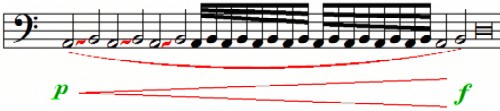
T he uncertainty in this is considerable, no matter how much rehearsal may have been done and no matter how much muscle-memory may have been built up. Technical mastery confronts vagaries of human flesh and neurophysiology, plus the multi-dimensional physics idiosyncrasies of the bowed [stopped] string(s). The string-damping is, to compound the physics further, pitch-dependent. The very low latency with which Priscilla accomplished this reminded me of a very fine pipa or zheng player—or of the impressive synchrony of large flocks of thousands of birds in simultaneous flight, never bumping into each other. Wings beating in branches, immediately damped as they take to the air. Accelerating slides, giving way to airborne trills when lift exceeds drag. She uses the left hand to bend the string to form a mode of two, three, four, five, or six—conveying a solemn, wistful feeling.
S he may have been born in California, but Priscilla must have some innate intuition of huayin! (Or else she has trained on pipa or zheng?)

I n the pipa-like or zheng-like passages, the movements of Priscilla’s left-hand resemble inside-to-outside (in the case of cello, A-string to C-string) finger movements executing a pipa tremolo (‘lun’ in Chinese).

I n some of these portamento/glissando passages, the interval to traverse is too narrow (seconds) for conventional cello ‘smooth-shift’ (slide initial finger, land by stopping with next finger) techniques to be practicable. Priscilla produces an exotic, soft, dissonant glissando—almost siren-like—punctuated by Kavafian’s pizzicato, and relieved by mezzo Stephanie Blythe’s resumption of her part. Jones binds the narrative whole of it together...
I n various passages, Priscilla played some delicate, exquisite harmonics. Both natural and artificial harmonics are possible, and, as I do not have the score available to me at the present time, I’m not sure which are indicated in this piece. Natural harmonics do not require any special notation; in a pipa or zheng score, one would specify the note with a ‘°’ above it. On each string one can obtain partial numbers 2, 3, 4. Artificial harmonics on a zheng are created by placing the edge of the left palm on a harmonic node while fingering the string as the pitch requires. Almost any note can be obtained, but not too quickly. Likewise, the cello. Ask what you will in the score, but don’t make these harmonics passages rhythmically impractically complex or fast. Zheng notation has artificial harmonics with the desired note and a ‘°’ above it, plus the abbreviation ‘artif.’ or similar. I will have to think more about that...

E xtramusical models: “…What properties are possessed by an arithmetical progression, for example, which make it appropriate for interpretation as a metrical or ordinal pitch, or durational, or dynamic, or timbral, or density determinant? What data in the field of musical perception determine the rules of correlation?”P riscilla Lee trained at Curtis Institute of Music and at Mannes College of Music, and is a member of Lincoln Center’s ‘Chamber Music Society Two’. She has received an Avery Fisher Career Grant, a Gregor Piatigorsky Scholarship, a John Williams Scholarship from the Young Musicians’ Foundation, and the Barnett Family Foundation Chamber Music Competition. She has appeared at the Marlboro Music Festival, Bargemusic, Caramoor, and the Santa Fe Chamber Music Festival, among others. She is a founding member of the piano trio, Trio Cavatina, at the New England Conservatory.
— Milton Babbitt, Past and present concepts of the limits of music, Boretz & Cone, 1972, p. 7.
- Priscilla Lee page at Chamber Music Society of Lincoln Center
- Chamber Music Society of Lincoln Center. Alan Smith: Covered Wagon Woman. (CMS, 2008.)
- Trio Cavatina website
- Alan Smith page at USC Dept of Music
- de Alcantara P. Indirect Procedures: A Musician's Guide to the Alexander Technique. Oxford Univ, 1997.
- Boretz B, Cone E, eds. Perspectives on Contemporary Music Theory. Norton, 1972.
- Chen J, Woollacott M, Pologe S, Moore G. Pitch and space maps of skilled cellists: accuracy, variability, and error correction. Exp Brain Res. 2008;188:493-503.
- Holmes K. Covered Wagon Women, Volume 2: Diaries and Letters from the Western Trails, 1850. Bison, 1996.
- Karjalainen M, et al. Frequency-zooming ARMA modeling of resonant and reverberant systems. J Aud Eng Soc 2002; 50:1012-29.
- Kowenhoven F. Meaning and structure: The case of Chinese qin music. Ethnomusicol Forum 2001; 10:39-62.
- Maconie R. Other Planets: The Works of Karlheinz Stockhausen. Oxford Univ, 2005.
- Melvin S, Jingdong Cai. Rhapsody in Red: How Western Classical Music Became Chinese. Algora, 2004.
- Oestreich J. The sound of new music is often Chinese: A new contingent of American composers. New York Times, 01-APR-2001.
- Paquette D. Flute Dreams: Playing the Native American Flute. iUniverse, 2005.
- Potter L. Cello Method. 2e. Summy-Birchard, 1980.
- Rahn J, ed. Music Inside Out: Going Too Far in Musical Essays. Routledge, 2000.
- Rees H, ed. Lives in Chinese Music. Univ Illinois, 2009.
- Sazer V. New Directions in Cello Playing. 3e. OfNote, 2003.
- Vames J. The Native American Flute: Understanding the Gift. 2e. Molly Moon, 2003.


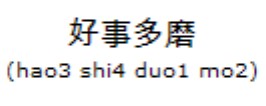


![Today we have wine [tomorrow, maybe not], so let’s drink today](http://gapyx.com/cmt/2008/03/today_we_have_wine_so_lets_drink_today.jpg)


![Indigo [student] is bluer than the plant it comes from [master]](http://gapyx.com/cmt/2008/03/indigo_student_bluer_than_the_plant_master.jpg)

![A cornered dog will leap over a high wall [do seemingly impossible things in extremis]](http://gapyx.com/cmt/2008/03/cornered_dog_will_leap_over_wall.jpg)


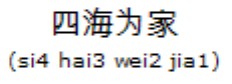

![Words escape from the lips [in a Freudian-slip way]](http://gapyx.com/cmt/2008/03/words_escape_from_lips.jpg)
![One hand cannot [without help from others] clap to make a sound](http://gapyx.com/cmt/2008/03/one_hand_cannot_clap_to_make_sound.jpg)


