Showing posts with label long tail. Show all posts

Monday, May 18, 2009

‘Keys to the Future’ and Contemporary Piano Repertoire: The Critical Role of Festivals

 Keys to the Future festival
T    here is a huge range of new piano music being written right now, and a huge range of new pianists to play it. I am very impressed with the ‘Keys to the Future’ festival, which fills a giant hole in New York’s musical life. This festival is an explosion of piano music of all types, played by a new generation of virtuosi.”
  —  David Lang, composer and co-founder of ‘Bang on a Can’.
T    he ‘Keys to the Future’ [festival] is one of the most inclusive and thoughtfully curated piano series anywhere. The repertoire encompasses composers from ‘uptown’ and ‘downtown’; the U.S., Europe, and South America; and the worlds of jazz and contemporary songwriting.”
  —  Fred Hersch, pianist/composer.
T  he plight of new music for solo instruments is inherently and substantially different from the plight of other new music forms for ensembles. Solo piano music is particularly vulnerable.

A  s any repertoire ages, its impact on audiences gradually diminishes. In all the arts except serious music, audience growth is cultivated by new works. In principle, the sustainability of serious music (including piano music) must depend at least partly on the excitement and energy that a continual supply of, and performance of, new works provides. But these can’t be just any works. They must be new works that successfully stimulate and broadly resonate with the concert-going audience segments, both young and old. To alienate the existing bread-and-butter audience segments in a quixotic pursuit of new audiences is the worst of all possible worlds.

V    ery often I get the impression that audiences seem to think that the endless repetition of a small body of entrenched masterworks is all that is required for a ripe musical culture… Needless to say, I have no quarrel with masterpieces. I think I revere and enjoy them as well as the next fellow. But when they are used, unwittingly perhaps, to stifle contemporary effort in our own country, then I am almost tempted to take the most extreme view and say that we should be better off without them!”
  —  Aaron Copland, 1941.
F  or a professional pianist who is not primarily an academician, the market pressures to confine one’s performance repertoire to a relatively restricted range of well-known ‘war-horses’ exceed all bounds. Jeremy Denk has remarked several times about this in his blog, as he himself rails against those pressures. No instrument is more competitive than the piano, and this fact weighs heavily on every working pianist.

F  or a professional composer not primarily employed in academe, it’s similarly a question of going where the money is, where the greatest number of commissions and the biggest commissions and the highest-profile commissions are—and focusing your energies on those. The pressures are huge.

A  nd for both, there is the practical matter of disturbing the peace, for those performers whose personal living quarters are the primary place for practice or writing. In other words, if your innovations in composing or rehearsing new frontiers of pianism are too bold and aggressive, ordinary neighbors and family members within ear-shot will exert powerful ‘normative’ pressures of their own, long before the new work ever greets the light of day.

S  ponsors to commission new solo piano works are fewer in number than for other genres. Presenters who program solo piano series are a subset of the chamber music presenters in each country. All of these are strong ‘filters’ that effectively limit the rate of commissioning of new solo piano works.

T  he net consequence of all of this is that specialized piano festivals are the way to go, and KttF gets the multi-genre marketing ‘mix’ exactly right, to beautifully address all of the factors mentioned above. With regard to something like new solo piano works, festivals (and competitions) are the best way to connect all of the constituencies—the audience market segments of people who will subscribe to the program series; the presenters who can host such a program series; the funders who will financially underwrite programs of this type; the performers; the composers.

T  o a greater extent than most other instruments and ensembles, I suppose, it is difficult to compose music for solo piano without great proficiency in the instrument. Close collaboration with a concert artist may get you by for composing for other instruments or voice, but piano? Not so much! As a result, a large part of the new piano repertoire consists of works by pianist-composers who are pianists first and foremost or who are very strong pianists in any case.

T  he 1980s to the end of the century yielded a great deal of fine music, but piano music seemed to have remained alien to many of the composers of that period. Most of them composed only a handful of piano pieces, peripheral to the rest of their oeuvre. And solo piano music prior to the 1950s tended to be composed by composers whose main output was orchestral or otherwise very diverse, and whose main instrumental skills may have been on non-keyboard instruments. Since then, however, the solo piano literature has depended more crucially on composers who are themselves superb pianists. Frederic Rzewski is one such example.

R    zewski’s 70th birthday [occurred in 2008], but the occasion [was] not ... marked with the sort of fanfare previously bestowed on Steve Reich, Philip Glass, and John Corigliano. This is kind of instructive—Rzewski primarily writes for the piano, and is clearly the most important and influential composer of works for piano of the past 25 years. In the 19th century, if you wrote great piano music you were a titan. But in the 21st century, you’re ... some sort of a marginalized ‘cult’ figure.”
  —  Darcy James Argue, SecretSociety blog, 09-MAR-2008.
J  ouni Kaipainen’s ‘Je chante la chaleur désespérée’ (1981) and ‘Conte’ (1985) are quite wonderful solo-piano pieces. Also, Esa-Pekka Salonen's ‘Dichotomie’ (2000), say. Juhani Nuorvala’s ‘Viisi bagatellia’ or Veli-Mati Puumala’s ‘Fuga interrotta’ (1997) or ‘Hommages fugitives’ (2002). Hmmm...

J  ukka Tiensuu and his piano pieces ‘Solo’ (1976) and ‘/L’ (1981) make use of live sound-reinforcement, to color the piano sound as desired. Tiensuu’s ‘Prélude non-mesuré’ and other works also push the envelope. An essential aspect of Tiensuu’s music is that he is an accomplished pianist and harpsichordist, who performs works of the Renaissance and Baroque as well as contemporary music.

A  h, maybe that’s it! … At least one reason for the pre-2000 relative dearth of solo piano music that’s easy to find. In the present era of sensory overload, timbre has become a progressively more important element of contemporary music that can attract mass audience—audiences that crave more and more sensory overload. But what the piano offers to you as a composer in the way of ‘color’ is pretty subtle, and how to make the most of what piano can do is only adequately understood if you are tremendously proficient as a pianist yourself. Notes sounded with force are colored with many harmonics, while notes sounded quietly are more flutey, holding only hints of harmonic complexity… The biomechanics of what is practical and achievable on the keyboard can scarcely be taught in conservatory classes... And so on. Therefore, it’s monumentally difficult to devise virtuosic solo piano pieces that will be playable and be accessible to concert-going audiences and simultaneously be emotive/demonstrative enough to capture audiences’ tattered, overloaded imaginations—more monumentally difficult than composing virtuosic pieces for most other solo instruments. Can we infer that, lacking adequate pianist ‘chops’, many composers have followed a ‘path of least resistance’ and have therefore preferred to work with various chamber ensembles or orchestral music, or with other ‘celebrity appeal’ solo instruments? An issue for the educators/pedagogues to continue to work on, going forward!

A  t any rate, the ‘Keys to the Future’ festival illustrates just how much excellent writing and collaboration between composers and pianists, and commissioning is going on today, and over the past several years, as attested in the blockquote from David Lang above. Cool!

P  ianists who will be performing at this year’s KttF include:
  • Amy Briggs
  • Stephen Gosling
  • Manon Hutton-DeWys
  • Marina Lomazov
  • Blair McMillen
  • Lisa Moore
  • Molly Morkoski
  • Tatjana Rankovich
  • Joseph Rubenstein
C  omposers whose works will be represented include:
  • John Adams
  • Chester Biscardi
  • William Bolcom
  • Ryan Brown
  • John Corigliano
  • Daniel Felsenfeld
  • Philip Glass
  • Robert Helps
  • Fred Hersch
  • Aaron Kernis
  • David Lang
  • Lowell Liebermann
  • Andrew List
  • Henry Martin
  • Eric Moe
  • Nico Muhly
  • Doug Opel
  • Carter Pann
  • Arvo Pärt
  • Radiohead/arr. O’Riley
  • Steve Reich
  • Joseph Rubenstein
  • Howard Skempton
  • Elliott Smith/arr. O’Riley
  • Bruce Stark
  • Karen Tanaka
  • Lois Vierk
  • Mischa Zupko
F  ounded in 2005, the KttF festival is now in its fourth season. The program is curated by studio pianist/composer Joseph Rubenstein, DMA Yale 2001.

T  he festival runs from Tuesday through Thursday, 19-21 MAY, at Greenwich House, Renee Weiler Concert Hall, 46 Barrow Street. (West of 7th Ave. Take the "1" train to Christopher Street, walk south two blocks and make a right on Barrow. BHMS is about a half block down on the right.) Each concert begins at 20:00, but the Renee Weiler Concert Hall doors open at 7:30 on the evening of each concert. Seats are general admission, $15 per concert, and are not sold in advance, only at the door, first-come, first-serve. The events were entirely sold-out last year, so be sure to get there early if you can.

 Greenwich House Music School, New York, photo ©2005 Hubert Steed

F    avorite solo passage? The ending of the 2nd movement of the Schumann Fantasy, with all the right notes!”
  —  Jeremy Denk, , 27-MAR-2007.


Tuesday, April 22, 2008

New Music ‘Expectations’ vs. ‘Expectancy’: George Perle

 George Perle
H  is [Perle’s] pieces also raise what has become a confusing question: What do classical composers writing music like this expect from listeners?”
  —  Bernard Holland, NYT, 20-MAY-2008.
W  hat do composers writing music like this expect from listeners? They expect nothing, except honesty and an open mind. They don’t expect charity or an unearned free ride. They expect no more ‘smarts’ than the curiosity one finds in cats watching ambient television in their owner’s house, for free. We self-select, those of us who are transfixed like cats, enthralled by Perle’s music. There is a contrary self-selection, too, by those who aren’t even mildly curious about what it is or how it works or what it might mean or what comes next. Honestly confessing to ‘not liking’ something is fine. And calling it a different language, as Holland does, is also fine. But choosing not to attend to a language, and impugning the comprehensibility of the language and those who speak and write it, and justifying one’s position by asserting the inevitable, righteous marginality/disenfranchisement of the shunned language—as Holland does—are indefensible, xenophobic choices. If we follow Holland’s lead, I guess we need not bother to learn Tlingit, or Monguor, or Southern Tiwa—because there are only a few hundred speakers of those, the languages are dying anyway, and the songs and the ideas they are about seem nasty or irrelevant to classical Euro-centric white metro consumption-crazed culture.”
  —  DSM.
I  t is true that in the natural course of things, languages, like everything else, sometimes die. People choose, for a variety of valid social reasons, not to teach their children their own mother tongue. In the case of American Indian languages, however, the language drop-off has been artificially induced and precipitous, and just as with the human-caused endangered species crisis, it is worth doing something about it. Amerindian languages were deliberately destroyed, particularly in North America. In the earlier days of European contact, Indians were separated from their linguistic kin and resettled hundreds of miles away with individuals from other tribes who couldn’t understand each other. Historically, this is the single most effective way to eliminate minority languages (for obvious imperialistic reasons).”
  —  Laura Redish, NativeLanguages.org.
Bernard Holland, one of the New York Times’s music critics, repeatedly bashes new music and composers of new music every few months or so. His piece on George Perle in Sunday’s NYT is another installment. Holland’s rants generally exhort composers to create audience-friendly works, works of ready-made ‘relevance’ for unprepared general audiences—as if doing so will somehow solve classical music’s sales and marketing problems in this era of mass-media consumerism. Holland, the staunch advocate for a Tyranny of Mass-Market Relevance.

I will continue to read Bernard, even though these anti-new music attitudes of his annoy me—and annoy Greg Sandow, Frank Oteri, David McMullin, and almost anyone who is composing or performing or attending or buying and experiencing new music.

But I think of these experiences differently from Holland. I think of them as explorations. An opportunity to hear, or perform, or write new music is a form of exploration, or art tourism, or musical anthropological adventure, into virtual cultures that are infrequently visited by ‘civilized’ consumeristic/capitalistic people. The ‘aboriginal’ musicians are spontaneously doing and creating what they do—not as though they have never encountered white men [of Bernard Holland’s imperial ilk] before, but as though they need to do it for their own real, honest, indigenous reasons.

In fact, they (we) are quite interested in trade with people from other ‘lands’. We welcome the visitors. But commercial trade with them is not what makes us most of us tick. And we are not about to allow ourselves to be subjugated by them. We don’t intend to end up making derivative ‘musical trinkets’ or commodities catering to the needs and mass-market aspirations of imperialists.

I  write music that I intend to be beautiful, and I hope that it will please listeners. My strange idea of beauty may not resonate as widely as Bach’s or Britney Spears’, but it’s what I have to offer, and it doesn’t mean I hate my audience. All I ask of listeners is an open mind.”
  —  David McMullin, American Composers’ Forum.
And, in general, we who do new music are not ‘defying’ anything, any more or less than any genuine indigenous culture is ‘defying’ a dominant-culture with which it comes into contact. We refuse to be tyrannized by the dominant out-culture’s traditions or expectations. Nor are we self-tyrannized by an obsession to always be ‘new’, in a way that deliberately, perversely races ahead of any audience’s ability to comprehend or enjoy, in the manner that Holland implies. We know that radical novelty in and of itself is no guarantee of meaningfulness or value.

Bernard Holland is right about one thing: we do create new languages—ones that he simply prefers not to learn and sees no possibility of enjoying and damns by faint praise.

I  can speak only the languages I was born to. Sometimes I feel guilty. Maybe I should work harder at [Perle’s] grammar and vocabulary. With age I feel guilty less and less [about my indolent attitude toward new music].”
  —  Bernard Holland, New York Times, 20-APR-2008.
We invent things. It’s what we do; it’s what we have to offer. And, to be worthy of the Patent Office’s term ‘invention’, by definition the things must be novel, non-obvious, and valuable—valuable to future societies, if not to the ones that exist right now. To be worthy of the term ‘invention’, by definition not everyone will have thought of it or immediately think it’s ‘fun’.

A  ‘language’ is a dialect with an army and a navy. [And anything lacking military force is merely a ‘dialect’ to be dismissed, not reckoned with.]”
  —  Max Weinreich, 1945.
Language extinctions:
  • 497 languages are projected to become extinct within 15 years;
  • ~3,000 will be lost within a generation [David W. Lightfoot, NSF data].
North America:
  • 700 languages in 1492 C.E.;
  • Now only 162 have living speakers;
  • 75 are now spoken only by a handful of elderly;
  • Only 12 languages are spoken by more than 10,000 people;
  • 100 languages spoken in the Arctic but dramatic changes over the last 40 years [e.g., Tlingit, Tsimshian, Haida].
George Perle himself gave the best answer, to Bernard Holland’s question as to what composers expect:
Y  ou should approach a new piece the same way in which you would any other new experience—with a sense of curiosity, and with the hope that it will be a challenging, interesting, and exciting experience ... When I first came to San Francisco to take up my post as composer-in-residence, I was introduced to the symphony’s board of governors. One of them asked me, ‘Is your music fun to listen to?’ When you see a new piece on the program, you have a right to hope that it will be fun to listen to. There is a very good chance that you will be disappointed. There must be ten times as many young composers around today as there were when I was a young composer. The only aim that I can discern in the music of some of them is not to offend anyone by offering him music that he might not find entirely obvious at a first hearing, so they give you second-hand versions of Debussy, or Mahler, or early Stravinsky, or even Vivaldi. Second-hand versions of anything are a bore, which is itself an offense, to my way of thinking, but the new piece is rarely allowed to last more than ten minutes, and so you put up with it, and both you and the management of the orchestra feel that they have done their part in furthering the cause of contemporary music. I ask you to expect much more from new music, and to be prepared to recognize the difference when the real thing comes along. And I think you will recognize the difference ... The older music that is an important part of your lives represents only a selected and very limited portion of the music of any particular period. It is music that has stood the test of time, which only means that it is music your predecessors have culled out of the music of the past. You should be intrigued and challenged by the notion that you, too, will be playing a similar role in the unfolding of music history. It seems to me that nothing can be more important for the future of that history than the relation that you establish to the music of your contemporaries.”
  —  George Perle, Commencement address, San Francisco Conservatory of Music, May, 1991.
Composers hope for open minds, for expectancy. We hope to be accorded the dignity and respect that anthropologists should give to any culture. Each of us is, after all, our own far-away ‘land’, lacking an army or navy.

 Grenoble & Whaley book


Sunday, March 30, 2008

Few Chamber Orchestras Are Too Big to Fail: Market Size, Scale and Sustainability

 Saint Paul Chamber Orchestra
The culture of electronic media and the internet and the culture of social interaction continue to erode classical music and chamber music concert attendance. In the U.S., possibly some of this erosion is augmented by the economic downturn, but the trend has been relentlessly underway for many years now. Lifestyle and arts consumption choices of shifting generations continue to thwart traditional concert attendance, despite the fact that there are today more high-quality concert events and more diverse programming than ever before.

How long can this go on? Which organizations are likely to survive? How much does size (assets; revenue; financial strength) insure sustainability? Are there norms that are embodied by the strongest and best of the current contenders in this nonprofit chamber music marketplace, that other organizations in the field ought to aim for? Do the treasury management decisions of such leading organizations constitute norms that others should emulate? As weaker organizations begin to fail, will we see some of them get aggregated by joint-ventures or M&A into other larger ‘survivor’ organizations in the same geographic vicinity? And, if so, what are the financial ratios that potential acquirers should look for in due-diligence?

These are questions that are not readily answerable. But it does seem that tough, Darwinian survival-of-the-fittest times are ahead.

Just as you would do if you were evaluating companies and stocks, it’s helpful to consider the competitive landscape for chamber music ensembles by applying some financial-ratio analysis, to characterize the field quantitatively and monitor the players and the outcomes.

 Form 990 data for 501(c)(3) U.S. chamber orchestras
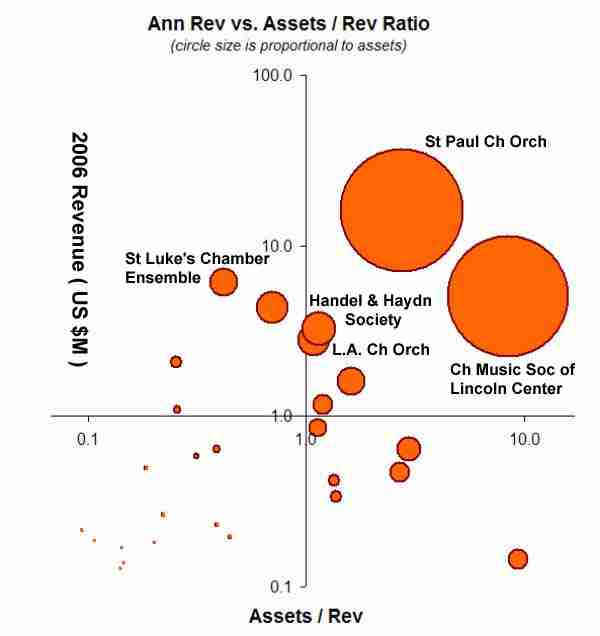
The log-log plot of the revenue vs. assets-to-revenue ratio shown above is for 35 nonprofit standing chamber orchestra organizations in the U.S. for the most recent year for which data are available, 2006. It provides at-a-glance comparison of top-line revenue and capital-output efficiency. I extracted the data from the federal IRS Form 990 tax documents that are publicly available via Guidestar and other sources. It’s easy to do—took me less than one hour. You may like to do this for your own organization, or for organizations that you make contributions to, to see how they are doing amongst their peers.

The upper-right quadrant contains ensembles that are both highly productive (in terms of revenue generation and free cashflow) and well-endowed. The upper-left quadrant contains ensembles that are very active but are relatively under-capitalized. The lower-right quadrant contains ensembles that are relatively well-endowed but are perhaps under-utilizing their available assets. And the lower-left quadrant contains organizations that are financially at-risk. Although this plot is strictly for standing chamber orchestras, the same sort of statistical distribution and scatter-plot could be done for 501(c)(3) chamber music presenter organizations and other groups. Robert Higgins’s and Richard Bull’s and Murray Dropkin’s books (links below) are particularly good, with regard to understanding and acting upon financial-ratio analysis for nonprofit organizations.

 eMarketer projected social networking annual ad spend
Possibly the most promising strategy for selling to the evolving chamber music market—of all ages—is social networking and Web 2.0 apps. Besides those environments, there are email affinity-marketing services, such as Emma.com, which are significantly more effective and flexible than services that were available several years ago.

When being chased by a bear, your survival first requires that you are not the slowest runner in the woods and that you are running in the best direction for getting away. I seriously doubt that the Federal Reserve will come to the rescue of any chamber music organizations ...

In this regard, the concept of sustainable growth was originally developed by Robert Higgins, Professor of Finance at the School of Business Administration, University of Washington. The sustainable growth rate (SGR) of any enterprise is the maximum rate of growth in sales that can be achieved, given the enterprise’s profitability, asset utilization, and debt (financial leverage) ratios. The variables in the SGR equation are the following:

  1. the net profit margin on new and existing revenues (P);
  2. the asset turnover ratio, which is the ratio of sales revenues to total assets (A);
  3. the retention rate, which is defined as the fraction of earnings retained in the business (R);
  4. the assets to beginning-of-period equity ratio (T).
To compute an orchestra’s SGR, multiply the four variables together, or, in other words, the SGR = P x A x R x T. Alternatively, the SGR equals the retention ratio, times the return on beginning-of-period equity.

The SGR increases when the operating margin increases, the assets to beginning-of-period equity increases, the asset turnover increases, or the retention rate increases. The sustainable growth model assumes that the firm wants to: (a) maintain a target capital structure without issuing new equity; and (b) increase sales as rapidly as market conditions allow.

Since the orchestras we are discussing are not-for-profits, the profit-margin term is a bit tricky. But the net income in the operating fund is a suitable proxy for what profit-margin would be in a for-profit enterprise, so the SGR equation can in fact be used for nonprofits.

The concept of sustainable growth can be helpful for planning healthy nonprofit growth. This concept forces managers to consider the financial consequences of sales increases and to set sales growth goals that are consistent with the operating and financial policies of the enterprise. Often, a conflict can arise if growth objectives are not consistent with the value of the organization's sustainable growth. If an orchestra’s sales expand at a rate that exceeds the sustainable rate, one or some combination of the four ratios must change. If an orchestra’s actual revenue growth rate temporarily exceeds the SGR, the required cash can usually be borrowed, against the orchestra’s line-of-credit. When actual growth exceeds the SGR for longer periods, management must formulate a financial strategy from among the following options: (1) permanently increase financial leverage (the issuance of debt); or (2) decrease the total assets to sales ratio. In practice, orchestras may be reluctant to undertake these steps. Orchestras are reluctant to issue debt because of high issue costs, and the unreliable nature of debt funding on terms favorable to the issuer. An orchestra can increase financial leverage only if it has unused debt capacity with assets that can be pledged and its debt-to-fund equity ratio is reasonable in relation to other nonprofits. Orchestras can attempt to liquidate marginal programs or intellectual property (such as trademarked broadcast programs or record labels, or branded educational/outreach content), increase ticket prices, or enhance production efficiencies to improve the financial ratios.

In summary, it is possible for an orchestra to grow too aggressively and rapidly, resulting in reduced liquidity and the need to deplete assets. Shrinking attendance and ticket sales is a worse problem, but it is not the only problem that can happen.

 Joseph Horowitz book


Sunday, July 29, 2007

Rolf Wallin: How to Build an Audience Through More Iconoclasm, Not Less

Attacca Quartet
CMT: ‘Concerning King’ (2006), by the 50-year-old Norwegian composer Rolf Wallin, was performed last week by Attacca Quartet in New York. This Wallin composition originates in a mathematical analysis of serial time-samples of the acoustic frequency spectrum of a recording of an antiwar speech given by the Rev. Dr. Martin Luther King Jr. at Riverside Church in 1967. Edgy staccato passages, without much lyricism. Challenging to listeners and performers alike!

DSM: Fractious. A long musical exhortation, like the best of King’s civil rights speeches, for the listener to personally do something to make things better in the world.

CMT: Yes. Wallin’s music has the blunt forthrightness, innocence, and stark beauty that are characteristic of a Norwegian temperament and outlook. It’s music that’s insistent in asserting discordant facts, but simultaneously expansive and optimistic. It strongly indicates reasons for hope, if only you will act! Rolf studied in Oslo at the Norgesmusikkhøgskole (Norwegian Academy of Music) with Finn Mortensen and Olav Anton Thommessen and later at the University of California where he studied under Roger Reynolds and Vinko Globokar. Wallin’s music combines an intuitive gestalt with mathematics, such as his use of fractal algorithms in his compositional technique, which results in music that sometimes resembles Xenakis or Berio. In 1987, Wallin received Norwegian Society of Composers Award for ‘…though what made it has gone’. He currently still resides in Oslo.

Rolf Wallin
DSM: With a performance such as the Attacca Quartet just gave, I think each faction of the audience hears what they already knew about. But they can’t help but learn something new, too. And when they leave the performance venue, they are aware of a whole different kind of music; whole new meanings. Older folks like me can see the art, musicianship and virtuosity that are part of new music at its best. This stuff makes you think, but it also makes you feel! Ideally, it may motivate you to Do, rather than just Consume or Experience. The aleatoric and other effects—they just propel and demand a greater degree of listener ‘investment’ in deriving the meaning than more canonical pieces typically do. The balance between the performers and the audience is more like jazz, that’s all.

CMT: And aleatory and electronica didn’t spring de novo from the heads of Kraftwerk or Brian Eno; they grew out of a century of musical experimentation. That’s part of what younger audience members find out in this. Fifty to a hundred years ago, Varèse was searching for, and finding, new sounds long before electronics could provide them. Cage more or less invented industrial music, using found industrial objects. Those and a legion of less well-known and under-appreciated members of the avant-garde. Wallin and others younger than he are merely carrying that banner forward and innovating entirely new banners!

DSM: Reading the New York Times’ reviewer Vivien Schweitzer’s comments, I wonder whether we were hearing the same performance! Attacca’s performance of Wallin was vibrant and thrilling and unsettling, not ‘long-winded’! And it’s seldom that we in the U.S. have the privilege of experiencing this kind of inspired aesthetic cross-pollination. Marketers and presenters are understandably uncomfortable with crossing boundaries and can hardly risk doing anything other than stick their music, and their audience, in easily identified, familiar, sanctioned categories. They dread offending those touchy patrons who will tolerate nothing that is unfamiliar or unproven, nothing that is uncomfortable. So the repertoire gets constricted—regardless how innovative the performances of canonical works may be. But we need more new music and more category-busting events if we are to evolve a new music that is both artful and speaks to growing audiences looking for bespoke ‘experiences’ rather than shrinking audiences looking for uncontroversial balm.

CMT: Outreach programs and ‘Young People's Concerts’ á la Bernstein clearly don’t ‘work’ in terms of increasing audience and paid butts in seats. The London Sinfonietta’s ‘Ether’ concerts do to a degree succeed in bridging the gap between yesterday’s avant-garde and tomorrow’s.

DSM: But much, much more quantity—and much, much more varied offerings than are currently on offer—are needed. In other words, one solution to an already over-crowded classical music market is not ‘less’ product but ‘more’! Just not necessarily more of the same canon.

CMT: One solution is to leverage the famous Chris Anderson ‘long tailed’ distribution—the economical packaging and wider accessibility and ‘push’ marketing of performances tailored to ever-narrower market segments and ever-more-specialized affinities.

DSM: We’ve talked several times in months past in this blog, about the relationship of musical composition and nonlinear systems—Roger Reynolds, Iannis Xenakis, Milton Babbitt, and others. Is Rolf Wallin using things like strange attractors (Lorenz Attractor algorithms) or Mandelbrot sets to generate his motives—surtout dans la phase “précompositionnelle”?

CMT: Well, go email him! Go to Oslo and ask him!


 [Wallin, ‘… though what made it has gone’, Hilde Torgersen, mezzo;
   Kenneth Karlsson, piano; from CD ‘MOVE’ 1.4MB MP3]

Ondaavstand Fractal
C ette notion que des ‘instructions de travail’ simples peuvent générer une musique imprévisible au niveau des détails, mais qui néanmoins corrèle avec les procédures, m’a beaucoup fascinée, en tant qu’alternative plus ‘liquide’ à la notion d’œuvre, alors que l’œuvre au sens traditionnel est ‘cristallisée’ ou ‘coagulée’.”
  —  Rolf Wallin.