Showing posts with label spco. Show all posts

Monday, March 7, 2011

Is Language Music? Sightreading Kirzinger’s Program Notes, BMOP w/ Bolcom

Garden of Cosmic Speculation, Dumfries, Scotland
W   hen writing a score, there’s got to be something that you can do that will not just be a nice honor to the play, or the book, or the film you’re dealing with, but some aspect that maybe can explore something that the play just couldn’t do. Once I know what the first page [of music] is, then the rest will come.”
  —  William Bolcom.
T he Boston Modern Orchestra Project - Bolcom w/ BMOP program last night was exceptionally good. A thread held in common by each of the works was their concern for spirituality, for Time, and for how we experience our short lives and the lives of those we love.
  • Sojourner Hodges - Full-Fathom Five, elegy for Donald C. Hodges [première] (Bethany Worrell, soprano)
  • Michael Gandolfi - Garden of the Senses Suite (Allemande-audition; Courante-olfaction; Sarabande-gustation; Passepied-palpation; Gigue-vision; Chorale-intuition)
  • Kati Agócs - ...like treasure hidden in a field (Chorale; Peregrination; Pearl of Great Price; Cathedral with No Ceiling; Celestial Machinery)
  • William Bolcom - Commedia for (Almost-) 18th-Century Orchestra
  • William Bolcom - Symphony No. 3 (Alpha; Scherzo vitale; Chiaroscuro; Omega)
T he program notes by composer Robert Kirzinger are always a genuine pleasure when attending BMOP events or Tanglewood, and last night was no exception. Knowing the composers/artists as well as he does, he is invariably able to provide a great number of fascinating details about the composers’ biographies and current projects—far more vivid than you would find in any press-kit or agent bio package, and far more than most artists would think to mention. Terse, crystalline, provocative; never enigmatic or museum-plaquelike. And his 7 pages and 3,500 words of text for last night’s BMOP program reveal many intimate bits; the dates of composition and first performance, and where and by whom it was first performed; generous juicy quotes from each composer, on what she or he intended and what inspired or motivated each work; the occasional wry, funny, ironical ditzel; plus mini-summaries of what’s ‘under the hood’ of each piece and how it works.

H e gives the audience a sense of what to expect while hearing the piece, but is never excessively technical—sonata form, rondo, passacaglia, etc.—he does not ‘talk down’ or define each term for his readers, but rather gently makes it apparent in his ensuing paragraphs what the deal is and why it’s interesting. Seven pages and 3,500 words are not “a lot” when they are truly exciting like his writing is—any more than 400 pages and 200,000 words are too much for a really good novel that you can’t put down.

T   he designation ‘symphony’ implies ambition—and the piece, in 30 minutes and four movements, delivers, if not precisely in a traditional way… the orchestra is more-or-less Mozart-sized, with modern doublings (piccolo, alto flute, E-flat clarinet) plus electric piano, which adds a distinct sonic touch… The beginning and end of the piece, musically similar, represent a ‘collective consciousness’ from which our individual spirits emerge and into which they return. The alto flute, English horn, and first bassoon are a ‘half-humorous visualization of three spirits who watch over the process of our birth and death.’ … Bolcom represents the collective consciousness with a miasma of string glissandi…”
  —  Robert Kirzinger, program notes.
W hile the primary consumers of program notes are the audience members, the notes can enrich the playing experience and understanding of the performers and the conductor as well. In fact, I suspect that the reason Kirzinger writes the way he does is because it is a genuine creative opportunity, not an ‘obligation’, not mere marketing ‘collateral’ that he is producing. Program notes are an artistic performance by its author(s), not a workaday ‘task’ with a commodified, mass-market ‘deliverable.’ Program notes are part and parcel of his ongoing dialogues with these people and with this music. It’s conversational—the writing of the program notes is an embodiment of the mutual commitment and the friendship that make high-quality conversation possible and real.

A nd if well-engineered program notes can manage to contribute to the performers’ and the conductor’s experience, then how much more we audience members can get from them! Hold the program notes in your hand. Open them. Begin reading them as though they were a piece of music. You are sight-reading a libretto! The story has characters in it—some who live; some who have died; all of whom have done some cool things. Things happen in that program-notes libretto—exciting stuff—and if you give a good ‘reading’, you might have a part! You really oughtta take that program home with you and re-read it. It isn’t a throw-away; it isn’t a only-for-show ‘sacrament’ of a religion you no longer believe in. Your sight-reading ability isn’t as great as it could and should be, you know…

T   his work represents the desire to keep spiritual things close and present in everyday life, with recognition of just how challenging this goal can be… a series of saturated chords is cast antiphonally throughout the ensemble, and the otherworldly presence of unpitched, flat Chinese gongs sustains a rarified atmosphere over the work’s five-movement arc, culminating in a cacophony of bells.”
  —  Kati Agócs, notes for ‘…like treasure’.
R obert Kirzinger’s program notes texts read like concise, friendly ‘gists’… in-a-nutshell analyses, bolted onto exciting, expertly-redacted, friend-to-friend interviews with the composers—this is substantially what his program notes are. It’s really heartwarming to read program notes as lively and honest as the programs they’re about, and we consider ourselves very lucky to receive them as a bonus for the modest price of admission. The pre-concert chat between William Bolcom and Michael Gandolfi on-stage was fantastic, too—providing insights into their music, yes, but also enabling us to know what smart, decent human beings they both are. Went home happy, a little brighter, a little bigger-hearted, and more confident about the future of serious music and of program notes. Bravo, Robert! Bravo, BMOP! Bravo, Kati, Bill, Michael, and Sojourner!

T   he ‘almost’ refers to the makeup of the [1971] then-very-new St. Paul Chamber Orchestra [who commissioned ‘Commedia’], of which Bolcom’s friend, composer Sydney Hodkinson, was conductor, and to whom the score of Commedia is dedicated… inspired (albeit distantly) by things Italian… the influence is the commedia dell’arte—the stock stage characters tossed against each other in a variety of situations, often comic but not without a dark side.”
  —  Robert Kirzinger, program notes.
T   he kingdom of heaven is like unto treasure hid in a field: which when a man hath found it, he hideth, and for joy thereof goeth and selleth all that he hath, and buyeth that field. Again, the kingdom of heaven is like unto a merchant, seeking goodly pearls: who, when he had found one pearl of great value, went and sold all that he had, and bought it.”
  —  Matthew 12:44 - 46. (“…like treasure hidden in a field”).
David Lidov, ‘Is Language a Music?’


Tuesday, March 1, 2011

Ton Koopman: C.P.E. Bach, Improvisation, and a License to Imagine

SPCO, Ton Koopman and Tini Mathot
T   he very difficulty of this music could be seen as a mark both of its sublimity and of its visionary modernity.”
  —  Annette Richards, p. 153.
T   o better understand ... conventional form not only drives perception and expectation, it promotes coherence. ... C.P.E. Bach could play with the audience’s expectations to heighten their sense of drama. ... C.P.E. Bach’s affective musical discourses involved many contrasting rhetorical materials such as exclamation, interjection, suspension, interruption, affirmation, and negation. Through the dramatic use of these semiotic guides, situating them within the framework of the rhetorical model, as well as associating these ideas with congruent key affects, C.P.E. Bach produced organized, coherent, musical arguments that were imbued with content and effected communication.”
  — Damian Espinosa, MTO 10(3), 2004.
T he SPCO’s performance last Sunday with Ton Koopman and his wife, Tini Mathot, was an inspired tour de force.
  • Carl Philipp Emanuel Bach - Concerto in F for Two Harpsichords, Wq. 46
  • Carl Philipp Emanuel Bach - Sinfonia in G, Wq. 183, No. 4.
  • Carl Philipp Emanuel Bach - Sinfonia in D, Wq. 183, No. 1.
  • Johann Sebastian Bach - Sinfonia from Cantata No. 42.
  • Georg Philipp Telemann - Tafelmusik III Suite
C hoices of tempi and pauses in the C.P.E. Bach Wq. 183 Sinfonias stylistic narrative were dramatic but not extreme. These are all highly melodic works that require great sensitivity to the lyrical contours and cues regarding expressions’ prominence, and the SPCO and Koopman rendered these with beautiful mastery.

Y es, the accompaniment’s “single lines, stabbing chords and pauses avoid covering up the delicate harpsichord sonorities” [Aaron Grad, program notes]. But, far more significant, the extemporaneous pauses—and interrupting the rhythmically cohesive fast movements with fantasy-like slow movements—impart an exuberant, expansive, improvisatory quality to each of these pieces—aided and abetted by Koopman’s enthusiastic conducting. This seems to grant us permission to apply looser, improvisatory paradigms to our listening. The ‘Allegro assai-Andante-Presto’ and ‘Allegro di molto-Largo-Presto’ best characterize how we feel the movements’ form and intent, reminiscent of ‘extroversive semiosis’ which involves the progress of variations in communicating meaning (Agawu 1991, see link below).

SPCO, Ton Koopman and Tini Mathot M oreover, some physical correlates of ‘prominence’ are duration, pitch movement, loudness, and timbre contrast (see Patel, p. 118). The loudness changes and timbral changes that occur with ‘releases’—with the decay and reverberation of the notes that the players have just released—are correlates that C.P.E. Bach uses to great advantage in these pieces. There are back-beat emphases in the Allegro assai in Wq. 183 No. 4 that are strong correlates of ‘prominence’ as well.

T he Concerto in F for two harpsichords Wq. 46 is likewise comprised of three movements, ‘Allegro-Largo-Allegro assai’, the same fast-slow-fast pattern of the Sinfonias. The harpsichord parts require phenomenal technical virtuosity, with really fast passages in the outer movements. Koopman’s and Mathot’s execution of these was flawless and successfully communicated to the audience in the acoustically-excellent, modest-sized 1,100-seat Ted Mann Concert Hall on the University of Minnesota’s main campus West Bank.

Ton Koopman and Tini Mathot C .P.E.’s dramatic and rhetorical devices include some features that, to me, resemble ‘time compression’ or ‘time focusing’ in laser systems—the interaction between an amplifier and a saturable nonlinear absorber results in pulse compression and intensification of harmonics in lasers (see Akhmanov Fig. 1-3, reproduced below). For example, the triplet figures (and 3x2 sextuplets) in the Allegro and Presto movements of the Sinfonias played against and coherently sync-ed with notes of longer duration yield a steeper pulse—a sonic contour with steeper loudness waveform—in much the same way as would be the case in a laser system. (I have no idea whether others have considered this before, but I swear it would be a common and natural reverie for any optical engineer or laser designer attending a Ton Koopman interpretation of C.P.E. Bach to have. Seldom confessed out-loud, this sort of conniption and trans-discipline serendipity is contributory to why we engineers and scientists love attending live chamber music performances.)
Akhmanov Fig. 1.3 M y delight and wonderment at these features make me entirely ready to believe that C.P.E.’s writing anticipated modernity and postmodernity by 200 or 250 years—anticipated not only laser physics but, gee, flexible, disintermediated capitalism of mobile rather than fixed capital; anticipated the victory of agility over power, of transnationalism over nationalism, of instantaneity over duration, of software over hardware, of services over products, of consumption over production; anticipated the supremacy of Now over the Past or the Future. Maybe even a Tardis. So dramatic and radical are these C.P.E. Bach pieces that all sorts of things seem plausible.

D   oes [Emanuel] Bach stand between the times? [Baroque and Classical] No, he is his own time.”
  —  Ludger Rémy, harpsichord, liner notes to C.P.E. Bach: Harpsichord Concertos Wq. 30, 37, & 38, CPO, 1995, p. 18.
T hese C.P.E Bach pieces—so vivid and dramatic as they are when interpreted by Koopman—also remind me of the ‘unmediatedness’ of photographs—so ‘unproblematic’ for modernists insofar as the photographer’s intent, the photograph, and the viewer’s experience of the photograph are assumed to cohere with each other, the meaning is assumed to be self-evident, and “unlike other cultural texts, even the simplest among us can read a photograph” [Lutz & Collins 1993; p. 28]. C.P.E.’s Sinfonias as acoustic holograms?

I n short, SPCO and Koopman and Mathot succeeded in diverting and inspiring us, in ways that we had no reason to expect or hope for. We came; we listened; we innovated—and went home very, very happy.


N ote/Update, 03-MAR-2011. Some readers emailed me to say that I must be joking, when I suggested the bit about acoustical lasers above. But no! I was entirely serious! Can chamber orchestras performing in chambers “lase” acoustically? Yes! I witnessed it in U of M Ted Mann Hall last Sunday. Ton Koopman and SPCO acoustically lased in the frequency range 0.1 Hz to 10 Hz... several decades lower than test-tube thermoacoustic lasers (see videos, links below). To have composed these peculiar pieces in the way he did, C.P.E. Bach almost certainly grasped this, even if he didn’t have a word like ‘lase’ to name what he was doing. The repetition of it in the Sinfonias is too ‘deliberate’, I think, for Bach to not have known what he was doing! The acoustic laser action is not stable, on account of the irregular shape of the chamber and the varied reflections/absorptions from the Ted Mann Hall’s walls and ceiling and surfaces below. Indeed, the intermittency/instability of the effect adds tremendously to the drama and emotional impact of the pieces. And the lasing is supported not at one frequency only but intermittently at several, also owing to the irregular shape of the enclosure. Chamber orchestra = polychromatic acoustic laser! Listen harder! You will hear it, too!

YouTube video #1
YouTube video #2
YouTube video #3
YouTube video #4

Some things to read, about acoustic lasers:
Item #1
Item #2
Item #3
Item #4
Item #5

What a novel compositional device, C.P.E.! Make the chamber ensemble ‘lase’!

T   he Enlightenment exemplified intellectual changes of early modern time-space compression, including the Copernican revolution and perspectival painting. These changes were important moments in the scalar jump from the city-state to the nation-state, the most important social and political unit of the modern era, homogenizing local cutures and economies...”
  — Barney Warf, p. 12.
N   ever in history has distance meant less... Figuratively, we ‘use up’ places and then dispose of them.”
  — Alvin Toffler, p. 75.

Lutz & Collins


Sunday, March 30, 2008

Few Chamber Orchestras Are Too Big to Fail: Market Size, Scale and Sustainability

 Saint Paul Chamber Orchestra
The culture of electronic media and the internet and the culture of social interaction continue to erode classical music and chamber music concert attendance. In the U.S., possibly some of this erosion is augmented by the economic downturn, but the trend has been relentlessly underway for many years now. Lifestyle and arts consumption choices of shifting generations continue to thwart traditional concert attendance, despite the fact that there are today more high-quality concert events and more diverse programming than ever before.

How long can this go on? Which organizations are likely to survive? How much does size (assets; revenue; financial strength) insure sustainability? Are there norms that are embodied by the strongest and best of the current contenders in this nonprofit chamber music marketplace, that other organizations in the field ought to aim for? Do the treasury management decisions of such leading organizations constitute norms that others should emulate? As weaker organizations begin to fail, will we see some of them get aggregated by joint-ventures or M&A into other larger ‘survivor’ organizations in the same geographic vicinity? And, if so, what are the financial ratios that potential acquirers should look for in due-diligence?

These are questions that are not readily answerable. But it does seem that tough, Darwinian survival-of-the-fittest times are ahead.

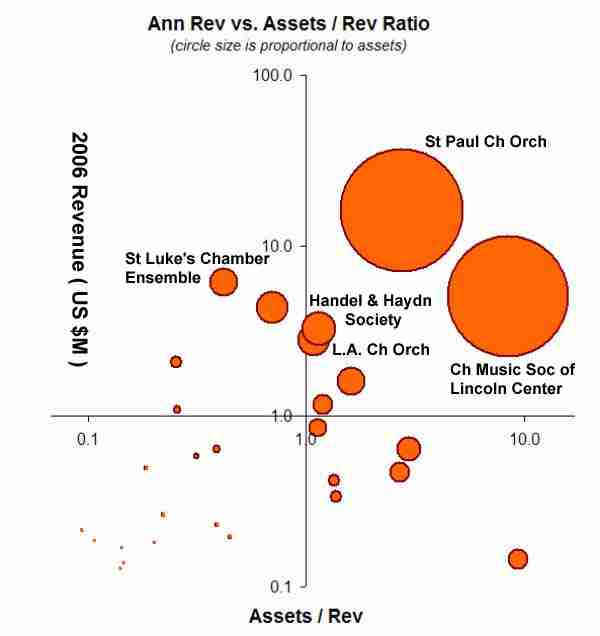
Just as you would do if you were evaluating companies and stocks, it’s helpful to consider the competitive landscape for chamber music ensembles by applying some financial-ratio analysis, to characterize the field quantitatively and monitor the players and the outcomes.

 Form 990 data for 501(c)(3) U.S. chamber orchestras
The log-log plot of the revenue vs. assets-to-revenue ratio shown above is for 35 nonprofit standing chamber orchestra organizations in the U.S. for the most recent year for which data are available, 2006. It provides at-a-glance comparison of top-line revenue and capital-output efficiency. I extracted the data from the federal IRS Form 990 tax documents that are publicly available via Guidestar and other sources. It’s easy to do—took me less than one hour. You may like to do this for your own organization, or for organizations that you make contributions to, to see how they are doing amongst their peers.

The upper-right quadrant contains ensembles that are both highly productive (in terms of revenue generation and free cashflow) and well-endowed. The upper-left quadrant contains ensembles that are very active but are relatively under-capitalized. The lower-right quadrant contains ensembles that are relatively well-endowed but are perhaps under-utilizing their available assets. And the lower-left quadrant contains organizations that are financially at-risk. Although this plot is strictly for standing chamber orchestras, the same sort of statistical distribution and scatter-plot could be done for 501(c)(3) chamber music presenter organizations and other groups. Robert Higgins’s and Richard Bull’s and Murray Dropkin’s books (links below) are particularly good, with regard to understanding and acting upon financial-ratio analysis for nonprofit organizations.

 eMarketer projected social networking annual ad spend
Possibly the most promising strategy for selling to the evolving chamber music market—of all ages—is social networking and Web 2.0 apps. Besides those environments, there are email affinity-marketing services, such as Emma.com, which are significantly more effective and flexible than services that were available several years ago.

When being chased by a bear, your survival first requires that you are not the slowest runner in the woods and that you are running in the best direction for getting away. I seriously doubt that the Federal Reserve will come to the rescue of any chamber music organizations ...

In this regard, the concept of sustainable growth was originally developed by Robert Higgins, Professor of Finance at the School of Business Administration, University of Washington. The sustainable growth rate (SGR) of any enterprise is the maximum rate of growth in sales that can be achieved, given the enterprise’s profitability, asset utilization, and debt (financial leverage) ratios. The variables in the SGR equation are the following:

  1. the net profit margin on new and existing revenues (P);
  2. the asset turnover ratio, which is the ratio of sales revenues to total assets (A);
  3. the retention rate, which is defined as the fraction of earnings retained in the business (R);
  4. the assets to beginning-of-period equity ratio (T).
To compute an orchestra’s SGR, multiply the four variables together, or, in other words, the SGR = P x A x R x T. Alternatively, the SGR equals the retention ratio, times the return on beginning-of-period equity.

The SGR increases when the operating margin increases, the assets to beginning-of-period equity increases, the asset turnover increases, or the retention rate increases. The sustainable growth model assumes that the firm wants to: (a) maintain a target capital structure without issuing new equity; and (b) increase sales as rapidly as market conditions allow.

Since the orchestras we are discussing are not-for-profits, the profit-margin term is a bit tricky. But the net income in the operating fund is a suitable proxy for what profit-margin would be in a for-profit enterprise, so the SGR equation can in fact be used for nonprofits.

The concept of sustainable growth can be helpful for planning healthy nonprofit growth. This concept forces managers to consider the financial consequences of sales increases and to set sales growth goals that are consistent with the operating and financial policies of the enterprise. Often, a conflict can arise if growth objectives are not consistent with the value of the organization's sustainable growth. If an orchestra’s sales expand at a rate that exceeds the sustainable rate, one or some combination of the four ratios must change. If an orchestra’s actual revenue growth rate temporarily exceeds the SGR, the required cash can usually be borrowed, against the orchestra’s line-of-credit. When actual growth exceeds the SGR for longer periods, management must formulate a financial strategy from among the following options: (1) permanently increase financial leverage (the issuance of debt); or (2) decrease the total assets to sales ratio. In practice, orchestras may be reluctant to undertake these steps. Orchestras are reluctant to issue debt because of high issue costs, and the unreliable nature of debt funding on terms favorable to the issuer. An orchestra can increase financial leverage only if it has unused debt capacity with assets that can be pledged and its debt-to-fund equity ratio is reasonable in relation to other nonprofits. Orchestras can attempt to liquidate marginal programs or intellectual property (such as trademarked broadcast programs or record labels, or branded educational/outreach content), increase ticket prices, or enhance production efficiencies to improve the financial ratios.

In summary, it is possible for an orchestra to grow too aggressively and rapidly, resulting in reduced liquidity and the need to deplete assets. Shrinking attendance and ticket sales is a worse problem, but it is not the only problem that can happen.

 Joseph Horowitz book