Showing posts with label culture. Show all posts

Friday, June 3, 2011

Just returned to U.S. from several weeks in China, inspired by the possibilities

NCPA
S    oft power is derived from both state and society. Savvy states are able to harness the creativity and vibrancy of their societies for soft power purposes while understanding that it is civil society’s independence from the state that contains the real persuasive power. When authoritarian states deny the global public the ability to directly access their domestic civil society, they are potentially depriving themselves of a key soft power asset in the information age.”
  —  Shanthi Kalathil, ISD Working Papers in New Diplomacy, MAY-2011.
I ’ve just returned from several weeks in China—a wonderful, profoundly stimulating experience. I attended chamber music performances in Beijing, including a delightful concert at the National Centre for the Performing Arts (“The Egg”) by pianist Igor Levit and three of his colleagues (Evgenia Rubinova, Michail Lifits, Herbert Schuch).

NCPA
U nfortunately, due to Chinese government policy Google Blogger, Twitter, and Facebook are all blocked in the PRC, which is why I have posted no blogs or tweets in recent weeks. (Did not try to use a proxy-server. Hotel ISPs were dodgy enough as it was...)

T here were interesting ‘audience compliance enforcement’ practices in China that we would never see in the West. For example, the concert hall staff aim red ‘marksman’/gun-sight-type lasers on the heads and backs of audience members who make noise or who move or try to take a forbidden photo during a performance. Everyone in the audience sees the bright red dot ‘painted’ on the body part of the offender. We don’t see that kind of enforcement of etiquette in the U.S. or Europe, that’s for sure. But the effectiveness of the social censure by the other audience members who are seated near the ‘offender’ is total and nearly instantaneous. From a performer’s perspective, this is kind of cool—especially when the behavior is disruptive and selfish on the part of the person doing the picture-taking or recording or moving-around.

NCPA
I gor Levit gave a fantastic left-hand-only rendering of BWV 971 (among other things). I asked him and he says the transcription was Brahms’s, published by Breitkopf & Hartel, but I look in Breitkopf catalog and do not see it... I will have to buy a copy of their EB-6018 to look... maybe it is in there and only the Breitkopf pdf file online is in error. There are lots of LH transcriptions of BWV 1004 Chaconne, BWV 1006, BWV 1002, BWV 1031, and so on. I so far do not find the LH tr. of 971...

T he unlikely LH as proponent of subject, object, everything: this reveals new dimensions in, and sheds new light on, a piece I thought I understood. The RH stands by like a watchful parent, saying nothing.

L eon Fleisher and others have had dystonia or other reasons to pursue such literature, but here in China I hear Igor Levit and learn new things. Some might consider one such piece in an otherwise normal program to be a ‘novelty’ or ‘gimmick’, but it was not. Absolutely masterful.

I visited hospitals—crowded but fastidiously clean and well-run—so many things different from the West, but so many things the same. Visited the Central Conservatory where Chen Yi and Zhou Long and others trained. Oh, the food! The friendly, gracious Chinese people!

S o China blazes this prodigious, distinctive, iconoclastic path—many paths, actually, reflecting mixtures of Han Chinese plus 55 minority groups: regional, metropolitan and rural—always diverging from the West, because why? Because what is distinctly Chinese embodies the belovèd “national circumstances” and reinforces the honorable “Chinese characteristics”, or guoqing (国情). That is why... that is why this Chinese ‘autopoietic’ tendency is self-sustaining. It is a little like Richard Dawkins’s ‘Selfish Gene’ on a large social scale. Based on my 3-week exposure, I think it’s not a deliberated process and not a politically-coerced one. Instead, it feels organic, inevitable. So many people, who mostly seem so happy, so long as the ‘boom’ lasts! I can hardly wait for the chance to return...

NCPA
  • Brahms transcription of the Bach Chaconne of Violin partita BWV 1004 for the left-hand (Peters)
  • Brahms transcription of Italian Concerto (Clavier-Ubung II) for the left-hand (Breitkopf)
  • Joseffy Violin partita BWV 1006 transcription for the left-hand
  • Kistler-Liebendorfer Choralvorspiel BWV 711, violin sonata BWV 1001, violin partita BWV 1006, orchestra suite No. 1 BWV 1066, orch suite No. 3 BWV 1068, musical offering canon BWV 1079... transcription for the left-hand
  • Philipp violin partita BWV 1002, violin partita BWV 1004 transcription for the left-hand
  • Raff Violin partita No. 2 BWV 1004 Chaconne transcription for the left-hand
  • Sitsky Violin partita No. 2 BWV 1004 Chaconne transcription for the left-hand
  • Sosa Chromatische Fantasie und Fuge BWV 903 transcription for the left-hand
  • Sosa Invention B-Dur BWV 785 transcription for the left-hand
  • Wittgenstein Violin partita No. 2 BWV 1004 Chaconne transcription for the left-hand
  • Wittgenstein Schule für die linke Hand III/2: Präludium c-Moll transcription for the left-hand
  • Wittgenstein Siciliano aus der Flötensonate Es-Dur BWV 1031 transcription for the left-hand


Sunday, March 30, 2008

Few Chamber Orchestras Are Too Big to Fail: Market Size, Scale and Sustainability

 Saint Paul Chamber Orchestra
The culture of electronic media and the internet and the culture of social interaction continue to erode classical music and chamber music concert attendance. In the U.S., possibly some of this erosion is augmented by the economic downturn, but the trend has been relentlessly underway for many years now. Lifestyle and arts consumption choices of shifting generations continue to thwart traditional concert attendance, despite the fact that there are today more high-quality concert events and more diverse programming than ever before.

How long can this go on? Which organizations are likely to survive? How much does size (assets; revenue; financial strength) insure sustainability? Are there norms that are embodied by the strongest and best of the current contenders in this nonprofit chamber music marketplace, that other organizations in the field ought to aim for? Do the treasury management decisions of such leading organizations constitute norms that others should emulate? As weaker organizations begin to fail, will we see some of them get aggregated by joint-ventures or M&A into other larger ‘survivor’ organizations in the same geographic vicinity? And, if so, what are the financial ratios that potential acquirers should look for in due-diligence?

These are questions that are not readily answerable. But it does seem that tough, Darwinian survival-of-the-fittest times are ahead.

Just as you would do if you were evaluating companies and stocks, it’s helpful to consider the competitive landscape for chamber music ensembles by applying some financial-ratio analysis, to characterize the field quantitatively and monitor the players and the outcomes.

 Form 990 data for 501(c)(3) U.S. chamber orchestras
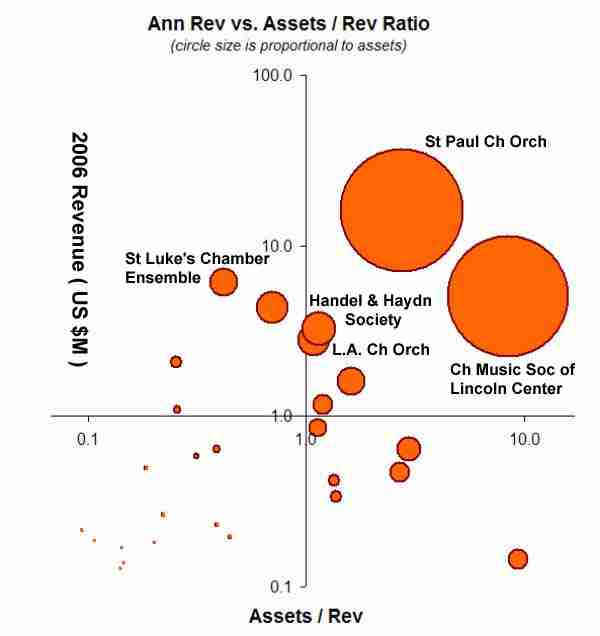
The log-log plot of the revenue vs. assets-to-revenue ratio shown above is for 35 nonprofit standing chamber orchestra organizations in the U.S. for the most recent year for which data are available, 2006. It provides at-a-glance comparison of top-line revenue and capital-output efficiency. I extracted the data from the federal IRS Form 990 tax documents that are publicly available via Guidestar and other sources. It’s easy to do—took me less than one hour. You may like to do this for your own organization, or for organizations that you make contributions to, to see how they are doing amongst their peers.

The upper-right quadrant contains ensembles that are both highly productive (in terms of revenue generation and free cashflow) and well-endowed. The upper-left quadrant contains ensembles that are very active but are relatively under-capitalized. The lower-right quadrant contains ensembles that are relatively well-endowed but are perhaps under-utilizing their available assets. And the lower-left quadrant contains organizations that are financially at-risk. Although this plot is strictly for standing chamber orchestras, the same sort of statistical distribution and scatter-plot could be done for 501(c)(3) chamber music presenter organizations and other groups. Robert Higgins’s and Richard Bull’s and Murray Dropkin’s books (links below) are particularly good, with regard to understanding and acting upon financial-ratio analysis for nonprofit organizations.

 eMarketer projected social networking annual ad spend
Possibly the most promising strategy for selling to the evolving chamber music market—of all ages—is social networking and Web 2.0 apps. Besides those environments, there are email affinity-marketing services, such as Emma.com, which are significantly more effective and flexible than services that were available several years ago.

When being chased by a bear, your survival first requires that you are not the slowest runner in the woods and that you are running in the best direction for getting away. I seriously doubt that the Federal Reserve will come to the rescue of any chamber music organizations ...

In this regard, the concept of sustainable growth was originally developed by Robert Higgins, Professor of Finance at the School of Business Administration, University of Washington. The sustainable growth rate (SGR) of any enterprise is the maximum rate of growth in sales that can be achieved, given the enterprise’s profitability, asset utilization, and debt (financial leverage) ratios. The variables in the SGR equation are the following:

  1. the net profit margin on new and existing revenues (P);
  2. the asset turnover ratio, which is the ratio of sales revenues to total assets (A);
  3. the retention rate, which is defined as the fraction of earnings retained in the business (R);
  4. the assets to beginning-of-period equity ratio (T).
To compute an orchestra’s SGR, multiply the four variables together, or, in other words, the SGR = P x A x R x T. Alternatively, the SGR equals the retention ratio, times the return on beginning-of-period equity.

The SGR increases when the operating margin increases, the assets to beginning-of-period equity increases, the asset turnover increases, or the retention rate increases. The sustainable growth model assumes that the firm wants to: (a) maintain a target capital structure without issuing new equity; and (b) increase sales as rapidly as market conditions allow.

Since the orchestras we are discussing are not-for-profits, the profit-margin term is a bit tricky. But the net income in the operating fund is a suitable proxy for what profit-margin would be in a for-profit enterprise, so the SGR equation can in fact be used for nonprofits.

The concept of sustainable growth can be helpful for planning healthy nonprofit growth. This concept forces managers to consider the financial consequences of sales increases and to set sales growth goals that are consistent with the operating and financial policies of the enterprise. Often, a conflict can arise if growth objectives are not consistent with the value of the organization's sustainable growth. If an orchestra’s sales expand at a rate that exceeds the sustainable rate, one or some combination of the four ratios must change. If an orchestra’s actual revenue growth rate temporarily exceeds the SGR, the required cash can usually be borrowed, against the orchestra’s line-of-credit. When actual growth exceeds the SGR for longer periods, management must formulate a financial strategy from among the following options: (1) permanently increase financial leverage (the issuance of debt); or (2) decrease the total assets to sales ratio. In practice, orchestras may be reluctant to undertake these steps. Orchestras are reluctant to issue debt because of high issue costs, and the unreliable nature of debt funding on terms favorable to the issuer. An orchestra can increase financial leverage only if it has unused debt capacity with assets that can be pledged and its debt-to-fund equity ratio is reasonable in relation to other nonprofits. Orchestras can attempt to liquidate marginal programs or intellectual property (such as trademarked broadcast programs or record labels, or branded educational/outreach content), increase ticket prices, or enhance production efficiencies to improve the financial ratios.

In summary, it is possible for an orchestra to grow too aggressively and rapidly, resulting in reduced liquidity and the need to deplete assets. Shrinking attendance and ticket sales is a worse problem, but it is not the only problem that can happen.

 Joseph Horowitz book


Wednesday, February 13, 2008

I ♥ Different Enchantments: Unexpected Uses of Elliott Carter Recordings as Punk Repellant

 Newburyport, MA, perfectly nice punk w/ mohawk hair
A ll the Preludes to Felicity

It is Time that beats in the breast and it is Time
That batters against the mind, silent and proud –
The mind that knows it is destroyed by Time.

Time is a horse that runs in the heart, a horse
Without a rider on a road at night.
The mind sits listening and hears it pass.

It is someone walking rapidly in the street.
The reader by the window has finished his book
And tells the hour by the lateness of the sounds.

Even breathing is the beating of Time, in kind:
A retardation of its battering,
A horse grotesquely taut, a walker like

A shadow in mid-earth . . . If we propose
A large-sculptured, platonic person, free from time,
And imagine for him the speech he cannot speak,

A form, then, protected from the battering, may
Mature: A capable being may replace
Dark horse and walker walking rapidly.

Felicity, ah! Time is the hooded enemy,
The inimical music, the enchantered space –
In which the enchanted preludes have their place.”

  —  Wallace Stevens, The Pure Good of Theory, in Transport to Summer, 1947.
 Newburyport, MA, State St
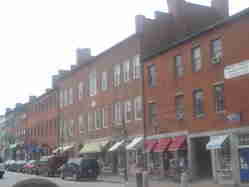
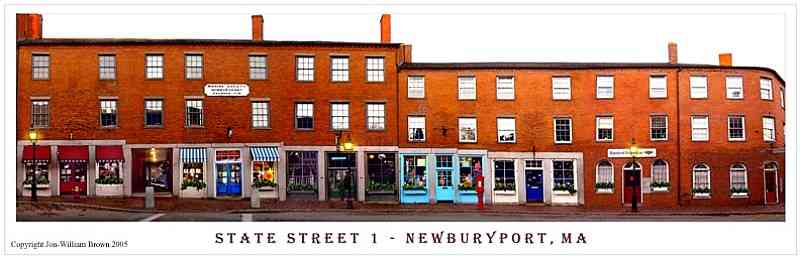
I ♥ you, too. Among the more unusual things you’ll ever hear is Elliott Carter’s ‘Enchanted Preludes’ being played on streetside loudspeakers as skinhead repellent ambient music, blaring down on the sidewalk from the eaves/soffits outside the Richdale Convenience Store on the corner of State Street and Pleasant Street in Newburyport, MA.

The kids scared the customers away. The kids loitered on the corner, crowded around the door so that you’d have to push your way through them to enter or exit the store. En masse, they filled the streetcorner outside the Richdale and blocked the Pleasant Street crosswalk, making it difficult to cross. The octogenarians were forced to walk in traffic or, better, avoid the location entirely. And then there was the occasional mention of shoplifting in the police blotter.

 Newburyport, MA, State St
First the store tried Lawrence Welk polkas. Didn’t work. Too jolly, and maybe just silly enough to be perversely amusing to the intended punker victims.

They tried Beethoven—probably mis-remembering Anthony Burgess’s A Clockwork Orange or something; a seat-of-pants reckoning that, if a toxin is strong in one application, then its toxic efficacy will likely generalize to other species. But the Sonata in E major, Op. 109 (1820), and the Sonata in A-flat major, Op. 110 (1821), seem like enchanted gardens of the blessèd, even to skinhead ears. The skinheads stayed put.

 Newburyport, MA, State St
Then the store tried Vivaldi. They’d read in the LA Times that Vivaldi was useful for this kind of infestation and had met with wide success in California. Yes, florid variations in dynamics and tempi did disperse the crowd at the Richdale for awhile. The fluorescent Mohawk-coifed punks moved down the street and began hanging out in front of Best of British. But over a few weeks they returned to the Richdale’s corner. They’d been able still to hear the Vivaldi all this time, faintly, from the 50 meters distance. And the fact was, it had ‘grown’ on them. Not to say that they liked it now. But they’d developed a high degree of tolerance for it. They knew the tracks on the Vivaldi CDs that the shopowner queued up, and they were now immune even to the outrageous juxtapositions that blared out when he put the player on ‘random shuffle’. They preferred to be close to their source of food, and to the frailer, more intimidatable souls on upper State Street.

 Newburyport, MA, State St
How the storeowner found this ultimate weapon—the super-strength Elliott Carter punk repellant—I do not know. Recordings of Carter are not plentiful, and they do not leap into your hand from record-store discount remainder bins.


[ John McMurtery, flute; Craig Hultgren, cello; video 2006 ]

Carter’s ‘Enchanted Preludes’, for flute and cello, was commissioned in 1988 by Harry Santen for the 50th birthday of his wife, Anne Santen, the musical director of Cincinnati’s public radio station, WGUC. The duet contrasts the flute with the cello and roughly follows the ‘arc’ of the Wallace Stevens poem from which the piece takes its name. Each instrument follows its own moods and logic, and a constant tension pulls each in disparate directions: the world of the intellect and the world of the senses. The flute mostly propels the thing forward, with extroverted, Messiaen-like figures. The cello takes a mostly subordinate role until the end, when it finally accepts and inclines toward the flute’s dynamic.

 Newburyport, MA, State St
The flute and cello have ever-shifting roles, but always with a sense of the evolving foreground and background. And the concession that the cello makes to the flute at the end is a gesture that is deeply offensive to the punk ethic of in-your-face confrontation. This is the feature that makes Elliott Carter’s writing so deadly to punks. The music mocks the punks’ poseurly faux dance along the societal fault-line. In a manner that resembles Stevens’s distinctive positioning of prepositions and prefixes and his demonstrative use of copular verbs, Carter plays with the disruptive metaphors and unexpected cadences. He dishes out developments unexpectedly pursued and developments unexpectedly abandoned.

The Stevens/Carter formula heightens the self-consciousness of the language/music. By making and unmaking the conventional patterns of language/music, the work draws attention to the temporal—the undeniably mortal, the inescapably transitory—nature of the text, of the performers’ personae, and of the listeners themselves. Twenty-something punks try to ignore this. But when the onslaught persists as an ambient acoustical feature it is like it penetrates their hardened carapaces and causes their systems to begin shutting down. It doesn’t have to be administered at high volume, in large doses that would interfere with commerce and the recreational life of others. No, low-dose continuous Carter is sufficient. Highly selective social death by musical alienation. Yobs, chavs, skinheads, punks, gangstas—gone. Selectively, nonviolently, quietly, voluntarily.

Newburyport, MA, State St
But it’s more than this, and the ‘more than this’ is why I bother to write about the ambient Carter at all. What I mean is, every spiritual alienation takes place within a space, within some enclosure, as does every spiritual union—even if the enclosure is an abstract or metaphorical one; even if the enclosure has no walls, really. When I walk by the Richdale, the ambient music outside defines a space, a space that is just as large as the radius within which I can hear the music. But not all enclosures are oppressive: the Beklemmt section of Beethoven’s Op. 130 is an example, and the Carter ‘Enchanted Preludes’ is also an example. They define enclosures that I long for, that I try frequently to return to. To me, they are ‘home’. In other words, ‘enclosedness’ isn’t alienating or confining; it may be an object of desire, a good place that protects and inspires and welcomes, ‘a place of refreshment for the exhausted hero, a foretaste of rewards to come, or the final goal and reward itself, where the beloved and the blessed society are waiting to receive you into their select company,’ as Auden put it. The door is open. It is not an exclusionary ‘gated community’ or a locked museum. The door is open, it’s a beautiful sanctuary, and there are lots of interesting people inside.

T  emenos (τέμενος , from the Greek verb τέμνω ‘to cut’) is a piece of land cut off and assigned as an official domain, especially to royalty, or a piece of land marked off from common uses and dedicated to a god; a sanctuary, holy grove or garden, or holy precinct.”
Baudrillard’s connection between alienation and the hyper-real is cited by Adam Possamai in his chapter in Lynne Hume’s and Kathleen McPhillips’s recent book. Hyper-reality is structured with signs and symbols such that people increasingly seek spectacle rather than transcendance. According to Possamai, hyperreality relocates personal identity within the domains of choice, individuality, aesthetics, and consumption. In Australia, Star Wars Jediism—a simulacrum of a religion created out of popular culture that provides inspiration for believers/consumers—constitutes a hyper-religion. Maybe Carter is, for me, a sort of hyper-religion. It pleases me to think so…

Is there an affinity between heroic characters in music and development of latent abilities? Could this affinity be motivated by a desire for sanctuary and for hyper-real re-enchantment of the world? For me, my taste for Carter’s writing involves a craving for ‘inner adventure’, not literally a search to become divine or super-human. It’s a quest for a higher self—maybe like a Westernized search for Buddhist enlightenment. It’s not a quest for abilities that would be instrumental in achieving other ends. It’s a search for illumination and wonder. How lucky for me that the Newburyport Richdale store owner inadvertently provides me with just the acoustical enchantment and spiritual nourishment I need as he simultaneously doses the multiply body-pierced, scarified and self-mutilated post-card punks, for whom wonderment is—evidently—poison.

“... grotesquely taut, a walker like
A shadow in mid-earth . . . If we propose
A large-sculptured, skin-headed person, free from time,
And imagine for him the speech he cannot speak.”

Imagine, too, the music he cannot play or sing or or write or even stand to hear. Just the same, I ♥ him, too.

T  he displacement of music-making by music-listening breaks the connection between creation and inspiration. Inspiration carries a motivation to act. And anyone who sits down and plays at the piano is inspired to act. The creative imagination motivates them directly. But once music is construed as a sonic equivalent of painting, the question arises—how does creativity inspire those who merely contemplate its products? What is it they are inspired to do?”
  —  Gordon Graham, p. 110.
P  roponents of [modernity-as-] disenchantment share with those who lament its loss the assumption that only a [human-centric] teleological world is worthy of enchantment. I contest that assumption. A world capable of enchanting need not be designed or disposed toward human happiness, or expressive of intrinsic purpose or meaning. It seems that there is musicological support for this, for chant is modal music, which means that it doesn’t have the powerful drive modern music has to arrive at a final [explicitly purposeful] harmonic destination.”
  —  Jane Bennett, p. 11.


Moore book