Showing posts with label carter. Show all posts

Tuesday, July 29, 2008

The Uncertain Lateness of the Hour: ‘Periods’ and the Musical Self

 Clocks
E  dward Said’s book [published posthumously, following his death in 2003 of leukemia] is a series of dazzling case studies exploring the idea of ‘lateness’ in a range of composers, writers and artists.”
  —  London Review of Books.
L  ateness doesn’t name a single relation to Time but it always brings Time in its wake. It is a way of remembering Time, whether it is missed or met or gone. … The quality of Time alters then, like a change in the light, because the present is so thoroughly shadowed by other seasons: the revived or receding past, the newly unmeasurable future, the unimaginable time beyond Time. The conversion of Time into Space.”
  —  Edward Said, ‘On Late Style: Music & Literature Against the Grain’, p. xi.
Edward Said, literary theorist and Columbia University Professor of Comparative Literature, had not expected to die when he did, in early Autumn, 2003, at age 67. He had had chronic myelogenous leukemia (CML) for more than 10 years. It was an acute infection related to CML blast crisis that took him away. His last book, ‘On Late Style: Music & Literature Against the Grain’, was unfinished at the time, and was completed by Michael Wood at Princeton University. There is both irony and poetic beauty in this fact.

 Edward Said, 2003
The intimacy of chamber music genres provides unusually apropos means to express lateness—the irreconcilabilities of it; the private amusements and perplexities of it—perhaps better than other genres. Lateness: the idea that one is not getting out of this alive, that one cannot go beyond the [terminal] idioms and stances to which one has finally arrived.

Edward Said asserts that ‘lateness’ has to do with ‘the sentiment of Being’ and ‘the sentiments of Art’. But there are plenty of specifics beyond such colorful hand-waving. The book was the result not only of his own drafts of material that were intended to become a published book but also lecture-notes and detailed outline materials that he used in his course on Late Style in the Dept of English and Comparative Literature at Columbia. Lateness: inculcating and sustaining the unity and integrity of the self—its dignity and freedom—like Jane Austen and her judgmental stance toward the selves of her characters.

 End of Pier
W  ith an unexceptionally Arab family name like Said connected to an improbably British first name, I was an uncomfortably anomalous student all through my early years: a Palestinian going to school in Egypt, with an English first name, an American passport and no certain identity at all.”
  —  Edward Said, London Review of Books interview, 07-MAY-1998.
Lateness: embodying the quality of self-sufficiency and, in anticipation of the finiteness of life, a measure of abandon and acceptance of the human condition. Said’s is a visionary normative stance, just as the qualities we refer to as ‘late’ are likewise visionary and normative. Lateness is the reaching of a new and final level of expression—Titian’s late-period discovery of the all-penetrating light that transmutes human flesh to reveal the soul and an alterior unity (Hermann Broch, quoted by Said, OLS, p. 137). It is the arrival at a state of ‘nothing-left-to-prove’ [to others], a renunciation of ambition.

A  mutation: the process by which the arduous enterprise of sincerity, of being true to one’s self, came to occupy a place of supreme importance in moral life—and the further cultural shift which finds that place now usurped by the darker and still more strenuous modern ideal of authenticity.”
  —  Jacket blurb for Lionel Trilling’s book, ‘Sincerity & Authenticity’.
Lateness’ is not about impoverishedness or loss or despondency. It is not about resignation or desolation. It may touch upon these, but it is not ‘about’ them. It is instead about parables and testaments. It is about exile and unashamed subjectivity. It is about the acceptance of life’s contradictions and irresolvable and irreconcilable differences. It is about the sadness of Life and the joy of Life all at once, as Elliott Carter has said. The longing and the fervency of expression may be, if anything, greater than ever in one’s ‘late’ period; just less concerned with coherence than before.

 End of Pier
W  hat gripped Adorno in Beethoven’s late work is its episodic character: its apparent disregard for its own continuity … seemingly unmotivated rhetorical devices like trills or appoggiaturas whose role in the work seems unintegrated into the structure … the caesuras, the sudden discontinuities … the work still remains ‘process’ but not as ‘development’; rather as a catching-fire between extremes which no longer allow for any secure middle-ground … the vestige of an individual human sorely aware of the wholeness that has eluded it forever.”
  —  Edward Said, ‘On Late Style: Music & Literature Against the Grain’, p. 10.
The notions of poetics and lateness imply at least some self-awareness. And whenever descriptive representation of a feeling or idea is planned and realized (composed; performed), poetics is met by analysis and interpretation. Composers, especially, cannot help projecting themselves and their own poetics into the analysis and interpretation by which their ideas are realized. Pierre Boulez’s analyses of Debussy and Berg are an example, as, too, are Adorno’s analyses of Beethoven and, now, Said’s analyses.

T  he most meaningful analysis of a symphony is another symphony. [And, at the end of life, there will be no more symphonies, no continuations of re-thinking things, no more replies.] ”
  —  Luciano Berio
What else? We often see an expressive prolixity in earlier compositions, while in ‘late works’ there is expressive economy. Given just enough notes to sustain the idea, ‘late’ pieces are often harmonically or rhythmically sparse and sometimes lapse into monody, then silence. Sometimes a piece is open-ended, simply vanishing. Early exponents of the practice of ending (‘abandoning’) a work in mid-passage include Frederic Chopin, Robert Schumann, and Franz Liszt. But there have been many since, including Elliott Carter—who spoke of this during his interview with Richard Dyer at Tanglewood last week.

An harmonic adventurousness, a radical chromaticism, a tonal ambiguity? Not necessarily. Those sorts of stylistic artifacts can arise at any age—early, middle, or late. Instead, what’s new in late compositions or late performances is a pervasive ‘worldliness’—not bitterness or cynicism or resignation. The musician has accumulated what business people jokingly call ‘scar tissue’—psychological grit; metaphysical emery. It doesn’t blunt the expressive edge; to the contrary, the lapidary effect sharpens all of the expressive edges.

 Joann Lynn, RAND Corp, trajectories at end of life
One of the facets of ‘lateness’ that Said does not address in his book is the age-independent psychological aspect of how a piece comes unexpectedly to be ‘late’ or have qualities that we associate with ‘lateness’. The composer may have bipolar depression from early on in life, for example. Or the early onset of strokes or Alzheimer’s may fundamentally alter the composer’s or the performer’s perspective while not extinguishing the ability to continue. Or serious events happen in a person’s life that situationally yield the mien of advanced age. All of those can creep into the music. All of those can determine what and how much is left, and how ‘late’ the output that does follow is.

 Beyond the Pier
For example, in the late 1950s, the Neo-Classicist Finnish composer Einar Englund experienced a personal crisis and stopped composing. Modernism, which he termed “a mockery of the composer as a serious artist,” had irrevocably changed what was getting commissioned and performed. He said that in that milieu he felt he no longer had anything to say; his Neo-Classical idioms were no longer welcome: the ‘river’ had changed course, and he was left ‘high and dry’ on the old riverbank.

In his autobiography (1996), Englund confided another, more serious reason for the crisis: the tragic death of his wife in 1956, when Einar was 40 years old. Englund didn’t resume composing until 1971. His most productive period in terms of sheer musical output was the 1980s—and those of the ‘later’ Englund pieces that I’ve listened to do manifest some of the desultory attitude or ‘scar tissue’ I’m referring to. Englund died at 83, in 1999.

 Beyond the Pier
W  hat of artistic ‘lateness’ not as harmony and mature resolution, but as intransigence, difficulty, and unresolved contradiction; as anachronism and anomaly; as a special ironic expressiveness well beyond the words and the situation?”
  —  Edward Said, ‘On Late Style: Music & Literature Against the Grain’, p. xiii.
Mahler and Schnittke and many other people have had health conditions that conferred a precocious ‘lateness’ early in their lives as composers. Schubert’s last three string quartets, the String Quintet in C (D 956), the last three piano sonatas (Sonata No. 19 in c (D 958); Sonata No. 20 in A (D 959); Sonata No. 21 in B-flat (D 960), and the ‘Schwanengesang’ cycle are yet another species of lateness that Said does not address. That is, lateness and apprehension sometimes impart a tense, hemmed-in-èdness—an amenability to expediency of orchestration and compositional cliché borne partly out of haste: compromises of the Eleventh Hour; contractions from the radical inventiveness that Said’s treatment of lateness dwells on.

If you haven’t previously seen them, have a look at Edward Said’s books, ‘On Late Style’ and ‘Music at the Limits’. They contain valuable insights for all musicians, with regard to age-appropriate style. And they are, inadvertently, eloquent auto-elegies for Said himself. Touching and, maybe, life-changing for the musician-reader.

A  s one can see in the early and the late ‘Goldberg Variations’ performances that eerily frame his career—one at the very beginning, the other at the very end—Gould excavated the contrapuntal as well as chaconne structure of the work to announce an ongoing exploration of Bach’s inventiveness through and by way of his own virtuosic realizations … crafted resolutely against the negation and disorder that surround us on all sides. In enacting it on the piano, the performer aligns himself/herself with the composer, not with the consuming public, which is impelled to pay attention not so much to the performance as a passively looked-at and heard presentation, as to a rational and transcendant activity being intellectually, aurally, and visually transmitted to others.”
  —  Edward Said, ‘On Late Style: Music & Literature Against the Grain’, pp. 130-2.

 Tsunami hitting pier, Hilo HI, 01-APR-1946; Time for the man pictured at left: about as 'Late' as it is possible to get.


Saturday, July 26, 2008

Some Resources for Timpani Chamber Music

 Timpani melody
T  he performances by Steven Merrill and Kyle Zerna at Tanglewood were spectacular. The music was almost like it was floating—it was fluid and virtuosic and amazingly tuneful. I’d never realized there was chamber music for timpani—a shortcoming of my training, I suppose, but there you are. Where might I go to find more of these—not just Carter’s chamber works and solo pieces for timpani, but other chamber works for timpani too, where the composer writes for timpani so the melodic and conversational capabilities of the instrument are featured? This [performance at Tanglewood] was way beyond ‘timpani-as-percussion’ [and I’d like to find and program other chamber pieces like these].”
  —  Anonymous.
The BSO’s Festival of Contemporary Music at Tanglewood (Elliott Carter Centenary) was consciousness-raising in many ways, and not just as a showcase for virtuosic solo timpani (reader comment above).

  • Saeta (1949) and Canaries (1949) [Steven Merrill (timpani)]
  • Canto (1966) and March (1949) [Kyle Zerna (timpani)]
Here are a few mp3 clips from several available recordings of other timpanists, to give you a flavor for some of the literature that’s out there:


    [30-sec clip, Jonathan Faralli, Carter, ‘Canto’, 1MB MP3]


    [30-sec clip, Staffan Borseman with Danmarks Radiosymfoniorkester members, Holmboe, ‘Chamber Concerto No. 1, Molto allegro’, 1MB MP3]


    [30-sec clip, Alexander Peter with Dresden Phil Chamber Orch, Sammartini, ‘Symphony in g minor, for 2 Horns, 2 Violins, Viola, Double-Bass & Timpani, IV. Bouree’, 1MB MP3]

And here is a short list of some of the literature you may or may not be familiar with. There are some solo timpani works in here, but most of these are for ensembles consisting of timpani plus one or more non-percussion instruments.
  • Adams - Concerto for Timpani, Percussion & Winds
  • Andersen - Pirun Polska, Op. 49, for 2 Bassoons, 2 Horns, 2 Trumpets, Trombone, Timpani & Triangle
  • Arevalo - Meridian for Timpani, Cello & Piano
  • Badings - Passacaglia for Timpani & Organ
  • Bartók - Sonata for 2 Pianos & Percussion
  • Batigne - caracteres for Timpani & Piano
  • Beck - Sonata for Timpani; Three Episodes for Timpani
  • Biber - Sonatae tam Ares, for Trumpets, Strings, Timpani & Continuo
  • Bolcom - Dark Music for Timpani & Cello
  • Bovey - Tombeau d’Antenor
  • Britten - Concert Piece for Jimmy (Timpani & Piano)
  • Bump - Studie II: Epthyic for Percussion Quartet
  • Buss - Capriccio
  • Carroll - Chaconne
  • Carter - 8 Pieces for 4 Timpani
  • Chavez - Partita for Solo Timpani
  • Cheadle - Melodic Movements for Timpani
  • Cirone - Sonata No. 1 for Timpani & Piano
  • Denisov - Music for 11 Wind Instruments and Timpani, Op. 13
  • Druschetzky - Timpani Concerto, Partita in C, etc.
  • Firth - Solo Impressions for Timpani & Piano
  • Granados - Escena religiosa for Violin, Organ, Piano & Timpani
  • Graupner - Symphony in D major for 2 Trumpets, 4 Timpani, 2 Violins, Viola & Basso continuo (GWV 520-534); Symphony in G major for 2 Horns, 4 Timpani, 2 Violins, Viola & Basso continuo (GWV 596-599); Symphony in A major for 2 Horns, 4 Timpani, 2 Violins, Viola & Basso continuo (GWV 612).
  • Haydn - The Seven Last Words; others …
  • Helble - Night Music
  • Holmboe - Chamber Concerto for Piano, Strings & Timpani, Op. 17, No. 1 (molto allegro)
  • Houllif - Four Verses for Timpani
  • Kellogg - Ben, for Chamber Orchestra (Piccolo, 2 Flutes, 2 Oboes, English horn, 3 Clarinets, 3 Bassoons, 4 Horns, 3 Trumpets, 3 Trombones, Tuba, Timpani, Percussion, and Strings)
  • Kessner - Sonata for 4 Timpani
  • Kloppers - Concerto for Organ, Timpani & Strings
  • Kohler - Concertino fur Pauken und Streicher
  • Kraft - Concerto for Percussion and Chamber Ensemble; Brazen for Timpani, Brass & Organ; Concerto for Timpani & Orchestra (arr. for Piano)
  • Leonard - Canticle for Solo Timpani
  • Lindberg - Marea Sinfonietta (2 Flutes, Oboe, English horn, Clarinet, Bass Clarinet, Bassoon, Contrabassoon, 2 Horns, Trumpet, Trombone, Tuba, Timpani, Percussion & Strings); Fanfare for Arne Wessberg (4 Horns, 3 Trumpets, 3 Trombones, Tuba & Timpani)
  • Muczynski - Designs for 3 Timpani, Op. 11, No. 2
  • Paliev - 19 Pieces Bulgares
  • Richter - Düsseldorf Concerto for Flute, Harp, Timpani, Percussion & Strings (chamber version)
  • Sagnier - Six Pieces for Timpani & Piano
  • Sammartini - Symphony in G minor, for 2 Horns, 2 Violins, Viola, Double-Bass & Timpani
  • Schinstein - Tympendium for Timpani & Piano; Sonata no. 1 for Timpani & Piano
  • Schmitz - Spiritual Excursion for Viola, Vibraphone & Timpani
  • Schnittke - 4 Hymns, No. 4, (Septet for Timpani, Cello, Double-bass, Bassoon, Harp, Harpsichord & Tubular bells)
  • Schwantner - From a Dark Millennium
  • Scriabin - Deux Morceaux, Op. 57, for 2 Horns, 2 Trumpets, 3 Trombones, Tuba, Timpani, Harp & Strings
  • Sibelius - Andante Festivo (JS 34b) for Strings & Timpani; Rakastava Op. 14, for 2 Violins, Viola, Cello, Basso, Timpani & Triangle.
  • van Slyck - Octet for Flute, Clarinet, Horn, Violin, Viola, Cello, Timpani & Piano
  • Surinach - Tientos for English Horn, Timpani & Piano
  • Takemitsu - Rain Tree
  • Tcherepnin - Sonatina for Two or Three Timpani & Piano
  • Thoresen - Lop, Lokk Og Linjar
  • Utvolskaya - Concerto for Piano, String Orchestra & Timpani
  • Vinao - Khan Variations
  • Vivaldi - Concerto for Violin, 2 Oboes, 2 Horns, Timpani, Strings & Basso continuo
  • Whaley - Scherzo for Timpani; Statement for Timpani
  • Wuebold - Fantasy for Timpani & Piano
  • Wuorinen - Percussion Quartet
  • Zivkovic - Cadenza for 5 Timpani; Trio per Uno
There are probably plenty more pieces, but the above list is what just a quick hour or two of web searching turns up.

Besides a trip to your nearest friendly local Conservatory’s library, the list of links below may offer some additional help.

S  o often, great artists, soloists, and orchestral instrumentalists have remarked to me after a performance that they never realized before that it was possible to hear from the timpani such clear defined pitch, tone quality and such a musical sound. Previously, they had the concept that timpani could sound only noisy, with no musical potential. This brings us to the unhappy recognition that too often today timpani are being played with a snare drum technique, and as such, has no relation to true timpani technique. Often this happens because a percussionist———who has never studied timpani at all—or, if he has, never with a professional timpanist—but who does know all the rest of the percussion———applies the snare drum technique to the timpani because of the similarity of wrist action and rhythmical requirements. This style of playing, almost mechanically pointed and rhythmical—staccato: we play this way when it is especially called for; but many performers play this way all the time. Missing is the knowledge of how to achieve tone quality, resonance and a noble full sound with an artistic touch. The nature of the timpani is to ring—full and resonant—so this should be developed to its full capability.”
  —  Cloyd Duff, 1966.
 American Drum, Mk XIV
S  o, how do you make your timpani sound like musical instruments? How do you get timpani to blend with other instruments? Start by eliminating as many variables as possible.
1) The timpano bowl should be free of large dents and must be in-round.
2) The lip of the bowl (the bearing edge) must be smooth, level and free of any nicks, dents and imperfections and create an air-tight seal between the bowl and head.
3) The counterhoop must be flush and in-round.
4) The head must be centered in the counterhoop.
5) The head must be true, free of dirt and defects and be centered on the drum.
6) The mechanics of the timpano must be functioning so that a uniform or equal tension can be maintained at all lug points throughout the range of the drum.
7) The proper MSR for the size of the drum must set.”
  —  Richard Jones, Nebraska Wesleyan Univ, 2006.
There are some challenges for scoring for timpani—as with practical realities for any instrument. Many of those challenges involve the narrow range of pitches achievable by tuning each size; the speed with which the head tension and pitch can be changed on any one timpano; and (if the harmonic complexity desired and tuned-pitches-per-second velocity are great, and therefore can’t be accommodated by pedaling a smaller set) the space required for a set of 5 or more timpani.

 Timpano pedal
Passages where the timpanist has to change the pitch of a drum while playing—for example, playing two consecutive notes of different pitches on the same drum—require pedaling. To do this on Dresden-type timpani, the timpanist has to disengage the clutch with the foot, adjust the pedal to change the pitch of the drum, and reengage the clutch. Doing this with musical precision takes time. The faster the changes are as-scored, the more risk for the timpanist in performance. One clutch or pedal adjustment screw-up can demolish the melodic/harmonic effects and ruin the piece. So, for very rapid figures, you need a bigger set of more timpani—and that requires more floor space; you need a longer, even acrobatic reach for the timpanist to strike the desired sticking spots on the drum heads that are furthest away; you need more pre-event time for the more finicky gear set-ups on-stage prior to performance; and so on.

 Timpani tuning gauge
What else? Prior to performance, the timpanist has to clear the heads by equalizing the tension at each tuning screw. When the head is ‘clear’, the timpano intonation is acceptable and blends reasonably well with other instruments. If the head is not clear, the pitch will bend after the initial mallet impact. The drum will also give different pitches at different dynamics: not something you want, in general. Clearing requires a similar level of care as piano tuning. The rental expense, or the complexity of shipping, or the pre-event tensioning/clearing, or relative shortage of timpanists accessible to chamber music ensembles, or other logistical challenges, though, are surely not the reasons for the rarity of timpani in chamber music performances. Probably instead it’s mainly that non-percussionist composers don’t think to write for timpani very often--which is a shame.

 American Drum, Mk XI
For safety’s sake and healthy composer-timpanist relations, a composer might do well to observe the red brackets in the figure below (from Dwight Thomas’s website) that circumscribe a portion of the nominal range for each head and show the extent of the best notes in the range for that head size. These ranges can vary a fair amount depending upon the manufacturer and the design of the instruments, but Dwight’s suggestions are good guides for composers who’d dare to write chamber works for these challenging instruments.

 Timpani pitch-ranges
Even if due care is taken, there can be some inherent intonation challenges that can restrict the music’s practical harmonic possibilities. The tensioning/tuning to a predominant (1,1) head vibration mode as suggested by Richard Jones and others can mitigate some of these challenges. Using cross-tuning, the timpanist tightens each pair of diametrically-opposing tension lugs to get a uniform pitch with an electronic tuner. Basically, you want to get the head into a (1,1) vibrating mode, from which the purest ‘fundamental’ pitch of the head is generated. But even in (1,1) mode, there are residual extraneous harmonics that may interfere with the timbre of other instruments, and those harmonics are impossible to eliminate entirely. But, in fact, maybe that’s the beauty of timpani: it makes them what they are. The safe harmonic choices for timpani are a bit like scoring for carillon and all its complex bell harmonics.

 Timpano head acoustic vibration mode (2,2)
No matter. Despite those challenges, the good fun that timpani, expertly tuned and virtuosically played, bring to the ensemble is really hard to resist, as the CMT commenter put it and as those of us at Tanglewood this past week experienced. There’s no reason why the chamber timpani literature—however big or small it may be—can’t be performed more. There’s considerable diversity to it, in terms of periods and genres and orchestrations, as the cursory list above suggests. Presenters, how about considering that possibility, with an eye toward audience development and marketing? There might even be room in your programming next year for a ‘Percussion Masters’ series?

Thank you again for your CMT comments. Thank you, Steven and Kyle, for your illustrious and beautiful performances this week.


 German timpani hand-tuner


Friday, July 25, 2008

On Stylized Naturalism: Chamber Music of Elliott Carter

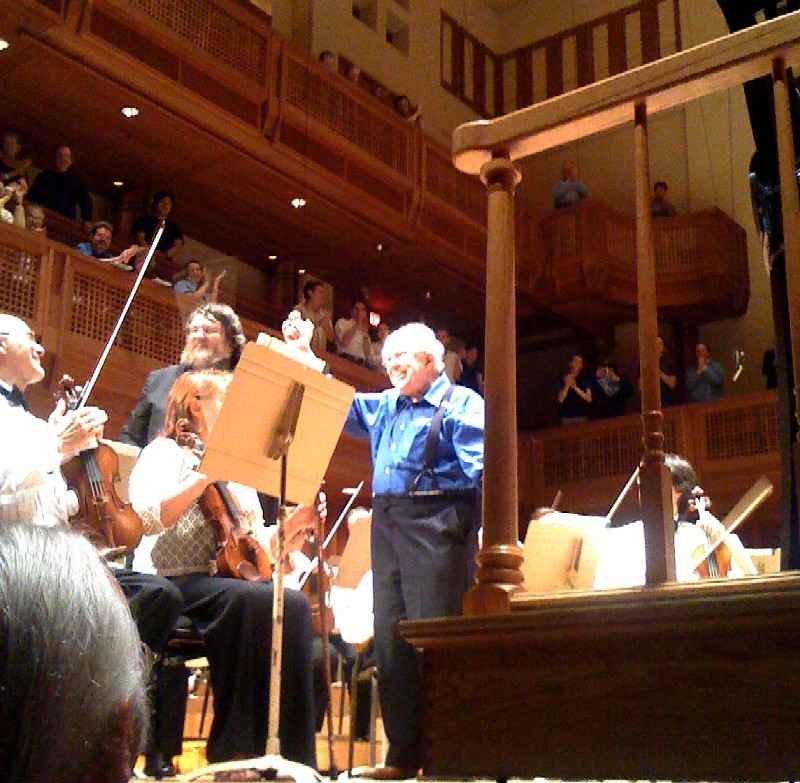
 Elliott Carter, Oliver Knussen, and TMC Orchestra, 24-JUL-2008, Tanglewood
F  inally, I began to understand what he [Carter] was doing. Then I said, ‘Well, it’s really not all that interesting: the same gestures over and over again.’ ”
  —  Robert Baska, comment on Allan Kozinn’s NY Times ArtsBeat blog post, 24-JUL-2008.
A  nd, to each his/her own. Is it true, then, that maybe you are not interested in patterns in nature: flocks of birds in flight; ripples on water; fresh breezes on your face? Those are the same gestures over and over again. Are those not interesting and beautiful? Do you turn away from those? No. Well, to me, Carter’s stylized naturalism—referred to by Oliver Knussen on Monday—is neither more nor less interesting than Nature itself. There is no law that says all music has to have a dramatic human-centric plot, no law that says all chamber music has to have explicit dialogue between the parts, no law that says you have to work yourself up to a big rhetorical finale.”
  —  DSM, 24-JUL-2008.
The BSO’s Festival of Contemporary Music at Tanglewood (Elliott Carter Centenary) on Thursday had a wonderful performance of several of Carter’s smaller instrumental pieces by Tanglewood Music Center Fellows, plus special guests Charles Rosen and Fred Sherry.

  • Saeta (1949) and Canaries (1949) [Steven Merrill (timpani)]
  • Four Lauds for Violin (1984-2001) [Martin Schultz: Remembering Aaron, and Remembering Roger; Stephanie Nussbaum: Riconoscenza per Goffredo Petrassi, and Rhapsodic Musings for Robert Mann]
  • Figment IV (2007) [Gareth Zehngut (viola)]
  • Figment III (2007) [Kevin Jablonski (double-bass)]
  • Steep Steps (2001) [Brent Besner (bass clarinet)]
  • Canto (1966) and March (1949) [Kyle Zerna (timpani)]
  • Elegy (1943) [Fred Sherry (cello), Charles Rosen (piano)]
  • 90+ (1994) [Charles Rosen (piano)]


    [30-sec clip, Charles Rosen, Elliott Carter, ‘90+ for Piano’, 1MB MP3]

Before the performance, we were treated to a captivating discussion, with former Boston Globe music critic Richard Dyer interviewing Elliott Carter. Elliott extemporizes his responses in a vivid, easy-going way—a way that enables us to see the genuineness of the man and his thinking. No mere reminiscences, his comments were up-to-the-minute ‘pearls’ reflecting his current assessment of how things are and why they are that way.

On matters where he feels he has no answer or where he thinks his views might be biased, he says so, simply and matter-of-factly. When one is 100, there is a premium on integrity.

But on most topics, Carter is expansive, each point leading to others in rapid succession. Those lucky enough to attend the Tanglewood Festival of Contemporary Music have much to be thankful for. Bravo!

I  have not thought about periods in my development as a composer. I do not think I have been striving to be more ‘transparent’, for example, in my recent compositions. In fact, I may return to my so-called ‘Second Period’ shortly. [Laughs.] Frankly, I have always simply written things that interest me … I am always just trying new things.”
  —  Elliott Carter, interview with Richard Dyer, Tanglewood, 24-JUL-2008.
T  he role of ‘intuition’ in the compositional process? Oh! That is a question! It’s a question I’d like to transpose into something else: What is the role of intuition in conversation, as you and I are talking to each other? Things come out automatically, without our having to think too much. … I get an idea that seems to be an interesting one, and I go from there.”
  —  Elliott Carter, interview with Richard Dyer, Tanglewood, 24-JUL-2008.
I  ntuition, yes. Composing, for me, is something like writing a letter. First you have a word, then it becomes a sentence. Pretty soon it’s a paragraph, and, eventually, what you have in front of you is what you would call a letter. Things just germinate. Composing is a process not unlike what each of us does every day—it’s like what we are living all the time.”
  —  Elliott Carter, interview with Richard Dyer, Tanglewood, 24-JUL-2008.
T  o answer your question [of where does the idea of putting a contrabassoon against the cello part come from] ... the very different timbres and registers—I’d say I’ve always been impressed with sounds. Sounds. I remember being very impressed by gardens in Japan, the sounds of water dropping and striking pieces of bamboo: very touching, very beautiful, like a soft pizzicato. And, you know, to make the cello part sound very high, you just need some low notes. Contrabassoon!”
  —  Elliott Carter, interview with Richard Dyer, Tanglewood, 24-JUL-2008.
M  ore than water dropping or leaves flickering—your allusion to the shimmering rubato of Liszt—I am instead trying to communicate something deeper than that [in my compositions]. It isn’t a literal naturalism exactly … but I can’t really explain it adequately. For the ‘Symphonia’, which you will hear performed tonight, I just thought about sad things and then I wrote it, that’s all. It is a vision—the sadness of Life, the joy of Life, and, in the end, a ‘balloon’: the piccolo going up. Not a big rhetorical ending. That would’ve been awful. ”
  —  Elliott Carter, interview with Richard Dyer, Tanglewood, 24-JUL-2008.
T  he musical ideas are not the problem. So many! Even now, I am trying to keep my mind off of them! [Laughs.]”
  —  Elliott Carter, interview with Richard Dyer, Tanglewood, 24-JUL-2008.
I  t’s not just I, I suppose, who should express gratitude for this extraordinary Festival. If the pieces of music spoke English instead of notes, they would say, ‘Thank you’. Their gratitude this week is immense.”
  —  Elliott Carter, interview with Richard Dyer, Tanglewood, 24-JUL-2008.

 Steven Nagy, Nikon SmallWorld 2007 Microscopy Photography Competition, 10th-place winner
 Convection regime of intersecting flows, semi-stable line on pool surface
 Convection regime of intersecting flows. Robert Baska would not think this flow-line is interesting or beautiful. But it reminds me of the processes in Carter's String Quartet No. 2
 Convection regime of intersecting flows, art in nature, nature in art
 Convection regime of intersecting flows, something in nature that interests me
 Convection regime of intersecting flows makes me think of the structure of Elliot Carter's music