T
The all-interval tetrachords, the mutating rhythms and meters: such facile pigeonholing by theorists/analysts!
But Elliott Carter’s compositions strongly resist analysts’ efforts to reduce them to mere products of any classifiable compositional ‘method’. There are evidences of careful method, of course, as there surely must be in any work that endures. But the ever-present spontaneity and novelty belie a method that is open to inspiration and chance. How has it been possible for Carter to sustain such creativity into his 90s and beyond? Amazing.
This year’s Tanglewood Festival marketing materials do extol the “100
th birthday of Elliott Carter” aspect of the celebration. It is indeed unusual to reach 100 years, and distinctly uncommon to achieve that milestone with a reasonable measure of one’s health. And, of course, there were celebrations ten years ago of Elliott Carter’s 90
th, and his 80
th ten years before, and honors and celebrations before that. So this CMT post is not about the U.S. cult of sensationalism (“Only 25 in 10,000 born in the U.S. in 1908 will have lived to be 100 years old; only 18 will make it to 101!”; “Being 100 is big box-office!”) or the centenary hoopla that accompanies the actual celebration. Instead, I’m wondering what we can learn about how Carter has managed to stay so energetic and vivacious. What can we learn from him?
I n cognitive pragmatics, which is primarily culture-based, there is evidence for stability and positive change in persons who reach old age without specific brain pathology, and who live in favorable life circumstances. Successful aging, selective optimization with compensation, illustrates how individuals and societies can effectively manage the age-related shift toward a less positive balance between gains and losses and the associated dynamics between culture-based growth and biology-based decline in level of functioning.”
— P.B. Baltes, Max Planck Institute for Human Development, Berlin, 1993.
It’s widely recognized that music for many older people is crucial in supporting a sense of well-being. But that recognition is with respect to the typical, aged non-musician. The role of music in the lives of musicians in their eighth, ninth, or tenth decades has not been systematically studied. Presumably, the importance of music as concerns musicians’ sense of well-being would be like average non-musicians, only more so.
But we really don’t know. Since music is, for musicians, such an important part of their identities, the role that music plays in later life may be very different from regular people. In particular, the progressive losses (of hearing acuity; of memory; of dexterity; and so on) would tend to more directly and dramatically reveal the musician’s progressive loss of the sources of selfhood and accomplishment. For the typical elderly non-musician, by contrast, the experience of music does not relentlessly reveal the important things that are slipping away. But there are exceptions to any generalization.
My maternal grandmother, for example, retained her ability to play piano until the very end. The centers in the brain that relate to musical creativity and appreciation are primitive, hindbrain, hypothalamic and other structures that have the good fortune to be spared in many cases. But continuing to play something (or compose something) every day may have had a lot to do with it. In other words, the continuing to play music was probably not an ‘effect’ of her daily habits so much as it was the ‘cause’ of her ability to continue other dimensions of her life, including her daily habits.
 G
Gudmund Smith and Gunilla van der Meer demonstrated in their research at the Gerontology Research Center in Lund, Sweden, in the 1980s that creativity can be preserved in old age and serve as a health-promoting adaptation to aging. In fact, continuing creating things is not only an ‘adaptation’; it may be an aging ‘retardant’.
 F
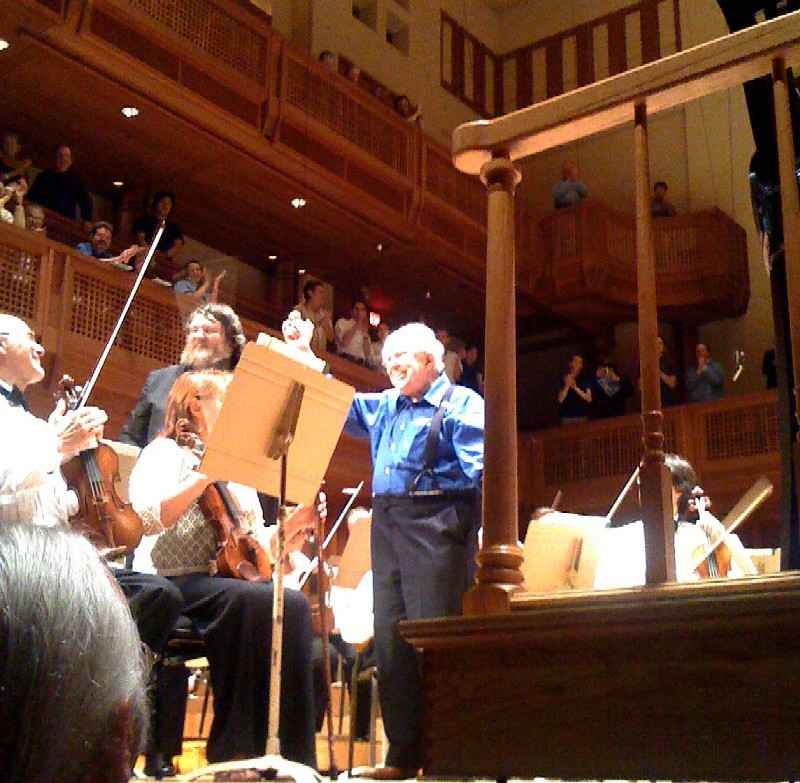
For us who attended the Carter panel discussion Monday afternoon with cellist Fred Sherry and conductor Oliver Knussen in Seiji Ozawa Hall at Tanglewood, it was hard to imagine that the person we were listening to is 100. Elliott stands up in the aisle, talking to friends during the intermission. Sharp as a tack, he discusses various points, laughing and gesturing animatedly as he goes. There is a characteristic twinkle in his eye, engaged and enthusiastic, that makes him seem decades younger than his years. The man looks and acts 70 if he is a day!
 U
Unlike other of his contemporaries, Carter’s brand of musical modernism always focuses on the human element. Carter’s music is essentially theatrical, emphasizing the interplay of characters or personalities in ways that are dramatically engaging. This is connected to that ‘twinkle’, I think.
C arter’s piano concerto looked, to me, like the Forbidden City, in 1968—the metronomic markings in decimals, and so forth. I devoured this thing. What attracted me most was ... the mathematical beauty of it; very European; why certain chords happen when they do is crystal clear. Anything in that score, however abstruse it may seem, can be traced back to single, individual elements. There is a consistency, an internal coherence—this was very different from the European avant garde at the time: Carter’s music made far more sense; it was completely playable. There was nothing ‘conjectural’ about it.”
— Oliver Knussen, panel discussion, Tanglewood, 21-JUL-2008.
T he form of the pieces is also completely traceable, completely comprehensible. All of it falls into place, very poetic, very natural. So it turns out that Carter is not so European after all. Everything in a Carter piece is made out of thinking about a simple, graspable thing.”
— Oliver Knussen, panel discussion, Tanglewood, 21-JUL-2008.
T hese pieces were, you know, considered ‘late’ pieces at the time. And since then we have had what might be called the longest ‘Indian Summer’ on record. How many pieces does Carter have in him?!”
— Oliver Knussen, panel discussion, Tanglewood, 21-JUL-2008.
R egarding his piece ‘Sound Fields’, I have no recollection of saying anything at all to Elliott that could’ve resulted in the piece that ‘Sound Fields’ is. And yet the other evening Elliott tells me that there is something about the way that we talk to each other that ‘triggers’ things for him, that results in his forming musical ideas and developing them. We are all ‘triggers’ for each other, I suppose.”
— Oliver Knussen, panel discussion, Tanglewood, 21-JUL-2008.
E ven when things are worked out, polished, equidistant intervals, regularized rhythms, and so on—the piece may not work, as-written. It may turn out to be boring. And so Elliott adjusts it. He is no slave to rules.”
— Oliver Knussen, panel discussion, Tanglewood, 21-JUL-2008.
T he Carter harpsichord sonata was the first piece I played, at 19 years old. It astounded me. He asked, ‘Is my music too difficult?’ And, of course, nobody would confess that it was. Later, when he was writing the cello concerto, Elliott called me up and said ‘Fred! Help! Can you learn this?’ I found many fingerings that were extremely awkward, nearly impossible. Actually, I never complained about any figure unless it was so difficult that I was confident that no living human being could play it. Then I would recommend a revision to Elliott. He would come back with the most wonderful changes—alternatives that I myself would not have thought of. Brilliant. Finally, Elliott said to me ‘Fred, don’t come back again. Your visits are too exhausting for me.’ [Laughs.] But then, several days later, he calls me up and says, ‘Fred! Can you come over here? I need you to try some things out! ’ ”
— Fred Sherry, panel discussion, Tanglewood, 21-JUL-2008.
C arter’s music has what I would call a ‘stylized naturalism’. It all feels natural somehow, if you play it as it is written—the combined ensemble feels natural. It will have this staggering effect that the individual player will not have anticipated from his or her individual part—playing 29 16th notes against 30 16th notes, against 31 16th notes in another part, over the same interval of time, ending up on the same downbeat together.”
— Oliver Knussen, panel discussion, Tanglewood, 21-JUL-2008.
I f you’re conducting a piece by Carter you’re deeply involved in the notation, laying down the beat, structuring the layers, and so on. But recently when I was listening to a recording, I realized that it is very different for a listener compared to my experience of this music as a conductor. I was astounded as a listener: the music just floats up, speeds up, slows down—it is a bubble. The shape of the piece seems very different for me as a listener than when I was conducting it. Form is very elusive—the partita is a good example. You can’t remember at all what’s coming on the next page—and it goes on for 116 pages. It’s like a chase scene.”
— Oliver Knussen, panel discussion, Tanglewood, 21-JUL-2008.
T he recurrences—the recursion—in Carter’s music are like a rhyme.”
— Fred Sherry, panel discussion, Tanglewood, 21-JUL-2008.
Y es, the dramaturgy, the rhyme-like patterns and cadences, are very attractive. In Carter’s music, it is really more impressive if you do not think about each thing too much. Then it hits you.”
— Oliver Knussen, panel discussion, Tanglewood, 21-JUL-2008.
L ike a fresh peach. A canned peach will never taste like a fresh peach, and you cannot intellectualize or explain just why that is. It just hits you.”
— Fred Sherry, panel discussion, Tanglewood, 21-JUL-2008.
People tend to think of creativity as a static trait—something we’re endowed with at birth and that stays pretty much the same throughout life. Many people also think of creativity as something that only very gifted people possess. Wrong.
 T
Torrance in the 1970s developed tests of creativity, which included exposing the person to a picture of a scene and having the person write out all of the questions he or she could think of in regard to that scene. Carter would not only write prolifically; he would also set forth an algorithm to depict scenes that plausibly could've come before the one pictured, plus a trajectory of scenes that could come afterward, depending on the answers to the questions. Oh, and for extra credit, he would have the trajectory turn back on itself and culminate in arriving back at the starting scene.
The ‘algorithm’ would be like the first-pass of a two-pass computer-language compiler—essentially addressing syntax rules but leaving runtime indirection to be resolved by the linker and, later, the runtime operating system. The first-pass insures the coherence and conformity of the work, parsing it according to the governing metrical and harmonic rules of [Carter’s] compositional method and reporting any deviations for subsequent editing. The first-pass doesn’t generate the executable ‘binaries’, nor does it constrain the expressive and creative content of the work. In other words, listening to him and listening to his music, I think Carter’s mathematics has served a ‘normative’ desk-checking role, rather than a ‘generative’ compositional role. Just an impression…
F rom the Cello Sonata onward Carter’s music sprang from a single idea: disconnection.”
— David Schiff, Reed College, Portland, Oregon.
For Carter, the relationship between music and ‘turf’ (territory) is, I think, a very strong one. Yet questions of how anybody’s music actually articulates a sense of place (or of who controls or owns particular musical territories and how) have only recently been posed by academic music theorists. Previously, such questions have been overlooked.
But questions of meaning and territorial ownership run through and through Carter’s compositions, which can be regarded as essays on music and ‘self-as-territory’ or ‘self-as-ballistic-object’ and the space that that self carves out as it hurtles through space. His music is fundamentally complex, even when it’s relatively simple, as David Schiff has said. The music, often highly multilayered like Carter’s Second String Quartet, or like the ‘Night Fantasies’ that Ursula Oppens performed so beautifully, or the brilliant account of the Carter piano sonata that Charles Rosen delivered at Ozawa Hall on Monday. The layering separates the players (or, in the piano pieces, the left hand and right hand) by individualizing their parts—they diverge and diverge from each other. But it doesn’t separate or disconnect them entirely, because each instrument’s (hand’s) part shares an interface with [at least one of—] the others. Carter’s originality and the long-lived twinkle in his eye seem to emanate from this constitutional curiosity—a fascination with interpersonal boundaries, integrity, self-hood, give-and-take, separation and convergence. There is a positive turbulence that he creates, and the trajectory that each part’s ‘flight envelope’ occupies responds to that turbulence and, in doing so, asserts itself. It is the same sort of identity—the same sort of ‘I am’—that we hear in Beethoven and in other classical composers. And
that, I think, is the predominant reason why Carter’s music is so important, and why it is so loved.
Great to be here; great to be alive as an authentic self; great to be in dialogue with other people.
T he music can be understood transformationally as a complete traversal of this [mathematical] structure by just a few, striking, characteristic gestures. A three-dimensional computer animation that can be viewed here makes vivid these transformational gestures, and the musical form of Figment II.”
— John Roeder, Univ British Columbia.
- BSO Tanglewood Festival of Contemporary Music
- Edgers G. Acumulating interest: BSO frees up resources from a rarely used fund, to celebrate Elliott Carter. Boston Globe, 20-JUL-2008.
- Carter page at Classical.net
- Carter Centenary website
- Baltes P. The aging mind: Potential and limits. Gerontologist 1993; 33:580-94.
- Austin J. Chase, Chance, and Creativity: The Lucky Art of Novelty. MIT, 2003.

- Bright R, Hayes T, Minichiello V. The contribution of music to positive aging. J Aging & Identity 2004; 7:165-75.
- DSM. Neurodiversity: Beethoven' Temperament. CMT blog, 26-JAN-2008.
- DSM. Composing as a Symptom and a Health Outcome. CMT blog, 11-DEC-2007.
- Fisher B, Specht D. Successful aging and creativity in later life. J Aging Studies 1999; 13:457-72.
- Heilman K. Creativity and the Brain. Psychol Press, 2005.
- Hopkins N, Link J, eds. Elliott Carter Harmony Book. Carl Fischer, 2002.
- Kaufman J, Sternberg R, eds. The International Handbook of Creativity. Cambridge Univ, 2006.
- Kozinn A. Blogging at Tanglewood on NYT ArtsBeat.
- Kozinn A. Tanglewood Contemporary Festival: Baby photos and musical puzzles. NYT ArtsBeat blog, 22-JUL-2008.
- Lindauer M. Aging, Creativity and Art: A Positive Perspective on Late-Life Development. Springer, 2003.
- John Link page at William Paterson Univ
- Link J. Elliott Carter: A Guide to Research. Routledge, 2000.
- Lubart T, Sternberg R. Defying the Crowd: Cultivating Creativity in a Culture of Conformity. Free Press, 2002.
- Pfenninger K, Shubik V, eds. Origins of Creativity. Oxford Univ, 2001.
- Roeder J. A transformational space for Elliott Carter’s recent Complement-Union music. Society for Mathematics and Computation in Music proceedings, 2007. [1MB pdf]
- Runco M. Creativity Theories. Academic, 2006.
- Runco M, Richards R. Eminent Creativity, Everyday Creativity, and Health. Ablex, 1998. (esp. Ch. 20, pp. 333ff, on aging)
- Society for Mathematics and Computation in Music (SMCM)
- David Schiff, R. P. Wollenberg Professor of Music, Reed College, Portland, Oregon
- Schiff D. The Carter-Messiaen project: Is the music American or European? Chamber Music Northwest, 2008.
- Schiff D. The Music of Elliott Carter. Cornell Univ, 1998.
- Shaw M, Runco M. Creativity and Affect. Ablex, 1994.
- Smith G, van der Meer G. Creativity in old age. Creativity Res J 1990; 3:249-64.
- Sternberg R. Wisom, Intelligence, and Creativity Synthesized. Cambridge Univ, 2003.
- Torrance E. Influence of dyadic interaction on creative functioning. Psychol Rep. 1970;26:391-4.
- DSM I (heart) different Enchantments: Unexpected Uses of Elliot Carter Recordings. CMT blog, 13-FEB-2008.

I love Elliott, but I loved his music first. (I can’t do this in reverse; I can’t love the music just based on a rapport with the composer.)”
— Conductor James Levine.