Showing posts with label intuition. Show all posts

Friday, July 25, 2008

On Stylized Naturalism: Chamber Music of Elliott Carter

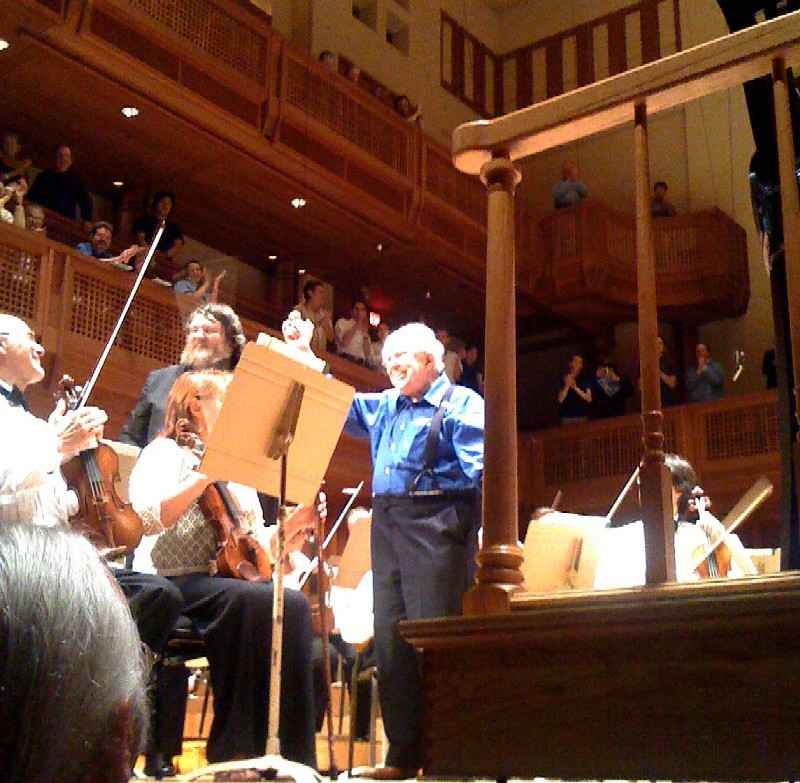
 Elliott Carter, Oliver Knussen, and TMC Orchestra, 24-JUL-2008, Tanglewood
F  inally, I began to understand what he [Carter] was doing. Then I said, ‘Well, it’s really not all that interesting: the same gestures over and over again.’ ”
  —  Robert Baska, comment on Allan Kozinn’s NY Times ArtsBeat blog post, 24-JUL-2008.
A  nd, to each his/her own. Is it true, then, that maybe you are not interested in patterns in nature: flocks of birds in flight; ripples on water; fresh breezes on your face? Those are the same gestures over and over again. Are those not interesting and beautiful? Do you turn away from those? No. Well, to me, Carter’s stylized naturalism—referred to by Oliver Knussen on Monday—is neither more nor less interesting than Nature itself. There is no law that says all music has to have a dramatic human-centric plot, no law that says all chamber music has to have explicit dialogue between the parts, no law that says you have to work yourself up to a big rhetorical finale.”
  —  DSM, 24-JUL-2008.
The BSO’s Festival of Contemporary Music at Tanglewood (Elliott Carter Centenary) on Thursday had a wonderful performance of several of Carter’s smaller instrumental pieces by Tanglewood Music Center Fellows, plus special guests Charles Rosen and Fred Sherry.

  • Saeta (1949) and Canaries (1949) [Steven Merrill (timpani)]
  • Four Lauds for Violin (1984-2001) [Martin Schultz: Remembering Aaron, and Remembering Roger; Stephanie Nussbaum: Riconoscenza per Goffredo Petrassi, and Rhapsodic Musings for Robert Mann]
  • Figment IV (2007) [Gareth Zehngut (viola)]
  • Figment III (2007) [Kevin Jablonski (double-bass)]
  • Steep Steps (2001) [Brent Besner (bass clarinet)]
  • Canto (1966) and March (1949) [Kyle Zerna (timpani)]
  • Elegy (1943) [Fred Sherry (cello), Charles Rosen (piano)]
  • 90+ (1994) [Charles Rosen (piano)]


    [30-sec clip, Charles Rosen, Elliott Carter, ‘90+ for Piano’, 1MB MP3]

Before the performance, we were treated to a captivating discussion, with former Boston Globe music critic Richard Dyer interviewing Elliott Carter. Elliott extemporizes his responses in a vivid, easy-going way—a way that enables us to see the genuineness of the man and his thinking. No mere reminiscences, his comments were up-to-the-minute ‘pearls’ reflecting his current assessment of how things are and why they are that way.

On matters where he feels he has no answer or where he thinks his views might be biased, he says so, simply and matter-of-factly. When one is 100, there is a premium on integrity.

But on most topics, Carter is expansive, each point leading to others in rapid succession. Those lucky enough to attend the Tanglewood Festival of Contemporary Music have much to be thankful for. Bravo!

I  have not thought about periods in my development as a composer. I do not think I have been striving to be more ‘transparent’, for example, in my recent compositions. In fact, I may return to my so-called ‘Second Period’ shortly. [Laughs.] Frankly, I have always simply written things that interest me … I am always just trying new things.”
  —  Elliott Carter, interview with Richard Dyer, Tanglewood, 24-JUL-2008.
T  he role of ‘intuition’ in the compositional process? Oh! That is a question! It’s a question I’d like to transpose into something else: What is the role of intuition in conversation, as you and I are talking to each other? Things come out automatically, without our having to think too much. … I get an idea that seems to be an interesting one, and I go from there.”
  —  Elliott Carter, interview with Richard Dyer, Tanglewood, 24-JUL-2008.
I  ntuition, yes. Composing, for me, is something like writing a letter. First you have a word, then it becomes a sentence. Pretty soon it’s a paragraph, and, eventually, what you have in front of you is what you would call a letter. Things just germinate. Composing is a process not unlike what each of us does every day—it’s like what we are living all the time.”
  —  Elliott Carter, interview with Richard Dyer, Tanglewood, 24-JUL-2008.
T  o answer your question [of where does the idea of putting a contrabassoon against the cello part come from] ... the very different timbres and registers—I’d say I’ve always been impressed with sounds. Sounds. I remember being very impressed by gardens in Japan, the sounds of water dropping and striking pieces of bamboo: very touching, very beautiful, like a soft pizzicato. And, you know, to make the cello part sound very high, you just need some low notes. Contrabassoon!”
  —  Elliott Carter, interview with Richard Dyer, Tanglewood, 24-JUL-2008.
M  ore than water dropping or leaves flickering—your allusion to the shimmering rubato of Liszt—I am instead trying to communicate something deeper than that [in my compositions]. It isn’t a literal naturalism exactly … but I can’t really explain it adequately. For the ‘Symphonia’, which you will hear performed tonight, I just thought about sad things and then I wrote it, that’s all. It is a vision—the sadness of Life, the joy of Life, and, in the end, a ‘balloon’: the piccolo going up. Not a big rhetorical ending. That would’ve been awful. ”
  —  Elliott Carter, interview with Richard Dyer, Tanglewood, 24-JUL-2008.
T  he musical ideas are not the problem. So many! Even now, I am trying to keep my mind off of them! [Laughs.]”
  —  Elliott Carter, interview with Richard Dyer, Tanglewood, 24-JUL-2008.
I  t’s not just I, I suppose, who should express gratitude for this extraordinary Festival. If the pieces of music spoke English instead of notes, they would say, ‘Thank you’. Their gratitude this week is immense.”
  —  Elliott Carter, interview with Richard Dyer, Tanglewood, 24-JUL-2008.

 Steven Nagy, Nikon SmallWorld 2007 Microscopy Photography Competition, 10th-place winner
 Convection regime of intersecting flows, semi-stable line on pool surface
 Convection regime of intersecting flows. Robert Baska would not think this flow-line is interesting or beautiful. But it reminds me of the processes in Carter's String Quartet No. 2
 Convection regime of intersecting flows, art in nature, nature in art
 Convection regime of intersecting flows, something in nature that interests me
 Convection regime of intersecting flows makes me think of the structure of Elliot Carter's music


Wednesday, October 24, 2007

Touching-for-Knowing: Christopher Falzone and the Cognitive Psychology of Haptic Piano

Christopher Falzone
Christopher Falzone performed Hindemith’s Sonata No. 3, Scriabin’s Etude in D-sharp minor Op. 8 No. 12, and Liszt’s Transcendental Etude No. 8 ‘Wilde Jagd’, as part of the student recital at The Curtis Institute of Music in Philadelphia on Monday evening. Falzone has received critical acclaim and numerous national and international awards for his piano performances and compositions. (In 2004, he received the prestigious Gilmore Young Artist Award. In recent years, he has appeared at the Banff Music Festival and the Ravinia Festival. Falzone is a member of the Favrile Quartet. In 2002, his ensemble, Orion Trio, received first prize in the Fischoff National Chamber Music Competition. Falzone, a native of Richmond, Virginia, presently studies at the Curtis Institute with Leon Fleisher and Claude Frank.)

Christopher’s performance on Monday night was spectacular throughout and delighted the 250 people in attendance at the recital. In particular, Liszt’s etude, ‘Wilde Jagd’, offered insights into Christopher’s physicality. This piece is arguably not as technically demanding as other of Liszt’s works, but it is nonetheless problematic for its many rhythmic challenges, triplets in the LH part, tricky leaps, and large staccato chords.

Liszt, Wilde Jagd, mm. 1 - 8
The left hand should be animated but not over-scaled. The performer’s effect may have panache but should not be preening or demonstrative. Instead, what we hope for is sensitivity alloyed with virtuosity. Falzone delivers this in abundance.

The wild hunt is mostly Presto furioso, except for the cheerful 6/8 hunt in the middle. Toward the conclusion it builds to a stormy climax, a confluence of emotional extravagance and inspiration. The hunt is a recurring theme in representational Romantic compositions and art, often associated with evocation of fright or terror as well as the excitement of the chase. Danger and the real possibility of human death is ever-present in the hunt, looming almost as much as the likelier fate of the quarry. Liszt’s ‘Mazeppa’ (Transcendental Etude No. 4) contains this idea. It is not just the eponymous ‘Jagd’.

In ‘Wilde Jagd’, Liszt is more representational than in other of his compositions. He evokes galloping horses with the persistent dotted rhythmic pattern—thundering hooves are implied by the LH part. The technical challenges of Wilde Jagd include blinding speed, prodigious power, the wide leaps, and repeated chords that demand a flexible wrist.

Liszt, Wilde Jagd, mm. 178 - 185
Falzone’s playing is massive and triumphant—thundering sheets of chords. This is epic pianism. He delivers a rhythmic precision that, olympian though it may be, still admits of flesh-and-blood. He clearly has excellent haptic memory in his fingers, his arms, his back, his entire body. This haptic memory is facilitated by intensive devotion to absorbing the music he performs.

Ultimately, music that is memorized by the mind and by the fingers is played flawlessly by heart. Yes, some pianists play from a score, or at least keep the score on the piano just in case. Falzone plays from memory—not, it seems, as a matter of performance aesthetic or requirement for this recital, but because of this wonderful, physical haptic capability that he is endowed with and has developed. He clearly keeps the notes stored in his mind—measure by measure in his mind, as any capable pianist does—but he also keeps them stored in his body, his arms, his fingers. Touching the piano is inevitable, a foregone conclusion. Magma rises under the earth’s crust; there are tremors; it erupts. Falzone is just such a Force of Nature. Not satisfied with mere sensation, touching and feeling erupt into embodied experiences that are emotional and expressive, personal and interpersonal, and mediated through Steinway technology.

A distinction can be drawn between ‘technical problems’ and ‘technical patterns’ in performance practice. The term ‘pattern’ is maybe best thought of as the sequence of fingering combinations that comprise a solution to a technical problem or challenge. For example, in Clementi’s Gradus ad Parnassum, Etude No. 85, the left hand plays a broken octave pattern with fingers 1 and 5 while fingers 2 and 3 are in a fixed position.

Clementi, Gradus, mm. 1 - 4
But Liszt’s polyphonic problems in Jagd and in other works are different. They require the performer to find some very innovative solutions/patterns and, having found them, to internalize them. When leaping, it’s preferable not to look at your hands. Maybe look at a key about one octave above the written note. Place your thumb there and press down the fifth finger; anticipate the coming chord destination when your hand is in motion, leaping. Linear jumps may be more efficient than arcs, although many accomplished pianists use big arcs successfully. If you are near enough to Falzone at one of his performances, you will see arcs, giant arcs. And probably sparks as well. Lava. Smoke. Brimstone. Exciting, impressive, beautiful!


Wednesday, April 11, 2007

Roger Reynolds: Following the Authority of Process + Intuition

Roger Reynolds
I  believe in as wide a range of musical involvements as is feasible given the Reality of Life.”
  —  Roger Reynolds, 1993

DSM: Cellist Rohan De Saram performed with violinist Mark Menzies and cellist Erika Duke-Kirkpatrick last month (16 March) at REDCAT (Roy and Edna Disney CalArts Theater at the Walt Disney Concert Hall) in Los Angeles —— Roger Reynolds’ ‘Focus a beam, emptied of thinking, outward... ’

CMT: And Reynolds’ ‘Angel of Death’ was performed a month ago as well (on 10 March) by the Columbia Sinfonietta at Miller Theatre, Broadway at 116th Street, in New York. These are fascinating pieces. But the taste for them is—What would you say?—an ‘acquired’ taste. They do get performed. But it’s hard to find the events, hard to find the opportunities to experience them. Currently on the faculty of University of California at San Diego. Roger Reynolds is now 72 years old but is still as ‘young’ as ever. Originally trained in Engineering Physics at the University of Michigan, he co-founded ‘ONCE Group’ with Robert Ashley. The ONCE Festivals in Ann Arbor in the early 1960s were renowned among avant-garde music events. And the ONCE Group included some of the most influential and imaginative composers of the day. Reynolds won a Pulitzer Prize in 1989 (for ‘Whispers Out of Time’ for string ensemble) and has accumulated many other honors over the course of his career. His works typically include text and electronic elements, plus theatrical and multimedia performance art. And he’s a pioneer in multi-channel spatial effects—dynamic antiphonal effects that change during the course of a composition and may have significant improvisational latitude for performers. Google around, and you find countless musicians and composers who cite ‘former student of Roger Reynolds’ on their curricula vitae. So, despite the acquiredness of the taste and the comparative scarcity of performances of Reynolds’ works, there’s tremendous ‘cachet’ associated with claiming some association with this Grand Not-Old Man of the electro-acoustic avant-garde.

DSM: He’s always been interested in antiphonal and aleatoric effects. Reynolds’ DVD of Watershed (MODE Records) was the first classical music DVD engineered and produced for surround-sound. Even up to today, MODE produces Roger Reynolds’ work, including his theater-piece ‘Justice’ and a collaboration with poet John Ashbery on a cycle of words and music, entitled ‘Last things, I think, to think about’.

T  he issue of self awareness is one of the most problematic things that any artist, perhaps any individual, encounters in his or her life. I would imagine that if you asked me, do I know myself better now than I did then, the truth is probably ‘No.’ What has changed is that [laughing] I care less about whether the connection between what I am ... It is folly to imagine that you are in complete control of what is happening. People use different metaphors, and the most common one in my experience is how composers talk about the work ‘taking over’. Of course, that’s nonsense. The piece doesn’t take over. But what does happen is that your ability to move things or to alter assumptions diminishes as the amount of material that already establishes normatives grows. Exactly how this relates to the question of self awareness I’m not entirely clear.”

  —  Roger Reynolds, on the issue of a composer’s self-awareness, at National Institute of Arts and Letters, 1973.

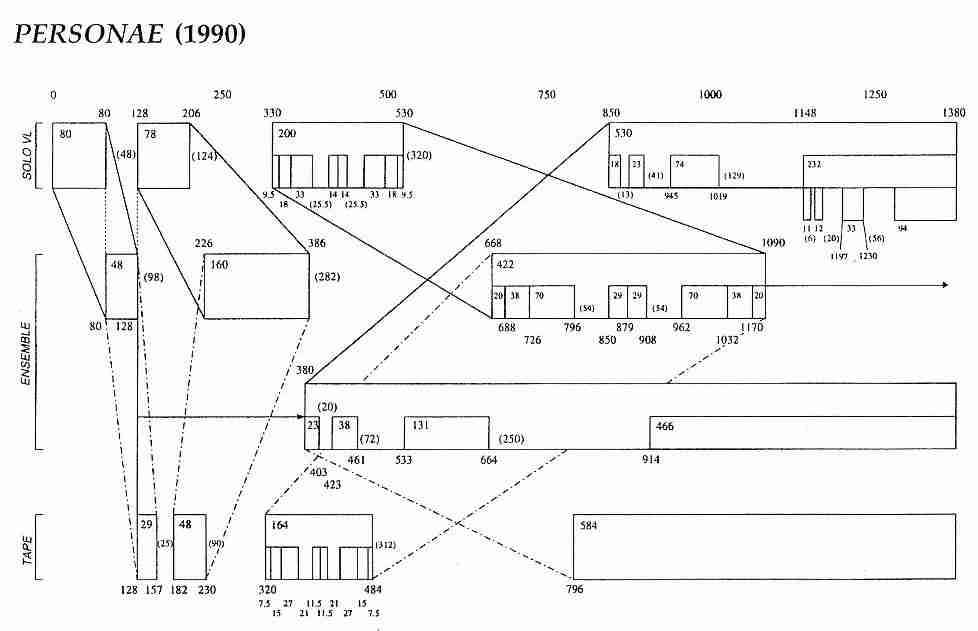
CMT: Reynolds has always ‘pushed the envelope’ rhythmically, too. Traditionally, western music has been dominated by binary structural elements: two-bar phrases, four-bar phrases, eight-bar, sixteen, and so on. That’s the normative pattern of the temporal structure of events and how they fit into larger units, assuming a coherent tempo. Of course, not all musical cultures deal with time in this way. But powers of base-2 are predominant. Regarding neurophysiology and cognition, Paul Fraisse’s book, The Psychology of Time, notes the importance of change—there must be change on a timescale that is neurobiologically congenial, for mammals to be able to perceive a stimulus. Constancy is ignored—it is part of how our nervous system automatically filters and reduces the sensory overload and makes it possible for us to attend to the things that matter most. In his compositions, Reynolds strives for novel aesthetic effects using hierarchical ‘self-similarity’ elements—to establish constancy where he wants it, and thereby to temporarily or progressively diminish the listener’s attentiveness to those voices that are exhibiting self-similarity or relative constancy. Each self-similar element may be echoed by subsequent statements in other voices, and those echoes in turn become transiently ‘new’ and attract a disproportionate amount of the listener’s attention for a time. The soloist plays, the ensemble plays, the synthesizer plays, and the soloist plays, but the relationship between solo and ensemble and synth starts shifting. In designing his unique polyphonal forms, Reynolds uses graphical compositional plans to manage the multiplicity of simultaneous layers of sound that he is composing.

DSM: One of Reynolds’ early works was ‘The Emperor of Ice Cream’, scored for three instrumentalists and eight singers. The score includes stage directions that show how, over time, the singers should redistribute themselves on-stage in order to alter the antiphonal ‘spatiality’ of their sounds. The entire process is depicted in his score and formal performance plan.

T his is a little difficult to see, but this is graph paper, and down here is a square, and down there is another square. That square represents the performance space, or it represents this room. What this represents - that curve, that curve, or this one - is a potential path that a sound can take. So let’s say that I say, ‘Abracadabra, abracadabra, abracadabra,’ that I say that continually, and that sound, ‘abracadabra,’ starts here and moves closer to you and then moves away. And what I’ve done is to design a variety of paths that aren’t just abstractly attractive, but that have actual, visceral effects on one. A fly-by is a very effective gesture in sound space. So I’ve become involved with the idea of using the spatial acuity of the human perceptual system as a component of my music. It involves, like everything else, a lot of planning and informed intuition.”
  —  Roger Reynolds

Plan of ‘Personae’
CMT: Roger’s fascination with explicitly scoring ‘processes’ leads me to wonder whether he’s ever used ProForma’s ProVision business-process modeling software to design one of his compositions. Or CaseWise or one of the other modeling languages. Just as the language standard for XML has been extended to MusicXML, is it not reasonable that BPML or BPEL might be extended to, say, MusicBPML or MusicBPEL to accommodate the music-specific syntactic and expressive requirements of music? Those BPM application packages include the possibility of Markov Chain Monte Carlo simulation (MCMC) and Discrete-Event Simulation (DES)—things that would be interesting and valuable to composers like Roger, I would think. These object-oriented BPM apps would help not only with the exploratory phases of composition—to make the process of discovering what process-flow works best for the aesthetic effects you’re after—but also with the practical staging and production phases—to “vet” or validation-test the performance implications of what you’ve written before you go and try to rehearse it.

If you think about a traditional musical score, you realize that a violin part to a Mozart sonata does not tell the violinist which way to move the bow, where to put his finger on the strings, how to hold the violin, how hard to push, how fast to pull the bow. It doesn't tell him any of those things. It just says: I want this note here, and then this one and then this one, and this should be louder than that one, and so on. What I’m trying to see, with a technical score, is whether there are parallel ways of addressing technological issues which are perhaps much more variable even than such a phenomenon as the technique of an individual instrumentalist.”
  —  Roger Reynolds, 1993

UCSD-CCRA Music Theatre production
DSM: UCSD’s $52 million New Music Center began contruction this January. Its 400-seat recital hall was designed by acoustical engineer Cyril Harris. Designed by LMN Architects of Seattle, the three-story, 47,000-square-foot design will have, among other things, configurable ‘black box’ theatre.

CMT: Yes. I visited the site earlier this winter, during a trip to UCSD. The flexibility that’s incorporated into the New Music Center’s design should be ideal for performance of multi-media works like Reynolds’ pieces. The UCSD New Music Center facility is due to open in early 2009.

UCSD New Music Center, architect’s model