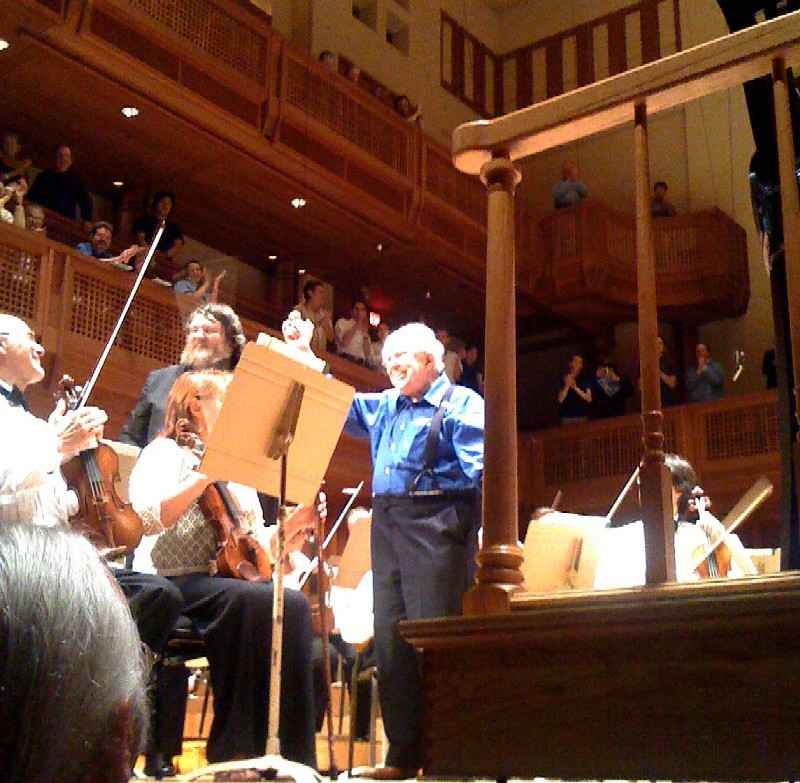
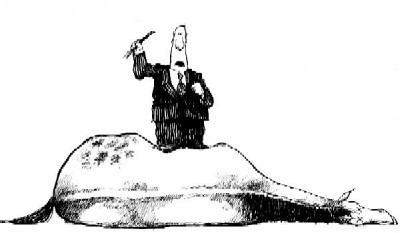
“Beating dead horses with enthusiasm.”
— Charles Rosen
“I love criticism—just so long as it’s unqualified praise.”
— Noel Coward
“The highest reward for a person’s toil is not what they get for it, but what they become by it.”
— John Ruskin
“Criticism is very important but only if it leads to improvement. A mere refutation is no victory. If mere criticism had authority, Berkeley would have stopped the development of mathematics and Dirac could not have found an editor for his papers.”
— Imre Lakatos, Proofs and Refutations
“A professor must have a theory, as a dog must have his fleas.”
— H.L. Menken, Prejudices: First Series - ‘Criticism of Criticism of Criticism’
“I believe that the public likes criticism only in so far as it is a good show, which means only in so far as it is bellicose. The crowd is always with the prosecution ... My own crowd is very small and probably somewhat superior, but it likes rough-house just as much as a crown around a bulletin-board. ... I am often wrong. My prejudices are innumerable, and often idiotic. My aim is not to determine facts, but to function freely and pleasantly - as Nietzsche used to say, to dance with arms and legs.”
— H.L. Menken, Letters of Mencken, ed. Forgue, p.186
“Having the critics praise you is like having the hangman say you’ve got a pretty neck.”
— Eli Wallach
CMT: I’m still reflecting on what Jonathan Biss was
saying about critics last week. What do any of these [print-media or online— ] commentaries do for the cause of classical music? In and of themselves, not a thing. They may divert a few casual readers, but they don’t directly serve the mission of bringing listeners to the art form. They don’t directly invigorate the classical music community or make the dialogue any more vibrant or better financed.
DSM: Well, not directly maybe. But indirectly? The promotion of a virtual community—a larger, more diverse community than could get together physically—is what the web does. It’s what commentators and critics throughout history have done.
CMT: But music critics ought not to be shameless promoters, praisemongers. Not everything critics write or say should be supportive or commending. One purpose of criticism is to advance the creativity of the genre, to add to people’s appreciation of the form, to add to the value and aesthetic quality of the canon and the productions. You want to stimulate demand for forms that would otherwise be in scarce supply, and by creating demand induce more supply. You can’t do that effectively if your credibility is low—if you’re uniformly biased in one direction; if you’re clearly in the back pocket of one stakeholder. More than that, it’d be unethical to represent yourself as a critic and not in fact deliver honest criticism. You want a vibrant and efficient classical music market? You need more producers and consumers! You need liquidity, more buyers and sellers, more market depth. As it is right now, classical music is a pretty thinly traded stock compared to other cultural securities.
“Mozart’s later, more refined style benefits from a measure of unbridled energy. But Ms. Mutter seemed to hold this conviction less firmly than Mr. Orkis. At times she lapsed into the smooth, streamlined, vibrato-rich sound that violinists find seductive in any context but that in this case undercut the music’s vigor and made it sound merely pretty. Pretty Mozart can be awfully inviting, and there are probably times when that’s enough. But it’s a pity when a performer retreats toward a superficial sheen just moments after touching on a more textured, nuanced and electrifying aspect of a work. Looking on the bright side, if the moments of intensely concentrated energy hadn’t been so good, the others wouldn’t have seemed so dull.”
— Allan Kozinn, NYT, 17-NOV-2006DSM: What about meta-criticism? Can we denounce some critics’ abuse of deconstructive techniques to justify their own idiosyncratic fragmentations—their savage distortions of non-canonical works in order to serve a supposedly radical political vision. It’s “jingoism” – self-conscious, precious, extremist views, nothing more.
CMT: Well, sure—righteous metacriticism has its place, especially if provoked. But it basically addresses a small group of specialist acolytes. That’s not going to do any good in the long run, no matter how cathartic it feels. Musical criticism should be geared to the interested lay person. It should aim to be both informative and accessible. Criticism should not only evaluate; it should also explain and educate. And, as William Marvin notes in his Foreward to Deborah Stein’s wonderful book, you can’t explain or educate unless you've first “made the music your own”. So there’s an absolute need to approach each work actively, as a performer or composer, not as merely a listener. Marvin also emphasizes that drafting critical commentary is an exploratory gesture—one that’s at least as likely to lead to “dead-ends” as “Ah-hah!” moments. Mastering a piece—to the point where you can offer a constructive comment on it—requires hours of immersion in the score, in the recordings, in other people’s writings about it, in various artists’ performances of it, and so on. It’s the duty of responsible journalism, of responsible narrative of any sort—not just arts criticism.
DSM: If a critic has added to our appreciation of a work, then that person has been useful to me—to us, to humankind. Or, as Paul McCartney recently said in an interview on NPR in the U.S. (
Sir Paul: Ecce Cor Meum ), what matters is that you give people your honest views; give them a piece of your heart. If you’re not real, then what’s the point!
CMT: So that’s it: utilitarianism trumps everything else. You’re going to hang musicology and arts criticism on a utiliarian’s brand of relativism: you discover that some bit of criticism is useful to you and that makes it okay, and you find some other bit of criticism completely useless to you—particularly if it only summarizes the themes, focuses on an issue you’re not interested in, concentrates too much on other critics or theories and not on the work itself, or uses a technical vocabulary that displeases you—and that makes it bad. Your perfectionism is deadly! Save the baby in that bathwater! The main goal of criticism, I think, should be to communicate—without any prejudice as to the content of the communication, other than that it should be civil and constructive.
DSM: At least Grant is a composer. And Rosen is a pianist. They can be hilarious, bombastic, irreverent, serious—all of these things. And their artistic credentials underlie their work as critics—their idiosyncrasies come with an unimpeachable pedigree. Does it make any sense for someone who isn’t trained and accomplished in some aspect of performance or composition and not still active in that discipline to be a critic?
CMT: I think it’s possible for anybody—anybody who is thoughtful and of good will—to do a decent job as a critic. But you have to inhale—you have to inhale the piece as William Marvin was saying—or you will fail to understand the piece sufficiently to deliver an account of it. Good criticism is a performing art in its own right!
DSM: But is it
necessary to ‘thematize’ the objectives of any criticism or analytical discourse? I notice that every time we’re together we focus on one or a few topics. Is the topicality of criticism inevitable?
CMT: There’s a duty that the critic has to his/her readers—at least in Western tradition—to create a comprehensible commentary. And I suppose that that does entail essay-like conceptual framework, and rational rhetorical devices to carry the ideas forward—it would make no sense to create narrative without a recognizable thesis or theme. It’s not like the theme has to be explicitly stated or announced, but it should be coherent and readily apprehended, don’t you think? I wouldn’t have any patience with absurdist non sequiturs or chaos on the page, would you?
DSM: No. But the pendulum is rather at the other end, isn’t it! One of the interesting trends in musicology is the extent to which technical musicology has invaded criticism and journalism. Since the 1950’s, music criticism has contracted and contracted until it is un-radical—almost a journalism of developments in music composition and performance. As the specific gravity, not to mention the attractiveness, of new works diminished, music criticism found itself increasingly focused on performance. This trend is coupled to the parallel trend of predominantly traditional performances, traditional interpretations of traditional familiar works, and performers who more and more resemble each other. Music criticism began somewhere in the 1970s to appear an exercise in making unsurprising distinctions between commodified products.
CMT: Or an exercise in nostalgia, in which current performances are held up against past recordings and found wanting. Foregone conclusions! It makes you really crave unusual works and unusual interpretations, doesn’t it!
DSM: As David Neumeyer once said (
MusicTheoryOnline, FEB-1993. ), “It is no secret that [critics’] language or methods are not designed to facilitate judgments of value, but only to support them after they have been made. Perhaps the most far-reaching implication is that the link between the tools of technical musical criticism and the ideology of masterwork culture is not at all secure.” So your perspective predetermines what you can see and how you will interpret it? Of course!
CMT: To some extent, the authentic-performance movement, the Historically-informed performance (HIP) movement, by bringing new (though really old) musical product to the public, did provide critics with something new to write about. But because the authentic-performance movement was so closely associated with musicologist academicians rather than with lay writers and lay musical impulses, writing about it in the press has required a lot of musicological training.
DSM: And it demands a reader who has a technical musicological bent. Music critics writing Sunday “think pieces” on baroque ornamentation, or on Czerny’s style of piano-playing, for a small but avid group of readers who already have enough musical training to be able to care about that sort of thing. So HIP hasn’t really achieved too much in terms of growing the audience, growing the market for classical music—or even growing the diversity of musical criticism.
CMT: More important even than that, the trend of converting music journalism into erstwhile cultural studies is rampant—present company included. Write about music by writing about something-else-very-much-not-music! Richard Taruskin is the icon for this—his writing on Prokofiev and Tchaikovsky. He tackles music as if all music were politics, governed by politics. At least you and I only look at politics and culture as a context for—and influence on—composing and performing.
DSM: Thomson’s book on Schoenberg is an example of more radical species of commentary. Thomson questions his reasons for implementing the 12 tone system. There’s a scarcity of Schoenberg criticism that radically re-thinks long-accepted tenets like this, and Thomson has effectively deconstructed the atonal-serialist innovations of Schoenberg, Webern and others. He opines that they’re culturally subversive—establishing new interrelationships between music, mathematics and nihilism. Thomson concurs with what composers like Sibelius, Bartok, and Shostakovich argued—that Western tonality is “the” natural language of music and is a product of entrenched human impulses. In creating works that flout natural imperatives and uphold inhuman precepts, the serialist composers spawned controversy. And controversy drives change. Change is good.
CMT: The book “Music and Ideology” is a response to the question “Must the practice of music analysis and music theory always re-inscribe the ideology of aesthetic autonomy?” And, if not, under what circumstances
does it re-inscribe that ideology? The responses to these questions should appeal not only to music and cultural theorists, but also to a larger audience engaged in critical theory.
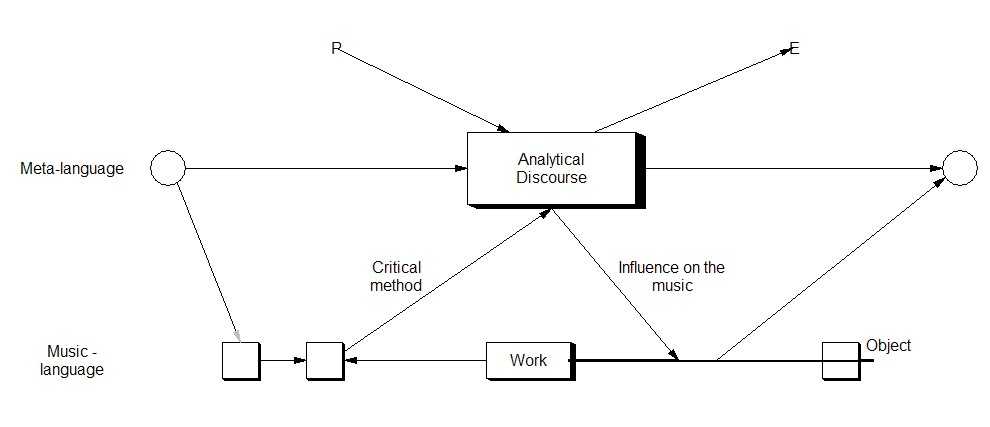
DSM: Rahn’s book construing music’s data structures (declarative code) to how it imparts its experiential structures through flow-of-control and phrasing (procedural code) is satisfying to those of us who spend part of our time in computer science and software development. Here is a music critic who bothers enough to stretch outside of musicology-proper to care to reach out to us. How can we not be intrigued by his ideas when he uses our own language? It’s a friendly invitation to make a connection. This is what helps to grow audiences—cross-pollinate with external market segments who haven’t traditionally been avid supporters. Get them interested, and communicate with them in ways that honor their native cultures! This leads to the question of moral infrastructures and value systems that are indigenous to the internal and external worlds—the music world (or arts world), and everything else. Rahn demonstrates remarkable insight. Acknowledging Gödel’s theorem, he recognizes that critical discourse can only address thoughts formulated in the internally-referential and non-referential language of the arts themselves. But he leaves the possibility open for linguistic “worm holes” to other disciplines, other languages.
CMT: There’s the social semiotics put forward by Lawrence Kramer and others. And Derek Scott’s writing is a refreshingly engaging style. Roger Kuin’s Chamber Music is playful in tone, imaginative, outgoing, inclusive, generous. The book is also an essay in modern (as contrasted with ‘postmodern’) criticism—the content of Kuin’s argument modifies his presentation.
DSM: I particularly like Charles Rosen’s writing as a critic. Rosen—such a superb pianist—tackles Beethoven and atonal music with equal enthusiasm and sensitivity. He’s sanguine about beating on his adversaries, yet he does so in such a kindly way that it preserves the channel of communication. They may not like what he says, but they can hardly but respect his logic and his civility.
CMT: I especially admire Rosen’s “The Irrelevance of Serious Music,” in which he observes that “the death of classical music is perhaps its oldest continuing tradition,” before reassuring us that “the music that survives is the music that musicians want to play”
DSM: Isn’t he also the one who wrote that classical music’s problems are of “resentment for an art that one does not understand—or rather, for an art that one is unwilling to understand”?
CMT: Yes. Rosen can be really funny, in the humor of his remarks on the New Grove and Harvard dictionaries of music. And he is poignant in his memoir of Oliver Strunk, and his distrust of dogmatic theory. Rosen’s account of Richard Taruskin, who he says “beats his dead horses with infectious enthusiasm” is hilarious.
 DSM:
DSM: Text & Act is a collection of Taruskin’s most bellicose essays on historically-informed performance of 18th- and 19th-century music. Taruskin is of course an accomplished Baroque cellist—he comes by his ascerbic opinions honestly. And, although he writes in a stuffy way, he’s really a fierce opponent of the pretentiousness that HIP can be plagued by or marketed with.
CMT: Yes, well, Taruskin is pretty full of himself. He routinely insults people. He makes wild statements at the outset of an essay and then retracts later. He quotes a statement by another writer or musician, takes it out of context and turns it into something that was never meant, and then mocks the speaker in absentia. Prideful hatchet-jobs. And authenticity in the sense of hermeneutics and faithful rendering of the composer’s intentions and realistic conditions of performance is simply not an achievable goal. If the composer is dead, we can know only imperfectly the composer’s real intentions. There are no more 14-year-old boy castrato sopranos to sing Taverne’s masses. It’s like ‘originalists’ and ‘pragmatists’ in constitutional law. Do we want the Constitution to be a living breathing document admitting of evolving, modern interpretations? Or do we want it to be a crusty tool of literalist inflexibility and contemporary coercion?
DSM: What’s important is a performance that moves us, the people performing and listening to the music now. Musicologists and critics should, ideally, be models of how to think independently, and of how to articulate values. If as such models they enable others to learn, then society is the better for it. Little escapes sharp eyes and sharp minds. Whimsy is fine to a point; so is biting criticism to a point, so long as it’s provocative and constructive, not self-indulgent.
CMT: Qureshi’s book is one that gives us an example of criticism in a different voice. Like Eagleton, we get perspectives on how Marxist thought impinges on music discourse. Qureshi explores everything from Marxism to feudal properties of Hindustani classical music, music production and consumption, music exchange economies.
DSM: Another paradigm-shifting writer, Boris Asaf’ev in his books from the Fifties—not widely read outside of Russia—talks about the situation in the field of musical criticism and the concept of Realism: “When I state that the sources and roots of the realistic in music lie in the intonational communication of people, and in the recognition of these socializing elements of music in the compositions of the musical past and present, I am trying to base the problem of musical realism on the unquestionability of the experience of musical communication, on the continuously occurring process if assimilation, evaluation, recognition and non recognition of music of one’s environment.” (Asaf’ev B. Intonation, p. 729.)
CMT: “Cold boot” into a different operating system, different country. That’s the sure way to freshen up music criticism—liven it up. Read everything everybody else writes, take the examples in Stein’s book to heart, then cold boot!
- The Flying Inkpot.
- Allan Kozinn NYT reviews.
- Music Critics Association of North America (MCANA).
- Andante magazine
- BBC interview “Crisis in Music Criticism” : Charles Rosen, Andrew Porter, Norman Lebrecht. [streaming RealAudio]
- Critics Survey 2006 [3MB pdf]
- Music & Letters journal
- Musical Quarterly journal
- Doug McLennan’s blog ‘Diacritical’ (ArtsJournal founder)
- Alex Ross’ blog, ‘The Rest Is Noise’ (New Yorker critic)
- Asaf'ev B. Intonation. Moscow, 1950.

- Austern L. Music, Sensation, and Sensuality. Routledge, 2002.
- Calvocoressi M. Principles and Methods of Musical Criticism. Library Reprints, 2001.
- Cavanaugh C, et al. The Critic. (Sony, 1994. DVD)
- Cooke D. The Language of Music. Oxford Univ, 1990.
- DeMan P. Blindness and Insight: Essays in the Rhetoric of Contemporary Criticism. Univ Minnesota, 1983.
- Demuth N. Anthology of Musical Criticism. Greenwood, 1947.
- Dowd G, Stevenson L, Strong J, eds. Genre Matters: Essays in Theory and Criticism. Intellect, 2006.
- Eagleton T. The Function of Criticism. Verso, 2006.
- Eagleton T. Criticism and Ideology. Verso, 2006.
- Eagleton T. The Ideology of the Aesthetic. Blackwell, 1990.
- Eagleton T. After Theory. Basic, 2004.
- Eagleton T. The Gatekeeper. St. Martin's, 2003.
- Graf M. Composer and Critic: Two Hundred Years of Musical Criticism. Greenwood, 1981.
- Grant M. Maestros of the Pen: History of Classical Music Criticism in America. Northeastern Univ, 2001.
- Hamilton C. Music Appreciation Based on Methods of Literary Criticism. Library Reprints, 2001.
- Haskell H. The Attentive Listener: Three Centuries of Music Criticism. Princeton Univ, 1996.
- Haweis H. Music and Morals. Adamant, 2002.
- Kemal S, Gaskell I, eds. Explanation and Value in the Arts. Cambridge Univ, 2006.
- Knowles J, ed. Critica Musica: Essays in Honour of Paul Brainard. Routledge, 1996.
- Kramer L. Critical Musicology and the Responsibility of Response. Ashgate, 2007.
- Kramer L. Classical Music and Postmodern Knowledge. Univ California, 1995.
- Krims A. Music and Ideology: Resisting the Aesthetic. Routledge, 1998.
- Kuin R. Chamber Music: Elizabethan Sonnet-Sequences and the Pleasure of Criticism. Univ Toronto, 1998.
- Landow G. Hypertext 3.0: Critical Theory and New Media. Johns Hopkins, 2006.
- Leitch V, ed. Norton Anthology of Theory and Criticsm. Norton, 2001.
- Levy A. Radical Aesthetics and Music Criticism in America 1930-1950. Mellen, 1991.
- Moretti F. Signs Taken for Wonders: On the Sociology of Literary Forms. Verson, 2006.
- Nattiez J. Music and Discourse. Princeton Univ, 1990.
- Paddison M. Adorno, Modernism and Mass Culture: Essays in Critical Theory and Music. Kahn & Averill, 2004.
- Portnoy J. Platonic Echoes in Soviet Musical Criticism. J Aesthetics and Art Criticism 1950; 8:245-50.
- Qureshi R. Music and Marx: Ideas, Practice, and Politics. Routledge, 2002.
- Rahn J. Music Inside Out: Going Too Far in Musical Essays. Routledge, 2000.
- Rich A. So I've Heard: Notes of a Migratory Music Critic. Amadeus, 2006.
- Rosen C. Critical Entertainments. Harvard Univ, 2000.
- Ryan M. Narrative as Virtual Reality: Immerson and Interactivity in Literature and Electronic Media. Johns Hopkins, 2003.
- Saussy H, ed. Comparative Literature in an Age of Globalization. Johns Hopkins, 2006.
- Schick R. Classical Music Criticism. Routledge, 1996.
- Schwoch J, White M. Question of Method in Cultural Studies. Blackwell, 2006.
- Scott D. From the Erotic to the Demonic: On Critical Musicology. Oxford Univ, 2003.
- Simon J. John Simon on Music. Applause, 2005.
- Slonimsky N. Lexicon of Musical Invective. Norton, 2000.
- Stein D. Engaging Music. Oxford, 2005.
- Straus J. Normalizing the Abnormal: Disability in Music and Music Theory. CUNY Working paper, 2001. [3MB pdf]
- Taruskin R. Text and Act: Essays on Music and Performance. Oxford Univ, 1995.
- Thompson O. Practical Music Criticism. Da Capo, 1979.
- Toivanen J. Perspectives on Intonation: English, Finnish, and English Spoken by Finns. Peter Lang, 2001.
- Tyson L. Critical Theory Today. Garland, 1998.
- Walker A. Anatomy of Musical Criticism. Chilton, 1968.
- Wichmann A. Intonation in Text Discourse. Pearson, 2001.