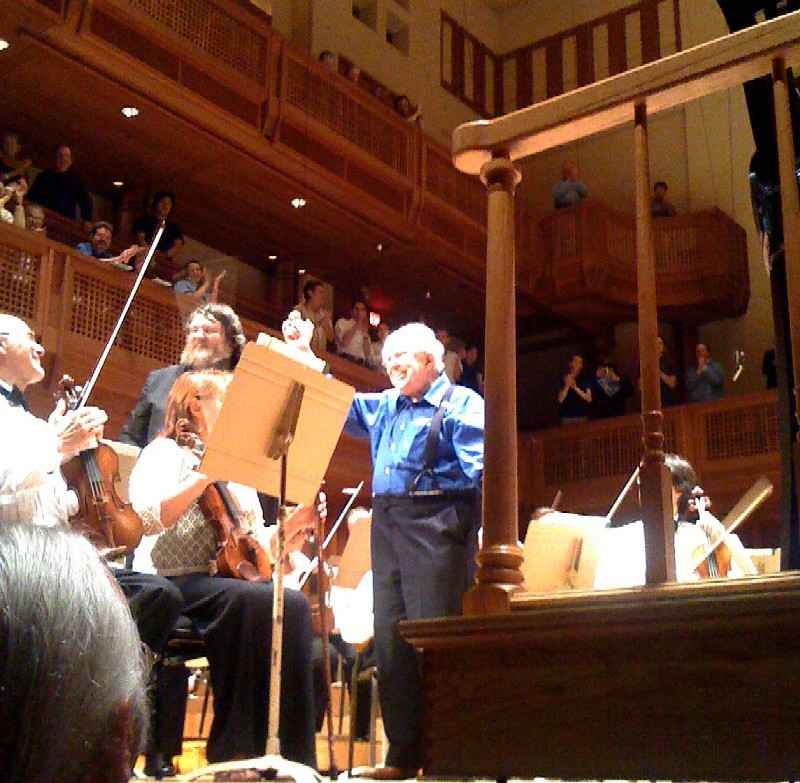
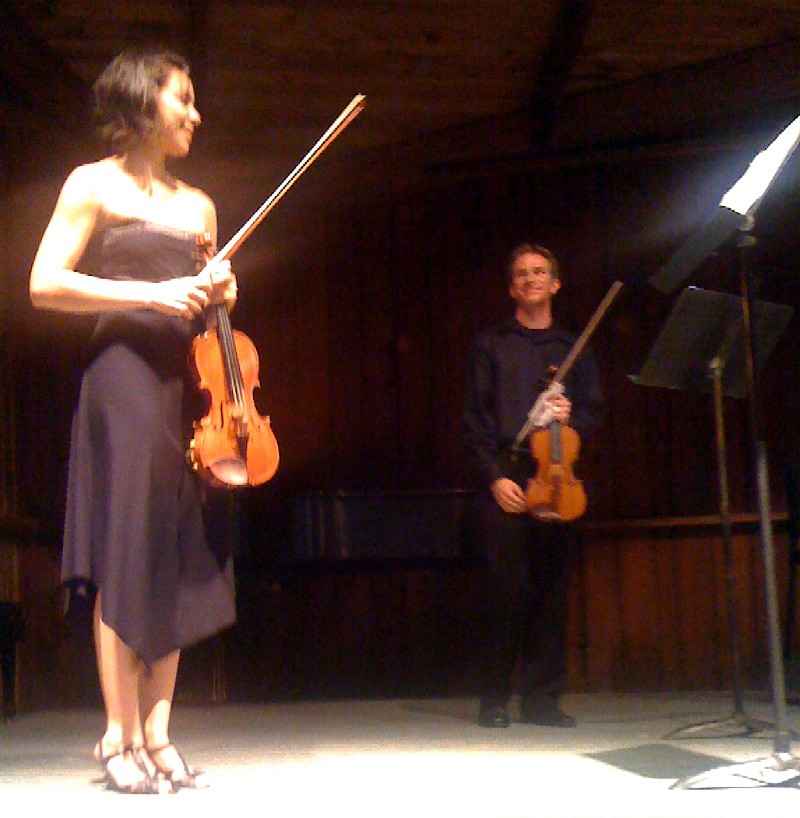
T he performances by Steven Merrill and Kyle Zerna at Tanglewood were spectacular. The music was almost like it was floating—it was fluid and virtuosic and amazingly tuneful. I’d never realized there was chamber music for timpani—a shortcoming of my training, I suppose, but there you are. Where might I go to find more of these—not just Carter’s chamber works and solo pieces for timpani, but other chamber works for timpani too, where the composer writes for timpani so the melodic and conversational capabilities of the instrument are featured? This [performance at Tanglewood] was way beyond ‘timpani-as-percussion’ [and I’d like to find and program other chamber pieces like these].”
— Anonymous.
The BSO’s Festival of Contemporary Music at Tanglewood (Elliott Carter Centenary) was consciousness-raising in many ways, and not just as a showcase for virtuosic solo timpani (reader comment above).
- Saeta (1949) and Canaries (1949) [Steven Merrill (timpani)]
- Canto (1966) and March (1949) [Kyle Zerna (timpani)]
Here are a few mp3 clips from several available recordings of other timpanists, to give you a flavor for some of the literature that’s out there:
[30-sec clip, Jonathan Faralli, Carter, ‘Canto’, 1MB MP3]
[30-sec clip, Staffan Borseman with Danmarks Radiosymfoniorkester members, Holmboe, ‘Chamber Concerto No. 1, Molto allegro’, 1MB MP3]
[30-sec clip, Alexander Peter with Dresden Phil Chamber Orch, Sammartini, ‘Symphony in g minor, for 2 Horns, 2 Violins, Viola, Double-Bass & Timpani, IV. Bouree’, 1MB MP3]
And here is a short list of some of the literature you may or may not be familiar with. There are some solo timpani works in here, but most of these are for ensembles consisting of timpani plus one or more non-percussion instruments.
- Adams - Concerto for Timpani, Percussion & Winds
- Andersen - Pirun Polska, Op. 49, for 2 Bassoons, 2 Horns, 2 Trumpets, Trombone, Timpani & Triangle
- Arevalo - Meridian for Timpani, Cello & Piano
- Badings - Passacaglia for Timpani & Organ
- Bartók - Sonata for 2 Pianos & Percussion
- Batigne - caracteres for Timpani & Piano
- Beck - Sonata for Timpani; Three Episodes for Timpani
- Biber - Sonatae tam Ares, for Trumpets, Strings, Timpani & Continuo
- Bolcom - Dark Music for Timpani & Cello
- Bovey - Tombeau d’Antenor
- Britten - Concert Piece for Jimmy (Timpani & Piano)
- Bump - Studie II: Epthyic for Percussion Quartet
- Buss - Capriccio
- Carroll - Chaconne
- Carter - 8 Pieces for 4 Timpani
- Chavez - Partita for Solo Timpani
- Cheadle - Melodic Movements for Timpani
- Cirone - Sonata No. 1 for Timpani & Piano
- Denisov - Music for 11 Wind Instruments and Timpani, Op. 13
- Druschetzky - Timpani Concerto, Partita in C, etc.
- Firth - Solo Impressions for Timpani & Piano
- Granados - Escena religiosa for Violin, Organ, Piano & Timpani
- Graupner - Symphony in D major for 2 Trumpets, 4 Timpani, 2 Violins, Viola & Basso continuo (GWV 520-534); Symphony in G major for 2 Horns, 4 Timpani, 2 Violins, Viola & Basso continuo (GWV 596-599); Symphony in A major for 2 Horns, 4 Timpani, 2 Violins, Viola & Basso continuo (GWV 612).
- Haydn - The Seven Last Words; others …
- Helble - Night Music
- Holmboe - Chamber Concerto for Piano, Strings & Timpani, Op. 17, No. 1 (molto allegro)
- Houllif - Four Verses for Timpani
- Kellogg - Ben, for Chamber Orchestra (Piccolo, 2 Flutes, 2 Oboes, English horn, 3 Clarinets, 3 Bassoons, 4 Horns, 3 Trumpets, 3 Trombones, Tuba, Timpani, Percussion, and Strings)
- Kessner - Sonata for 4 Timpani
- Kloppers - Concerto for Organ, Timpani & Strings
- Kohler - Concertino fur Pauken und Streicher
- Kraft - Concerto for Percussion and Chamber Ensemble; Brazen for Timpani, Brass & Organ; Concerto for Timpani & Orchestra (arr. for Piano)
- Leonard - Canticle for Solo Timpani
- Lindberg - Marea Sinfonietta (2 Flutes, Oboe, English horn, Clarinet, Bass Clarinet, Bassoon, Contrabassoon, 2 Horns, Trumpet, Trombone, Tuba, Timpani, Percussion & Strings); Fanfare for Arne Wessberg (4 Horns, 3 Trumpets, 3 Trombones, Tuba & Timpani)
- Muczynski - Designs for 3 Timpani, Op. 11, No. 2
- Paliev - 19 Pieces Bulgares
- Richter - Düsseldorf Concerto for Flute, Harp, Timpani, Percussion & Strings (chamber version)
- Sagnier - Six Pieces for Timpani & Piano
- Sammartini - Symphony in G minor, for 2 Horns, 2 Violins, Viola, Double-Bass & Timpani
- Schinstein - Tympendium for Timpani & Piano; Sonata no. 1 for Timpani & Piano
- Schmitz - Spiritual Excursion for Viola, Vibraphone & Timpani
- Schnittke - 4 Hymns, No. 4, (Septet for Timpani, Cello, Double-bass, Bassoon, Harp, Harpsichord & Tubular bells)
- Schwantner - From a Dark Millennium
- Scriabin - Deux Morceaux, Op. 57, for 2 Horns, 2 Trumpets, 3 Trombones, Tuba, Timpani, Harp & Strings
- Sibelius - Andante Festivo (JS 34b) for Strings & Timpani; Rakastava Op. 14, for 2 Violins, Viola, Cello, Basso, Timpani & Triangle.
- van Slyck - Octet for Flute, Clarinet, Horn, Violin, Viola, Cello, Timpani & Piano
- Surinach - Tientos for English Horn, Timpani & Piano
- Takemitsu - Rain Tree
- Tcherepnin - Sonatina for Two or Three Timpani & Piano
- Thoresen - Lop, Lokk Og Linjar
- Utvolskaya - Concerto for Piano, String Orchestra & Timpani
- Vinao - Khan Variations
- Vivaldi - Concerto for Violin, 2 Oboes, 2 Horns, Timpani, Strings & Basso continuo
- Whaley - Scherzo for Timpani; Statement for Timpani
- Wuebold - Fantasy for Timpani & Piano
- Wuorinen - Percussion Quartet
- Zivkovic - Cadenza for 5 Timpani; Trio per Uno
There are probably plenty more pieces, but the above list is what just a quick hour or two of web searching turns up.
Besides a trip to your nearest friendly local Conservatory’s library, the list of links below may offer some additional help.
S o often, great artists, soloists, and orchestral instrumentalists have remarked to me after a performance that they never realized before that it was possible to hear from the timpani such clear defined pitch, tone quality and such a musical sound. Previously, they had the concept that timpani could sound only noisy, with no musical potential. This brings us to the unhappy recognition that too often today timpani are being played with a snare drum technique, and as such, has no relation to true timpani technique. Often this happens because a percussionist———who has never studied timpani at all—or, if he has, never with a professional timpanist—but who does know all the rest of the percussion———applies the snare drum technique to the timpani because of the similarity of wrist action and rhythmical requirements. This style of playing, almost mechanically pointed and rhythmical—staccato: we play this way when it is especially called for; but many performers play this way all the time. Missing is the knowledge of how to achieve tone quality, resonance and a noble full sound with an artistic touch. The nature of the timpani is to ring—full and resonant—so this should be developed to its full capability.”
— Cloyd Duff, 1966.

S o, how do you make your timpani sound like musical instruments? How do you get timpani to blend with other instruments? Start by eliminating as many variables as possible.
1) The timpano bowl should be free of large dents and must be in-round.
2) The lip of the bowl (the bearing edge) must be smooth, level and free of any nicks, dents and imperfections and create an air-tight seal between the bowl and head.
3) The counterhoop must be flush and in-round.
4) The head must be centered in the counterhoop.
5) The head must be true, free of dirt and defects and be centered on the drum.
6) The mechanics of the timpano must be functioning so that a uniform or equal tension can be maintained at all lug points throughout the range of the drum.
7) The proper MSR for the size of the drum must set.”
— Richard Jones, Nebraska Wesleyan Univ, 2006.
There are some challenges for scoring for timpani—as with practical realities for any instrument. Many of those challenges involve the narrow range of pitches achievable by tuning each size; the speed with which the head tension and pitch can be changed on any one timpano; and (if the harmonic complexity desired and tuned-pitches-per-second velocity are great, and therefore can’t be accommodated by pedaling a smaller set) the space required for a set of 5 or more timpani.
 P
Passages where the timpanist has to change the pitch of a drum while playing—for example, playing two consecutive notes of different pitches on the same drum—require pedaling. To do this on Dresden-type timpani, the timpanist has to disengage the clutch with the foot, adjust the pedal to change the pitch of the drum, and reengage the clutch. Doing this with musical precision takes time. The faster the changes are as-scored, the more risk for the timpanist in performance. One clutch or pedal adjustment screw-up can demolish the melodic/harmonic effects and ruin the piece. So, for very rapid figures, you need a bigger set of more timpani—and that requires more floor space; you need a longer, even acrobatic reach for the timpanist to strike the desired sticking spots on the drum heads that are furthest away; you need more pre-event time for the more finicky gear set-ups on-stage prior to performance; and so on.
 W
What else? Prior to performance, the timpanist has to clear the heads by equalizing the tension at each tuning screw. When the head is ‘clear’, the timpano intonation is acceptable and blends reasonably well with other instruments. If the head is not clear, the pitch will bend after the initial mallet impact. The drum will also give different pitches at different dynamics: not something you want, in general. Clearing requires a similar level of care as piano tuning. The rental expense, or the complexity of shipping, or the pre-event tensioning/clearing, or relative shortage of timpanists accessible to chamber music ensembles, or other logistical challenges, though, are surely not the reasons for the rarity of timpani in chamber music performances. Probably instead it’s mainly that non-percussionist composers don’t think to write for timpani very often--which is a shame.
 F
For safety’s sake and healthy composer-timpanist relations, a composer might do well to observe the red brackets in the figure below (from
Dwight Thomas’s website) that circumscribe a portion of the nominal range for each head and show the extent of the best notes in the range for that head size. These ranges can vary a fair amount depending upon the manufacturer and the design of the instruments, but Dwight’s suggestions are good guides for composers who’d dare to write chamber works for these challenging instruments.
 E
Even if due care is taken, there can be some inherent intonation challenges that can restrict the music’s practical harmonic possibilities. The tensioning/tuning to a predominant (1,1) head vibration mode as suggested by Richard Jones and others can mitigate some of these challenges. Using cross-tuning, the timpanist tightens each pair of diametrically-opposing tension lugs to get a uniform pitch with an electronic tuner. Basically, you want to get the head into a (1,1) vibrating mode, from which the purest ‘fundamental’ pitch of the head is generated. But even in (1,1) mode, there are residual extraneous harmonics that may interfere with the timbre of other instruments, and those harmonics are impossible to eliminate entirely. But, in fact, maybe that’s the beauty of timpani: it makes them what they are. The safe harmonic choices for timpani are a bit like scoring for carillon and all its complex bell harmonics.
 N
No matter. Despite those challenges, the good fun that timpani, expertly tuned and virtuosically played, bring to the ensemble is really hard to resist, as the CMT commenter put it and as those of us at Tanglewood this past week experienced. There’s no reason why the chamber timpani literature—however big or small it may be—can’t be performed more. There’s considerable diversity to it, in terms of periods and genres and orchestrations, as the cursory list above suggests. Presenters, how about considering that possibility, with an eye toward audience development and marketing? There might even be room in your programming next year for a ‘Percussion Masters’ series?
Thank you again for your CMT comments. Thank you, Steven and Kyle, for your illustrious and beautiful performances this week.
- BSO Tanglewood Festival of Contemporary Music
- Guerrieri M. Magna Carter: Either/Or. SohoTheDog blog, 25-JUL-2008.
- Punsalan D. Chladni patterns in timpani heads. KLANG~440 blog, 15-JUL-2008.
- Petr Krysl's SOFEA MATLAB page at UCSD
- Krysl P. Pragmatic Introduction to Finite Element Method. World, 2006. (esp. Ch. 13 [pp. 202ff] for FEM mathematical modeling of the physics of clamped circular plate vibrations and vibrational modes in MATLAB; see animated GIF graphic above)

- MathWorks MATLAB Wavelets Toolbox
- MathWorks MATLAB Signal Processing Toolbox
- Percussive Arts Society
- PercussionMusicOnline.com
- Percussion Chamber Music at Hickeys.com
- Timpani sheet music at StagePass.com
- John Beck Sonata for Timpani at SheetMusicPlus.com
- Timpani chamber music at SteveWeissMusic.com
- Timpani sheet music at BatterieMusic.com
- William Kraft (U.S.), Timpani & percussion composition
- Kraft page at Theo Presser.com
- Bridge R. Timpani construction. SUNY, 2001. [500KB pdf]
- Duff C. Timpanist: Musician or Technician? PAS Percussionist 1966.
- Jones R. The Well-Tempered Timpani. Nebraska Wesleyan Univ, 2004.
- ProfessionalPercussionProducts.com
- Mitchell Peters page at UCLA
- Jeff Milarsky, Director, Percussion Ensemble, Manhattan School of Music
- B. Michael Williams, Director, Percussion Ensemble, Winthrop University
- Donald Knaack Percussion Ensemble/JunkMusic
- Percussion Studies at NYU (Jonathan Haas)
- Haas J. Timpani tuning and gauges. REMO application note, 2008.
- KettlesAndCompany.com
- DrumsOnTheWeb.com
- Percussion Studies at Oberlin (Michael Rosen)
- Timpani page at PercussionSource.com
- ModernDrummer.com
- DrummerWorld.com
- PercOrch.com
- Marc Zoutendijk website
- American Drum Mfg. Co. (Walter Light timpani)
- Janos Keszei (U.K.), Baroque timpani
- Adams Baroque Timpani
- Kohlberg Baroque Timpani
- Hardtke Berlin Classic Timpani
- Majestic-Ross Percussion timpani
- Ethos Percussion Group
- Rossing T. The physics of kettledrums. Scientific American 1982 Nov; 247(16):172-8.
- Kristel D. Breath Was the First Drummer: A Treatise on Drums, Drumming and Drummers. Qx, 1995.
- Faralli J. Percussion XX. (ArtsMusic, 1999.)
- Alexander Peter. Virtuosic Timpani Concertos. (Naxos, 2004.)
- Staffan Borseman and members of Danmarks Radiosymfoniorkester. Vagn Holmboe: complete Chamber Concertos, Vol. 1. (Marco Polo, 1996.)
- Zoltán Rácz and Erdody Chamber Orchestra. Druschetzky: Works For Timpani And Orchestra. (Hungaroton, 2005.)
- Graham Ashton Brass Ensemble, with Duncan Patton (timpani) and Anthony Newman (organ). Music for Organ, Brass & Timpani. (Sonoma, 2001.)