Showing posts with label google. Show all posts

Friday, June 3, 2011

Just returned to U.S. from several weeks in China, inspired by the possibilities

NCPA
S    oft power is derived from both state and society. Savvy states are able to harness the creativity and vibrancy of their societies for soft power purposes while understanding that it is civil society’s independence from the state that contains the real persuasive power. When authoritarian states deny the global public the ability to directly access their domestic civil society, they are potentially depriving themselves of a key soft power asset in the information age.”
  —  Shanthi Kalathil, ISD Working Papers in New Diplomacy, MAY-2011.
I ’ve just returned from several weeks in China—a wonderful, profoundly stimulating experience. I attended chamber music performances in Beijing, including a delightful concert at the National Centre for the Performing Arts (“The Egg”) by pianist Igor Levit and three of his colleagues (Evgenia Rubinova, Michail Lifits, Herbert Schuch).

NCPA
U nfortunately, due to Chinese government policy Google Blogger, Twitter, and Facebook are all blocked in the PRC, which is why I have posted no blogs or tweets in recent weeks. (Did not try to use a proxy-server. Hotel ISPs were dodgy enough as it was...)

T here were interesting ‘audience compliance enforcement’ practices in China that we would never see in the West. For example, the concert hall staff aim red ‘marksman’/gun-sight-type lasers on the heads and backs of audience members who make noise or who move or try to take a forbidden photo during a performance. Everyone in the audience sees the bright red dot ‘painted’ on the body part of the offender. We don’t see that kind of enforcement of etiquette in the U.S. or Europe, that’s for sure. But the effectiveness of the social censure by the other audience members who are seated near the ‘offender’ is total and nearly instantaneous. From a performer’s perspective, this is kind of cool—especially when the behavior is disruptive and selfish on the part of the person doing the picture-taking or recording or moving-around.

NCPA
I gor Levit gave a fantastic left-hand-only rendering of BWV 971 (among other things). I asked him and he says the transcription was Brahms’s, published by Breitkopf & Hartel, but I look in Breitkopf catalog and do not see it... I will have to buy a copy of their EB-6018 to look... maybe it is in there and only the Breitkopf pdf file online is in error. There are lots of LH transcriptions of BWV 1004 Chaconne, BWV 1006, BWV 1002, BWV 1031, and so on. I so far do not find the LH tr. of 971...

T he unlikely LH as proponent of subject, object, everything: this reveals new dimensions in, and sheds new light on, a piece I thought I understood. The RH stands by like a watchful parent, saying nothing.

L eon Fleisher and others have had dystonia or other reasons to pursue such literature, but here in China I hear Igor Levit and learn new things. Some might consider one such piece in an otherwise normal program to be a ‘novelty’ or ‘gimmick’, but it was not. Absolutely masterful.

I visited hospitals—crowded but fastidiously clean and well-run—so many things different from the West, but so many things the same. Visited the Central Conservatory where Chen Yi and Zhou Long and others trained. Oh, the food! The friendly, gracious Chinese people!

S o China blazes this prodigious, distinctive, iconoclastic path—many paths, actually, reflecting mixtures of Han Chinese plus 55 minority groups: regional, metropolitan and rural—always diverging from the West, because why? Because what is distinctly Chinese embodies the belovèd “national circumstances” and reinforces the honorable “Chinese characteristics”, or guoqing (国情). That is why... that is why this Chinese ‘autopoietic’ tendency is self-sustaining. It is a little like Richard Dawkins’s ‘Selfish Gene’ on a large social scale. Based on my 3-week exposure, I think it’s not a deliberated process and not a politically-coerced one. Instead, it feels organic, inevitable. So many people, who mostly seem so happy, so long as the ‘boom’ lasts! I can hardly wait for the chance to return...

NCPA
  • Brahms transcription of the Bach Chaconne of Violin partita BWV 1004 for the left-hand (Peters)
  • Brahms transcription of Italian Concerto (Clavier-Ubung II) for the left-hand (Breitkopf)
  • Joseffy Violin partita BWV 1006 transcription for the left-hand
  • Kistler-Liebendorfer Choralvorspiel BWV 711, violin sonata BWV 1001, violin partita BWV 1006, orchestra suite No. 1 BWV 1066, orch suite No. 3 BWV 1068, musical offering canon BWV 1079... transcription for the left-hand
  • Philipp violin partita BWV 1002, violin partita BWV 1004 transcription for the left-hand
  • Raff Violin partita No. 2 BWV 1004 Chaconne transcription for the left-hand
  • Sitsky Violin partita No. 2 BWV 1004 Chaconne transcription for the left-hand
  • Sosa Chromatische Fantasie und Fuge BWV 903 transcription for the left-hand
  • Sosa Invention B-Dur BWV 785 transcription for the left-hand
  • Wittgenstein Violin partita No. 2 BWV 1004 Chaconne transcription for the left-hand
  • Wittgenstein Schule für die linke Hand III/2: Präludium c-Moll transcription for the left-hand
  • Wittgenstein Siciliano aus der Flötensonate Es-Dur BWV 1031 transcription for the left-hand


Tuesday, December 25, 2007

Yotcheva, Franck, Musical Quotation, Minimalism and MIR?

 Yotcheva
A  n assumption that Minimalism and Baroque are both basically musics of tightly patterned cyclic repetition ... led the director of the Eos Ensemble to
devise a concert program under the rubric ‘Perceptible Processes: Minimalism and the Baroque.’ Scheffer’s belief in his ear’s ability to forge trans-historical links is absolute: ‘Think of the Bach Suites for solo cello and their long series of arpeggios through the circle of fifths. They are at once expansive in time and rigid in gesture. Now think of Philip Glass, of ecstatic arpeggios and simple harmonic changes, and you may begin to hear a great unison sounding throughout the history of music.’ ... ‘Bach the humble craftsman’ is, of course, no more historical a reading than ‘Bach the protominimalist.’ But it does move us from the domain of technique to the domain of music’s societal function. Perhaps the link between Minimalist and Baroque [or Romantic] music is not
how they are produced, but how they are consumed.”
  —  Robert Fink, p.171-2.
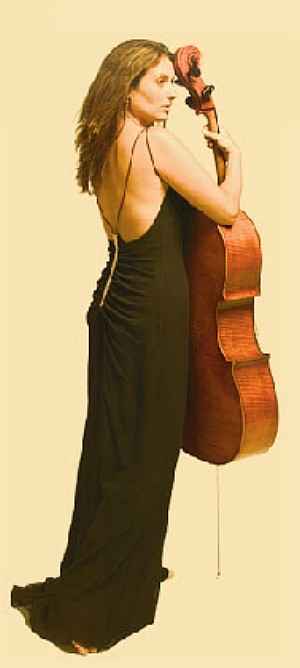
Vélitchka Yotcheva’s new recording of Franck’s ‘Sonate en la majeur pour violon avec piano’ FWV 8 (1886) on XXI-21 Records is wonderful—and it contains some novel and convincing interpretations. (Patrice Laré’s piano playing on this disc is admirable as well.) Yotcheva, founder of Trio Rachmaninoff, performs regularly in Canada, Russia, Bulgaria, France and the U.S. Her exuberant style epitomizes the Russian school of cello playing, which she comes by naturally (via her training at the Tchaikovsky Conservatory, with Marina Tchaikovskaya and later Valentin Feigin and Alexandre Korchagin). She completed her doctorate in 2000 at the University of Montreal, with Yuli Turovsky.

Franck wrote this sonata as a wedding gift for his fellow Belgian, the violinist Eugene Ysaÿe, who gave the premiere in Brussels in November 1886. This cello sonata is an arrangement of the violin version, made shortly after Franck’s death. Franck is usually thought of in terms of harmonic textures and compositional idioms more complex and multi-dimensional than those of other Romantics. One of Franck’s snarkier students (Debussy) termed him a chromatic ‘modulating machine’ (‘Une machine à moduler! La theme, c'est comme la confiture, moins on en a, plus on l'étale. À chaque jour suffit sa peine! Il a une araignée au plafond! Chantez à l'âne, il vous fera des pets! Grosse Corvette, petite cervelle!’), and over the years that characterization has somewhat ‘stuck’. But from Yotcheva we hear new possibilities in this sonata, with more emphasis on its cyclical structures. Her articulations reveal a new logical sense of Franck’s modulations and rhythmic patterns—reveal how simplistic attempts to pigeon-hole Franck’s compositional style do him (and us) great disservice.

Themes from one movement in this sonata are transformed and used over subsequent movements. The whole thing devolves from the opening of the first movement. In a manner that anticipates 20th Century minimalism, every new theme in this sonata turns out to be a subtle variation on a previous theme. For example, the piano’s chords at the beginning of the Allegretto introduce a theme that the cello takes up, and this becomes a recurring motif throughout the whole sonata. The mood changes completely at the passionato second movement, but the original theme reappears here, too, as it does again in the Recitativo–Fantasia movement. The finale is a canon in octaves, with one voice following the other at the interval of a measure, but it, too, is derived from the sonata’s opening theme.

B  ach and Mozart were [‘summational’ artists] dealing with known vocabularies and an accepted body of aesthetic principles.”
  —  Gene Lees, The Will to Swing, p. 192.
A  composer’s choice of time signature is an essential element of the compositional process. When Franck chose to use the 9/8 time signature in this sonata, he did so under the influence of the notational and temporal conventions he had inherited from composers before him. But he also adapted it to his own purposes, with some new compositional procedures to create novel expressive effects, including projection of affect and emotion. Franck’s characteristic harmonic language (such as his iambic melodic rhythms in this sonata) is an example of this. Take a look at what we find by running some match-by-incipit queries in ThemeFinder, a joint music information retrieval (MIR) project of the Center for Computer Assisted Research in the Humanities (CCARH) at Stanford University and the Cognitive and Systematic Musicology Laboratory (CSML) at the Ohio State University.

 Franck, Sonata in A maj, Mvt. 1, mm 1 - 11
Themefinder.org
I t is a mistake to consider this meter (9/8) as a 3/4 meter whose beats consist of triplets. He who has only moderate command of performance knows that triplets in 3/4 meter are played differently from eighths in 9/8 meter. The former are played very lightly and without the slightest pressure on the last note, but the latter heavier and with some weight on the last note…if the two meters were not distinguished by special qualities, all gigues in 6/8 could also be written in 2/4; 12/8 would be a C meter. How senseless this is can easily be discovered by anyone who rewrites, for example, a gigue in 12/8 or 6/8 meter in C or 2/4 meter.”
  —  Johann Kirnberger, p. 396.
The opening phrase of the last movement in this sonata is surely original. But in its development, when it strays from the major into the minor, does it sound like Schumann’s Arabesque? Was Franck hoping to draw upon his audience’s likely familiarity with the Schumann Arabesque? Was he hoping to increase his ‘page rank’ by referencing the Schumann Arabesque?

Themefinder.org
Themefinder.org
Themefinder.org
Themefinder.org
Schumann, Arabesque, Op. 18, Minore I
Or, instead, ought Franck to have expressly avoided developing his idea in A major the way that he did, lest he evoke an arm’s-length resemblance to Schumann?

No. This sonata is genuinely Franck through and through and not plausibly a ‘borrowing’, regardless of any coincidental resemblance. Should van Gogh have refrained from painting yellow flowers, in deference to other painters who’d chosen yellow flowers as a motif previously? Of course not. Brent Smith, writing in Music & Letters in 1931 (12:71-7), felt that two or more composers might naturally be inspired by the same subject, and that similar motifs might be expected to arise independently. In works that are minimalistic—or in performances like Yotcheva’s that enable us to uniquely detect minimalistic tendencies in works where we’d never noticed them before—such similarities are surprisingly common.

 Yotcheva
Of course, ‘musical similarity’ metrics are a hot topic in music information retrieval (MIR). It’s notoriously hard to measure musical similarity in a fair and robust way, or to compare the classification accuracy of different MIR systems and MIR software algorithms. The best that can be done is to assemble panels of musicians who represent a range of musical expertise and points of view, and ask them to classify pieces according to a set of standardized attributes, as to whether pairs of pieces are ‘like’ each other—create a gold-standard reference database of pieces of expert-consensus similarity. Then do Cohen kappa, Kendall tau, Cronbach alpha, and other statistical tests to see how much concordance or disagreement there may be between different MIR systems being compared. Look at ‘false-discovery rate’ (FDR), as a genomics software package would do. Look at false-hits and false-misses. Statistical sensitivity and specificity.

Text IR has an easier time compared to MIR insofar as there is—at least at a basic (‘dictionary’) level—a high degree of agreement about the meanings of individual words, despite the obvious problems caused by ambiguities, mis-spellings, contextual alterations of meaning and all the other things that make human language such a rich means of communication. But music has no semantic unit which corresponds in any useful way to a word, and certainly no agreed vocabulary or ontology of ‘meaning’. While it’s possible to decouple the individual ‘atomic’ elements that make up a musical work, none of those elements ‘makes sense’ on its own. The sense of each derives from the relations to the other elements around it, plus ‘summational’ references to other works before it. Yotcheva manages to create an astonishing new ‘sense’ of the elements in this Franck sonata. You think you know this sonata? You may want to listen to Yotcheva and think again. Deeply moving, original!

 Yotcheva
T his blog is, admittedly, an atypical classical music site. CMT’s not a tlog, and it’s not a splog. I’m grateful for the people I’ve been messaging with here ... and for those who share these interests, including seemingly-bizarre conjunctions (like performance practice, composition methods, musicology, computer science (MIR), musical genres (Baroque, Romantic, Minimalist), musical borrowing, sociology of Web 2.0 cross-links, and search-engine idiosyncrasies—as in this post). I wonder whether Debussy might’ve had Asperger’s or Tourette’s? ... Happy Holidays! Peace!”
  —  DSM.


 Yotcheva