T he very difficulty of this music could be seen as a mark both of its sublimity and of its visionary modernity.”
— Annette Richards, p. 153.
T o better understand ... conventional form not only drives perception and expectation, it promotes coherence. ... C.P.E. Bach could play with the audience’s expectations to heighten their sense of drama. ... C.P.E. Bach’s affective musical discourses involved many contrasting rhetorical materials such as exclamation, interjection, suspension, interruption, affirmation, and negation. Through the dramatic use of these semiotic guides, situating them within the framework of the rhetorical model, as well as associating these ideas with congruent key affects, C.P.E. Bach produced organized, coherent, musical arguments that were imbued with content and effected communication.”T he SPCO’s performance last Sunday with Ton Koopman and his wife, Tini Mathot, was an inspired tour de force.
— Damian Espinosa, MTO 10(3), 2004.
- Carl Philipp Emanuel Bach - Concerto in F for Two Harpsichords, Wq. 46
- Carl Philipp Emanuel Bach - Sinfonia in G, Wq. 183, No. 4.
- Carl Philipp Emanuel Bach - Sinfonia in D, Wq. 183, No. 1.
- Johann Sebastian Bach - Sinfonia from Cantata No. 42.
- Georg Philipp Telemann - Tafelmusik III Suite
Y es, the accompaniment’s “single lines, stabbing chords and pauses avoid covering up the delicate harpsichord sonorities” [Aaron Grad, program notes]. But, far more significant, the extemporaneous pauses—and interrupting the rhythmically cohesive fast movements with fantasy-like slow movements—impart an exuberant, expansive, improvisatory quality to each of these pieces—aided and abetted by Koopman’s enthusiastic conducting. This seems to grant us permission to apply looser, improvisatory paradigms to our listening. The ‘Allegro assai-Andante-Presto’ and ‘Allegro di molto-Largo-Presto’ best characterize how we feel the movements’ form and intent, reminiscent of ‘extroversive semiosis’ which involves the progress of variations in communicating meaning (Agawu 1991, see link below).
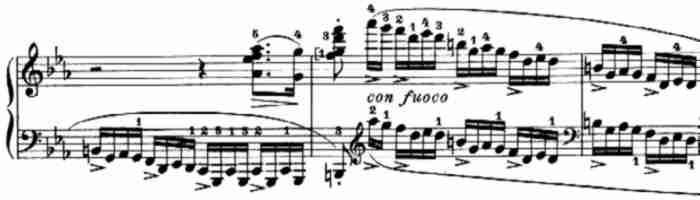
 M oreover, some physical correlates of ‘prominence’ are duration, pitch movement, loudness, and timbre contrast (see Patel, p. 118). The loudness changes and timbral changes that occur with ‘releases’—with the decay and reverberation of the notes that the players have just released—are correlates that C.P.E. Bach uses to great advantage in these pieces. There are back-beat emphases in the Allegro assai in Wq. 183 No. 4 that are strong correlates of ‘prominence’ as well.
T he Concerto in F for two harpsichords Wq. 46 is likewise comprised of three movements, ‘Allegro-Largo-Allegro assai’, the same fast-slow-fast pattern of the Sinfonias. The harpsichord parts require phenomenal technical virtuosity, with really fast passages in the outer movements. Koopman’s and Mathot’s execution of these was flawless and successfully communicated to the audience in the acoustically-excellent, modest-sized 1,100-seat Ted Mann Concert Hall on the University of Minnesota’s main campus West Bank.
 C .P.E.’s dramatic and rhetorical devices include some features that, to me, resemble ‘time compression’ or ‘time focusing’ in laser systems—the interaction between an amplifier and a saturable nonlinear absorber results in pulse compression and intensification of harmonics in lasers (see Akhmanov Fig. 1-3, reproduced below). For example, the triplet figures (and 3x2 sextuplets) in the Allegro and Presto movements of the Sinfonias played against and coherently sync-ed with notes of longer duration yield a steeper pulse—a sonic contour with steeper loudness waveform—in much the same way as would be the case in a laser system. (I have no idea whether others have considered this before, but I swear it would be a common and natural reverie for any optical engineer or laser designer attending a Ton Koopman interpretation of C.P.E. Bach to have. Seldom confessed out-loud, this sort of conniption and trans-discipline serendipity is contributory to why we engineers and scientists love attending live chamber music performances.)
 M y delight and wonderment at these features make me entirely ready to believe that C.P.E.’s writing anticipated modernity and postmodernity by 200 or 250 years—anticipated not only laser physics but, gee, flexible, disintermediated capitalism of mobile rather than fixed capital; anticipated the victory of agility over power, of transnationalism over nationalism, of instantaneity over duration, of software over hardware, of services over products, of consumption over production; anticipated the supremacy of Now over the Past or the Future. Maybe even a Tardis. So dramatic and radical are these C.P.E. Bach pieces that all sorts of things seem plausible.
D oes [Emanuel] Bach stand between the times? [Baroque and Classical] No, he is his own time.”T hese C.P.E Bach pieces—so vivid and dramatic as they are when interpreted by Koopman—also remind me of the ‘unmediatedness’ of photographs—so ‘unproblematic’ for modernists insofar as the photographer’s intent, the photograph, and the viewer’s experience of the photograph are assumed to cohere with each other, the meaning is assumed to be self-evident, and “unlike other cultural texts, even the simplest among us can read a photograph” [Lutz & Collins 1993; p. 28]. C.P.E.’s Sinfonias as acoustic holograms?
— Ludger Rémy, harpsichord, liner notes to C.P.E. Bach: Harpsichord Concertos Wq. 30, 37, & 38, CPO, 1995, p. 18.
I n short, SPCO and Koopman and Mathot succeeded in diverting and inspiring us, in ways that we had no reason to expect or hope for. We came; we listened; we innovated—and went home very, very happy.
N ote/Update, 03-MAR-2011. Some readers emailed me to say that I must be joking, when I suggested the bit about acoustical lasers above. But no! I was entirely serious! Can chamber orchestras performing in chambers “lase” acoustically? Yes! I witnessed it in U of M Ted Mann Hall last Sunday. Ton Koopman and SPCO acoustically lased in the frequency range 0.1 Hz to 10 Hz... several decades lower than test-tube thermoacoustic lasers (see videos, links below). To have composed these peculiar pieces in the way he did, C.P.E. Bach almost certainly grasped this, even if he didn’t have a word like ‘lase’ to name what he was doing. The repetition of it in the Sinfonias is too ‘deliberate’, I think, for Bach to not have known what he was doing! The acoustic laser action is not stable, on account of the irregular shape of the chamber and the varied reflections/absorptions from the Ted Mann Hall’s walls and ceiling and surfaces below. Indeed, the intermittency/instability of the effect adds tremendously to the drama and emotional impact of the pieces. And the lasing is supported not at one frequency only but intermittently at several, also owing to the irregular shape of the enclosure. Chamber orchestra = polychromatic acoustic laser! Listen harder! You will hear it, too!
YouTube video #1
YouTube video #2
YouTube video #3
YouTube video #4
Some things to read, about acoustic lasers:
Item #1
Item #2
Item #3
Item #4
Item #5
What a novel compositional device, C.P.E.! Make the chamber ensemble ‘lase’!
- Ton Koopman, Tini Mathot, and SPCO German Baroque program
- Ton Koopman and Amsterdam Baroque Orchestra & Choir website
- Hubbard R. Koopman’s joy in music-making. St. Paul Pioneer Press 25-FEB-2011.
- C.P.E. Bach Cto. in F for 2 Harpsichords and Orchestra, Wq. 46 at Schirmer
- C.P.E. Bach works at Chester Novello
- Amsterdam Baroque w/ Ton Koopman and Tini Mathot. C.P.E. Bach Wq. 46, Wq. 479. (Erato #45306; Arkiv reissue, 2007.)
- Agawu K. Playing with Signs. Princeton Univ, 1991.
- Akhmanov S, Vysloukh V, Chirkin A. Optics of Femtosecond Laser Pulses. Amer Inst Physics, 1991.
- Berger J, Turow G, eds. Music, Science, and the Rhythmic Brain: Cultural and Clinical Implications. Routledge, 2011.
- Berkowitz A. The improvising mind: Cognition and Creativity in the Musical Moment. Oxford Univ, 2010.
- Clark S, tr. The Letters of C. P. E. Bach. Oxford Univ, 1997.
- Drumheller D. Introduction to Wave Propagation in Nonlinear Fluids and Solids. Cambridge Univ, 1998.
- Graff K. Wave Motion in Elastic Solids. Dover, 1991.
- Jankovsky J. Time Compression Trading: Exploiting Multiple Time Frames in Zero Sum Markets. Wiley, 2010.
- Lutz C, Collins J. Reading National Geographic. Univ Chicago, 1993.
- Nettl B, Russell M, eds. In the Course of Performance: Studies in the World of Musical Improvisation. Univ Chicago, 1998.
- Patel A. Music, Language, and the Brain. Oxford Univ, 2010.
- Powers D. C.P.E. Bach: A Guide to Research. Routledge, 2002.
- Richards A, ed. C.P.E. Bach Studies. Cambridge Univ, 2009.
- Rose F, ed. Neurology of Music. Imperial College, 2010. (esp. Steve Jones, 'Music as a calibrator of Time', pp. 127-42.)
- Small C. Musicking: The Meanings of Performing and Listening. Wesleyan, 1998.
- Tan S-L, Pfordresher P, Harré R. Psychology of Music: From Sound to Significance. Psychology Press, 2010.
- Toffler A. Future Shock. Bantam, 1970.
- Warf B. Time-Space Compression: Historical Geographies. Routledge, 2008. (esp. pp. 135-40.)
- Wayner P. Compression Algorithms for Real Programmers. Morgan-Kaufmann, 1999.
- Youngren W. C.P.E. Bach and the Rebirth of the Strophic Song. Scarecrow, 2004.

T he Enlightenment exemplified intellectual changes of early modern time-space compression, including the Copernican revolution and perspectival painting. These changes were important moments in the scalar jump from the city-state to the nation-state, the most important social and political unit of the modern era, homogenizing local cutures and economies...”
— Barney Warf, p. 12.
N ever in history has distance meant less... Figuratively, we ‘use up’ places and then dispose of them.”
— Alvin Toffler, p. 75.