Showing posts with label bronfman. Show all posts

Friday, November 7, 2008

Brothers Selling Dreams: Ax & Bronfman Piano Duo

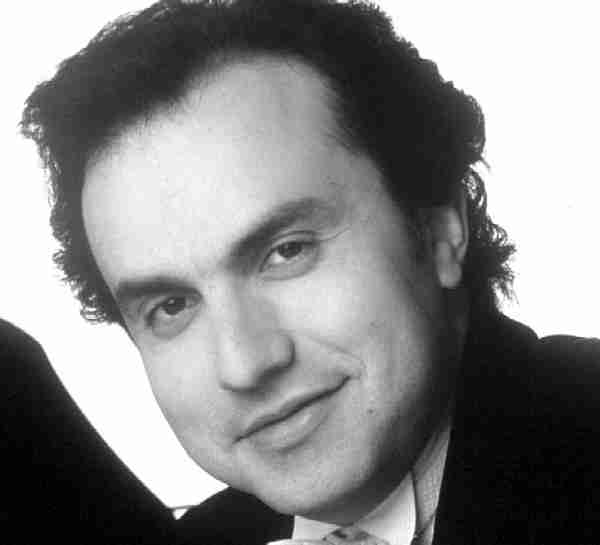
Manny Ax & Yefim Bronfman
M   any years ago, my wife Joan Morris and I got to know the once-very-famous William Saroyan [Armenian-American writer and playwright]. Many people just ‘blank’ on Saroyan’s name today. We once took Saroyan to dinner in Paris. Afterwards, we went to a friend’s house where I played some of our recorded music for him. He listened respectfully. As he was leaving us he said, ‘Art is what is irresistible.’ I’m still chewing on that all these years later. I think it means that if something of mine isn’t irresistible, it won’t last because it won't be needed by us. Knowing that I can’t be around to see if my stuff lasts has given me such a huge sense of relief. No lobbying or politicking for my own work will make it any more or less irresistible. In the end, it’s the performers who decide what they want to perform, and in the long run they will play what they really want to hear.”
  —  William Bolcom, interview with Christopher Wright, 2005.
The Harriman-Jewell Series hosted pianists Emanuel Ax and Yefim Bronfman in a brilliant duo recital last night in Kansas City.

  • Brahms: Variations on a Theme by Haydn
  • Bolcom: Recuerdos (Three Traditional Latin-American Dances) for Two Pianos
  • Mozart: Sonata for Two Pianos in D Major, K. 448
  • Rachmaninoff: Symphonic Dances
The Bolcom piece was particularly interesting….


    [50-sec clip, Elizabeth & Marcel Bergmann, William Bolcom, ‘Recuerdos: III. Valse Venezolano - a la memoire de Ramón Delgado Palacios’, 1.6MB MP3]

Clearly, the ‘perform a duo together’ gig is a different dynamic than to play in larger ensembles and very different, too, than solo performance. The intimacy and the intensity of the shared goals in ‘duo’ are exceedingly great. The project is infused with the historically-situated political pre-suppositions of both of the duo members, including the aim together to embody something true and enduring and universal and memorable. The dynamic of the exchanges between Ax and Bronfman was fascinating—in a word, ‘brotherly’.

And the Bolcom piece was a perfect vehicle for displaying their brotherly wit and ‘Oh, yeah? Well, how about this?!’ irony. The third movement (MP3 clip above) is an especially appealing tale, I would say—‘recalled’ ... Los ‘recuerdos’ fueron recordadas por Manny de forma diferente que Fima ... in progressively escalating, boastful paragraphs by two young boys, each of whom hopes you will deem his ‘version’ of the story to be the better, more amusing one. Classic Bolcom tonality and punchy, confabulating rhythms, in the service of tag-team storytelling. Bolcom’s chordal orientation and boy-like ‘neo-tonal vs. post-tonal’ mocking of both tonal and atonal devices. All of that! In that regard, Jonathan Bernard has observed [not about Bolcom or this piece, but broadly speaking] that “the so-called ‘return to harmony’ or even ‘return to tonality,’ much remarked upon by critics, is really an appropriation of harmony for purposes that are essentially new and not so well understood. To assume that composers, by retrieving such familiar sonorities as triads and major-minor seventh chords, have also taken on, whether intending to or not, the ‘hierarchical’ nature of common-practice tonality (if not its specific structures) may be assuming far too much.”

Bernard’s distinction between what he calls the third and fourth “Stages” in “the story of what happened after [the] initial establishment of minimalism” makes the point clear. In ‘Stage 3’, “pieces began sounding more explicitly ‘harmonic’, that is, chordally oriented, though not, at this point, necessarily ‘tonal’ in any sense.” In ‘Stage 4’, “harmony of an ever more tonal (or neo-tonal, or quasi-tonal) aspect assumed primary control, leaving minimalist devices pushed into the background, where they became stylistic objects” [see the Bernard link below, p. 114].

It was also Bernard who about 10 years ago came up with a useful gambit for analyzing compositions: compare a minimalist piece of music with examples of minimalism in the fine arts, where discussion is, as Bernard puts it, “less bound-up with exactitudes… Regions that alternate regularly between relative sparseness and relative density, very much like the alternating stretches of rhythmic synchrony and rhythmically out-of-phase transition...” In other words, very much like the features of these ‘Recuerdos’ by Bolcom [even though they are by no means ‘minimalist’ and are maybe beyond ‘post-minimalist’ even, heh!].

How does it help understand Bolcom’s music better—to know that it resembles a painting as Bernard is fond of suggesting—or, in my case, to know that it has certain features that are like the dynamic between two competitive 10-year-old brothers, each trying to tell the more successful, irresistible version of a story—[or to know that it is mathematically measurable, and has a distinct rhythmic density or a time-varying power-spectrum or (as in the previous CMT post on Gubaidulina) a Shannon entropy that varies over time]? Do analyses like these—both the ones without any discernible exactitude, plus the ones with some intermediate [e.g., literary-theory] level of exactitude, and the ones with precise mathematical exactitude—help?

W ell, the art comparisons are evocative enough. Lots and lots of people have been to enough art museums to have the contextual knowledge so that comparing a piece of well-known art to a piece of music can be broadly accessible and understandable and helpful. And literary comparisons are also pretty accessible and evocative in stimulating critical discussion among people. The only question, I guess, is how helpful mathematics can be, given the current state of ‘numeracy’ around the world. Can the mathematical features in a piece for two pianos help the performers play it or the listeners listen to it more insightfully and profitably? I firmly believe the answer is ‘Yes.’ You just have to have a decent level of ‘numeracy’, and you have to be in the mood for it. Based on several emails I’ve received on the maths in some of the CMT posts, it looks like the math music geeks are an underserved market in music criticism and music journalism. Maybe in a future CMT post, I will look at the math of Bolcom compositions...

At any rate, with Ax and Bronfman in-charge, we find ourselves in the mood to buy any dream they want to sell us, consider any fabulous tale they want to recount for us, see any neo-tonal/post-everything art they want to show us ... go anywhere acoustically and expressively they want to take us. They make us this irresistible offer that’s ‘aspirational’—and it invariably embodies things that we aspire to have, to be, to do, to experience, to feel. Attractive in the extreme. An irresistible offer—one that has a return-on-investment (ROI) that’s big and immediately recognizable and believable. ‘Irresistible’ in that it is not a one-time ‘special offer’—it offers assurances of dependability and reliable ongoing presence—it’s safe to depend on it being there. It is not compulsive, ‘over-the-top’ novelty—it is comfortable, credible. As an ‘investment’ it has a beta that is not too high, with liquidity and financial ratios that denote tolerable risk.

In short, at the Ax-Bronfman recital last night I was (we were) ‘sold’. Their brotherly sales pitch was irresistible. And as I reflect on the Bolcom quote at the top, I think it was nice, too, that these pieces—and the colors and ideas that they contain—are what Fima and Manny like to perform together. Their choice of these pieces says a great deal about their affection for each other, and about their optimism and enduring/endearing enthusiasm for life.


Saturday, December 8, 2007

Bronfman: Is Virtuosity ‘Necessary’? Is Sublimity ‘Measurable’?

Yefim Bronfman
I t is not true that the entire evening will be as hard as you say. There is one easy part in tonight’s program. I think you call it the interval, the intermission?”
  — Yefim Bronfman, jesting repartee with audience, in reply to Cynthia Siebert’s words introducing him, 07-DEC-2007, Kansas City.
There are many instances of virtuosic writing in these pieces and, with Yefim Bronfman, many instances of virtuosic playing. The profusion of dazzle makes apprehending the pieces even harder—we find ourselves wanting to press a ‘◄’ button and hear each passage again. Even the asynchrony in the second movement of the Beethoven Sonata No. 13 (Op. 27, No. 1) is texturally and rhythmically complex—it resists decomposition or deconstruction. But Bronfman’s account of Balakirev’s ‘Islamei’ may be the first time when I had to set aside the whole process of comprending the music, step back from it, throw up my hands and just marvel: How did he do that? ... Intricate sets of nonlinear relationships such that only certain aspects of them can be grasped at a time, to use Paul Cilliers’ phrase, defining complexity.

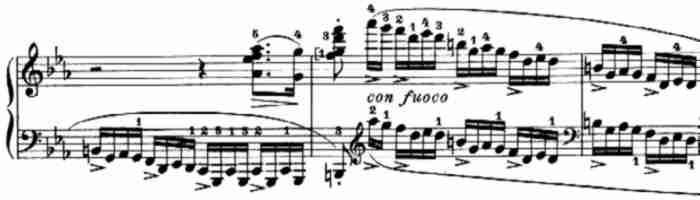
Look below — think of all the cognition and neurophysiology needed to absorb all that’s happening even in this short little introductory bit: the rhythmic and contrapuntal complexity, and how these link up so seamlessly with what has come before and what is yet to come, not only within these 6 bars but within the next 29 pages. I’m impatient, not a fan of protracted development. Very few composers can pull long thematic developments off gracefully and, even when they do, the listener thinks, ‘Okay, that was impressive, but — was it necessary?’ But with Yefim Bronfman the virtuosic passages not only ‘work’ — we glimpse how the passages are necessary to the expressive goals of the piece. We suspend our disbelief and immerse ourselves in the thing, and we take it to heart and rapidly accept the composer’s/Bronfman’s goals as our own.

I should like now to play something easy: Chopin… Now, Prokofiev, something that is, finally, easy… The Schumann Romance and Intermezzo: at last, easy!”
  — Yefim Bronfman, remarks to audience, winking puckishly, prior to performing encores #1, #2, and #3 [Chopin Etude Op. 10 No. 12; Prokofiev, Finale from Sonata No. 7 Op. 83; and Schumann Op. 26, respectively], 07-DEC-2007, Kansas City.
Balakirev, Islamei, mm. 9 - 14
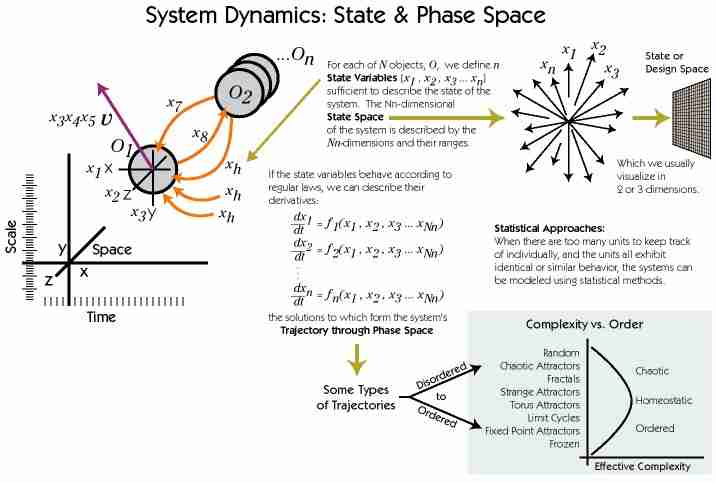
How, then, would we measure virtuosity? Could musical virtuosity be quantified? I think the answer is ‘yes’. A good ‘virtuosity metric’ would not only be longitudinal—a velocity correlate of the number of notes per unit time. Velocity or longitudinal complexity is not enough to capture what we routinely mean by the word ‘virtuosic’.

Virtuosity is also related to the degree of rhythmic irregularity and vertical harmonic complexity and pitch span, the slew rate (how fast the span is traversed, in individual jumps; how long is the cumulative duration that such rapid jumps, hand-crossings, etc., are sustained), the jump rate (how many jumps per minute), the degree of multi-processing and rendezvousing between the parallel processes (in the right and left hands of the pianist, in regard to Bronfman’s playing), and the precision required in all of these moves. This last part—the precision—is important. It’s closely related to ‘system identification’: our intuitive ‘Can you detect a mistake or not?’ criterion.

In regard to these factors, I think ‘processual’ musical virtuosity (or a virtuosic composition) would be measured like complexity in nature is measured—and how it is mathematically measured in computer science: pi algebras, minimum description length, Hausdorff fractal measure, and Kolmogorov complexity measure. So far, only a few have looked at applying Kolmogorov complexity to music (Paul Vitányi; Ming Li; handful of others), but I think it will be a fruitful avenue to pursue further ...

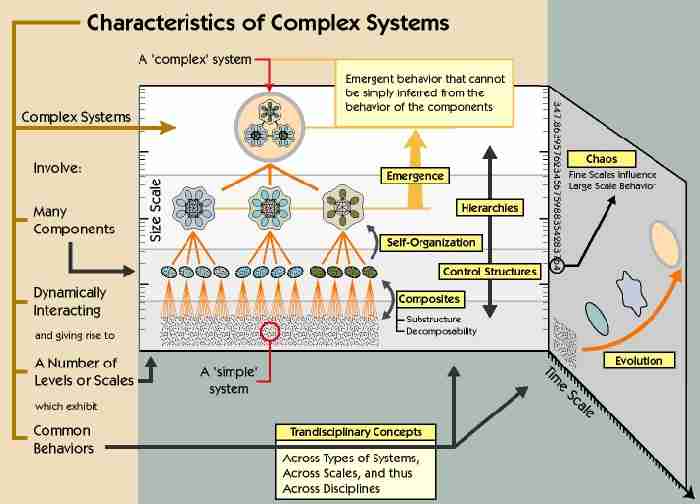
A  complex system is one that is thermodynamically open (participates in a matter and energy budget and exchange) and operates away from equilibrium. A complex system is one whose history matters; whose present and future behavior are, in part, determined by its past.”
  —  J. Ricard, Complexity and Dynamics of Life Processes.
C omplexity results from the interaction between the components of a system, and therefore complexity is manifested at the level of the system itself.”
  —  Gregoire Nicolis & Ilya Prigogine, Exploring Complexity.
A  complex system is one in which there are far more possibilities than can be actualized.”
  —  Niklas Luhmann, Sociological Theory of Law.

It’s also related to philosophy-of-mind and artificial intelligence and Turing Machines and Searle’s Chinese Box: can a listener tell whether the performer hidden inside the machine/box is human or not? If the sounds emitted are implausibly complex in terms of their cognitive and motor nervous system implications and the composition is syntactically well-formed and precisely ordered, then we ordinarily deduce that the box may contain either a very good synthesizer and a very good software-driven sequencer attempting to deceive us to believing it is a live human, or it may contain a new super-human being whose virtuosic skill is simply beyond anything that we’ve ever before encountered or imagined. (I close my eyes and listen to Bronfman... My conclusion, especially in view of his casualness and humor, is that he must be super-human.)

(On the other hand, if a composition is implausibly complex but doesn’t consist of syntactically ‘well-formed’ expressions——is instead comprised of random sounds whose structure strikes us as arbitrary, chaotic, and imprecise, as, say, in a piece by the late Karlheinz Stockhausen——then we can’t make any such deduction.)

Schumann, Faschingsschwank, Intermezzo, mm. 1-2
In the case of a human performer—Yefim Bronfman, last night—whose sounds, virtuosic in their precision and in their emotional aptness, were beyond our imagining, we experience a sublime sense of wonder: sheer wonderment at possibilities not thought to be humanly achievable. Virtuosity like this is empowering of all humankind. It doesn’t only redound upon the individual virtuoso. And that is really why we find it sublime. Our witnessing such virtuosity can be transcendent, in much the way that gazing through a large telescope on a clear cold night can be so … gazing abjectly into the chasm of possibility.

What I mean to say is that virtuosity and unearthly complexity are psychologically connected with the innate human drive for awe and spirituality. Tonight, Bronfman’s cosmic playing forced me to confront this fact.

Yefim Bronfman
K olmogorov complexity is a notion of randomness dealing with the quantity of information in individual objects; that is, pointwise randomness rather than average randomness as produced by a random source. Known as ‘descriptional complexity’, ‘shortest program length’, ‘algorithmic entropy’, and others. Martin-Loef tests for randomness and Gödel’s incompleteness are related to this.”
  —  Ming Li & Paul Vitanyi, Introduction to Kolmogorov Complexity and Its Applications.


T raditional wisdom has it that the better a theory compresses evidence, the better the theory predicts unknown data. With the advent of Kolmogorov complexity this was rigorously proved in a general setting. Making these ideas rigorous involves the length of the shortest effective description of an individual object: its Kolmogorov complexity. Ray Solomonoff invented the notion of universal prediction using Kolmogorov complexity-based universal distribution. Universal prediction is related to optimal effective compression.”
  —  Jorg Rothe, Complexity Theory and Cryptology.

D   efine it by example—societies, governments, corporations, the stock market, families, the body, an organ system, memory, a cell, an organelle, the weather, ecosystems, flow in a river, the snap of a whip: these are undeniably complex. Chief properties of such systems include: components, modularity, spatial dispersion, interactions among components across space and time, self-organization, multiple relevant spatial and time scales of formation and operation, diversity, instability, nonlinearity, variability, functional activities and the existence of objectives. The latter properties confer autonomy, anticipativeness, and adaptiveness. In other words, complexity admits of degrees and types.”
  —  Yaneer Bar-Yam. Dynamics of Complex Systems.
S ome systems have a very large number of components but can be analyzed in the full sense of the word. Such systems are merely complicated. Other systems are constituted by intricate sets of nonlinear relationships such that only certain aspects of them can be analyzed at a time. Such systems are properly termed complex.”
  —  Paul Cilliers, Complexity and Postmodernism.
D   istinction between simple and complex is a function of our distance from the system.”
  —  Roberto Serra & Gianni Zanarini, Complex Systems and Cognitive Processes.
P eople stare contemplating the ocean as it swells and crashes on a rocky shore. They gaze fixedly into a fire until the sting of smoke raises their awareness. People lie on their backs and follow passing clouds or marvel at the glittering of the stars. There are many things that fascinate us, that mesmerize us, that cause us to forget ourselves and our situations as we become lost in a timeless appreciation. ...Kant introduces the dynamically sublime as relating to encounters with the ferocity of nature and the sense of vulnerability this entails, coupled with the triumph of reason over fear. And in his own writings on the sublime, Edmund Burke takes the view that the sensation of incomprehensibility, the fear of hopelessness, coupled with the knowledge that one is able to reason about something beyond one’s senses... causes a kind of delight through internal conflict: a sublime experience.”
  —  Alan Dorin, Wonder and The Sublime in Art and Nature, in Adamatzky & Komosinski, Artificial Life in Software.


Chopin, Etude No. 12 Op. 10, mm. 3 – 4


Wednesday, December 5, 2007

Bronfman and Everest: Balakirev’s and Ravel’s Virtuosic Fantasies

Yefim BronfmanIn the U.S. the new season of DiscoveryChannel’s documentary, ‘Everest: Beyond the Limit’, is currently being broadcast as an ongoing series of television programs. Each episode shows climbers—young and old ones, highly-skilled ones and relative novices—risking their lives trying to reach the summit of Everest. Not surprisingly, the drama revolves around the steepest, riskiest, most hostile parts of the climb. We viewers feel a [morbid?] fascination with the ever-present possibility of catastrophe—a fascination equal to the admiration we feel for the climbers’ endurance and achievements and successes. The spectacle of the natural beauty that’s connected with the pursuit captivates us, too, as does the diversity of humankind when (self-) driven to these extremes——when (self-) driven to accept such suffering and risk, in pursuit of an extreme, world-class goal.

Everest
‘Summits’ of a different kind—musical comparables to Everest—are in store when pianist Yefim Bronfman performs on Friday evening in the Kansas City Friends of Chamber Music Master Pianists Series. The program includes Balakirev’s ‘Islamey’ and Ravel’s ‘Gaspard de la nuit’, among other works. The program requires a capacity to play these technically demanding works—prodigious athleticism—but never decoupled from the capacity to play with interpretive skill. In other words (and to paraphrase Stephen Pettitt, music critic of The Times in London), true virtuosity requires as much poetry as athleticism—or so Bronfman implies, in devising a program like this.

A  virtuoso is a musician who can play with panache a score of seemingly impossible technical difficulty... The north face of the Eiger has been conquered. The musician has, once again, triumphed over impossible adversity... A significant part of the musician’s craft has to do with the acquisition—through many hours, many years, of arduous, repetitive practice—of a very particular athleticism, one that enables the accurate playing of a large number of notes within a small amount of time while still making a pleasing sound. Virtuoso playing is a high-wire act, and the sensation it delivers to the audience similar. Surely he’s going to fall off at that speed, we think. When he gets to the other side intact we still think it a miracle. … Surely some dark magical force must be at work to enable such superhuman miracles of execution. … Indeed, is what seems like virtuoso playing necessarily that? Don’t misunderstand me. Even if its purpose is simply to thrill its audience, much as a particularly adroit footballer thrills with a piece of consummate skill, there’s nothing wrong with this showy variety of virtuosity. It’s fun to hear — and see — a violinist skate across a Paganini Caprice now and again. Yet it’s hardly a test of the most insightful musicianship. The player isn’t required to see between the notes, because between the notes there lies precisely nothing. There’s no insight into the human condition. No miracle of contrapuntal logic. Just a musician showing off his or her amazing skills. But maybe we should recognise more generously than we do the exercise of the inconspicuous brand of virtuosity... Virtuosity need not be a matter of playing lots of notes brilliantly at all. The truth is that all serious music worth the playing and singing, no matter how physically simple it might seem, requires a certain virtuosity of the mind. … Although the notes in Mozart might come relatively easily, the contextualising of them, the weighing of them, the nuancing of them, does not. Mozart demands such precision of touch, colour and phrase that an interpretation can fail on the slightest contextual faux pas. Moreover, it’s the performer who must find a personal context, since playing Mozart is no more a matter of choosing one correct way than is playing anything else. Control and freedom need to co-exist in perfect balance, so that the mysterious eloquence of the music is allowed to emerge, the player opening a window on to the soul of a miraculously gifted person. That is true virtuosity.”
  —  Stephen Pettitt.
In 1928, Ravel wrote, “ ‘Gaspard de la nuit’, piano pieces after Aloysius Bertrand, are three romantic poems of transcendental virtuosity.” Well, Mozart can be technically demanding, too—the two-part cadenza of the opening allegro of K 466, for example. But we usually think of the virtuosity required for Mozart as predominantly interpretive virtuosity. Similarly tough: revealing the emotion in Chopin without falling into cliché, or articulating the voices within Bach without being stilted and suppressing the emotion or creating a fugue-pastiche. Ravel’s ‘Gaspard de la nuit’ imposes demands that are simultaneously interpretive and technical/athletic——hideously, dauntingly so. Aloysius Bertrand’s prose-poems, ‘Gaspard de la nuit: Fantaisies à la manière de Rembrandt et de Callot’, were published posthumously in 1842 and re-issued in 1895, when Ravel’s friend Ricardo Viñes discovered them and introduced them to Ravel. Later Ravel returned to the poems and was captivated by their grotesque, hallucinatory imagery as an evocative subject for a piano composition.

And what about ‘Islamey’—composed in 1869 by Mily Balakirev, then 32 years old? The first theme is a folk dance from the Caucasus. The prevalent augmented seconds lend a south Asian ‘islamic’ aspect. The central section is lyrical and derives from an Armenian folk song. The slow, exotic middle section contrasts with the energetic outer parts. In the third section, Balakirev reprises the thematic material of the opening, culminating in a pyrotechnical coda. ‘Islamey’ is comprised of variations with increasingly, insanely, demonically complex elaborations. (Maybe we should note that Balakirev had a nervous breakdown in 1872, three years after composing this piece?) So our definition of ‘virtuosity’ gets worse: virtuosity is defiant and risky; it tempts fate; it scoffs at danger. It wouldn’t be virtuosic if catastrophe were impossible. You have to work without a safety net! (Balakirev punched out—became a railway clerk for awhile; worked as a school inspector until 1883; then returned to music as Director of the Imperial Chapel and conductor of the Imperial Musical Society, where he remained until retiring in 1895.)


I n music, no less than in athletics, audiences thrill at witnessing exceptional feats of physiological accomplishment, and they fête and reward those who
afford them such thrills.”
  —  Jane O’Dea, p. 40.
Everest
H e did not appeal to the emotions, except those of wonder—for his playing was statuesque, cold, beautiful, and so masterly that it was said of him, with reason, that he would play with the same care and finish if roused out of the deepest sleep in the middle of the night.”
  —  Sir Charles Halle, review of Thalberg, quoted in O’Dea, p.39.
In ‘Performance as an Extreme Occasion’, Edward Said writes that the contemporary concert is an extraordinary event, highly specialized and totally alienated from ordinary life. Before the mid-20th century performers were often also composers, and listeners were also often amateur musicians. Today the audience is marginalized. The specialized artist so ‘owns’ the work today! The recital has come to be an occasion for the display of extreme ability—on a level that’s totally alien to the listeners, most of whom are neither familiar with the scores nor play any instrument or sing. Their ‘regression of hearing’ (Adorno’s phrase) is manifested in “the listener’s poignant speechlessness as he/she faces an onslaught of such refinement, articulation and technique as almost to constitute a sado-masochistic experience.”

The audience has become more passive and concurrently we get this spectatorly cult of virtuosity. But why has social power recently captivated the imagination of popular culture—and academic anthropologists as well? Surely it’s not just a consequence of fewer practicing amateurs! Is it instead a society-wide reaction to our diminishing power as individuals? Is it a reaction to the decimation of social cohesiveness by the recent emergence of long-tailed, fragmented, web-based culture? Is it a backhanded way to oppose the ‘colonization’ of our selves—that is, an endorsement of and vicarious participation in demonstrations that individual victory over mass culture is still possible—more than gazing at an athlete/artist’s literal victory over physical difficulty?

Stanley Barrett asserts that the answer can be found in the effect of the past 100 years’ warfare throughout the world; the end of old colonialism and emergence of new forms of colonialism under the guise of multinational corporate globalization; the information and technology revolution, mass culture and cultural fragmentation. “The notion of a homogeneous, cohesive, geographically-bounded local culture consisting of people who share a putative common ancestry is obsolete,” he says. The diversity of distinctive cultures and identities “has become constricted, and ‘culture’ has become the new equivalent of ‘race’: difference-as-inferiority; new structures of exploitation and domination; new relations of power saturated with new possibility of inequality and disparities.”

I hope that hearing Bronfman perform on Friday may shed additional light on these issues. Me, I’ll be listening from a moderate elevation, at ‘Base Camp #3’!

T he question of the relationship of the individual person or subject to domination carries ‘resistance’ to the level of consciousness, subjectivity, intentionality, and identity.”
  —  Sherry Ortner, Anthropology and Social Theory: Culture, Power, and the Acting Subject.
Everest: Cairns (memorials to those who have died on the mountain)
[Mr. Bronfman was born in Tashkent, in the Soviet Union, on April 10, 1958. Bronfman immigrated to Israel with his family in 1973, and made his international debut two years later with Zubin Mehta and the Montreal Symphony. In Israel, he studied with pianist Arie Vardi, at the Samuel Rubin Academy of Music at Tel Aviv University. In the United States he studied at Juilliard and the Curtis Institute—with Rudolf Firkusny, Leon Fleisher, and Rudolf Serkin. He made his New York Philharmonic debut in May l978 and his New York recital debut in January 1982 at the 92nd Street Y. Bronfman became a U.S. citizen in 1989. In 2006, Bronfman partnered with Emanuel Ax in Mozart's ‘Concerto for Two Pianos’ conducted by Lorin Maazel. Early in 2007 he premiered Esa-Pekka Salonen’s Piano Concerto, written for him and commissioned by the New York Philharmonic. In addition to solo recital appearances, he recently served as the Pianist in Residence with the Berlin Philharmonic and completed recordings of all the Beethoven piano concerti and the Triple Concerto with violinist Gil Shaham and cellist Truls Mork with the Tönhalle Orchestra Zürich under David Zinman for the Arte Nova/BMG label. Bronfman is a “Perspectives” artist at Carnegie Hall during this 2007-08 season.]

Everest: Prayer Flags, Rocks, Fog