Showing posts with label ravel. Show all posts

Sunday, March 18, 2012

Morgenstern Trio: Ravel, the Amateur Mathematician

Morgenstern Trio
P  antoum poetical form—where each subsequent line changes function to become an antecedent line in the next stanza. Ravel’s music shows a love of the musical equivalent of this, playing on in-built ambiguities between antecedent and consequent to build up large-scale forms and at the same time hold our attention by letting the ambiguities surprise us.”
  — Roy Howat, 1993.
T he Morgenstern Trio (Catherine Klipfel, piano; Stefan Hempel, violin; Emanuel Wehse, cello) have a uniquely intense, incisive style, as was abundantly demonstrated in their performance of Debussy, Mozart, and Brahms in a Music Alliance Series program Friday evening.

T he trio also have a characteristic, wry sense of humor, as befits the eponymous Christian Morgenstern, a German poet who was born in 1871 and died of TB in 1914.

T he Trio’s whole performance was superb—fresh; exciting; technically flawless—no surprise, given the many prizes they have received in competitions.

B ut even their encore—the second movement of Ravel’s piano trio, entitled ‘Pantoum’—delivered more, more than one routinely expects from an ‘encore’. The piano opens with the edgy, intense first theme, and the strings respond in double octaves. The short scherzo and trio ‘A-B-A’ structure makes for a perfect encore-length morsel. But there are ironies and meta-meanings in this piece. The repetitions and surface-level structures of the piece are not as straight-forward as they seem. The structure is like a ‘spell’ cast by a witch in a folktale. The rhetoric is one not of declamation but enchantment.

R avel wrote the trio theme in a completely different metre (4/2) from the scherzo (3/4), and the two time signatures co-exist—a kind of metrical dissonance that adds a lot of drama to an otherwise ‘dèpouiller’ (‘pared-down’, to the level of a children’s fairytale) narrative.

T he ‘piano-against-strings’, ‘4/2 vs. 3/4’ meter switches with the 4/2 that is initially in the piano part later swapped as the strings go from 3/4 to 4/2 and the piano returns to 3/4. The “competing meters” metrical dissonance persists for a long, long stretch: 168 quarter notes at 192 bpm, almost a whole minute’s worth.

Lehmer SieveT he ornaments are ‘reflexive’, as if they are compulsory, happenstantial features of how the music lays under the physical hand for each instrument, and as contrasted with a fully-deliberated, polished, composerly gesture.

T he reflexive, organic sounds wash over us, and we develop a suspicion of ambient, non-human order; a sense of diabolical, out-of-control natural forces at-work; a mix of awe and wonder and foreboding.

T he tension between the different meters—the different time percepts—inducing us to switch between an ‘ensemble algorithmic level’ and an ‘individual voice level’ depending on what is more significant or more commanding of our attention—is the primary reason why this ‘Pantoum’ movement is so exciting, I believe. In the languid section between numbers 11 and 15 in the score, the trio “sound grains” are large, and the listener attends to the ensemble sound and its algorithmic metrical structure.

B ut in the emphatic pizzicato passages, our attention is absorbed in the motion of the individual string parts, and we suspend attending to the algorithmic interactions associated with the metrical dissonance.

T he metrical dissonance persists and “lurks”, though. It is still within our awareness—and we feel apprehensive about the finiteness of our attention and the risks that might come true on account of shifting our attention away from the metrical dissonance “ensemble” features and onto the individual parts, much as a child hearing a fairytale experiences apprehension as her attention is absorbed by some new story development but the wolf is without doubt still in those woods and nightfall is not long off.
O  ne may say that the number of functions is extremely small whereas the number of characters is extremely large. This explains the two-fold quality of a folktale—its amazing multiformity, picturesqueness, and color... and, on the other hand, its no-less-striking uniformity—its repetition.”
  — Vladimir Propp, Morphology of the Folktale, p. 20.
I t captivates us—it fully absorbs us, this fairytale-like pantun of Ravel’s—all the way to its ending flourish. We are spell-bound, returned to a primitive state of wonder, feeling much like we felt as children listening to thrilling stories—ones we had never heard before—told to us by belovèd grandparent or parent. You don’t get this entrancing music experience from recordings—not really. You need to attend a “live” performance, like the especially fine one given by Morgenstern Trio Friday night!
L  ass die Moleküle rasen,
was sie auch zusammenknobeln!
lass das Tüfteln, lass das Hobeln,
heilig halte die Ekstasen.

[Let race the molecules,
tossing together what compounds they may!
Let the random tinkering continue; let the atoms’ planes and dihedral angles,
Keep holy the ecstasy.]”
  — Christian Morgenstern, Lass die Moleküle rasen.
[Lehmer Sieve, 1932, solving Diophantine equations] Lehmer Sieve
D  iophantine Pantoum where A=7, B=3

1Lehmer sieve’s ribbon o’er Diophantine field;
2White paper slides to the tune of rods’ switches.
3Sieve sings congruences, linear aria concealed,
4Seeks solutions to be found in theory which, as

2White paper slides to the tune of rods’ switches,
5Ribbon infers nineteen B minus eight A equals one.
4Seeks solutions to be found in theory which, as
6A father’s age AB is one less than twice BA the son,

5Ribbon infers nineteen B minus eight A equals one.
7Polynomial conjecture, in Fermat’s margin centuries’ toil!
6A father’s age AB is one less than twice BA the son
8Yields seventy-three and thirty-seven, algebraically closed foil.

7Polynomial conjecture, in Fermat’s margin centuries’ toil!
3Sieve sings congruences, linear aria concealed,
8Yields seventy-three and thirty-seven, algebraically closed foil—
1Lehmer sieve’s ribbon o’er Diophantine field.”

  — DSM.

Wednesday, March 12, 2008

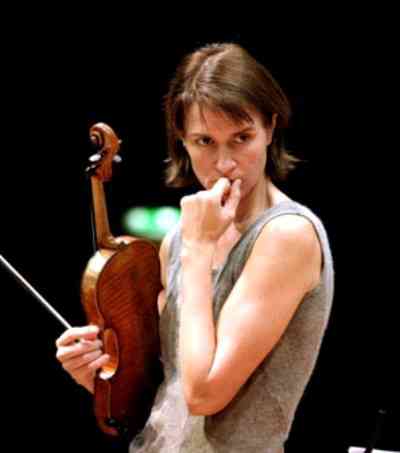
Primordial Thrownness of Interpretation: Viktoria Mullova, Katia Labèque, and the Aesthetics of Martin Heidegger

 Victoria Mullova, Katia Labèque, and Martin Heidegger nowhere in sight
I  n the space of such a music, listening to Heidegger’s silence, one must attend to the articulation of the needful connection between saying and thinking... the acoustic dimensionality. This is the silence that speaks between the words, between the lines: echoing as the ‘unsaid’ in what is said.”
  —  Babbette Babich, Words in Blood, Like Flowers, p. 11.
Viktoria Mullova and Katia Labèque will perform tomorrow evening (13-MAR-2008) at National Concert Hall, Dublin, as part of the Irish Times Celebrity Concert Series.
  • Stravinsky - Suite Italienne
  • Bartók - Hungarian Folk Tunes for violin and piano [arr. Joseph Szigeti]
  • Schubert - Fantasie in C Major D934
  • Ravel - Violin Sonata
Violinist Viktoria Mullova’s simultaneous devotion to historically-informed performance of Baroque music and to new music makes for some novel interpretations that merit your attention. Viktoria performs on either the ‘Jules Falk’ 1723 Stradivarius or her Guadagnini violin—and she elicits from these instruments beautiful sounds that the luthiers who created them could never have imagined. Viktoria’s recital partner, Katia Labèque, is a classically-trained pianist who regularly transgresses into jazz outings——and the pairing with Viktoria is a perfect match in terms of aesthetic sensibilities.

Their performance of Ravel’s Violin Sonata (the second movement is marked ‘Blues; Moderato’) is a case-in-point, incorporating as it does idiomatic 1920s Blues.

This is not iconoclasm for its own sake. It is not radical ‘look-ism’; it does respect the intentions of the composers and their respective periods/styles. And it draws attention to the fact that Early Music is not the only domain for historically-informed performance. Historically-informed performance is applied every day—to works from all epochs, including the Ravel and the Bartók and the Stravinsky, and including new music composed yesterday.

There is an immediacy and Heideggerian ‘thrownness’ in every musical interpretation, in every performance by every performer, no matter how scrupulous the attention to historical detail. Mullova’s and Labèque’s performance reminds me of this. Specifically, their accounts of the Ravel and of the Stravinsky remind me of this. Although relatively few passages in Heidegger’s books pertain directly to music, in his correspondence he did frequently express his esteem for Stravinsky’s and Ravel’s and Orff’s music. He was very fond of Trakl’s and Celan’s and Rilke’s poetry. Of painters, he was enthused about Van Gogh, Braque, Klee, and Cézanne.

T  he radical contingency of one’s thrownness and the inescapability of an ever-threatening death... This incompatibility is not a rational inconsistency or a failure to be rational enough. We are simply not in charge of whether care fails or not, or how to think our way into or out of such an experience. This ‘being-a-basis’ means never to have power over one’s own-most being from the ground up. This ‘not’ belongs to the existential meaning of thrownness. It is more primordial than any knowledge of it.”
  —  Robert Pippin, in Crowell & Malpas, Transcendental Heidegger, p. 209.
The interpretations are forged either by the arbitrary acts of a radically free human subject (‘decisionism’, the position of the early Heidegger) or by the equally arbitrary dispensations of the unrestricted power of Being, which is beyond the capability of human reason to comprehend (‘quietism’, the position of late Heidegger). Mullova’s and Labèque’s playing engages in such radical freedom.

Viktoria Mullova
W  here ‘projection’ grasps the future-directedness of a life happening, ‘thrownness’ refers to our being already enmeshed in a particular context. [Being] enmeshed in a particular historical culture predefines the range of possibilities of action that will make sense in my situation. ‘Dasein’ is always ahead of itself: it is a projection into the future insofar as its actions involve a commitment as to what sort of person it will be. What this means is that, in taking a stand on its own life, Dasein takes over some range of possibilities as definitive of its identity—some set of personality traits, lifestyles, roles, attitudes—and exists as a ‘being-toward’ the realization of a final configuration of possibilities. Heidegger calls this futurity the ‘bringing-itself-to-fruition’ (sich zeitigen) of Dasein. Everything we do contributes to making us people of a particular sort.”
  —  Charles Guignon, Companion to Heidegger, p. 278.
Whereas writing aims at a whole or ‘completed’ work, live performance of music spins and weaves, toward a work that is always inherently ‘incomplete’: the subjectivity of the performer/listener is far more prominent than the subjectivity of the reader. In writing, the whole, which is tremendously ‘present’ at each instant of the author’s writing, is being undone—to the author, the serial moments of creation constitute a pure ‘present’. But in music, to the composer (or improvising performer), the whole is not necessarily ‘present’ at once: in general, the conception is not as serial as writing—not now, not in Ravel’s time, not ever. In both [recorded] music and writing, I can go back and discover that the ‘text’ and its implications had [partly] eluded me on the first experience; I can revise and extend my interpretation. The [musical] text still is a coherent whole, but it has unraveled and reconstituted itself in my understanding of it and in its effects on me.

Victoria Mullova
P rojection stands in an essential relation to thrownness, to facticity, state-of-mind, and mood. In Heidegger’s ‘Being and Time’ the emphasis tends to be on the priority of disclosedness over concealment, of Truth over untruth, of projection over thrownness. There is an important sense in which the way ‘World’ is founded—in ‘Being and Time’, in the ecstatic unity of temporality—implies that World, as meaningful, is founded on that which, although it is the ‘meaning’ of the being of ‘being-there’, is not itself ‘meaningful’—originary temporality—and so the ‘being’ of being-there cannot be ‘uncovered’ [disclosed, unshielded] in the way that entities in-the-world can be uncovered since it is the ground of ‘being-uncovering’, of disclosedness.”
  —  Jeff Malpas, Heidegger’s Topology, p. 182.
Unshieldedness—the proximity of our venture into pure ‘draft’ and ‘re-writing’ in our mind, along with the performers and respecting the intentions of the composer—displaces the epochality of the work. Our interpretive unshieldedness undermines the epoch of the technological—of the violin and the piano and the idioms of the particular time when the piece was composed.

This venturing into serious ‘draft’ and ‘re-writing’ is a sort of safe-keeping that Heidegger wrote about in several of his philosophical essays: “The gravity of pure forces, the unheard-of center, the pure draft, the whole draft, full Nature, Life—they are the same” [Poetry, Language & Thought, p. 105].

 Victoria Mullova, photo Pucciariello
Honest interpretive thinking—in performance and in listening (and in conducting and music theory and criticism)—is a resistance of Desire, against Will (of others; of a self that is regulated by externalities). It’s a creative resistance that overcomes the resistance we naturally have to unshieldedness and responsibility. The easiest path would be to close-reading, scholarly reproduction and slavish historicism. But this would be to deny the incompleteness of the evidence upon which historically-informed performance can be based.

Mullova and Labèque give us careful, historically-informed performances—beautiful interpretations that honor the intentions of the composers—but ones that also reveal our own subjectivity, that compel us to the same sort of brave unshieldedness that they themselves espouse. Their approach produces a unique, ‘edgy’, introspective quality—a distinctive and impressive feature of their playing, in my opinion, but one that seems not to have been noticed or commented upon by others…

[Viktoria Mullova trained at the Moscow Conservatoire. In 1980, she won first prize at the Sibelius Competition in Helsinki, and her career in concertizing and recording has been prolific since that time. Since 2000 she has performed and toured with the Venice Baroque, Orchestra of the Age of Enlightenment, and Il Giardino Armonico. Her 2007 recording with Ottavio Dantone (harpsichord) of Bach sonatas on ONYX Classics won the Diapason D’Or. Performances in the coming weeks include several with Il Giardino Armonico and appearances with London Symphony Orchestra. Viktoria’s website has full details.]

 Victoria Mullova, photo Fair
A  ll of this is perfectly consistent with what I would call the average project of Romanticism... from the moment when the aim of the work is communal fusion, and when it seeks to evoke the vaguest metaphysical intuition—by, as it were, touching affect alone (emotion)—poetry becomes subservient to music. The metaphysicopolitical project of a new ‘myth’ therefore leads, in a pure paradox, to the secondary status of ‘saying’.”
  —  Phillippe Lacoue-Labarthe, Heidegger and the Politics of Poetry, p. 32.

Malpas book


Wednesday, December 5, 2007

Bronfman and Everest: Balakirev’s and Ravel’s Virtuosic Fantasies

Yefim BronfmanIn the U.S. the new season of DiscoveryChannel’s documentary, ‘Everest: Beyond the Limit’, is currently being broadcast as an ongoing series of television programs. Each episode shows climbers—young and old ones, highly-skilled ones and relative novices—risking their lives trying to reach the summit of Everest. Not surprisingly, the drama revolves around the steepest, riskiest, most hostile parts of the climb. We viewers feel a [morbid?] fascination with the ever-present possibility of catastrophe—a fascination equal to the admiration we feel for the climbers’ endurance and achievements and successes. The spectacle of the natural beauty that’s connected with the pursuit captivates us, too, as does the diversity of humankind when (self-) driven to these extremes——when (self-) driven to accept such suffering and risk, in pursuit of an extreme, world-class goal.

Everest
‘Summits’ of a different kind—musical comparables to Everest—are in store when pianist Yefim Bronfman performs on Friday evening in the Kansas City Friends of Chamber Music Master Pianists Series. The program includes Balakirev’s ‘Islamey’ and Ravel’s ‘Gaspard de la nuit’, among other works. The program requires a capacity to play these technically demanding works—prodigious athleticism—but never decoupled from the capacity to play with interpretive skill. In other words (and to paraphrase Stephen Pettitt, music critic of The Times in London), true virtuosity requires as much poetry as athleticism—or so Bronfman implies, in devising a program like this.

A  virtuoso is a musician who can play with panache a score of seemingly impossible technical difficulty... The north face of the Eiger has been conquered. The musician has, once again, triumphed over impossible adversity... A significant part of the musician’s craft has to do with the acquisition—through many hours, many years, of arduous, repetitive practice—of a very particular athleticism, one that enables the accurate playing of a large number of notes within a small amount of time while still making a pleasing sound. Virtuoso playing is a high-wire act, and the sensation it delivers to the audience similar. Surely he’s going to fall off at that speed, we think. When he gets to the other side intact we still think it a miracle. … Surely some dark magical force must be at work to enable such superhuman miracles of execution. … Indeed, is what seems like virtuoso playing necessarily that? Don’t misunderstand me. Even if its purpose is simply to thrill its audience, much as a particularly adroit footballer thrills with a piece of consummate skill, there’s nothing wrong with this showy variety of virtuosity. It’s fun to hear — and see — a violinist skate across a Paganini Caprice now and again. Yet it’s hardly a test of the most insightful musicianship. The player isn’t required to see between the notes, because between the notes there lies precisely nothing. There’s no insight into the human condition. No miracle of contrapuntal logic. Just a musician showing off his or her amazing skills. But maybe we should recognise more generously than we do the exercise of the inconspicuous brand of virtuosity... Virtuosity need not be a matter of playing lots of notes brilliantly at all. The truth is that all serious music worth the playing and singing, no matter how physically simple it might seem, requires a certain virtuosity of the mind. … Although the notes in Mozart might come relatively easily, the contextualising of them, the weighing of them, the nuancing of them, does not. Mozart demands such precision of touch, colour and phrase that an interpretation can fail on the slightest contextual faux pas. Moreover, it’s the performer who must find a personal context, since playing Mozart is no more a matter of choosing one correct way than is playing anything else. Control and freedom need to co-exist in perfect balance, so that the mysterious eloquence of the music is allowed to emerge, the player opening a window on to the soul of a miraculously gifted person. That is true virtuosity.”
  —  Stephen Pettitt.
In 1928, Ravel wrote, “ ‘Gaspard de la nuit’, piano pieces after Aloysius Bertrand, are three romantic poems of transcendental virtuosity.” Well, Mozart can be technically demanding, too—the two-part cadenza of the opening allegro of K 466, for example. But we usually think of the virtuosity required for Mozart as predominantly interpretive virtuosity. Similarly tough: revealing the emotion in Chopin without falling into cliché, or articulating the voices within Bach without being stilted and suppressing the emotion or creating a fugue-pastiche. Ravel’s ‘Gaspard de la nuit’ imposes demands that are simultaneously interpretive and technical/athletic——hideously, dauntingly so. Aloysius Bertrand’s prose-poems, ‘Gaspard de la nuit: Fantaisies à la manière de Rembrandt et de Callot’, were published posthumously in 1842 and re-issued in 1895, when Ravel’s friend Ricardo Viñes discovered them and introduced them to Ravel. Later Ravel returned to the poems and was captivated by their grotesque, hallucinatory imagery as an evocative subject for a piano composition.

And what about ‘Islamey’—composed in 1869 by Mily Balakirev, then 32 years old? The first theme is a folk dance from the Caucasus. The prevalent augmented seconds lend a south Asian ‘islamic’ aspect. The central section is lyrical and derives from an Armenian folk song. The slow, exotic middle section contrasts with the energetic outer parts. In the third section, Balakirev reprises the thematic material of the opening, culminating in a pyrotechnical coda. ‘Islamey’ is comprised of variations with increasingly, insanely, demonically complex elaborations. (Maybe we should note that Balakirev had a nervous breakdown in 1872, three years after composing this piece?) So our definition of ‘virtuosity’ gets worse: virtuosity is defiant and risky; it tempts fate; it scoffs at danger. It wouldn’t be virtuosic if catastrophe were impossible. You have to work without a safety net! (Balakirev punched out—became a railway clerk for awhile; worked as a school inspector until 1883; then returned to music as Director of the Imperial Chapel and conductor of the Imperial Musical Society, where he remained until retiring in 1895.)


I n music, no less than in athletics, audiences thrill at witnessing exceptional feats of physiological accomplishment, and they fête and reward those who
afford them such thrills.”
  —  Jane O’Dea, p. 40.
Everest
H e did not appeal to the emotions, except those of wonder—for his playing was statuesque, cold, beautiful, and so masterly that it was said of him, with reason, that he would play with the same care and finish if roused out of the deepest sleep in the middle of the night.”
  —  Sir Charles Halle, review of Thalberg, quoted in O’Dea, p.39.
In ‘Performance as an Extreme Occasion’, Edward Said writes that the contemporary concert is an extraordinary event, highly specialized and totally alienated from ordinary life. Before the mid-20th century performers were often also composers, and listeners were also often amateur musicians. Today the audience is marginalized. The specialized artist so ‘owns’ the work today! The recital has come to be an occasion for the display of extreme ability—on a level that’s totally alien to the listeners, most of whom are neither familiar with the scores nor play any instrument or sing. Their ‘regression of hearing’ (Adorno’s phrase) is manifested in “the listener’s poignant speechlessness as he/she faces an onslaught of such refinement, articulation and technique as almost to constitute a sado-masochistic experience.”

The audience has become more passive and concurrently we get this spectatorly cult of virtuosity. But why has social power recently captivated the imagination of popular culture—and academic anthropologists as well? Surely it’s not just a consequence of fewer practicing amateurs! Is it instead a society-wide reaction to our diminishing power as individuals? Is it a reaction to the decimation of social cohesiveness by the recent emergence of long-tailed, fragmented, web-based culture? Is it a backhanded way to oppose the ‘colonization’ of our selves—that is, an endorsement of and vicarious participation in demonstrations that individual victory over mass culture is still possible—more than gazing at an athlete/artist’s literal victory over physical difficulty?

Stanley Barrett asserts that the answer can be found in the effect of the past 100 years’ warfare throughout the world; the end of old colonialism and emergence of new forms of colonialism under the guise of multinational corporate globalization; the information and technology revolution, mass culture and cultural fragmentation. “The notion of a homogeneous, cohesive, geographically-bounded local culture consisting of people who share a putative common ancestry is obsolete,” he says. The diversity of distinctive cultures and identities “has become constricted, and ‘culture’ has become the new equivalent of ‘race’: difference-as-inferiority; new structures of exploitation and domination; new relations of power saturated with new possibility of inequality and disparities.”

I hope that hearing Bronfman perform on Friday may shed additional light on these issues. Me, I’ll be listening from a moderate elevation, at ‘Base Camp #3’!

T he question of the relationship of the individual person or subject to domination carries ‘resistance’ to the level of consciousness, subjectivity, intentionality, and identity.”
  —  Sherry Ortner, Anthropology and Social Theory: Culture, Power, and the Acting Subject.
Everest: Cairns (memorials to those who have died on the mountain)
[Mr. Bronfman was born in Tashkent, in the Soviet Union, on April 10, 1958. Bronfman immigrated to Israel with his family in 1973, and made his international debut two years later with Zubin Mehta and the Montreal Symphony. In Israel, he studied with pianist Arie Vardi, at the Samuel Rubin Academy of Music at Tel Aviv University. In the United States he studied at Juilliard and the Curtis Institute—with Rudolf Firkusny, Leon Fleisher, and Rudolf Serkin. He made his New York Philharmonic debut in May l978 and his New York recital debut in January 1982 at the 92nd Street Y. Bronfman became a U.S. citizen in 1989. In 2006, Bronfman partnered with Emanuel Ax in Mozart's ‘Concerto for Two Pianos’ conducted by Lorin Maazel. Early in 2007 he premiered Esa-Pekka Salonen’s Piano Concerto, written for him and commissioned by the New York Philharmonic. In addition to solo recital appearances, he recently served as the Pianist in Residence with the Berlin Philharmonic and completed recordings of all the Beethoven piano concerti and the Triple Concerto with violinist Gil Shaham and cellist Truls Mork with the Tönhalle Orchestra Zürich under David Zinman for the Arte Nova/BMG label. Bronfman is a “Perspectives” artist at Carnegie Hall during this 2007-08 season.]

Everest: Prayer Flags, Rocks, Fog