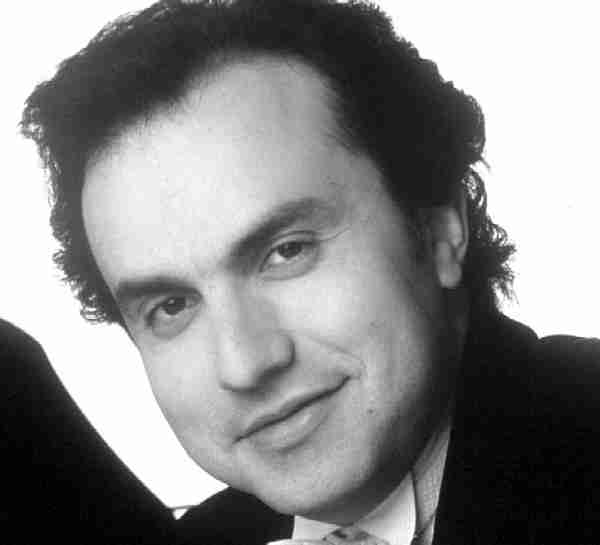
I t is not true that the entire evening will be as hard as you say. There is one easy part in tonight’s program. I think you call it the interval, the intermission?”There are many instances of virtuosic writing in these pieces and, with Yefim Bronfman, many instances of virtuosic playing. The profusion of dazzle makes apprehending the pieces even harder—we find ourselves wanting to press a ‘◄’ button and hear each passage again. Even the asynchrony in the second movement of the Beethoven Sonata No. 13 (Op. 27, No. 1) is texturally and rhythmically complex—it resists decomposition or deconstruction. But Bronfman’s account of Balakirev’s ‘Islamei’ may be the first time when I had to set aside the whole process of comprending the music, step back from it, throw up my hands and just marvel: How did he do that? ... Intricate sets of nonlinear relationships such that only certain aspects of them can be grasped at a time, to use Paul Cilliers’ phrase, defining complexity.
— Yefim Bronfman, jesting repartee with audience, in reply to Cynthia Siebert’s words introducing him, 07-DEC-2007, Kansas City.
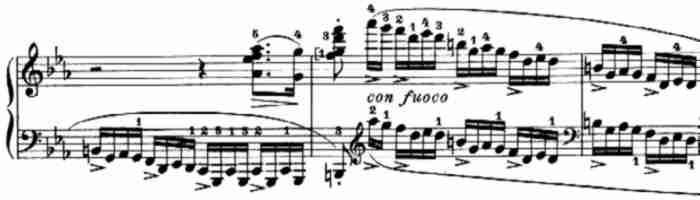
Look below — think of all the cognition and neurophysiology needed to absorb all that’s happening even in this short little introductory bit: the rhythmic and contrapuntal complexity, and how these link up so seamlessly with what has come before and what is yet to come, not only within these 6 bars but within the next 29 pages. I’m impatient, not a fan of protracted development. Very few composers can pull long thematic developments off gracefully and, even when they do, the listener thinks, ‘Okay, that was impressive, but — was it necessary?’ But with Yefim Bronfman the virtuosic passages not only ‘work’ — we glimpse how the passages are necessary to the expressive goals of the piece. We suspend our disbelief and immerse ourselves in the thing, and we take it to heart and rapidly accept the composer’s/Bronfman’s goals as our own.
I should like now to play something easy: Chopin… Now, Prokofiev, something that is, finally, easy… The Schumann Romance and Intermezzo: at last, easy!”
— Yefim Bronfman, remarks to audience, winking puckishly, prior to performing encores #1, #2, and #3 [Chopin Etude Op. 10 No. 12; Prokofiev, Finale from Sonata No. 7 Op. 83; and Schumann Op. 26, respectively], 07-DEC-2007, Kansas City.

How, then, would we measure virtuosity? Could musical virtuosity be quantified? I think the answer is ‘yes’. A good ‘virtuosity metric’ would not only be longitudinal—a velocity correlate of the number of notes per unit time. Velocity or longitudinal complexity is not enough to capture what we routinely mean by the word ‘virtuosic’.
Virtuosity is also related to the degree of rhythmic irregularity and vertical harmonic complexity and pitch span, the slew rate (how fast the span is traversed, in individual jumps; how long is the cumulative duration that such rapid jumps, hand-crossings, etc., are sustained), the jump rate (how many jumps per minute), the degree of multi-processing and rendezvousing between the parallel processes (in the right and left hands of the pianist, in regard to Bronfman’s playing), and the precision required in all of these moves. This last part—the precision—is important. It’s closely related to ‘system identification’: our intuitive ‘Can you detect a mistake or not?’ criterion.
In regard to these factors, I think ‘processual’ musical virtuosity (or a virtuosic composition) would be measured like complexity in nature is measured—and how it is mathematically measured in computer science: pi algebras, minimum description length, Hausdorff fractal measure, and Kolmogorov complexity measure. So far, only a few have looked at applying Kolmogorov complexity to music (Paul Vitányi; Ming Li; handful of others), but I think it will be a fruitful avenue to pursue further ...
A complex system is one that is thermodynamically open (participates in a matter and energy budget and exchange) and operates away from equilibrium. A complex system is one whose history matters; whose present and future behavior are, in part, determined by its past.”
— J. Ricard, Complexity and Dynamics of Life Processes.
C omplexity results from the interaction between the components of a system, and therefore complexity is manifested at the level of the system itself.”
— Gregoire Nicolis & Ilya Prigogine, Exploring Complexity.
A complex system is one in which there are far more possibilities than can be actualized.”
— Niklas Luhmann, Sociological Theory of Law.
It’s also related to philosophy-of-mind and artificial intelligence and Turing Machines and Searle’s Chinese Box: can a listener tell whether the performer hidden inside the machine/box is human or not? If the sounds emitted are implausibly complex in terms of their cognitive and motor nervous system implications and the composition is syntactically well-formed and precisely ordered, then we ordinarily deduce that the box may contain either a very good synthesizer and a very good software-driven sequencer attempting to deceive us to believing it is a live human, or it may contain a new super-human being whose virtuosic skill is simply beyond anything that we’ve ever before encountered or imagined. (I close my eyes and listen to Bronfman... My conclusion, especially in view of his casualness and humor, is that he must be super-human.)
(On the other hand, if a composition is implausibly complex but doesn’t consist of syntactically ‘well-formed’ expressions——is instead comprised of random sounds whose structure strikes us as arbitrary, chaotic, and imprecise, as, say, in a piece by the late Karlheinz Stockhausen——then we can’t make any such deduction.)

In the case of a human performer—Yefim Bronfman, last night—whose sounds, virtuosic in their precision and in their emotional aptness, were beyond our imagining, we experience a sublime sense of wonder: sheer wonderment at possibilities not thought to be humanly achievable. Virtuosity like this is empowering of all humankind. It doesn’t only redound upon the individual virtuoso. And that is really why we find it sublime. Our witnessing such virtuosity can be transcendent, in much the way that gazing through a large telescope on a clear cold night can be so … gazing abjectly into the chasm of possibility.
What I mean to say is that virtuosity and unearthly complexity are psychologically connected with the innate human drive for awe and spirituality. Tonight, Bronfman’s cosmic playing forced me to confront this fact.
K olmogorov complexity is a notion of randomness dealing with the quantity of information in individual objects; that is, pointwise randomness rather than average randomness as produced by a random source. Known as ‘descriptional complexity’, ‘shortest program length’, ‘algorithmic entropy’, and others. Martin-Loef tests for randomness and Gödel’s incompleteness are related to this.”
— Ming Li & Paul Vitanyi, Introduction to Kolmogorov Complexity and Its Applications.
T raditional wisdom has it that the better a theory compresses evidence, the better the theory predicts unknown data. With the advent of Kolmogorov complexity this was rigorously proved in a general setting. Making these ideas rigorous involves the length of the shortest effective description of an individual object: its Kolmogorov complexity. Ray Solomonoff invented the notion of universal prediction using Kolmogorov complexity-based universal distribution. Universal prediction is related to optimal effective compression.”
— Jorg Rothe, Complexity Theory and Cryptology.
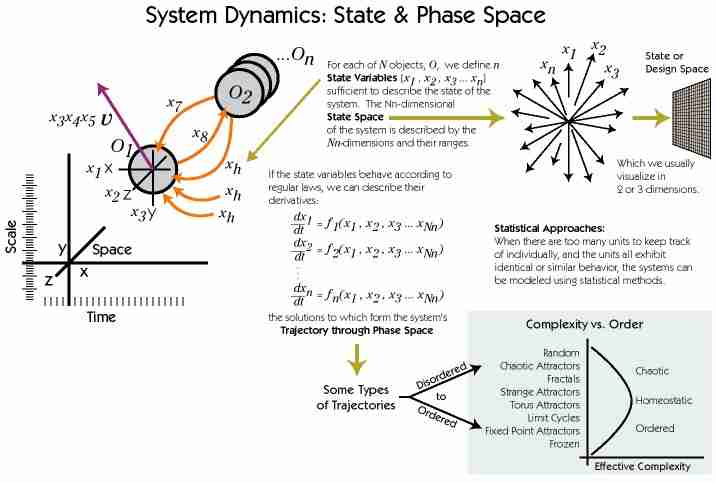
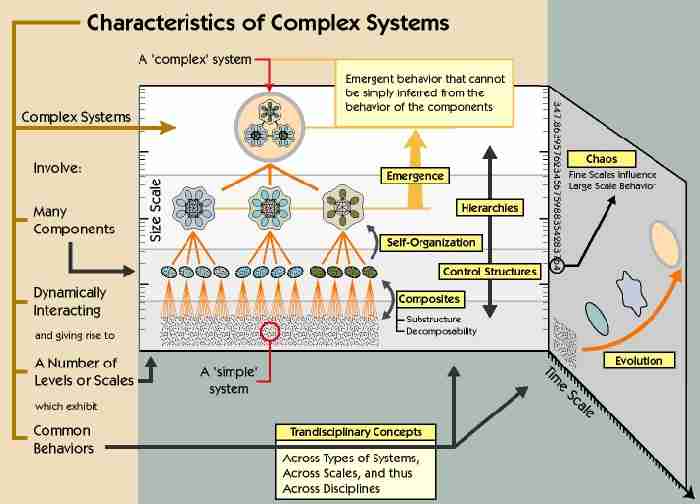
D efine it by example—societies, governments, corporations, the stock market, families, the body, an organ system, memory, a cell, an organelle, the weather, ecosystems, flow in a river, the snap of a whip: these are undeniably complex. Chief properties of such systems include: components, modularity, spatial dispersion, interactions among components across space and time, self-organization, multiple relevant spatial and time scales of formation and operation, diversity, instability, nonlinearity, variability, functional activities and the existence of objectives. The latter properties confer autonomy, anticipativeness, and adaptiveness. In other words, complexity admits of degrees and types.”
— Yaneer Bar-Yam. Dynamics of Complex Systems.
S ome systems have a very large number of components but can be analyzed in the full sense of the word. Such systems are merely complicated. Other systems are constituted by intricate sets of nonlinear relationships such that only certain aspects of them can be analyzed at a time. Such systems are properly termed complex.”
— Paul Cilliers, Complexity and Postmodernism.
D istinction between simple and complex is a function of our distance from the system.”
— Roberto Serra & Gianni Zanarini, Complex Systems and Cognitive Processes.
P eople stare contemplating the ocean as it swells and crashes on a rocky shore. They gaze fixedly into a fire until the sting of smoke raises their awareness. People lie on their backs and follow passing clouds or marvel at the glittering of the stars. There are many things that fascinate us, that mesmerize us, that cause us to forget ourselves and our situations as we become lost in a timeless appreciation. ...Kant introduces the dynamically sublime as relating to encounters with the ferocity of nature and the sense of vulnerability this entails, coupled with the triumph of reason over fear. And in his own writings on the sublime, Edmund Burke takes the view that the sensation of incomprehensibility, the fear of hopelessness, coupled with the knowledge that one is able to reason about something beyond one’s senses... causes a kind of delight through internal conflict: a sublime experience.”
— Alan Dorin, Wonder and The Sublime in Art and Nature, in Adamatzky & Komosinski, Artificial Life in Software.
- Yefim Bronfman website and discography
- Yefim Bronfman at Opus3 Artists management
- Adamatzky A, Komosinski M, eds. Artificial Life Models in Software. Springer, 2005.
- Auyang SY, Auyang SA. Foundations of Complex-System Theories: Economics, Evolutionary Biology and Statistical Physics. Cambridge Univ, 1999.
- Banzhaf W, Christaller T, Dittrich P, Kim J. Ziegler J, eds. Advances in Artificial Life: 7th European Conference, ECAL 2003, Dortmund, Germany, September 14-17, 2003. Springer, 2003.
- Bar-Yam Y. Dynamics of Complex Systems. Westview, 2003.
- Cilibrasi R, Vitanyi P, de Wolf R. Algorithmic Clusering of Music. ERCIM, 2003.
- Cilliers P. Complexity and Postmodernism. Routledge, 1998.
- Copeland B, ed. The Essential Turing: Seminal Writings in Computing, Logic, Philosophy, Artificial Intelligence, and Artificial Life. Oxford Univ, 2004.
- Garey M, Johnson D. Computers and Intractability: A Guide to the Theory of NP-Completeness. Freeman, 1979.
- Grünwald P. The Minimum Description Length Principle. MIT, 2007.
- Hemaspaandra L, Ogihara M. The Complexity Theory Companion. Springer, 2001.
- Jukna S. Extremal Combinatorics: With Applications in Computer Science. Springer, 2001.
- Kember S. Cyberfeminism and Artificial Life. Taylor&Francis/Kindle, 2007.
- Kristeva J. Powers of Horror. Columbia Univ, 1982.
- Li M, Vitanyi P. An Introduction to Kolmogorov Complexity and Its Applications. Wiley, 2007.
- Li M, Sleep R. Melody Classification Using a Similarity Metric Based on Kolmogorov Complexity. [1MB pdf]
- Luhmann N Sociological Theory of Law. Routledge, 1985.
- Mandelbrot B. The Fractal Geometry of Nature. Freeman, 1982.
- Nicolis G, Prigogine I. Exploring Complexity: An Introduction. Freeman, 1989.
- Randall M, Abbass H, Wiles J, eds. Progress in Artificial Life: Third Australian Conference, ACAL 2007 Gold Coast, Australia, December 4-6, 2007. Springer, 2007.
- Ricard J. Complexity and Dynamics of Life Processes. Elsevier, 1999.
- Rothe J. Complexity Theory and Cryptology. Springer, 2005.
- Serra R, Zanarini G. Complex Systems and Cognitive Processes. Springer, 1990.
- Watanabe O, ed. Kolmogorov Complexity and Computational Complexity. Springer, 1992.
- Wolfram S. Cellular Automata and Complexity. Westview, 2002.
- DSM. Bronfman and Everest: Balakirev’s and Ravel’s Virtuosic Fantasies. CMT, 05-DEC-2007.