A n oppressive government is more to be feared than a tiger or a beer.”
— Confucius
DSM: I was thinking about the way nationalism and internationalism work together in Dvorák’s chamber music.
CMT: Well, what about other Bohemians? Earlier Bohemians! What about nationalism and internationalism in the Baroque period? I am looking forward to master class week in Brandýs nad Labem from Saturday, 14 July, until Saturday, 21 July. Then the Ameropa Music Festival continues with two weeks of chamber music courses and concerts from Sunday, 22 July, through Sunday, 05 August, in Prague, Czech Republic. Vadim Mazo is Artistic Director, Jiří Havlík is Managing Director, and Ada Slivanská is Executive Director of Ameropa.
- Franz Benda
- Jan Ladislav Dusek
- Frantisek Xaver Brixi
- Bohuslav Matej Cernohorsky
- Jan Antonín Koželuh
- Jiří Ignác Linek
- Josef Mysliveček
- Jan Krtitel Vanhal
- Vaclav Vodicka
- Antonin Vranickys
- Jan Dismas Zelenka
Top composers of the Czech Baroque are—what—maybe Zelenka and Cernohorsky? And ‘Kantor’ meant ‘teacher’, not ‘choirmaster’ in 18th century Czech. Kind of changes the scope of what the content and demeanor of the job were, doesn’t it?
DSM: Zelenka came from Louňovice pod Blanikem, and studied music in Vienna and Italy. His style came to be emblematic of Czech music, far from the Italian orbit. His distinctive melodies are contrapuntal but are freely expanded, articulated in closed form,
da capo. Zelenka’s compositions were praised even by contemporaries like Telemann and J.S. Bach.
CMT: So why did this major Bohemian composer of the Baroque—known to and esteemed by Johann Sebastian Bach and others—get relegated to the heap of obscurity? Besides his Catholic liturgical music, he left some secular compositions, including six chamber sonatas, first published in the 1960s. We need more insights into Zelenka’s life. Possibly some light will be shed during this year’s Ameropa Festival.
DSM: Well, first of all, you’re asking about the life of a man who was a Catholic outsider in the Lutheran world of Saxony. The challenge piecing together his life is also tough because of damage from fires set in Dresden by the Austrians and Prussians in the seige of 1760, plus further damage in WWII, and then possible Soviet pilfering from the Dresden archives. Whole chunks of the Zelenka catalogue are missing. Manucripts are missing whole sections.
CMT: And, apparently, Zelenka didn’t leave much to start with, even for historians in his own time. He left no portrait; had no children; no students he was close to socially, to whom he confided his secrets and through whom they might’ve been passed on. He kept no known personal diary. Never married. Leaving so little behind makes the task of characterizing him or musicologically ‘placing’ him difficult.
 DSM:
DSM: Janice Stockigt has a nice recent book out, though. Dr. Stockigt weaves together a picture of life as a Bohemian child learning music, shows Zelenka maturation from Count Sporck’s orchestra to the Dresden hopfkappel. She shows the convoluted politics of the Dresden Court, the tensions between the Catholics who are tolerated for political reasons and the Lutheran majority who resent Papist influences in the Court. The Jesuits are dogging him throughout Zelenka’s life. Stockigt examines Zelenka’s music—analyzes its themes, its compositional technic, and its performance practices. We learn that Zelenka’s sponsor, Empress Maria Josepha, shielded him and, in return, Zelenka crafted works of devotion, dedicated to her. We also learn that G.P. Telemann attempted to publish Zelenka’s ‘Responsora’ at considerable risk to himself.
CMT: So the best composers of the time did value Zelenka’s music—even Lutherans who had no great love of Catholics in general and Jesuit-trained Catholics in particular.
DSM: Yes, and there is some evidence that J.S. Bach and Zelenka collaborated on Masses and other compositions at the Dresden Court. In Stockigt’s book we learn that Zelenka’s help was critical to the first performance of Bach’s B minor Mass.
CMT: What about music as a vehicle for nationalism, and as a means for transnational rapproachement as well? Nationalism today is a destructive force. But a century ago, nationalism exerted a more constructive influence, at least in the arts. Groups of European people unified by a common language or ethnicity were beginning to reject the political and cultural domination of Germany and Austria. They tried to emphasize the aspects of their local culture that set them apart from the big, oppressive empires. If they couldn’t have political autonomy, at least they could achieve artistic autonomy.
DSM: So, instead of guns, they armed themselves with folkmusic and dances. Dvorák was, strictly speaking, a native of Bohemia, the western non-Slovak part of what ultimately became Czechoslovakia. For centuries this region had been a pocketful of artistic treasures in the geopolitical overcoat of the Austrian empire. Because they were subjects of a cosmopolitan empire, Bohemian composers were fully aware of musical currents elsewhere in Europe. But they also wanted to develop their own musical identity, not merely follow the lead of dominant Germanic composers like Beethoven and Brahms.
So, while the more isolated Russian composers like Glinka and Mussorgsky were inventing their own novel forms as they went along, the Czechs were thoroughly grounded in standard patterns of European classical music.
CMT: Instead of tossing together free-form symphonic poems inspired by folk tales and events in local history, the Czechs could set to work incorporating folk elements into their symphonies and string quartets. Dvorák did write his share of symphonic poems inspired by Czech poetry and legends, but those were tactical and came late in his career.
DSM: Dvoràk began to use local song and dance forms in many of his trios, quartets and symphonies. One form he especially favored was the furiant, a dance in 3/4 time with the accent constantly shifting to a different beat. Another was the dumka, a ballad form that came from the Ukraine. A dumka usually opens in a dour mood, then has a sudden happy outburst. Desultory, counter-intuitive. Dvorák wrote a trio for violin, cello and piano in which each of the six movements is a dumka. The famous ‘Dumky,’ the plural of dumka.
CMT: Dvorák might have turned out to be little more than a footnote in music history texts if he’d relied on nationalism alone. That’s what happened to Russia’s Dargomizhsky, Poland’s Moniuszko and the Netherlands’ Diepenbrock. Beethoven and Brahms are regarded as ‘universal’ composers, because their music is abstract and supposedly appeals to everyone.
DSM: But, basically, Dvorák, like Grieg and Rimsky-Korsakov, was an eclectic composer whose composing techniques resembled the universalists. Strip away Dvorák’s nationalistic materials, and what you uncover is close to a Brahms, a univeralist. The two composers used a similar harmonic language, and were proponents of classical forms. Their chamber works use patterns similar to Mozart’s and Haydn’s. Hard to say that that sort of compositional borrowing was going on in Zelenka . . .
CMT: I’m especially intrigued to read Timothy Taylor’s new book on music and globalization. Beginning with a focus on musical manifestations of colonialism and imperialism, Taylor discusses how the “discovery” of the New World and the development of an understanding of self as distinct from the other, of “here” as different from “there,” was implicated in the development of tonality, a musical system which effectively creates centers and margins.
DSM: Marianne Franklin’s 2005 book touches upon some of the same concepts. And Tom Schoenbaum’s book. How music can change things, foster a multi-lateral solidarity. Out of cultural exchange can come shifts in international relations. In Schoenbaum’s anecdote (p. 25), it was a chamber music concert given by Moscow orchestral artists in Ann Arbor, Michigan, in the Fall of 1962, the Cuban Missile Crisis.
CMT: You know, globalization is eroding culture everywhere. Though not as well known as those from Plzen and Ceské Budejovice, the Prague beers were wonderful when I visited a few years ago. Unhappily, this is no longer the case. The ubiquitous Staropramen lagers have descended to the low standard of ‘international’ pilsner beers.
DSM: It’s the unfair way the Czech brewing industry was privatized, when the regional industries of the communist era were sold off. All the local breweries were then under a single private owner. In Prague, the three big breweries (Staropramen, Braník and Mestan) were in a single group, Prazské Pivovary, under one owner. By 1996, that owner was the British firm, Bass. And, when Bass decided to get out of brewing, the breweries passed to the Belgian multinational, Interbrew.
CMT: Interbrew isn’t the only transnational to have glommed onto the Czech brewing industry. SABMiller got almost half of the Czech market and immediately transferred production to plants they control in other countries, like Poland. That’s just the way globalists operate.
DSM: Most of the Czech Republic’s breweries have been obsessed with modernization—‘Lean’ manufacturing, ISO9000, conical fermenters and stainless steel lagering tanks. It’s as if they’re racing to see how quickly they can eradicate centuries of tradition.
CMT: But, conversely, the good economy there has enabled a healthy local reaction, like microbreweries and brewpubs. These now make up over 40% of all the breweries in the Czech Republic. They’re of negligible importance in terms of market share, but they’re thriving. More and more of them. There are at least 7 microbreweries scheduled to open during 2007 alone. So, before your visit, here are some things to contemplate. Beers are labeled according to their strength in ‘degrees plato’— 10°, 12°, and so on. This is similar system to the specific gravity system used in Britain. It refers to the sugar concentration in the wort before fermentation. It gives an approximate idea of the strength. This varies according to the degree of attenuation, or how much of the sugar has been converted into alcohol. Most Czech beers are between 10° and 13°, with a few special beers in the range 14° to 20°. Get yourself a copy of Evan Rail’s new book.
DSM: Na Zdravi! (To your health!) Kolik řečí znáš, tolikrát jsi člověkem! (You are as many times a human as the number of languages you know. )
CMT: Všude dobře, doma nejlépe! (Everywhere is fine, but at home it’s best.)
DSM: Kdo chce psa bít, hůl si vždycky najde! (Who wants to beat the dog will always be able to find the stick.)
CMT: Kdo si počká, ten se dočká! (He who waits shall live to see.)
DSM: Jak se do lesa volá, tak se z lesa ozývá! (The way you yell into a forest, the same way it will echo out.)
CMT: Děkuju! (Thank you!) Nazdar! (Cheers!)
K de se pivo vari, tam se dobre dari! (Where beer is brewed, they have it good.)”
— Czech proverb

- U Bulovky, Bulovka 17, 180 00 Praha 8
[Višňová pivo 4.8% 12°: Cherry lager. ]
- U Fleků, Křemencova 11, 110 00 Praha 1
[Flekovský ležák tmavỳ 5.5% 13°: Dark lager; brown with tan head; liquorice, raisin, roasted and cream aroma; bitterish finish with sweet coffee aromas. ]
- Klášterní Pivovar, Strahovské nádvoří 302/10, 118 00 Praha 1
[Svatý Norbert tmavỳ 5.5% 14°: Dark lager. ]
- Novoměstský Pivovar, Vodičkova 20, 110 00 Praha 1
[Novoměstský ležák světlý 4% 11°: Pale lager; dark in color for a pale lager; yeast, cream and vanilla in the mouth; finishes very bitter with hop and wood aromas. ]
- Pivovarský Dům, Lípová 15, 120 00 Praha 2
[Višňové pivo 5.2% 13°: Cherry lager; Světlý ležák 4.5% 11°: Pale lager; pepper and basil aroma; tobacco, pepper and resin aromas; bitter finish with mint, hops, spice and wood aromas; Kopřivové 4.5% 11°: Lager with nettles. ]
Y ou can’t be a real country unless you have a beer and an airline. It helps if you have some kind of a football team or some nuclear weapons, but at the very least you need a beer.”
— Frank Zappa

- Ameropa 14th Annual Chamber Music Festival, Prague.
- Janice Stockigt website, University of Melbourne
- Czech and Slovak Music Society, UCSB.
- Prague Conservatory website.
- Czech-Music.net (CzechMusicQuarterly publication; plus, just-released CD of new music)
- Supraphon record label (Prague).
- Prague Chamber Orchestra website.
- Bryan P, ed. Johann Vanhal: Six Symphonies. (A-R, 1985.)

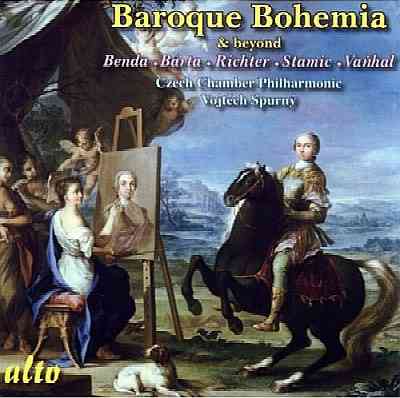
- Czech Philharmonic Chamber Orchestra. Baroque Bohemia & Beyond: Benda, Barta, Richter, Stamitz, Vanhal. (Musical Concepts, 2007.)
- Franklin M. Resounding International Relations: On Music, Culture and Politics. Palgrave, 2005.
- Janaki String Trio. Vanhal: Flute Quartets. (Naxos, 2007.)
- Musica Bohemica. Bohemian Baroque: Hammerschmidt, Otto, Muffat, Demantius, Krcek (Panton, 2005.)
- Prague Chamber Orchestra. Vanhal/Reicha: Bohemian Flute Concertos. (VMS, 2007.)
- Prague Chamber Orchestra. Myslivecek: Six Sinfonias. (Supraphon, 1994.)
- Rail E. Ultimate Beer Run in the Czech Republic. NYT, 06-AUG-2006.
- Rail E. Good Beer Guide Prague and the Czech Republic. CAMRA, 2007.
- Schoenbaum T. International Relations: The Path Not Taken. Cambridge Univ, 2006.
- Stiglitz J. Making Globalization Work. Norton, 2006.
- Stockigt J. Jan Dismas Zelenka: Bohemian Musician at the Court of Dresden. Oxford Univ, 2002.
- Taylor T. Beyond Exoticism: Western Music and the World. Duke Univ, 2007.
- European Beer Guide website
- CAMRA website
- Czech Beer Guide website