U eno’s concert music, writing for a variety of ensembles from chamber groups to orchestra, has been informed in significant ways by his experiences as a performer... Cultural resonances abound in his music; for example, the biwa and shakahuachi concerto Kaze-no-Oka (‘Hill of the Winds’) has an architectural basis, being inspired by buildings designed by Fumihiko Maki... [Japanese] ideograms are used as musical formants, the details of which can be extrapolated and recontexualized to create an organic, but continually changing, whole. Subjecting an acoustical object or objects to scrutiny using computer-based tools of timbral analysis, Ueno extracts details of its musical makeup, such as its prevailing frequencies and how that profile might change over time... What are the limits of perception? ... In Kaze-no-Oka, in addition to the architectural origin, the conceptual-musical idea is of the orchestral body as a reflection and amplification of the biwa (orchestral strings as ‘super-biwa’) and shakuhachi (bass sax and contrabass clarinet as ‘super-shakuhachi’).” — Robert Kirzinger, liner notes, Ken Ueno - BMOP ‘Talus’ CD.
I was relieved to hear that composer Ken Ueno’s parents, grandma, and other family members in Japan are okay following the quake and tsunami.
T hinking of them and others affected by Friday’s magnitude 8.9 temblor and hundreds of aftershocks, I put Ken’s CD ‘Talus’ on to play. I look at its CD jewelcase. It still bears this orange warning label:
I think: how big is the dynamic range in decibels of the music in this recording, to which the safety warning label refers? The quietest room on Earth (the old Sound 80 studio in Minneapolis) has an ambient sound pressure level (SPL) of -9.4 dB. And the latent SPL of the top-of-the-line audio signal path (microphones, cables, connectors, pre-amps, amps, EQ, digital recording media, audio workstations/mixing consoles, audio CD media, playback amplifier and EQ, monitors/headphones, tympanic membranes and ossicles in the ears, cochlea, Organ of Corti, spiral ganglion, and acoustic nerve, cranial nerve VIII) is about 3.1 dB RMS, at 2 KHz and 20 years of age.
T he corresponding minimum perceptible ambient vibration in the Earth is about -0.7 Richter, according to Thouvenot and Bouchon (see link, below).
T he biggest recorded earthquake was the Great Chilean Earthquake of 22-MAY-1960, which had a magnitude of 9.5 Richter. So, 10 times [9.5 minus -0.7] equals a perceptible dynamic range of 102 dB for maximum earthshaking ever, and 96 dB for Friday’s Japanese earthquake.
A nd the approximate maximum of dynamic range for playing this BMOP CD of Ken’s is about 96 dB on standard digital audio at 16-bit resolution and 44.1 KHz sampling rate, given the limits of CDs and available amplifier chains and monitors/headphones.
K en’s ‘Talus’ CD jewelcase orange warning label alerts us to acoustic SPL differences in his compositions that are basically comparable to the SPL differences of what people experienced in Japan on Friday, just in different ranges of frequency spectrum. [...Heeding orange warning label, turns volume down.]
[30-sec clip, BMOP, Ken Ueno, ‘Kaze-no-Oka’, 1.1MB MP3]
K en’s music is like koans... not a progression from pain to realization, or pain and loss as a reminder of realization. It is the lean-ness of the mind focusing on the present, consciously exerting energy in the face of difficult odds and adversity. Yamada Roshi: “When you stand up, there is only that standing-up in the whole world, with nothing sticking to it.” Ueno’s music is, like, “This! Just this!” ... something of a ‘last word,’ a rhetoric of pure experience. His compositions’ expression is without judgment, sort of a Zen-like “letting the Shodo calligraphy brush write whatever it wants,” but that does not mean that it is ‘acquiescing’ or accepting of the reality, the suffering that Nature dishes out, nor is it free from worry.
O ur thoughts go out to those in Japan and their families.
T he visit I had to Ripon, Wisconsin, over the weekend was notable for many things—among them an excellent amateur duet, by a violin student accompanied by her father on a musical saw. Recently, composer Ken Ueno has been interested in experimenting with bowed metal bars and sheets. This fortuitous (?gratuitous) coincidence led me to get the Stanley cross-cut saw out of my basement and explore what can be done.
A ny CMT readers who are interested in composing for musical saw should be aware that, as with any instrument, the dimensions of the material determine the pitch range that’s achievable. Almost any saw can produce musically usable sounds, but saws of 26 inches (66 cm) or longer are best. Such a length insures that the ‘sweet spot’—the lengthwise portion of the blade where a bow contacting the flat edge (not the side with the teeth) can set the blade into stable, resonant vibration—is relatively large... several centimeters long. Such a length also insures that flexing the blade in an ‘S’ shape to produce the desired pitches will not place excessive demands on the player’s left-hand strength.
T he majority of commercial woodworking handsaws are tempered carbon steel with a thickness of about 0.040 inches (1 mm). Saws that are specifically made for musical purposes (see links below) may be considerably thinner than this. The thin material allows the S-shape flexion to be achieved with less muscular effort. The preparation of the saw shape and tension before commencing the bow attack can be done more easily, compared to an ordinary commercial woodworking handsaw. The resulting intonation, vibrato, and overall musicality are undoubtedly better—with less performance risk and stress for the performer. (My own views below are informed by only cursory experience with a Stanley woodworking saw, motivated by curiosity about such an exotic instrument. Please accept these comments with a ‘grain of salt’; your own mileage may vary...)
[30-sec clip, Jim Parker, ‘Midsomer Murders Theme’, 0.9MB MP3]
T he majority of musical saws are capable of delivering pitches roughly in the range of a viola. Some 30-inch and larger saws are available and are labeled ‘bass’ or ‘baritone’, but most musical saws are evidently around 26 inches—‘tenor’ instruments. As such, it seems reasonable to score the saw using the alto clef—same as viola. The range in the illustration below represents safe limits for the Stanley hardware-store saw.
I f you decide to purchase a special ‘musical saw’, the backside edge will have been polished and prepared by the manufacturer in such a way as to be suitable to receive bow contact. I examined my Stanley crosscut saw with a magnifying glass and noted that there were some burrs along the backside edge—tiny, sharp projections that could easily damage or cut bowhairs. I removed these with a few strokes of emery cloth, followed by fine steelwool.
O rdinary amounts of rosin on the bow seem to work just fine with the saw. My own brief experiments were with a pernambuco violin bow—too delicate, really, for the 0.040-inch Stanley blade. My suspicion is that a cello bow would offer the stiffness needed to properly articulate the notes on a saw.
H olding the handle of the saw between the legs and jiggling the left leg to produce vibrato in the S-flexed saw is pretty easy. Flexing the blade with the left hand, however, is tricky and quite tiring unless you affix a handle through the hole near the tip of the blade—a technique referred to by saw players as a ‘cheat’. Acknowledging the deprecation of the ‘cheat’ by serious players and the visual aesthetic detractions of the ‘cheat’ for the audience, it seems to me that practical compositions for saw will limit the duration of saw passages to maybe one minute or less at a stretch. After a rest the saw player will have recovered the muscular control to proceed with a subsequent passage.
S urely there may be some virtuosic saw players for whom extended multi-minute passages would present few problems, and for whom the arduous gauntlet-running at prodigious tessitura would afford a proof of their freakish virtuosity. But a composer who wants to score for saw because of its wonderful, peculiar, Theremin-ish timbre ought, I think, to assume that such saw virtuosi are scarce as hens’ teeth. The typical saw artist will be a normal string player who is partial to odd and exotic things, and that sort of person will not care to (a) risk over-stress or injury to their left hand and its musculature, by the weird movements required for saw flexion, or (b) engage in extended practice and rehearsal on the metallic interloper, forsaking their belovèd stringèd axe. In other words, you’ll want to write modest stuff that’s playable without too much trouble.
T he technique of saw is similar to bowing a viola da gamba—underhanded—except for the fact that you are bowing more or less vertically. Like a viola, the saw’s size is somewhat at odds with its pitch range—too large to be comfortably played under the chin, yet smaller than would be ideal for playing between the legs. But, also like the viola, this size-pitch mismatch is probably the reason why we have such a highly distinctive, beautiful tone-color in the saw.
C hromatic passages are pretty easy to perform. Intervals of a major or minor third or perfect fourth can be navigated with little trouble. Fifths and longer jumps seem (to me) to be exceedingly risky. Safe writing for saw would stick with melodic lines—careful attention to voice-leading and no endangerment of the gristle.
T he top end of the saw has a quite distinct ‘nasal’ quality, which can be exploited for short, plaintive effects. The lower range has an apocalyptic, austere, dark sound. If you don’t like that, well, tough. (In fact, I feel that the weird, impending catastrophe demeanor of the saw down there is part of its psychological charm. It’s like a wise, dour octogenarian who perennially and insistently warns everyone in the room that there will inevitably be more serious trouble in the Middle East, no matter what the topic of conversation might be. This ‘wild card’ can have a wonderfully unsettling effect on the other party-goers. Just so with the musical saw...)
T he vibrato technique is basically the same as on the violin, though you may wish to indicate on your score that the performer may vibrate somewhat slower and wider in the lower register. A cautionary notation might be useful, to instruct the performer about the effect that you are aiming for. A musical saw has—What? I am shocked!—a propensity to bring out the ‘ham’; a simple admonishment that ‘less is more’ and that you are looking for ‘subtlety that defies temptation’ should be sufficient.
P ortamento and glissando can be readily executed on the saw—so okay to write those in your score. Obviously, trills or fingered tremolo effects are out of the question. There are no double-stops or triple-stops—at least not without severed digits or ripped trousers. Remember that the performer’s genitalia are facing the sharp teeth of the cross-cut. They (and their significant other) will long remember you if your writing is excessively ambitious.
D o not write sixteenth notes or thirty-second notes for the poor, ‘flickted thing. Doing so will win you no friends.
A rtificial harmonics? Well, my adventures in trying to produce them stopped when my dear spouse told me to “Cut it out!” I can only say that harmonics are in there, and that they will come out to play if you coax them. Touching the blade below the “S”, as the blade heads toward your lap can entice some spooky, scritchy, ethereal stuff out. Hard to control, though, so you may want to choose your practice environment more judiciously than I had done, so as not to tax your loved ones’ ears beyond their endurance...
E levations of the bow—pretty much the same as the viola da gamba, except that the excursions are more vertical. Considerable bow-speed is necessary. Maybe a right-arm “break-away sleeve” for the concert performer would be a practical solution, albeit one that would promote general “hamminess”. For studio work, the player may prefer to wear a comfortable tee-shirt...
B owed tremolo—quite effective on the saw. It has a sharp, biting effect in forte and a silken, decrepit effect in pianissimo, due to the tragic tone color of the instrument.
P izzicati are more resonant on saw than on the violin—a feature that worked wonderfully for the daughter-father duet in the Wisconsin recital last weekend. As with harmonics, the higher pizzicati are usually best left to the violins. Unless, that is, you want the thematically desultory effect of plunked saw rubbing the violin noses in “it”—an entirely valid possibility (You choose!) but more histrionic than would suit most commissions. After all, you do not want your saw opus to end your career.
A djectives in Italian applied to the saw must agree with it in gender (sola or sole, not solo or soli). Although it is the only instrument of the steel family in the feminine gender, it has probably the most masculine tone—Ueno’s bowed steel bar affixed to a timpani head notwithstanding.
O ccasional short solo passages for the saw can be of telling effect for orchestral music, although recent works tend to focus on chamber ensembles. I am not sure whether this is due to the saw’s fall from grace since the 1950s—a time when there were many thousands of saw players throughout North America.
T he solo repertory for saw is scanty—although transcriptions can be effected straightforwardly. Berlioz’s “Harold (‘The Saw’) in Italy”, for example. Or try William Walton or Walter Piston viola concerti.
L ike the viola, the saw is easily obscured or ‘covered’ by other instruments. And saws easily cover and confuse other saws. With that in mind, you will want in general to write open harmonies. Your orchestration should assiduously avoid unisons or minor seconds in the saw section. Do not, I repeat, do not write ‘tutti’ for saw.
I n the olden days there may have been up to eight saws in a symphony orchestra. They used to sit at the conductor’s right, upstage of the cellos, who would in this configuration be out of toothy-edged harm’s way should any slips occur amongst the saws. This was acoustically non-optimal insofar as the blades of the saws were in a particularly inefficient position for directing sound out to the audience. A large saw section is, I think it can now be agreed, extremely ill-advised. Probably it was a phenomenon of long-ago budgets and old union rules; maybe it was a consequence of the erratic sound projection next to the cellos; or maybe it was a marketing ploy by orchestras, leveraging the then-common amateur interest in playing saw as a parlour pastime. In any case, the chamber music idiom is far more reasonable for saw, and the saw is anyway properly a narrative/discursive force, not a ‘symphonic’ one. The era of the eight-saw orchestral section is thankfully now lost to living memory...
B e aware: the striking tone-color of the instrument, while pleasantly novel at first, can soon become cloying. Therefore, a program usually should have only one work for saw, to avoid wearing out one’s ‘welcome’. You are not aiming at a ‘comeback’ for the infamous musical saw of yesteryear! You are only seeking a nice effect with some diverting novelty, which everyone will afterwards say was just fine, yes it was, and amply justified, all things considered.
Y ou may occasionally be inclined to have saw doubling the violin(s). This will take away some of the violin’s brilliance and add weight—sometimes precisely what you want. Although unison doubling of cello by saw can be excellent, the continual doubling of the bass line an octave higher (because why? because you can’t think of anything better to do?) is a cardinal sin. The interest that can be given to inner parts can be given to the saw if you will only put your shoulder into the work. In fact, the saw player is temperamentally a lot like a good viola player and relishes exciting inner-part work as well as solos.
O n occasion, the saw may be propelled into a range higher than it is used to—to the thrill and abject bystanderly rubber-necker excitement of all concerned. Get it down from there; talk it down carefully. Tell it how deeply loved it is, and how jumping is not the answer...
R emember that the noble saw derives dignity from its sheer weirdness. People who choose to play the saw choose it because of its against-all-odds doggèdness and esoteric merits, and not because they are poor string players or too wicked or senile to play the violin.
T he saw is, quite clearly, amenable to the mounting of microphones or pick-ups for sound-reinforcement—especially for ensemble work in bars or other alternative venues. (My exploring that possibility will have to wait for some future CMT post.) But, as with other chamber music, the nuanced beauty is best appreciated in live, unamplified acoustic performance. Good luck with your bowed-metal instrument project, Ken!
[Be sure and click on the 'Comments' hyperlink in the lower left-hand corner below (if comments frame is not already open), to see Natalia Paruz's remarks!]
I think of the concerto in terms of a musical narrative … [unfolding] as a dialogue between the individual (represented by the solo) and the crowd.” — Martin Boykan, notes for Concerto for Violin & Orchestra, 2003.
The Boston Modern Orchestra Project BMOP presented a concert of new string concertos (plus Schoenberg’s 1933 concerto for string quartet and orchestra) last night at Jordan Hall in Boston, conducted by BMOP Artistic Director Gil Rose.
Martin Boykan: Concerto for Violin and Orchestra (Curtis Macomber, violin)
Robert Erickson: Fantasy for Cello and Orchestra (Rafael Popper-Keizer, cello)
Elliott Schwartz: Chamber Concerto VI: Mr. Jefferson (Charles Dimmick, violin)
Ken Ueno: Talus, Concerto for Viola and Orchestra (Wendy Richman, viola)
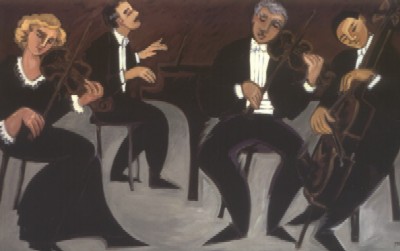
Arnold Schoenberg: Concerto for String Quartet and Orchestra
This exciting program reaffirmed that the concerto continues to thrive as an expressive idiom even today. These ingenious composers continue to find new ways to match the timbre and rhythmic and melodic capabilities of a solo instrument to the sonorities of an orchestra. The virtuosity of a concerto soloist always fascinates us; our appetite for soloists is boundless.
But it’s de rigeur in western cultures to focus on the soloist. What about the orchestra (vis à vis the Boykan blockquote above), the ‘society’ in which the soloist appears?
T here’s nothing wrong with interpreting concerto form socially. That’s not too subversive, interpreting this music in the context of these composers’ social views … Schwartz’s postmodernism; Erikson’s veganism; the inconstancy of Schoenberg’s quantum Judaism and regard for apocalypse; Boykan’s fascination with the textuality and temporality of everything; Ueno’s cheerful anarchism that considers anarchy as a ‘greenfield enterprise’.
Ueno says “Should justice and love not be observed also toward a stranger? The answer is that this, too, is according to a ‘just’ principle of public order, that regular citizens and subscribers are honored beyond outsiders and strangers, lest everything be uniform and ridiculously equal.” Honor the concerto soloist, then, but not in a topsy-turvy way that does injustice to ‘regular-anybody’ else.
There are indications in the music served up last night that each of these composers considers (and that the BMOP considers, as a matter consequent upon its charter and founding principles) the figuration of the orchestra in Ueno-ian conditional-egalitarian terms. (The Schwartz piece, explicitly ‘Jeffersonian’, in fact.) Their conceptions of the orchestra do not have to be understood as ‘representational art’—as literal depictions of contemporary society. Instead think of it this way: our social structures and story-telling processes come from certain habits of thinking, our predispositions, our political and moral stances. These habits and social processes and their consequences are (partly) what the composers—what these concertos—reveal.
I don’t imagine that these composers (or BMOP as sponsor-provocateur) advocate or foresee ‘revolutionary’ action against contemporary social hierarchies any more than Bach anticipated or agitated for revolutionary social justice with his concertos in Leipzig. These concertos are not tame, but they are accessible, listenable. But there can be little doubt that in last night’s concert Ueno, Schwartz, Erikson, Boykan, and Schoenberg ‘reminded’ the listeners and performers—of lively issues in controversial/revolutionary relations between the individual (‘soloist’; or, in Schoenberg’s case, ‘quartet’) and the society (orchestra) as a whole.
T he Ueno piece, for example, has toward the end of it a beautiful section where the viola part becomes immersed in the orchestral waves, and then the texture of the orchestra parts becomes progressively sparser until the solo viola once again emerges, pure and whole. This ‘restoration’ was elegant and convincing—indicating the resilience of the traumatized individual, so long as there is an effective social support network in operation, plus a modicum of good luck and good protoplasm that’s able to heal.
Reminded whom? These engaging concertos are works designed mostly for fellow new-musickers. Not historiographic time-capsules addressed to unknown future generations, nor narratives for audiences desiring to be told comfortable musical stories they already know oh so well, nor urgent pleas put in bottles and set afloat on distant seas against the improbable chance of discovery and rescue by somebody, anybody. No, these concertos are manifestos for the parties pro-tem, powerful incantations for new congregants already here.
One tendency defining the American works could, I think, be fairly labeled ‘classicism’. The ‘turn’ to traditional concerto form is a kind of classicism, and these works do each display a strong retrospective awareness, an historical consciousness. But they display this as Schoenberg did, believing in “Art as a profound instrument of ethical transportation and moral transformation”: we can_has futures that are really new, and we can go places really different from the past.
Now in its 13th year, BMOP provides a valued public service by aiding and abetting new, notorious, transportable and non-transportable things. What a wonderful start to the new 2008-2009 season! Bravo!
The next BMOP event is a Club Concert on 09-DEC-2008 (Tuesday, 19:00) at the Moonshine Room at Club Cafe Bistro & Lounge, 209 Columbus Ave, in Boston.
I n the spring of 2006, my friend Wendy Richman fell off the stage at MassMoCA during rehearsals for a David Lang opera, ‘Anatomy Theater’, and broke her ankle (the talus, tibia and fibula bones). [The opening of the concerto begins in a most surprising way (which I will not divulge here), before Wendy addresses her viola with the bow.] When Wendy sent around a jpg of her foot x-ray [by email to her friends], the horizontal lines of the bolts in her ankle immediately suggested harmonic possibilities to me. Some of the harmonies in this piece are, in fact, generated from spectral analysis that I did of the digitized x-ray. Seeing Wendy’s courage as she worked to recover from this severe injury reminded me of my mother’s courage during her recovery after tearing three ligaments in her knee from a skiing accident (I deferred a semester of college to take care of her during that time). My mother was determined go back and ski down the same hill in Park City where she was injured and accomplished this feat in two years’ time. A spectrogram that I made from the jpg of Wendy’s ankle x-ray is here:” — Ken Ueno, interview with David Bruce, CompositionToday.com, 29-OCT-2008.
A major focus of my work has been trying to reconcile the grammatological distance between ‘transportable’ and ‘non-transportable’ sounds. Transportable sounds are those elements that usually comprise the grammar of western music: rhythm, melody, and harmony. Non-transportable sounds are those sounds that have to be produced on a specific instrument in a specific way, which, in the West, have often been labeled as noise. Takemitsu’s compositions have helped to convince the world of the validity of non-transportable sounds, in that they are beautiful and worth listening to ... silence as expressive of the Japanese aesthetic principle of ‘ma’... I hope to have prepared the listener to focus on a [really] wide rubric of timbres.” — Ken Ueno, interview with Brian Sacawa, 2005.
T he history of music from Haydn to Mahler, via Beethoven and Wagner, was a narrative of obfuscation. The logical conclusion to all this was Schoenberg’s: harmonic form ceases to function, and the diatonic scale is no longer a reliable reference point. Each note is as important as the others, and this ideal is ensured by prohibiting the resounding of a pitch until its eleven colleagues have been allowed to speak. The Galileis, père and fils, are circumscribed: we’re out of orbit, we’ve escaped the pull of tonal gravity, we’re in the floating, directionless heaven of Schoenberg’s beloved Swedenborg. That was in 1908. He had converted to Lutheranism ten years before. He fled Christianity and returned to Judaism in 1933, when he composed the peculiar ‘Concerto for String Quartet and Orchestra’— the same year as he fled Berlin for Paris and, finally, Los Angeles.” — Joshua Cody, ‘10 + 5 = Gott’: Die Macht der Zeichen, 2004.
T he thesis of ‘violin in the age of shopping’ is that musical— ] content as a recognizable idea has anymore ceased to exist because all ‘the content’ has become interchangeable: it doesn’t matter what is going on, provided there is evidence that something is going on—a merely quantitative world of mass copies and fakes. All music—whatever its origin, status or supposed function—would now exist in a digital ‘dreamtime’ that the originators of ‘muzak’ could never have imagined.” — Jon Rose, Violin in the Age of Shopping.
J oseph Gingold was coaching a student string quartet at Indiana University. He noticed that the first violinist, in addition to the first-violin part on his stand, also had a heavily annotated score to which he referred frequently. Gingold, a marvelous violinist, genuinely decent person, and wonderful teacher, picked up the score and asked the first violinist, ‘What are these markings on the score?’ The violinist dutifully replied, ‘Mr. Gingold, I’m a double major, violin and theory. I wrote my analysis in the score.’ Gingold perused the score, closed it, put it down on a table on the other side of the room, and turned back to the quartet, ‘That’s a nice hobby. Now let’s get back to music.’ ”
DSM: At one point, at dinner last night with Josh Gindele, the cellist of the Miró Quartet, the conversation touched on interpretive spontaneity during performances. The emotional context, the ambience of the recital hall, how the players are feeling, what has happened to each of them in the days and minutes preceding a given performance, the mood of the audience telegraphed to the performers on the stage, the idiosyncrasies of the players’ well-traveled instruments—all of these things conspire to impart something unique and unexpected in each rendering of a piece.
CMT: Yes, Josh talked at length about this, and about his fascination with artists who have recorded multiple accounts of certain works over the span of their careers; about how their interpretations evolved over the years.
DSM: John Largess, the Miró Quartet’s violist, also said a bit about this at dinner. His comments, though, had more to do with broadly localizing the reading—had to do with establishing an overall conception of a piece when rehearsing or performing it. If performers choose one fingering, bowing, or tonguing over another; if composers use a chord because they ‘like’ it; if listeners respond to passages—in all these acts and decisions, I believe that they are doing what music theorists do. Performers may not realize that their choices of fingering or bowing are guided by analysis. But those choices do affect the projection of the music’s structure and voice, and they have the same interpretive force as any analytic notations that a theorist might apply.
CMT: Other musicians find many theorists off-putting because the theorists insist on setting the ground rules. They insist that the conversation will be conducted using a theoretical framework and abstruse idioms, and refuse to use kinesthetic frames of reference that other musicians use to address their interpretions and performance practice.
DSM: But the reason for that is not the theorists’ personalities, you know. There’s the relentless academic pressure on theorists to continually publish novel findings, things that lack any precedent in the theoretical literature. The compulsion to scholarly novelty is what often causes theory to neglect or run roughshod over performers’ and composers’ interpretations. The theorist opines as to how a piece should be projected in performance or how a composer must have conceived of it. This is what’s required to get published. As a result, most of the journal literature that relates analysis to performance presumes that we analyze a passage in such and such a way, and therefore performers should play it so as to project what the theorist found in it. The asymmetry of power and authority between theorists and other musicians is an inadvertent consequence, not of theorists’ alleged hubris, but of acadème and pressures on the theorists to survive. It’s the injustice that’s inherent in the system!
CMT: But if the conversation ever gets so far as performers or composer objecting to theorists’ performance directions, the theorist characteristically responds by asking them to provide an alternative analysis. That’s not hubris, but it can be offensive nonetheless. Rather than acquiesce to the theorist’s demand, the composer or performers reject the framing of the question, reject the presumption that the theorist should be the one choosing the language that shall be used to understand the piece. The conversation breaks down. More theorists need to find more appealing ways to engage with other musicians!
A doctoral student in Music Theory stood up and asked: ‘Mr. Crumb, I noticed in the opening flute vocalise that you use a gapped scale—that is, a scale with bunched semitones separated by augmented seconds and other larger intervals. I was wondering, was this an ethnic or exotic scale that you adopted or adapted, or did you invent it? And could you tell us about your motivations for using that scale?’ I sat quietly for a considerable time and then answered, ‘Well . . . I suppose one could consider it a scale . . . but I never did!’ ” — George Crumb with Da Capo Chamber Players, Carnegie Hall, after a 1973 performance of Voice of the Whale
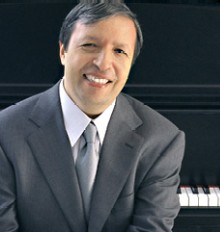
DSM: Murray Perahia is one of those rare concert artists who not only works out analyses but even admits it—admits that he’s a theorist as well as a performer. But it’s not clear how his performance is affected by his analysis and graphing of a piece—or that his performances of a piece are necessarily more consistent or homogeneous because of his analysis. His performance is informed by his analysis, no doubt. But it’s as if the analysis were just another form of rehearsal or practice for him, a meditation on the piece in anticipation of performing it, a critical consideration of the structure of it so as to more deliberately endow the performance with the voice it should have.
CMT: But the analysis-as-rehearsal doesn’t impair Perahia’s ability to make discoveries in each performance, doesn’t impair his freedom to deviate from his analytical assessment, doesn’t impair his realtime inspiration. Performers communicate musical structure through performance, not through words and graphs.
DSM: You’re right. You can hear Perahia continuing to make discoveries each time he encounters a piece, even ones that he has performed hundreds of times. You could hear Miró Quartet members continuing to make discoveries as they performed the Shostakovich Quartet No. 8 yesterday, even though they have performed it many, many times before.
CMT: But theorists are musicians. They make continuing discoveries, too, just like anybody else. And if the theorists’ discoveries are to achieve a deep and lasting relevance, they must, I think, find new ways of communicating with other musicians. They shouldn’t merely announce their positions, but should directly engage other musicians in matters of performance practice and interpretation. Nicholas Cook is one of the best examples of how to do this. Nicholas Cook’s essays on semiotics raise myriad questions of analysis and music theory, but they all suggest answers regarding how one might play or hear a piece differently.
DSM: Think about it: literary criticism these days no longer bears any relation to the reading of books. This is not the way it was 40 years ago. Just as much contemporary literary theorizing seems to have little to do with reading and writing, much of the music theory literature I read is not directed to creating, performing, and listening to music, even when those articles and books are deeply pertinent to those activities. Theorists should, I believe, communicate their discoveries in practical terms to performers, composers, and listeners. Literary critics and theorists should do that, too, as they did once upon a time. But it’s much more urgent that music theorists do this.
A theorist who held advanced degrees in both performance and theory remarked to me that he no longer wished to be called a performer. ‘Theory is a legitimate field that needs to be respected,’ he asserted, ‘and, by insisting on calling myself a theorist, I am making a statement.’ I replied, ‘Why not call yourself a musician?’ ” — Joel Lester, Mannes College of Music, New York
CMT: There is in what you’ve said about spontaneity and interpretation a focus on ‘particularity’ or individualism, of individual free-will—the ‘authorial’ voice of the individual composer or individual performer and his or her specific history. But there can be spontaneity that is transcendent and universal, that begs the question of individuality or even of humanity. The piece ‘all moments stop here and together we become every memory that has ever been’ (2003) is a 13-min work for 14 instruments and 15 hand-cranked music boxes. That’s a good example of universalist music. It was written by Ken Ueno for the Boston Modern Orchestra Project (Gil Rose, conductor). The title was borrowed from an artwork by Ugo Rondinone. The spaces between sounds are dramatic for me (“all moments stop here”). But the silences energize me, as a listener, to participate in each forthcoming sound, including the ones emitted by the music boxes. After the moment of greatest density, we arrive at a spectral world, embodied by the delicate cacophony of the music boxes. If you crank a music box very slowly, so that you isolate each note of a melody, the melody disappears. This happens even if the melody is one that is universally known (e.g. “Twinkle, twinkle little star,” “Row, row, row your boat,” “Happy Birthday”). You experience each note as a sound in itself, rather than as melody. Your mind also begins to “fill in” fleeting references to familiar tunes. Sometimes your mind, so hungry as it is to find familiar patterns, “fills in” with a reference that’s incorrect. And then as the music proceeds you notice that your “fill in” was wrong, but the music is continuing and you have no time to go back and revise or resolve the error. The river has flowed on. You go on in the ‘now’.
DSM: Additionally, if we experience a large collection of music boxes playing simultaneously, the melodic identity of each music box is buried in the aggregate sound. A society of music boxes. Within this aggregate sound, you “pick out” fragments of melodies, but you never completely grasp them. You abandon the conventional notion of composer-as-author, when the mass of sound that confronts your ears is caused by this pile of automata. This piece is not a despairing comment on our identity in a post-industrial digital world, though. It is not to say, “We are all music boxes. We are all genetically and culturally pre-conditioned automata. We labor in a deterministic world where creativity and moral responsibility are dead.” Instead, it’s a meditation on the perplexity of our society and the universe; on the protean voices whose different dialects and different paces and spatial and temporal isolation prevent them from resonating and interacting meaningfully or understanding each other; on the different dimensions of sentience of various life forms; on the timeless, cosmic “organism” that individual living beings including humans contribute to.
CMT: Ken is an Assistant Professor and Director of the Electronic Music Studios at the University Massachussetts Dartmouth. Previously, he was an Assistant Professor at the Berklee College of Music. As the character ‘DJ Moderne’ he has for some years hosted and produced a Boston-based weekly live half-hour public-access television show devoted to introducing new music and new music composers and performers to the public at large. He attended Berklee College of Music, where it was his first exposure to Bartók’s Fourth String Quartet that propelled him toward new music composition. After Berklee, he attended Boston University, Yale, and Harvard. His teachers have included John Bavicchi, Bernard Rands, and Mario Davidovsky.
I didn’t work out the analytical relations among any of those chords! Analysis did not precede or accompany the writing. I just put down the sounds that I liked!” — Miriam Gideon, upon finding out that a composer/theorist was spuriously using pitch-class set analysis to parse one of her works
DSM: Even with someone like Ken Ueno, though, you still want to focus on live performance, the live narrative, the spontaneous authenticity of it. One criticism that Charles Rosen has made is that the obsession with ‘authentic performance’ has depended very heavily on the recording industry. This results from two factors, for older music anyhow. First, the lower volume of authentic performance instruments means they tend to be ineffective in large modern concert halls, so that live performance is difficult to sustain financially. The same could be said for 100 music boxes or 100 metronomes. Second, the unstable intonation and lesser reliability of early instruments means that a high-quality performance is most feasible in the recording studio, where multiple takes can be spliced together to iron out mistakes, and it is possible to interrupt the music frequently to retune the instruments. Totally impossible in a recital hall. A musical culture based predominantly on recordings is arguably an expressively impoverished one, compared to listeners gathered together in a recital hall responding intensely to a live performance. Miró Quartet’s performance yesterday of the Shostakovich Quartet No. 8 for the audience of several hundred kids; the kids’ rapt involvement in the work! Everyone in that hall was changed, transformed by the work, by Miró’s rendering of it, by the interactions among everyone who was present.
Somfai L. Idea, Notation, Interpretation: Written and Oral Transmission in Bartok’s Works for Strings. Studia Musicologica Academiae Scientiarum Hungaricae, Vol. 37, Fasc. 1, Proceedings of the International Bartok Colloquium, Szombathely, July 3-5, 1995. Part II, pp. 37-49.
Thompson W. ‘Composer-specific Aspects of Musical Performance: An Evaluation of Clynes’ Theory of Pulse for Performances of Mozart and Beethoven.’ Music Perception 1989;7:15-42.

 I think: how big is the dynamic range in decibels of the music in this recording, to which the safety warning label refers? The quietest room on Earth (the old Sound 80 studio in Minneapolis) has an ambient sound pressure level (SPL) of -9.4 dB. And the latent SPL of the top-of-the-line audio signal path (microphones, cables, connectors, pre-amps, amps, EQ, digital recording media, audio workstations/mixing consoles, audio CD media, playback amplifier and EQ, monitors/headphones, tympanic membranes and ossicles in the ears, cochlea, Organ of Corti, spiral ganglion, and acoustic nerve, cranial nerve VIII) is about 3.1 dB RMS, at 2 KHz and 20 years of age.