J oseph Gingold was coaching a student string quartet at Indiana University. He noticed that the first violinist, in addition to the first-violin part on his stand, also had a heavily annotated score to which he referred frequently. Gingold, a marvelous violinist, genuinely decent person, and wonderful teacher, picked up the score and asked the first violinist, ‘What are these markings on the score?’ The violinist dutifully replied, ‘Mr. Gingold, I’m a double major, violin and theory. I wrote my analysis in the score.’ Gingold perused the score, closed it, put it down on a table on the other side of the room, and turned back to the quartet, ‘That’s a nice hobby. Now let’s get back to music.’ ”DSM: At one point, at dinner last night with Josh Gindele, the cellist of the Miró Quartet, the conversation touched on interpretive spontaneity during performances. The emotional context, the ambience of the recital hall, how the players are feeling, what has happened to each of them in the days and minutes preceding a given performance, the mood of the audience telegraphed to the performers on the stage, the idiosyncrasies of the players’ well-traveled instruments—all of these things conspire to impart something unique and unexpected in each rendering of a piece.
CMT: Yes, Josh talked at length about this, and about his fascination with artists who have recorded multiple accounts of certain works over the span of their careers; about how their interpretations evolved over the years.
DSM: John Largess, the Miró Quartet’s violist, also said a bit about this at dinner. His comments, though, had more to do with broadly localizing the reading—had to do with establishing an overall conception of a piece when rehearsing or performing it. If performers choose one fingering, bowing, or tonguing over another; if composers use a chord because they ‘like’ it; if listeners respond to passages—in all these acts and decisions, I believe that they are doing what music theorists do. Performers may not realize that their choices of fingering or bowing are guided by analysis. But those choices do affect the projection of the music’s structure and voice, and they have the same interpretive force as any analytic notations that a theorist might apply.
CMT: Other musicians find many theorists off-putting because the theorists insist on setting the ground rules. They insist that the conversation will be conducted using a theoretical framework and abstruse idioms, and refuse to use kinesthetic frames of reference that other musicians use to address their interpretions and performance practice.
DSM: But the reason for that is not the theorists’ personalities, you know. There’s the relentless academic pressure on theorists to continually publish novel findings, things that lack any precedent in the theoretical literature. The compulsion to scholarly novelty is what often causes theory to neglect or run roughshod over performers’ and composers’ interpretations. The theorist opines as to how a piece should be projected in performance or how a composer must have conceived of it. This is what’s required to get published. As a result, most of the journal literature that relates analysis to performance presumes that we analyze a passage in such and such a way, and therefore performers should play it so as to project what the theorist found in it. The asymmetry of power and authority between theorists and other musicians is an inadvertent consequence, not of theorists’ alleged hubris, but of acadème and pressures on the theorists to survive. It’s the injustice that’s inherent in the system!
CMT: But if the conversation ever gets so far as performers or composer objecting to theorists’ performance directions, the theorist characteristically responds by asking them to provide an alternative analysis. That’s not hubris, but it can be offensive nonetheless. Rather than acquiesce to the theorist’s demand, the composer or performers reject the framing of the question, reject the presumption that the theorist should be the one choosing the language that shall be used to understand the piece. The conversation breaks down. More theorists need to find more appealing ways to engage with other musicians!
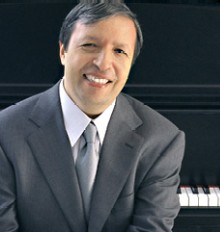
A doctoral student in Music Theory stood up and asked: ‘Mr. Crumb, I noticed in the opening flute vocalise that you use a gapped scale—that is, a scale with bunched semitones separated by augmented seconds and other larger intervals. I was wondering, was this an ethnic or exotic scale that you adopted or adapted, or did you invent it? And could you tell us about your motivations for using that scale?’ I sat quietly for a considerable time and then answered, ‘Well . . . I suppose one could consider it a scale . . . but I never did!’ ”DSM: Murray Perahia is one of those rare concert artists who not only works out analyses but even admits it—admits that he’s a theorist as well as a performer. But it’s not clear how his performance is affected by his analysis and graphing of a piece—or that his performances of a piece are necessarily more consistent or homogeneous because of his analysis. His performance is informed by his analysis, no doubt. But it’s as if the analysis were just another form of rehearsal or practice for him, a meditation on the piece in anticipation of performing it, a critical consideration of the structure of it so as to more deliberately endow the performance with the voice it should have.
— George Crumb with Da Capo Chamber Players, Carnegie Hall, after a 1973 performance of Voice of the Whale

CMT: But the analysis-as-rehearsal doesn’t impair Perahia’s ability to make discoveries in each performance, doesn’t impair his freedom to deviate from his analytical assessment, doesn’t impair his realtime inspiration. Performers communicate musical structure through performance, not through words and graphs.
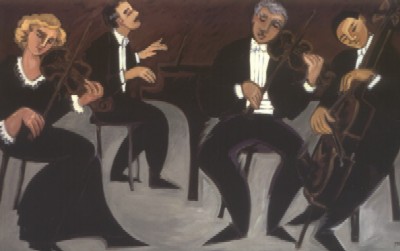
DSM: You’re right. You can hear Perahia continuing to make discoveries each time he encounters a piece, even ones that he has performed hundreds of times. You could hear Miró Quartet members continuing to make discoveries as they performed the Shostakovich Quartet No. 8 yesterday, even though they have performed it many, many times before.
CMT: But theorists are musicians. They make continuing discoveries, too, just like anybody else. And if the theorists’ discoveries are to achieve a deep and lasting relevance, they must, I think, find new ways of communicating with other musicians. They shouldn’t merely announce their positions, but should directly engage other musicians in matters of performance practice and interpretation. Nicholas Cook is one of the best examples of how to do this. Nicholas Cook’s essays on semiotics raise myriad questions of analysis and music theory, but they all suggest answers regarding how one might play or hear a piece differently.
DSM: Think about it: literary criticism these days no longer bears any relation to the reading of books. This is not the way it was 40 years ago. Just as much contemporary literary theorizing seems to have little to do with reading and writing, much of the music theory literature I read is not directed to creating, performing, and listening to music, even when those articles and books are deeply pertinent to those activities. Theorists should, I believe, communicate their discoveries in practical terms to performers, composers, and listeners. Literary critics and theorists should do that, too, as they did once upon a time. But it’s much more urgent that music theorists do this.
A theorist who held advanced degrees in both performance and theory remarked to me that he no longer wished to be called a performer. ‘Theory is a legitimate field that needs to be respected,’ he asserted, ‘and, by insisting on calling myself a theorist, I am making a statement.’ I replied, ‘Why not call yourself a musician?’ ”
— Joel Lester, Mannes College of Music, New York

CMT: There is in what you’ve said about spontaneity and interpretation a focus on ‘particularity’ or individualism, of individual free-will—the ‘authorial’ voice of the individual composer or individual performer and his or her specific history. But there can be spontaneity that is transcendent and universal, that begs the question of individuality or even of humanity. The piece ‘all moments stop here and together we become every memory that has ever been’ (2003) is a 13-min work for 14 instruments and 15 hand-cranked music boxes. That’s a good example of universalist music. It was written by Ken Ueno for the Boston Modern Orchestra Project (Gil Rose, conductor). The title was borrowed from an artwork by Ugo Rondinone. The spaces between sounds are dramatic for me (“all moments stop here”). But the silences energize me, as a listener, to participate in each forthcoming sound, including the ones emitted by the music boxes. After the moment of greatest density, we arrive at a spectral world, embodied by the delicate cacophony of the music boxes. If you crank a music box very slowly, so that you isolate each note of a melody, the melody disappears. This happens even if the melody is one that is universally known (e.g. “Twinkle, twinkle little star,” “Row, row, row your boat,” “Happy Birthday”). You experience each note as a sound in itself, rather than as melody. Your mind also begins to “fill in” fleeting references to familiar tunes. Sometimes your mind, so hungry as it is to find familiar patterns, “fills in” with a reference that’s incorrect. And then as the music proceeds you notice that your “fill in” was wrong, but the music is continuing and you have no time to go back and revise or resolve the error. The river has flowed on. You go on in the ‘now’.
DSM: Additionally, if we experience a large collection of music boxes playing simultaneously, the melodic identity of each music box is buried in the aggregate sound. A society of music boxes. Within this aggregate sound, you “pick out” fragments of melodies, but you never completely grasp them. You abandon the conventional notion of composer-as-author, when the mass of sound that confronts your ears is caused by this pile of automata. This piece is not a despairing comment on our identity in a post-industrial digital world, though. It is not to say, “We are all music boxes. We are all genetically and culturally pre-conditioned automata. We labor in a deterministic world where creativity and moral responsibility are dead.” Instead, it’s a meditation on the perplexity of our society and the universe; on the protean voices whose different dialects and different paces and spatial and temporal isolation prevent them from resonating and interacting meaningfully or understanding each other; on the different dimensions of sentience of various life forms; on the timeless, cosmic “organism” that individual living beings including humans contribute to.

CMT: Ken is an Assistant Professor and Director of the Electronic Music Studios at the University Massachussetts Dartmouth. Previously, he was an Assistant Professor at the Berklee College of Music. As the character ‘DJ Moderne’ he has for some years hosted and produced a Boston-based weekly live half-hour public-access television show devoted to introducing new music and new music composers and performers to the public at large. He attended Berklee College of Music, where it was his first exposure to Bartók’s Fourth String Quartet that propelled him toward new music composition. After Berklee, he attended Boston University, Yale, and Harvard. His teachers have included John Bavicchi, Bernard Rands, and Mario Davidovsky.
I didn’t work out the analytical relations among any of those chords! Analysis did not precede or accompany the writing. I just put down the sounds that I liked!”DSM: Even with someone like Ken Ueno, though, you still want to focus on live performance, the live narrative, the spontaneous authenticity of it. One criticism that Charles Rosen has made is that the obsession with ‘authentic performance’ has depended very heavily on the recording industry. This results from two factors, for older music anyhow. First, the lower volume of authentic performance instruments means they tend to be ineffective in large modern concert halls, so that live performance is difficult to sustain financially. The same could be said for 100 music boxes or 100 metronomes. Second, the unstable intonation and lesser reliability of early instruments means that a high-quality performance is most feasible in the recording studio, where multiple takes can be spliced together to iron out mistakes, and it is possible to interrupt the music frequently to retune the instruments. Totally impossible in a recital hall. A musical culture based predominantly on recordings is arguably an expressively impoverished one, compared to listeners gathered together in a recital hall responding intensely to a live performance. Miró Quartet’s performance yesterday of the Shostakovich Quartet No. 8 for the audience of several hundred kids; the kids’ rapt involvement in the work! Everyone in that hall was changed, transformed by the work, by Miró’s rendering of it, by the interactions among everyone who was present.
— Miriam Gideon, upon finding out that a composer/theorist was spuriously using pitch-class set analysis to parse one of her works
- Miro Quartet website
- Murray Perahia website
- Ken Ueno website
- Ken Ueno 'All Moments' [18 MB mp3]
- Ken Ueno 'All Moments' performance notes
- Performance Practice Review journal website
- Bazzana K. Glenn Gould: The Performer in the Work. Clarendon Press, 1997.
- Cone E. Musical Form and Musical Performance. Norton, 1968.
- Cook N. ‘Analyzing Performance, and Performing Analysis’ in Rethinking Music, Cook N, Everist M, eds. Oxford Univ, 2006.
- Cumming N. The Sonic Self: Musical Subjectivity and Signification. Indiana Univ, 2001.
- Davies S. Musical Works and Performances: A Philosophical Exploration. Oxford Univ, 2001.
- Deutsch D, ed. The Psychology of Music. Academic,1982.
- Dorian F. The History of Music in Performance: The Art of Musical Interpretation from the Renaissance to our Day. Greenwood, 1981.
- Hatten R. Interpreting Musical Gestures, Topics, And Tropes: Mozart, Beethoven, Schubert. Indiana Univ, 2004.
- Kendall R, Carterette E. ‘The Communication of Musical Expression.’ Musical Perception 1990;8:129-164.
- Kivy P. Authenticities: Philosophical Reflections on Musical Performance. Cornell Univ, 1998.
- Klein M. Intertextuality In Western Art Music. Indiana Univ, 2004.
- Krausz M. The Interpretation of Music: Philosophical Essays. Oxford Univ, 1995.
- Lidov D. Is Language a Music?: Writings on Musical Form and Signification. Indiana Univ, 2004.
- Lochhead J. Postmodern Music/Postmodern Thought. Garland, 2000.
- Lochhead J. ‘Performance Practice in the Indeterminate Works of John Cage.’ Performance Practice Review 1994; 7:233-41.
- Moelants D. ‘Statistical Analysis of Written and Performed Music. A Study of Compositional Principles and Problems of Coordination and Expression in Punctual Serial Music.’ J New Music Research 2000; 29:37-60.
Narmour E. The Analysis and Cognition of Melodic Complexity: The Implication-Realization Model. Univ Chicago, 1992. - Narmour E, Solie R, eds. Explorations in Music, the Arts, and Ideas. Pendragon, 1988.
- Nattiez J. Music and Discourse. Princeton Univ, 1990.
- Parks R. ‘Structure and Performance: Metric and Phrase Ambiguities in the Three Chamber Sonatas’ in Debussy in Performance, Briscoe J, ed. Yale University Press, 1999, pp. 193-224.
- Requin J, ed. Attention and Performance. Lawrence Erlbaum, 1984.
- Rink J, ed. Practice of Performance: Studies in Musical Interpretation. Cambridge Univ, 2004.
- Rink J. Musical Performance: A Guide to Understanding. Cambridge Univ, 2003.
- Rosen C. Critical Entertainments. Harvard Univ, 2000.
- Shaffer L. ‘Musical Performance as Interpretation.’ Psychology of Music 1995; 23:17-38.
- Sloboda J, Aiello R, eds. Musical Perceptions. Oxford Univ, 1994.
- Sloboda J, ed. Generative Processes in Music. Clarendon, 1988.
- Sloboda J. The Musical Mind. Clarendon, 1986.
- Somfai L. The Keyboard Sonatas of Joseph Haydn: Instruments and Performance Practice, Genres and Styles. Univ Chicago, 1995.
- Somfai L. Idea, Notation, Interpretation: Written and Oral Transmission in Bartok’s Works for Strings. Studia Musicologica Academiae Scientiarum Hungaricae, Vol. 37, Fasc. 1, Proceedings of the International Bartok Colloquium, Szombathely, July 3-5, 1995. Part II, pp. 37-49.
- Spitzer M. Metaphor and Musical Thought. Univ Chicago, 2003.
- Tanguiane A. ‘Analytical Approach to Performance Interpretation’ in Computer Representations and Models in Music, Marsden A, Pople A, eds. Academic, 1992, pp. 121-141.
- Tarasti E. Signs of Music: A Guide to Musical Semiotics. de Gruyter, 2003.
- Tarasti E. Existential Semiotics. Indiana Univ, 2001.
- Tarasti E. A Theory of Musical Semiotics. Indiana Univ, 1994, pp 193-208.
- Tarasti E. Snow, Forest, Silence: The Finnish Tradition of Semiotics. Indiana Univ, 1999.
- Taruskin R. Text and Act. Univ California, 1995.
- Thompson W. ‘Composer-specific Aspects of Musical Performance: An Evaluation of Clynes’ Theory of Pulse for Performances of Mozart and Beethoven.’ Music Perception 1989;7:15-42.