Showing posts with label iraq. Show all posts

Saturday, April 4, 2009

David Behrman and Chamber Music Storytelling

 David Behrman
I    have seen and endured the sufferings... and I can no longer be a party to prolonging those sufferings for ends which I believe to be evil and unjust... I am not protesting against the military conduct of the War, but against the political errors and insincerities for which the fighting troops are being sacrificed.”
  —  Siegfried Sassoon, Statement against the War, 1917.
T his is maybe the best, most eloquent and moving, most beautiful anti-war music I have ever heard. It is also a work that vividly illustrates the powerful narrativity that chamber music can embody. And I am not just referring to the concrete textuality of the poems and excerpts of private correspondence that engage in dialogues with the instrumental parts; I am referring also to the ways that David Behrman treats the vocal parts as instruments per se, and the ways that the composition reveals the inherent narrativity of the instrumental parts.

    My Dear Siegfried (2003 and 2005)
  • Statement against the War, London, 1917
  • My Father’s Grocery Store, Worcester, MA, 1902
  • Watercress Well, Kent, England, 1902
  • Letter from Samuel Behrman (to Siegfried Sassoon), 22-AUG-1939
  • Letter from Siegried Sassoon (to Samuel Behrman), 01-SEP-1939
  • Everyone Sang (Siegfried Sassoon) 1919
T hese ‘movements’ are performed by Thomas Buckner, Eric Barsness, Meria Ludovici, vocalists; Ralph Samuelson, shakuhachi; Peter Zummo, trombone; David Behrman, keyboard, electronics; and Tom Hamilton, engineering, special effects.

S tatement against the War’ (6:42) has a punctate bass line, sometimes processed to increase the unison-width. Like a piano, to change the timbre or color of the sound, a piano tuner introduces small tuning differences between the three strings struck by the hammer. The unison width, that is, the difference between the lowest and the highest frequency produced by the three strings of a single note is usually narrow, but, in the case of ‘honky-tonk’ piano, may be very wide. Here the plucked bass is digitally post-processed and fed back, to impart a pretty big pitch dispersion to each note.

T he honky-tonk timbre of the bass part enables it to serve in a dour narrator’s role through this piece. It may seem like it is not doing much, but in reality it is an important, essential contribution to the overall storytelling that happens.

I    went to study with Stockhausen because I was a fan of some of his music, especially ‘Gesang der Juenglinge’, a wonderful tape-music piece made in the mid-Fifties—taped boys’ voices. La Monte Young and I were both in his composition class at Darmstadt in the summer of 1959; Cornelius Cardew and David Tudor were there as advisers. Stockhausen’s course was an eye-opening experience for me—in part because of his intense devotion to new music; in part because he encouraged my efforts; and in part because it was at that course that a long-lasting friendship with David Tudor began. It seems far in the past now, but there was a kind of optimistic feeling there, as though a new, good society was emerging from the horrors of the recent past.”
  —  David Behrman, interview with Jason Gross Furious, AUG-1997.
T he bass trombone here is sometimes straight acoustic trombone and sometimes vocoder-distorted or comb-filter processed to create eerie, macabre effects that are deeply disturbing—appropriate to the anti-war thematic intent. ‘My Dear Siegfried’ was commissioned by MutableMusic for baritone Thomas Buckner.

M y Father’s Grocery Store’ (11:27) has the narrator’s sprechstimme overlain with liquid synth glisses, skulking and pugilistic. The narrative is an account from David Behrman’s father’s (Samuel Behrman’s) early 20th-Century experiences growing up in a Jewish neighborhood in Worcester, Mass—a tale of broken eyeglasses; tampering with cigarette packages in the store, in order to filch the promotional photos of prize-fighters that the packages contained; the not-so-innocent acquisitiveness of children; the consequences of being caught red-handed by the parent; the existential agony and rupture of trust within the family that this precipitates; the irony of this minor trauma on the eve of WWI. Had only the pictures been ones of Maimonides and Spinoza instead of prize-fighters who kill for money, the sin of the theft of pictures would not have been so great.

I n ‘Letter from S.N. Behrman’ (9:50) we have irregularly-irregular atrial-fibrillatory, asynchronous dubbing of a woman’s voice in the foreground and an electronically-distorted man’s voice, comb-filtered and heavily reverbed, in the background. Spooky, spectral words, foreshadowing the horrific events of 1939 and beyond. Discursive, bubbling synth and reedy, muted trumpet. The relevance of this dusty 70-year-old letter to our contemporary situation is uncanny—and the poetical/composerly beauty and pungency of David Behrman’s incorporation of this old text into his musical polemic opposing the Iraq War are shattering, iconic. Chamber music as voiced cardiac arrhythmia. This effort will be a tough act to follow... and cardioversion may not succeed, or may not last.

I n ‘Letter from Siegfried Sassoon’ (11:41), even the pulse of the narration and the instrumental parts is moribund, clinically depressed. Composer Nic Collins says in the liner-notes (p. 22) that Behrman’s writing embodies a ‘talmudic, self-referential’ critic’s stance in this composition.

E veryone Sang’ (6:20) is Behrman’s setting of Sassoon’s 1919 poem commemorating the end of WWI, replete with ambient thunder, birds chirping and trilling, breathy trombone obviously exhausted and grieving but glad to have survived, and other-worldly organ synth patch intoning chords from the netherworld. Devastating in 1919 and devastating once again in this 2005 Behrman reincarnation.

 Siegfried Sassoon, 1918
E    veryone suddenly burst out singing;
And I was filled with such delight
as prisoned birds must find in freedom—
winging wildly across the white
  orchards and dark green fields; on; on; out of sight.
Everyone’s voice was suddenly lifted,
and beauty came like the setting sun.
My heart was shaken with tears, and horror
drifted away... O, but every one
Was a bird; and the song was wordless; the singing ... will
  never be done.”
  —  Siegfried Sassoon.
O n disc No. 2 of the set, we have QSRL (1998), performed by Jon Gibson; Viewfinder (2002) , and A New Team Takes Over (1969) on the occasion of Richard Nixon’s inauguration, both performed by Behrman; Touch Tones (1979), performed by Frankie Mann with Arthur Stidfole; and Pools of Phase Locked Loops (1972), performed by Katherine Morton and David Behrman. In the first two of these, we have sensors detecting ambient activity in the installation space, and software algorithms automatically implementing changes in the synths’ pitches and harmonic and rhythmic structures based on the events and velocities and masses detected by the sensors. In this situation/configuration, the ‘chamber’ is the instrument, and the ‘performers’ are the random, ambient people who enter the chamber: throw-down chamber music.

B y contrast to conventional jazz where the sound palette and riff possibilities for improvisation are pretty well known to the performers in advance, Behrman’s installation-art scenarios feature on-the-fly discovery of improvisational tools by inadvertent, happenstantial ‘performers’. Deliberation is consequent upon discovery—discovery of one’s performerhood, and discovery of the tools that are at your disposal. Very cool. Deeply revelatory of what it means to be human (at least it is so if the ‘performers’ who enter the chamber are cooperative, emotionally engaged, curious/creative souls).

C    ollins: Knowing your work as being primarily non-lyric-based, non-text-based, ... how is human voice and the text aspect different from working with other instruments? What happens to your work?

Behrman: It becomes an ‘amalgam’ of the two things: the music and the spoken text. It’s a wider dispersion of the idea of music. If you think of sound-art as encompassing anything that comes into the ears, it can include spoken or whispered or sung language, as well as noise, pitched sound, or environmental sound. I’ve been a great admirer of Robert Ashley’s use of linear narrative text in his music since the 1960s. Of course, our styles are very different. But in a sense his work served as a model for the ‘Siegfried’ piece. Also, I’ve gotten interested recently in enhancing and transforming the voice with the help of newly-available techniques, both in live performance and recording.”
  —  David Behrman interview with Nicholas Collins, AUG-2004, ‘My Dear Siegfried’ linernotes, p. 19.
P ool of Phase-Locked Loops’ (13:56) is, as chance would have it, the famous 1972 piece that caused me to buy this CD. I was not looking for Siegfried or any of the wonderful things that are on these discs; I was working with PWGL and I needed a ‘benchmark’ for my exploring PLL algorithmic control of a piece of a score I was working on. I had never heard ‘Pool of PLLs’ before, and the Siegfried recording was a source where ‘Pool’ could be found. Throbbing sixteenth-note mm = 200 phase-interference and phase-modulation constitute the predominant pulse and rhythmic structure in this hypnotic, minimalist adventure, revealing and obfuscating many different layers/voices/narrators. But, regardless how this CD came to be in my possession, I am deeply grateful for and inspired by the political content of ‘Siegfried’. There is much to learn here: Behrman’s consummate skill as a storyteller-composer-poet expands the bounds of chamber music. ‘Epistolary’ chamber music, in the novelistic style of ‘Clarissa’? ‘Polemical’ chamber music, in the idiom of itinerant troubadours?


    [50-sec clip, Behrman et al., My Dear Siegfried, ‘Statement against the War, 1917’, 1.6MB MP3]


    [50-sec clip, Behrman et al., My Dear Siegfried, ‘My Father’s Grocery Store’, 1.6MB MP3]


    [50-sec clip, Behrman et al., My Dear Siegfried, ‘Watercress Well’, 1.6MB MP3]


    [50-sec clip, Behrman et al., My Dear Siegfried, ‘QSRL’, 1.6MB MP3]


    [50-sec clip, Behrman et al., My Dear Siegfried, ‘Pools of Phase-Locked Loops’, 1.6MB MP3]

D avid Behrman was born Salzburg, Austria, in 1937. Since the 1960s has made sound and multimedia installations for art galleries, as well as works for performance in conventional concert venues. He worked with John Cage, Christian Wolff, David Tudor, and Merce Cunningham in the 1960s and 1970s and, with Robert Ashley and others, was a founding member of the (now defunct) Sonic Arts Union. Among Behrman’s works for soloists and chamber ensembles are Unforeseen Events, My Dear Siegfried, Leapday Night, On the Other Ocean, Homemade Synthesizer Music with Sliding Pitches, Useful Information and Protests 1917–2004, and Interspecies Smalltalk. Among Behrman’s sound and multimedia installations are Cloud Music, Pen Light (2002), and Viewfinder (2005). Recordings of his works appear on the XI, Lovely Music, Alga Marghen, Classic Masters and Ellipsis Arts labels. He has collaborated with Veenfabriek in the Netherlands on music for a (revived) Futurists’ Orchestra. Behrman is based in New York and is a member of the faculty at the Avery Graduate Arts Program at Bard College.

 My Dear Sigfried, XI Records

 Walsh, p. 89


Thursday, January 22, 2009

Santa Fe Guitar Quartet and Rahim al Haj: Hermanos, Caminando por el Mundo

 Santa Fe Guitar Quartet, photo © Diana Molina
M    usic is like a clock—it moves around in a circle.”
  —  Rahim al Haj, interview in Roots World, Bill Nevins, 2006.
E    l flamenco parece moverse en un mundo oscuro, cargado de sobreentendidos accesible sólo para un reducido círculo de iniciados—hasta ahora. El cuarteto guitarra Santa Fe explica el lenguaje y los detalles del flamenco, junto con un poco de contexto histórico para que gocemos la total experiencia de este estilo musicál. Las guitarras cuentan siempre una historia de las penas y alegrías, la pasión, la rabia y el amor que se viven…
[Until now, flamenco seemed to me to function in a private, covert, highly-implicated world accessible only to natives and ‘initiates’. The SFG4 explain to us the intimate details of flamenco, along with historic context so that we gringos can finally grasp and enjoy the total experience of this musical style. The guitars emit always a living history of griefs and happinesses, passion, rage and love…]”
  —  DSM, blown away by SFG4 concert in Albuquerque on 18-JAN-2009.
S ome things passively happen; other things you actively and collectively/collaboratively ‘make happen’. It’s nice when you are able to enjoy and derive joy and satisfaction from both.

T he four members of the Argentinian group, Santa Fe Guitar Quartet (SFG4), performed last Sunday with special guest, the Iraqi émigré oud artist Rahim al Haj, as part of this season’s international program by Chamber Music Albuquerque at the Simms Center recital hall of the Albuquerque Academy, to an appreciative audience of more than 600. Their stage manner was notable for its ‘inclusiveness’ and the warmth and humor of the artists’ remarks, punctuating and interleaved between each piece… shades of Sandow’s admonishments about making classical music accessible in the Age of Pop.

C ombining the individual talents of two Argentineans and two North Americans, the group has been touring internationally since 1989. Santa Fe Guitar Quartet’s members are Miguel Piva, Mariano Fontana, Eric Slavin, Christopher Dorsey—“two Argentinians and two gringos,” as Mariano puts it in his introductory words to the audience.

T he program began with ‘Three Latin Dances’, composed by the Cuban clarinetist Paquito d’Rivera in 2000. In ‘Wapango’, d’Rivera references the rhythm of the Mexican dance called ‘huapango’, exploring relationships between traditional and new, masculine and feminine.


    [50-sec clip, D’Rivera, ‘Wapango’, Santa Fe Guitar Quartet, 1.2MB MP3]

P iazzolla’s ‘Cuatro Estaciones’ was composed between 1965 and 1970. Originally written for his quintet of violin, bandoneón, electric guitar, piano, and contrabass, the transcription performed by the Santa Fe String Quartet was filled with rich, homogenized sonorities—made more intense by the familial timbres of the guitars. Tango was transformed by Piazzolla’s writing, and this piece is the pinnacle of that influence, as SFG4 member Eric Slavin told the audience. Baroque counterpoint is obvious in ‘Invierno porteño’, and a fugue-like section begins the last movement, ‘Primavera porteña’.


    [50-sec clip, Piazzolla, ‘Invierno porteño’, Santa Fe Guitar Quartet, 1.2MB MP3]

A lbeníz’s ‘Iberia-Almería’ was, for me, a high-point in the SFG4 performance—‘backhandedly’ so, because of my acquaintaince with it as a piano composition. I admit that the depth of my prior experience of ‘Iberia’ has been limited by my modest abilities as a pianist. In fact, hearing SFG4’s arrangement of it for guitar quartet made me think that one brain operating ten fingers and pedals at a keyboard is actually seriously suboptimal—too little grey matter ‘computing power’, to adequately render all of what ‘Iberia’ has to offer.

 Albeníz, Iberia-Almería, mm. 1-4

    [50-sec clip, Albeníz, ‘Iberia-Almería’, Santa Fe Guitar Quartet, 1.2MB MP3]

Y es, there is a certain amount of ‘parallel processing’ that each brain is capable of on its own. But with respect to muscle motor activity—fine control of fingers, etc.—and with respect to attending to and coping with ‘affective’ and expressive ‘emotional’ content, the parallelism any person’s one-brain, ‘single-core’ architecture can support is limited, no matter how virtuosic she/he may be. Neural structures in the brain that mediate our ‘active’ (versus passive) emotional coping have been identified anatomically and are located within distinct, longitudinal neuronal columns of the midbrain [the periaqueductal gray (PAG) region]. Active coping is associated with activation of either the dorsolateral or lateral columns of the PAG; whereas passive coping is triggered by activation of the ventrolateral PAG. In each one of us, these brain areas generally attend to one trigger or evoking event at a time. But with SFG4 we have a ‘four-core’ massively-parallel multiprocessor, with an extremely high-bandwidth bus for interprocessor communication. The musical/expressive effect is impressive—as staggering as, say, moving to a supercomputer, after having experienced the execution of a program on a smaller, slower computer.

T he ‘Iberia’ that I thought I ‘knew’ and understood suddenly, in SFG4’s hands, has tremendous new depth. My mouth had already been agog at the beauty and technical virtuosity of their playing. But during their rendering of the Albeníz my jaw was on the floor. [And now that I am back home from Albuquerque I will get out my copy of ‘Iberia’ Books 1 and 2 and try to figure out what else I can learn, about the deep structure of these pieces and about how they work… regardless that my single-core mind could never play them like what the four-core SFG4 has done.]

 Albeníz, Iberia-Almería, mm. 53-56, bass melody
O ne example that epitomizes the flavor of SFG4’s interpretation: in ‘Almería’, the 2-vs-3 polymeter (lower parts’ timesignature is 3/4 against 6/8) imbues it with a collaborative ‘caminando’ urgency that completely betrays the ‘dolce’ marking. ‘Caminando’—driving forward, together and urgently, on the road of Life; requiring only the most abbreviated signals amongst yourselves, because you each know so very well what your companions on the journey are thinking and feeling, and you are all simultaneously hearing and seeing the same ‘scenery’.

T he ‘copla’ (melodic line) does not inhibit the other parts from elaborating their own ideas and personalities. Dense, intricate textures; impressionistic, forward-looking but honoring the past. Domestic, not courtly. Exuberant, not brooding. The textural and interpretive diversity here can be understood in terms of notions of authority and autonomy, as Coelho has done. ‘Authority’ refers to the performer’s reliance on the score—the musical text—and established tradition as to performance style. ‘Autonomy’ refers to latitudes taken in animating and interpreting the score in performance. The artistic license they take is in their transcriptions, their mark-ups of the scores; the re-contextualizations of the music, to their own situations and experiences. The pieces are open to interpolation, extension, repetition, suppression, elaboration—the performers’ autonomy is not separable from the composers’ authority. Compositional style is [mathematically, processually] convolved with performance style.

T he ‘middle ground’/’foreground’ structures... pedal tones have their equivalent here, especially (but not exclusively) in the bass guitar part. These generate cues to digressions and returns—the role which otherwise would be borne by transitions involving tonic and dominant. Use of the subdominant as a secondary key and elided/synoptic restatement of the primary theme on its return ... are essentially co-optations of sonata form.

T he tonic pedal tones unite the thematic content—the themes exhibit small but perceptible mutations and modal inflections but are glued together by the tonic pedal tones. But the bass part is not accompaniment, nor is it directorial in its gestures. It's an equal among brothers. In mm. 53-55, for example, the bass part introduces a new melody. The other parts listen, take it into account, acknowledge it without mimicking it. It reappears briefly, in mm. 83-84, which gives way to a (Mixolydian mode?) copla/theme in mm. 87-100 where the tonic and subtonic harmonies alternate, followed by Phrygian-mode designs. These lend a distinctive ambiguity—one that only sinks in over dozens of bars. Probably it would be more accurate to think of the effect as a coloristic, context-imparting device, rather than an ambiguity-inducing one.

A ll of this is distinctly ‘fraternal’ in character. It is far beyond folkloric or nationalistic. And the rhythmic accents (compás) are similar to that of siguiriyas, which are the most ‘jondo’ (deep) of all flamenco rhythms.

I n fact, the entire SFG4 program has what could fairly be called ‘jondo’ spirit. The encore—a quartet composed by Paris-based guitar master, Roland Dyens, was superb. Visit SFG4’s website and buy their CDs. Better, attend their concerts if you possibly, possibly can.

T he concert was notable also for the captivating performance by oud artist Rahim al Haj. Rahim, an Iraqi who was imprisoned by Saddam Hussein’s regime and who emigrated to the U.S. in 2000, played a requiem that he recently composed for an Albuquerque friend of his who had passed away. He joined SFG4 members on the performance of his piece entitled ‘Fly Away’, which was commissioned by SFG4. Phenomenal! Al Haj’s playing deserves a blog post all by itself—something I’ll set myself to in coming weeks.

 Rahim al Haj, photo © Douglas Kent Hall

 Cosquín festival


Saturday, February 10, 2007

Cryptography: Dissidence and Forbidden Music

Shostakovich
In the midst of chaos, Messiaen wrote about the apocalypse in a completely unapocalyptic manner. And not too long after Messiaen’s quartet was completed, Schoenberg, Shostakovich, Britten, and Penderecki would write pieces expressive of the horrors of the Nazis and their war, music full of screams, howls, and cries for righteous justice against the oppressor. But Messiaen has no place for such neo-pagan hysterics. In the middle of his prison camp, as a prisoner unsure if he would ever again see his family or home again, Messiaen composed a vision of Heaven where anger, violence, vengeance, and despair are not so much repressed as irrelevant.”
  —  Michael Linton

DSM: The Indian Ambassador, Ronen Sen, speaking at the International Relations Council banquet Thursday night almost got to finish his remarks without controversy, didn’t he?

CMT: Yes. Almost. And then the final question, the one from the fellow in the back of the room who asked whether the distinguished Ambassador would please comment on India’s feelings about the U.S. position in Iraq. Two genteel hours in that pleasant banquet room and here was the giant elephant finally! It had been lurking all the while the several hundred of us ate our elegant dinners and talked about U.S.-India trade relations and business development and globalization, politely ignoring the big ugly rogue elephant. But here was the question that acknowledged its presence, acknowledged the war and the U.S.’s bellicosity!

DSM: I thought that Ambassador Sen responded in impeccable, characteristicaly diplomatic style. In fact, while several of his extended remarks glinted at actual signification, he concluded by saying, “I suppose I have said quite enough for now, without saying really anything.” His humility and gracefulness were superb. This exchange between the Ambassador and the audience was classic!

CMT: There are moments that are congenial for conclusory, pithy directness. And there are moments for being dilatory and oblique. The acrimony in U.S. politics in recent years; the degree to which open discussion is suppressed, in many, many ways; the difficulty that the person asking Ronen Sen about the war had in asking that question in a room of several hundred people; the fact that such a question had to be calculatedly held and held until it could be the very last question of the evening . . . It reminds me of the suppression that Shostakovich experienced—the obliquity of Shostakovich’s stance under the Soviet regime and during the Cold War. Or Messiaen in World War II and after. Or Stravinsky in World War I. Or other composers who have labored under tremendous political constraints but who have nonetheless managed to create art of enduring value and honesty—works that were morally decisive but not so aggressively so that the regime silenced their voices. They lived to fight another day.

DSM: Do you think Madama Butterfly is an accurate representation of the U.S. military? Or, regarding Messiaen's imprisonment by the Nazis, do you think Messiaen was commending the respect accorded Allied prisoners of war by the Nazis?

CMT: Well, yes, paradoxically maybe. Or maybe with a bit of the so-called Stockholm syndrome. You know, Antares Quartet has commissioned or premiered works by composers such as Ezra Laderman, Stefan Freund, John Mackey, Carter Pann and members of the Minimum Security Composers Collective. A number of these are highly political commentaries rendered in musical form.

DSM: Stravinsky’s L’histoire du Soldat Trio; Shostakovich’s Piano Trio No. 2 and String Quartet No. 14 in F-sharp major, Op. 142; Britten’s War Requiem; many other things. Hans Gál, Peter Gellhorn, Berthold Goldschmid, Pavel Haas, Ernst Krenek, Karl Rankl, Franz Reizenstein, Mátyás Seiber, Leopold Spinner, Vilém Tausky, Victor Ullmann, Egon Wellesz. Suppressed composers, suppressed music!

CMT: And Messiaen’s answer to incarceration as a prisoner of war, Quatuor pour la fin du temps (Quartet for the End of Time), uses a clarinet in place of a viola because that’s all Messiaen had available to him in the prison camp. Would we perceive this as the epitome of disenfranchisement and oppression if we did not know the circumstances under which Messiaen composed this, in Stalag 8A at Gorlitz?

DSM: Well, it’s impossible to now turn back the clock to a time before we knew those circumstances. But can tell you I first heard the Quatuor pour la fin du temps when I was 7 years old—at Northrop Auditorium at the University of Minnesota. I’m certain I had no idea at that time, about Messiaen’s circumstances or views. And the things that this piece signified to me then are, I think, not very different from what it imparts to me now. The forsakenness of the clarinet is penetrating.

CMT: I am, as you know, not a religious person. So what is astonishing to me is Messiaen’s outpouring of love toward his captors and his display of religious devotion in the circumstances of his imprisonment. The Stockholm syndrome and the psychology of coping in untenable situations, these I understand. But Dietrich Bonhoeffer and others whose religious devotion was as profound as Messiaen’s chose different paths during the times of their imprisonment.

DSM: Pungent dissonances rub shoulders with pure, gorgeous, open chords. Rhythms that at first careen here and there coalesce into something that makes perfect sense. And throughout all of it, birdsong!

CMT: Frankly, I hear irony in this—not the insuperable victory of Good over Evil; not the human spirit buoyed up by divine mercy. I hear the continuation of dumb nature despite the idiocies of humankind. I hear the brutal indifference of the Universe. It is, for me, not unlike one of Werner Herzog’s films. Frankly imitative at one turn, fleshed out with complex harmonies at another, Messiaen’s careful notation of what he heard in the trees and bushes in France and in his travels permeates his music, but localizes the music in the context of human oppression. On the surface, yes, the result is a raw naturalism that infuses our senses. But there’s a subtext. Messiaen’s implicature! The backstory is the one that we would most like to know. Was this music performed for Messiaen’s German captors? Is this Herzog-esque subtext that I perceive in it something that Messiaen had to put deep, deep undercover?

DSM: I think you’re wrong here. The eight movements’ titles refer to the biblical Revelation of St. John, and Messiaen was emphatic about this. Three of them are pure solos. Messiaen’s bird calls in the clarinet solo unfold like an improvisation—an inspired meditation on the human condition. Entrances of the other instruments come out of nowhere and die away like ghosts—pretty good evidence for your subtext argument. But rapid-fire articulation in all registers here is a hallmark of direct exposition, not of oblique implication. The long, slow, singing line in the fifth movement and the gorgeous, consonant violin solo in the finale, which closes with a phrase that rises gently into the stratosphere in both the piano and the violin—these convey the pathos of the resigned martyr’s acceptance of his fate, not a covert dissident’s commentary on silenced voices and forbidden points of view. This is not the cryptographic expression of someone who is agitating to change things! Nothing like a Solzhenitsyn or Sakharov. Instead, in a way that is consistent with the Michael Linto blockquote above, there is a Zen-like quality to it, I believe. Vengeance and despair are not so much repressed as irrelevant. Messiaen has entered the state of not-wanting, the absence of desire. A Zen-like or Eckhart Tolle-like state.

CMT: Well, what about Shostakovich? He is the antithesis of a Zen-like response. It’s now clear that Shostakovich loathed the Soviet system, but he saw compromise as the best way to continue to work, to live and fight another day. Yes, he signed articles criticizing dissidents and Western formalism. But he apparently thought that no thinking person in the Soviet Union or elsewhere would take the ludicrous articles seriously anyway. He also took refuge in irony—for example the Finale of his Fifth Symphony? Is this not an ironic commentary on the emptiness of the reality that communism presented? His music needs to be decoded to be able to tell. If he spoke up for the oppressed, it was as one of them, and he had to be careful doing this. He obfuscated what he was doing with layers of motivic reference and irony.

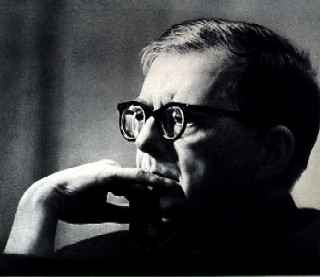
Shostakovich
DSM: In the few photographs that show Shostakovich smiling, there’s a wariness about him. It’s not merely that he didn’t enjoy being photographed. Look, there is an edgy vulnerability and guardedness in his posture, certainly, but there’s also strength—not the vehemence of a Beethoven, but a quality of dogged determination to survive. Dogged, not beatific!

CMT: Even if we’re right in these speculations, we shouldn’t see Shostakovich as egotistical or self-obsessed; there’s nothing of the Also Sprach Zarathustra about him. If he’s survived it’s as a representative of common humanity; it’s through his ability to feel the sufferings of others, one of his most noticeable and attractive traits.

DSM: It’s in the famous Quartet No. 8 where we’re most aware of Shostakovich’s empathy with others’ suffering. It was written in 1959 following his visit to Dresden where he was appalled by the destruction. What are we to read into his DSCH motif in this work? The first movement is a profound and sombre fugue based on the four notes. Not so much ‘I was there’ but more ‘I went through it and so did (or so will—) you.’

CMT: And the Quartet No. 14, performed last night by Miró Quartet, composed in 1973, in the darkness of the Vietnam War! He began it in 1971-1972. Do you remember when we protested the war, you and I—on the campus of University of Minnesota in the spring of 1972? Do you remember the fires burning on Washington Avenue, at the foot of the Mall? Do you remember when the police with the shields and the night-sticks charged us and ran us off? When we returned after midnight to the fires, still burning, and had a sandwich under the stars? Lived to fight another day?

DSM: Seems like an eternity! But lately we at least see the public protests against war beginning again. Long, long overdue. But at least it’s beginning.

Quartet No. 14, Op. 142

Entartete Musik