Showing posts with label lully. Show all posts

Wednesday, August 27, 2008

He Who Dies with the Most Toys Wins: Jean-Baptiste Lully’s Non-Musical Exploits

broken heart
Q  uestion: What did Lully do when he wasn’t writing music?”
  —  Anonymous email to CMT blog.
A  nswer #1: He was exerting many and varied efforts to make his living as a composer and insure that he was paid for his works’ performances and publication. He was acting as his own agent and manager and presenter. Such exertions would have been much as any composer would do today, only Lully was more overtly political and power-connected than anybody is today.”
A  nswer #2: He was practicing at being an amateur alchemist; dancing the minuet, gavotte, and the bourée; playing the guitar lasciviously when it suited him as a suitor; playing pranks on friends; and generally leading the life of a wealthy rascal, libertine and bon vivant.”
A  nswer #3: Don’t ask, don’t tell.”

Early in his life, composing was, perhaps, the only thing Lully had within his control. Getting manuscript copies made, and arranging for scores to be printed took lots of his time and attention. As the son of a miller—as a poor kid whose mom died and who was then farmed out to work as a child laborer—he had no reservations about getting personally involved selling manuscript copies of his works at performances of his operas. Whatever it takes, he would do. He had extensive dealings with publishers—troublesome negotiations that took entirely too much time away from more valorous pursuits. “Business, pesky business. Such a bother, even for (especially for!) a spectacularly successful composer! People should just pay handsomely and pay royalties in perpetuity without having to negotiate! People should just pay on-time, as they had promised! Competitors should be banished!”

Well, no. His correspondence does not show any such ‘tude. He was tactically using and manipulating the aristocracy; he was not one of them. Evidence of arrogance in the extant Lully documents is, maybe, more a reflection of the shark-waters he was swimming in, than a narcissistic conviction of his innate superiority.

Lully was born in Florence in 1632 and spent his formative years there, until 1645. Through Roger de Lorraine, the Chevalier de Guise, he became a servant to Mademoiselle de Montpensier as ‘garçon de chamber.’ “Kitchen help”; “pot and bottle-washer”; “teaching the duchess Italian when it pleased her.” (Right. More like “Tutoring Trysts in the Tuileries”?)

When J-B was 13, the then-18 year-old ‘minerva-esque’ Mlle. Montpensier thought his sassiness was cute. She saw to it that he received music lessons … a gambit to enable the two of them to spend more time together playing chamber music? But in his later teens he grew contemptuous of her and wore out his welcome. Jean-Baptiste’s sophomoric poem satirizing his mercurial by then 25 year-old patroness led her to dispatch his impudent, no-longer-so-little then-20 year-old self in 1652. (We suspect there was more to this escapade than some apocryphal doggerel and a fit of pique jeunesse, but, alas, historical evidence thereof is scanty.)


J-B was no slacker, though, and finagled continuing his music studies under the illustrious Nicolas Métru. While there, he kept his prankster tendencies in check; his talents were noteworthy enough to enable him audition and appointment to the orchestra of the French court as a violinist.

When he was 30, Lully was appointed director of music to Louis XIV (in 1662). About the same time, he became a naturalized French citizen (his Italian name had been Giovanni Battista Lulli). In 1662, Lully married Madeleine Lambert, daughter of court musician and co-worker Michel Lambert. Madeleine and Jean-Baptiste had ten children together over the next twenty years. But in 1685, Lully ‘outed’ and revealed his relationship with Brunet, his young page.

Besides his serial affairs with multiple boys, Lully also openly carried on with a number of women, much to the displeasure of Louis XIV and, no doubt, the good Roman Catholic, Madeleine. Curiously, Lully was also interested in alchemy and conducted experiments with de Tarraga, a converted Jew who studied the occult. Popular hobby in the 1680s.

As an artist he was top-flight, but as a human being his ethics were incontinent at best, wholly lacking at worst. Facilitated by his marriage in 1662, he achieved a rapport with Molière, with whom had not previously had dealings but with whom for the next ten years he collaborated on numerous successful ballets. A consummate courtier, he curried Louis XIV’s favor at every opportunity, making himself seemingly indispensable and sowing disparagement of others. In March, 1672, he succeeded in ousting Abbé Perrin from the directorship of the Academy of Music. He did this, in part, by preying upon the Abbé’s penchant for gambling. Perrin founded the Académie Royale de Musique, but he was a distracted/incompetent administrator. He had no patience for financial details, and dishonest collaborators took advantage of him—bullshitted him, got him to commit to ruinous deals, unfavorable terms. Lully was just another opportunist in this destructive saga. Perrin was forced to sell his court privilege to Lully, to settle a debt with Lully. But Perrin nontheless ended up in debtors prison because of his other debts. Lully apparently cast aspersions on Perrin, to prevent Louis XIV from paying off Perrin’s creditors. He thereby sealed Perrin’s fate. All’s fair in love and war. Fight dirty. Do unto others, because you can get away with it.

Poetic justice eventually supervened, though. Lully’s death in 1687 at age 55 resulted from sepsis secondary to gangrene in his toe, a ridiculous complication of blunt trauma he incurred while conducting a ‘Te Deum’, compounded by Lully’s perverse refusal to have the toe amputated. He’d been emphatically beating time with the heavy ‘staff’ or mega-baton, when he smashed his foot accidentally with the thing. Abscess formation ensued and, some days later, sepsis and death. Sweet.

On his death-bed Lully wrote, ‘Bisogna morire, peccatore’ (‘It is necessary to die now, sinner’). ‘Damn,’ said the bon vivant. Game Over.

By the time he died Lully owned four elegant houses—three in France and one in Italy.

But unlike John McCain, Lully remembered how many houses he had, how much he paid for each of them, and where each was located.

If we want to indulge in speculating, then the real question is how rare and fortuitous is the gangrenous toe from one whack with a stick? In a 55 year-old man in the pre-insulin era, you would put your money on Type-II diabetes. Peripheral vascular disease due to diabetes; trauma from the stick; poor perfusion to the modestly injured tissues; abscess formation; gangrene; sepsis; death.

Gangrene of the lower extremities is from 8 to 150 times more frequent in diabetic than in non-diabetic people, most often occurring in those who smoke. But so far as I can tell, there are no scholarly explorations into the matter of whether Lully was a Type-II diabetic. No mention of whether he had intermittent claudication or other chronic pain in his legs. Thorough medical historianship regarding Lully’s clinical condition is conspicuously absent to-date.

Waldenstrom’s Macroglobulinemia or multiple myeloma with fulminant paraproteinemia, Buerger’s disease (thromboangiitis obliterans), Polycythemia vera, atrial fibrillation and atrial thrombus embolizing to foot, ergot poisoning, whatever; Lazy Leukocyte Syndrome and other possible metabolic or inherited conditions that could eventuate in gangrene after a single knock with a stick are “green dragon” diagnoses—rare as hens’ teeth. Your better bet would be diabetes.

The most important decision required these days is whether excision of gangrenous toe should be undertaken before or after the attempt to restore peripheral circulation by angioplasty. In many situations, surgeons prefer to attempt angioplasty first because of the possibility of non-healing of wound if excision were undertaken before a peripheral arterial angioplasty. Just saying.

Gangrenous toe in a Type-II diabeticDon’t forget to get a copy of John Hajdu Heyer’s wonderful volume of essays on Lully, originally released in 1989. A new less-expensive paperback edition of this has just this month been published by Cambridge University Press. While this book is predominantly serious, card-carrying musicology of the French Baroque, there is a wealth of colorful detail in there concerning what Lully did do and did not do, as distinct from his composerly deeds and musicianly output. Beautifully edited.

In the years since the book was first published, Hajdu Heyer became Dean of the College of Arts & Communication at the University of Wisconsin - Whitewater (UWW). John received his PhD in musicology from the University of Colorado in 1973. He has been on the faculty at UWW since 1997. Prior to that he was at Indiana University of Pennsylvania and UC Santa Cruz. From 1980 to 1997 he was Lecturer and Program Annotator for the Carmel Bach Festival in Carmel, California. Since 1998 Hajdu Heyer has served on the ‘Comité scientifique Jean-Baptiste Lully • Œuvres Completes’, the scholarly editorial board for the multi-volume Lully series published by Olm Verlag, Hildesheim, and by Musica Gallica, Paris. For nearly twenty years he was also a member of the Lully Committee, an international group involved with conserving and publishing Lully’s work, and also a member of its Sub-committee on Resources, which succeeded in getting U.S. National Endowment for the Humanities financial underwriting for an archive of Lully ballets at Stanford University.

Hajdu Heyer book
Check out Hajdu Heyer’s ‘Lully Studies’ book, too—published by Cambridge University Press in 2000; engagingly written and a treasure-trove of information not available elsewhere. (By the way, in 1973 John married linguist Sandra Heyer and changed his name from the Hungarian ‘Hajdu’ to the hyphenation with her surname: ‘Hajdu Heyer’.)


de La Gorce book


Saturday, June 23, 2007

Hargis: Music to Live For, Aided and Abetted by Gestures

Ellen
CMT: Ellen Hargis is a member of the Newberry Consort and The King’s Noyse. As a soprano, she’s one of America’s preeminent early music artists, specializing in repertoire ranging from ballads to opera. She’s performed at many of the world’s leading festivals including the Adelaide Festival (Australia), Utrecht Festival (Holland), Resonanzen Festival (Vienna), Tanglewood, the New Music America Festival, Festival Vancouver, the Berkeley Festival (California), and is a frequent guest at the Boston Early Music Festival, where she’s sung title roles in Baroque operas and recently served as assistant director and Vocal and Gesture Coach for the production of the Lully opera, Psyché.


DSM: Her discography includes repertoire ranging from medieval to contemporary music. She’s recently recorded the leading role of Aeglé in Lully’s Thésée for CPO Records, released this month. Recent releases also include the premier recording of Conradi’s opera Ariadne. She’s featured on a number of Harmonia Mundi recordings including a critically acclaimed solo recital disc of music by Jacopo Peri, and in Arvo Pärt’s Berlin Mass. Ellen’s on the vocal faculty of Case Western Reserve University in Cleveland, and teaches numerous summer courses in early music, including the Longy International Baroque Institute in Cambridge, The Lute Society of America Seminars and the Vancouver Baroque Vocal Programme.

CMT: Ellen’s sense of operatic gesture is superb. Every dramatic action requires a justification, a rationale that can be apprehended by the audience, and Ellen’s Psyché direction ensured that the connection between action and justification—through appropriate visual scale of the gestures, and the reinforcement and repetition of gestures consistently by the various actors—was clear and convincing and natural.

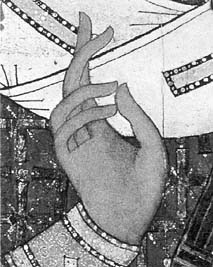
Hand Gesture, Russian Blessing
DSM: But ‘clear and natural’ doesn’t have to mean ‘tame’. The gestures of Venus, performed by Karina Gauvin, called to mind Martha Rosler’s “system of harnessed subjectivity” in her short film, Semiotics of the Kitchen (1975)—in which the artist blithely traverses a seemingly benign range of various kitchen utensils, punctuated by sudden violent actions, followed in each case by calm returns to composure.

Hand Gesture
CMT: Repeat the gesture at least several times, pausing at the end of each repetition to allow the gesture's ‘radiations’ to flow through you. Walk around the stage. See yourself doing the gesture inwardly. You generate a kind of “pull” through repetition and radiation of the gesture, and awaken a sense of urgency in the character—which can be amusing or heartbreaking or other things, depending on what the gesture is and what it signifies.

DSM: Allowing your breath to release with each “pull” helps, too—it adds to the power and complexity and emotional richness/truth. The “pull” reinforces the emotional truth, makes it more vivid. Nicole Potter has a lot to say about this in her book on acting.

B  y distilling characters or scenic moments to their core gestures, you can achieve performances that are so psychologically complex that it would take reams of paper to describe them.”
  —  Nicole Potter, Movement for Actors, p. 22

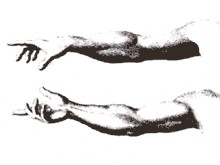
Hand Gesture
CMT: When multiple players are on stage, as is usually the case in opera, special considerations arise. There are often multiple activities going on at once, which is confusing since a viewer can only really focus on one activity at a time. It’s important for actors to coordinate their activities to make the overall action on stage understandable and coherent. One way to lend coherence to multi-player action is to give it focus. If one player has the primary role in the current action, then the other characters should direct their attention to that character.

DSM: This helps the audience to see where to direct their attention, and avoids extraneous action on stage that can distract the viewer.

CMT: Giving focus doesn’t simply involve staring at other cast members, though. Each player must have an intention at all times, and display that intention. So if a player is focusing on another player and listening to what that player is saying, the first player should react to what the other player is saying or singing, and display that reaction. Action on stage involves a continual give-and-take among the players, where action leads to reaction, which entrains further action. When done right, these actions and reactions combine into a continuous flow, and that propels the drama forward—as we saw done so well in the BEMF production of Psyché!

DSM: In Psyché, I saw human beings, fully-dimensional characters. I saw suffering and joy in their eyes; I saw their lips tremble; I saw Venus’s face darkened by rage, jealousy and pain; I saw Psyché’s face brightened by love and relief. Obviously, it’s a big difference to see the opera live, at BEMF. I saw completely human people, fighting, suffering, loving and expressing all shades of human feeling, from the brightest to the darkest. Light and shadow is the leitmotiv that comes to mind.

CMT: I could hardly separate the singing from the orchestra, so harmonious was the fusion between all the elements of this production: voices, instruments, gestures, lighting … like a broad stream that just carried us away.

DSM: Ellen Hargis’ stage presence is simply phenomenal. In the various BEMF performances in which she appeared last week, what struck me most about her stage skill was the simplicity of her body language. She didn’t have to gesticulate and pace around on the stage to be expressive. She projects an aura of mobility which gives her individual gestures weight and emotional power. In her workshop at BEMF, Ellen explained the agile placement and orientation of the body—the torso, hips, arms, legs—so as to be readily and fluidly able to move to the next location on the stage, and the next.

CMT: The word ‘impressive’ is insufficient to describe Ellen’s physical presence on stage—as we saw in her performances at last week’s Boston Early Music Festival. Her beauty and smile are so striking that you can feel the audience focus on her and, at that moment, I wouldn’t have been surprised if the musicians lowered their bows and the whole audience got to their feet.

Hand Gesture
DSM: Interestingly, she isn’t the kind of singer who appeals to everyone instantly. When I first saw her I was surprised by the low tone of her soprano voice—but I soon found her singing superb and profoundly moving.

CMT: When music moves you to the extent of rendering you speechless, you utter platitudes like “This is music to die for.” In the case of Ellen Hargis, I would invert it: this is music to live for!

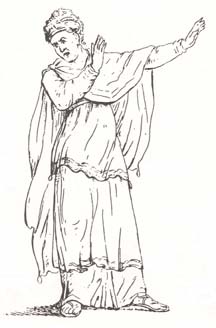
Hand Gesture, Sioux Malediction
DSM: Dr. Elena Nicoladis and her research colleagues have studied the hand gestures of bilingual children as they told the same story twice, first in one language and then the other. The researchers were surprised by what they saw. The children used gestures a lot more when telling the story in what they considered to be their stronger language. These results seem counter-intuitive. You’d imagine the children would be more inclined to use gestures to help them communicate in their weaker language. Based on these results and the results of earlier studies, Nicoladis believes there is a connection between language and memory access and gesturing.

CMT: What they believe is going on is that the very fact of moving your hands around helps you recall parts of the story—the gestures help you access memory and language so that you can tell more of the story. In other words, it’s not that the gestures are all outwardly directed, for the purpose of emphasis or persuasion or clarity of communicating what is already queued-up to be told; instead, it’s that the performative process, including gesturing, serves to “lubricate” the speaker’s memory and verbal expression centers in the brain—enabling “more” to be told, than what would otherwise have been queued-up. Benjamin Bagby says something that amounts to the same thing in the round-table discussion that’s included on his Beowulf DVD.

Initially, we thought gestures were related to meaning—that they mean things on their own. But now we believe they are more deeply related to language.”
  —  Elena Nicolaidis, Univ Alberta, 2005.

DSM: Even with a libretto to follow, there’s no question that well-devised gestures can have this same “lubricating” expressive effect in opera! This BEMF production of Psyché is ample evidence of that!

G  esture has therefore this Advantage above mere Speaking, that by this we're only understood by those of our own Language, but by Action and Gesture (I mean just and regular Action) we make our Thoughts and Passions intelligible to all Nations and Tongues.”
  — Thomas Betterton, 1710

CMT: In Russian theatre we have Otkaz (Refusal/Reversal). The ‘otkaz’ is the preparation for the action, the wind-up before the pitch. The inhale before the speech, the bent knees before the jump. Basically preparing and storing up energy needed for the intended imminent action. And we have Posyl (Sending Out, To or Away). The ‘posyl’ is the execution of the main action. It’s the path from C to B passing through the point of origin, A. Just like a ball thrown by a pitcher, the energy held in the body during the ‘otkaz’ is released and sent in the direction of the action. Because it passes through the point of origin, A, the posyl is seen by the audience as the path from A to B—containing the energy collected from the otkaz. Without such energy, the posyl has no momentum. If it’s difficult to understand an actor—if her/his lines seem unconvincing—it’s usually because she/he hasn’t prepared and gathered the energy necessary for the line. Hasn’t used the otkaz.

M  ovement is the most powerful means of expression in the creation of a theatrical production. Deprived of words, costumes, footlights, wings, auditorium, and left with only the actor and his mastery of movement, the theatre would still be theatre.”
  — Vsevolod Meyerhold, 1914

DSM: Ellen’s workshop stressed that we must always bear in mind the ‘when’ and ‘why’ of gestures, or else the ornaments will merely be ornaments—of little consequence to the energy and meaning of the performance. Indiscriminate use of gestures is a kind of incontinence—it belies a lack of understanding of when less is more. She alluded to “that landscape painter who knew how to paint cypress trees well, and who then [stupidly] painted them into every landscape everywhere.”

CMT: She also noted that the ‘accessibility’ of stage gestures does depend upon a certain amount of cultural literacy among members of the audience—a general literacy of physical/kinesthetic “grammar” that these days is faltering. So companies producing baroque operas today have the additional burden of gently informing or illustrating for audience members the 17th century gestures that are essential for their understanding and enjoyment of the performance.

DSM: There’s also the matter of timing. As Ellen emphasized in the BEMF workshop, the gesture usually precedes the action or line that it references. The gesture’s typically an ‘otkaz’-like “set up.” It may even be paradoxical or silly if it’s synchronous with the action or line.

CMT: The gesture isn’t only a “set up” for a positive verbal disclosure or declamation. Ellen points out that a gesture can also anticipate an impending ‘withholding’ of information—a secret, an emptiness, a negative whitespace. Gestures span the full range of rhetorical devices—something that was ably illustrated by the Psyché cast—aided and abetted by Ellen’s expert coaching and direction. I was glad to see that Heidi Wilson, the Wall Street Journal music critic, noted this in her review. I was glad also to see that Heidi was enthused about the notion of getting investors interested in producing this Psyché in Paris and/or New York . . .
S  eek not to know what must not be reveal’d,
Joys only flow when hate is most conceal’d ...
Let me no more with powerful charms be press’d —
I am forbid by fate to tell the rest..”
  — Indian Queen, Act III
    (opera by John Dryden and Robert Howard,
     music by Henry Purcell)


Hand Gesture


Wednesday, June 13, 2007

Psyché: Jean-Baptiste Lully’s Puissance Autoriale

Psyche, Furies
  • Psyché, production by BEMF
  • Music by Jean-Baptiste Lully, 1671-8 (1632-1687)
  • Libretto by Thomas Corneille (1625-1709)
  • Paul O’Dette & Stephen Stubbs, Music Directors
  • Gilbert Blin, Stage Director
  • Lucy Graham, Choreographer
  • Ellen Hargis, Vocal & Gesture Director
  • Caleb Wertenbaker, Set Designer
  • Lenore Doxsee, Lighting Designer
  • Anna Watkins, Costume Designer
  • Kathleen Fay, Executive Producer
  • Abbie Katz, Associate Producer

DSM: You know, there’s a conventional notion of French classicism – that the Arts moved in the 17th Century toward purity and increasing standardization, and that French as a language was elevated such that it came to rival ancient languages in its expressive richness. Though it’s usually associated with Louis XIV’s Versailles and such figures as Molière, La Fontaine, La Bruyère, and Racine, the formative period of classicism was a bit earlier, and writers like Corneille were its vanguard. A caricature of French classicism goes further and implies that the development of the absolute monarchy, the pacification of the realm, the rising prestige and power of France in Europe, and the emergence of classicism are all “of a piece”. But it’s precisely this latter-day conclusory tone – the tacitly assumed inevitability of the association between political and social order, on the one hand, and aesthetic order in the Arts, on the other – that this Lully opera with the Corneille libretto calls into question. Christian Jouhaud’s 2000 book, Les Pouvoirs de la Littérature: Histoire d’un Paradoxe, is an excellent analysis of French Seventeenth Century literature and music and art, as revealing features and changes in the exercise of political power during that era.

CMT: Jouhaud’s book is a kind of sociological analysis of classicism, arguing that the affinity of classicism with royal power was an illusion. Rather than emphasize the commanding influence of the monarchy and patronage in creating classicism, or at least in ensuring its success, Jouhaud speaks instead of the ‘writer’ or ‘literature’. His book shows that in the seventeenth century that writers were seeking and getting increasing autonomy.

DSM: In that connection, Bourdieu once wrote that the Arts are not only situated in a social context but he asserted that this context was necessary for its emergence – debunking the claims for the universality and timelessness of classical expression. One aspect of this social context was a public of readers and chamber music listeners whose interests and level of culture enabled them to participate in these Arts, thereby fueling their development.

CMT: This reminds me of Habermas’ notion of a public sphere, but Jouhaud objects to the claim that a public emerged only in the eighteenth century. He says it was earlier, in the seventeenth century with Corneille and Lully. The modern entity of a public emerged then, he says — a public concerned with eloquence and expression, as intensely as the court was.

DSM: And at that time there were, of course, competing versions of eloquence — Jesuit and Gallican, say — in seventeenth-century France. The Jesuit style championed a thoroughly French rhetoric of images, and a not-too-challenging level of learning that was congenial to a nobility with limited educational aspirations and resources. Gallican eloquence, on the other hand, was cultivated by the magistrates of the parlement, who were bearers of more erudition — a Latinate humanism of the late Renaissance.

CMT: In Lully’s Psyché (see-shay'), we have an example of a humanistic interest in the ‘modernity’ of Ciceronianism that was at the heart of French culture then — in the generations following the wars of religion. The Jesuits’ style won the day by appealing to the gens de la cour, but their victory didn’t come from the public itself.

DSM: Yes, that’s part of Jouhaud’s argument. Jouhaud begins by considering a paradox, insofar as the Arts’ dependence on power actually created the conditions for its construction, and ultimately its autonomy, as a field or realm of human activity and culture production. To frame culture in paradoxical terms conforms to a contradiction, one that transcends the literary realm. Early seventeenth-century France was characterized by two tendencies. On one level was the consolidation of royal power and the consensus that emerged across elite society behind the continuing need for a powerful monarchy. On the other was the new bourgeois cultural realm marked by disparate trends — ones that suggest a scattering, ‘centrifugal’ dynamic in contrast to the crown’s ‘centripetal’ force.

Baroque Opera Orchetra Pit
CMT: The arrangement of the baroque orchestra to accompany the opera manifests some of this centrifugal tension too, I think – sitting as the performers do on opposite sides of a picnic-table-like layout in the orchestra pit. The principal violinist actually projects his/her sound predominantly toward the stage, toward the singers, not toward the audience. There is an egalitarian aspect to the musicians’ performance in baroque opera that, unlike other opera or orchestral forms, retains the dialogue-among-equals, discursive character of smaller chamber music idioms. Very interesting, compared to eighteenth and nineteenth century opera. You know, Jouhaud’s focus doesn’t dwell on Paris in the decades following the religious wars, a city that had become a haven for cosmopolitan elites, humanists, and various eccentrics. But his concentration on a handful of literati, and on the paradoxical nature of contemporary culture, yields ideas that brings these contradictory things—power and culture—into a clear and informative relationship. Jouhaud’s method is to see the relationship between power and the Arts as a series of exchanges – to see it as a process that serves to construct each. Political power and literature don’t confront one another as fully constituted entities. Rather, each feeds off the other. In this Lully opera, we have music in service of statecraft, or as an artifact of statecraft.

DSM: In Jouhaud’s words, we get a “littérarisation” of politics and a “politicization” of literature. Does this exchange suggest parity between the two? Although Jouhaud acknowledges that in the eighteenth century it would lead to the autonomy of literature as an independent discursive venue for the first time, he insists that in the early seventeenth century, at its birth, a dependency characterized the Arts’ relationship to power.

CMT: Looked at in this way, there’s an abstract quality to Jouhaud’s idea that, even in the detailed case studies he provides, threatens to obscure his argument. To start with, it’s helpful to know that his concern isn’t primarily with the simple connections between politics and literature and music and other art that come to mind when we think of the seventeenth century: not the exploitation of literary forms to exalt the monarch; not the control of literature through patronage or censorship; not the appropriation of political subjects by literati—although all of these do find a place in Jouhaud’s analysis. So what does he mean by the “littérarisation” of politics and the “politicization” of literature, and what are the implications of this process?

DSM: One place not to begin, Jouhaud says, is with the institution that traditionally stands at the center of discussions of literary life in the early seventeenth century, the Académie Française. That would give a misleading view of writers and composers and artists (who previously had no formal standing in the “society of orders” of the Old Regime) as having gained autonomy and protection through its establishment.

CMT: Jouhaud argues that writers and composers and others were defined by their exceptional nature—as individuals and an activity lacking a corporate identity. “Fundamentally, their status was not to have one,” he says. This feature was both a weakness and an advantage: a weakness because it left them vulnerable and in need of protection; an advantage because as relatively free agents they were uniquely suited to the ad hoc service that aristocrats, ministers, and monarchy required.

DSM: So Jouhaud holds forth with a social analysis of writers’ anomalous position in the society of orders, and suggests that the novelty of literature and the Arts in the early seventeenth century—or of composing music—was not only its promotion of writing and composing in the vernacular. The novelty of the Arts consisted in the artists’ unique social position as well. Jouhaud implies that writers embodied a modern predicament: individuals, lacking any traditional moorings and support, engaged in a novel enterprise, in need of legitimizing for the sustainability of their social status and livelihood and practice. They naturally gravitated to the service and patronage of the wealthy and powerful, whom they were uniquely equipped to serve because of their adaptable skills. Surely has face-validity as modern — sounds like today, in fact.

CMT: Far into Jouhaud’s book we learn why politicians and royalty were so interested in artists of this sort. It wasn’t so much the intrinsic nature of their writings and compositions as the position they occupied on the sociocultural landscape. They were valued as an alternative and, even more, as a counterforce to the rising bourgeoisie whose legitimacy and expertise represented obstacles to both the crown’s authority and its latitude of maneuverability. He writes: ‘Between the development of these new forms of literary authority and the development of a power that sought to confine the privileges of corporations and to deny them the right to dispute political matters, there would thus be agreement, harmony . . . perhaps even a solidarity in expansion’ (p. 330).

DSM: So writers and composers served to domesticate—the term is not necessarily pejorative one—a cultural field which the rulers did not wish to see emancipated. They recalibrated the norms of comportment and limited the authority of the ‘learned’ bourgeois members of society while simultaneously giving lessons in pleasure and good taste (p. 368).

CMT: It’s in this way thaqt the subject of Jouhaud’s analysis is really a theory of the origins of “the public”, although it’s not Habermas’s notion of a public characterized by an independence from the court and crown. Just the same, Jouhaud addresses autonomy as part of the culture of a developing modern civil society. And Jouhaud’s public fundamentally intersects and overlaps with the court, instead of being fully independent from it.

DSM: And in the case of Lully’s operas, we can read them as reactions to, and at the same time intertwined with, court culture itself. It’s consistent with Jouhaud’s warning us against reifying the idea of a “public” as a space or a cultural arena fundamentally characterized by autonomy from royal control and manipulation. It’s still intertwined with the emerging political consolidation and intersections with self-referential royal, ministerial, and aristocratic power. The wedding festivities and Bacchanalia in Act V of Psyché are good illustrations of that!

CMT: But still, even if we set aside the problematic idea of a ‘public’ we can examine the idea of the term ‘publicity’, indicating a dynamic of representation and disclosure through the discourse of literature and music and the Arts. Insofar as a public coincides with court culture, or the court itself, the analysis is fraught with ambiguity.

DSM: But if you consider outsiders and bourgeois citizens – contemporaries who would have viewed the court in terms of secrecy and power not yet attained – the analysis of disclosure and publicity is straight-forward. This is certainly the prescriptive characterization of apologists for reasons of state—the view of statecraft that, as Jouhaud notes and as Ross suggests in his new book, was shared by members of the Arts community.

CMT: The Arts of the early seventeenth century—based on the vernacular and aimed at somewhat educated aristocrats—were pretty transparent and accessible. And it must be that a desire to appeal to a broader ‘public’ was not limited just to literature but would’ve been a factor for all of the Arts.

DSM: Erudite magistrates were also looking to enlarge the appeal of ‘eloquence’ through a so-called Ciceronianism that would synthesize the rival camps of courtly cultures. So the move to broaden public discourse—to make it in fact public—was shared by others, including Lully’s circle.

CMT: In conflating public and court, Jouhaud finesses differences between aristocracy and crown that play a central role in this period. Intertwined, inseparable, but different.

DSM: One aspect concerns me. Jouhaud does seem to under-appreciate the literary text or the musical text as imparting ‘political ideas.’ Instead, he emphasizes the textuality of political commentary and its reality as a literary performance with political implications. For Jouhaud, the ‘text’ serves to demonstrate that the realm of political power can be penetrated by a ‘puissance autoriale.’ This puissance, this intertwined reactionary independence — is surely part of what Lully accomplished in Psyché.

CMT: The BEMF team’s brilliant insights into seventeenth-century culture; their extraordinarily astute, sensitive, and learned reading of a whole range of musical texts, some well known but many obscure, make this production of Psyché an important resource for anyone interested in the relationship between the Arts and politics in the Ancien Regime. The discourse of power is never so simple as a tool of state at the service of a royal or ministerial absolutist regime, nor is opera or literature or any other art form every confined to a handful of writers whose texts meet the criterion of having political import. In this period, when literature and literary sociability permeated so much of elite culture, especially in Paris, surely there was more to the ‘powers of literature’ than this. Bravo to the BEMF in imparting these subtleties to this production of Psyché!


Cutler Majestic Theatre