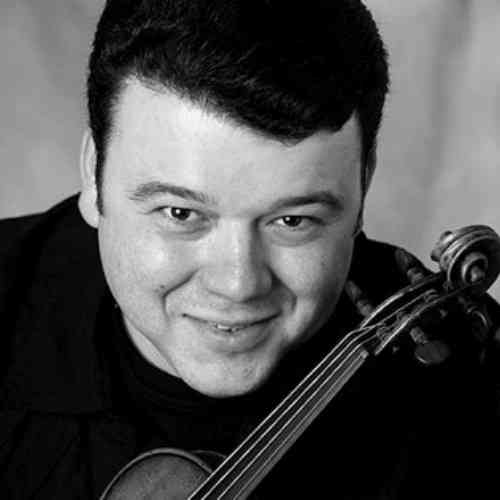
M ihaela Ursuleasa was the soloist in Beethoven’s Piano Concerto No. 3 (Op. 37). Ms. Ursuleasa shares Mr. Vanska’s penchant for unusual, often surprising reconsiderations of a score’s essential materials, and their collaboration was electrifying. Still, there was no doubt who was in control here: Ms. Ursuleasa played with a combination of ferocity and clarity that put Beethoven’s already striking contrasts into sharper relief and turned the score into a tense drama. Interpretively she was out on the edge, but it was the kind of high-risk performance that makes the ‘war horses’ worth revisiting.”Allan Kozinn’s review of Romanian pianist Mihaela Ursuleasa’s performance in the Lincoln Center’s Mostly Mozart Festival praised a number of the aspects of Mihaela’s charismatic style. I’d heard Mihaela perform earlier this summer in Ireland and can affirm that her playing is exciting: she expresses a wide range of emotions musically; the sonic image that she projects is—despite the emotional range that’s traversed—thoroughly credible, never histrionic. This combination of technical brilliance, lightning-fast wit, charm, enchantment, fascination, magnetism, athleticism, and credibility—what else would we call this except ‘charisma’ or ‘magic’?
— Allan Kozinn, NY Times, 22-AUG-2008.

Why are Mihaelas so rare? The perennial issue facing chamber music (and classical music and the arts in general) is how to cultivate more magic like this among a larger number of school-age kids. The U.S. maybe has a more serious issue in this regard than other countries, but it is true all around the world to some degree, with the possible exception of China. We need this ‘magic’ or ‘charisma’ not only in performers, but also in the next generation of composers, conductors, presenters, arts managers and execs of non-profit arts NGOs, recording producers and engineers, and educators. Frankly, we need more of it, too, among current and future-generation audience members.
What I mean is, too often classical music marketing is focused on the ‘sizzle’ and relevance or appeal that the programming or performance has, as if it were merely an excellent “product” or “experience”. IMHO, consumerism in terms of an enticing ‘product’ or venue-bound, Starbucks-oid lifestyle ‘experience’ is fine so far as it goes, competitively. But what you instead want to aim for, I think, is actually far higher than that. You want total suspension of disbelief, at least as much as the best novel or film achieves. You want ‘converts’. Composer/author Greg Sandow comes close to that point of view in his ArtsJournal blog.

C harisma comes in many forms. Like physical beauty it has many variables, but somehow the various elements must sum up to an effective, powerful presence. Without it in some measure, a person cannot in the long run succeed... The possessors of the magic will survive over the years in the role while others may find themselves less well-known. Appeal of this type is hard to spot in students, but [it is] even more elusive since it is based on some sort of instant psychological exchange—projection and recognition of a social image which needs no explanation in words... a remarkable combination of childlike innocence consumed in the process of pouring out music, untouched by the bittersweet quality of adult experience. At a later time, it may be the full-bodied embracing of life by the youthful adult whose intensity of spirit seems to have the good things of life in abundance... Particularly interesting are those artists whose charismatic index soars with maturity, or even in late years. These artists suddenly ... begin to project maturity, authority, [perplexity, irony, vicissitudes of coping with loss and hurt, etc.] and the simple fact of having successfully met life’s problems square-on and emerging beautifully with strength, wisdom, and compassion.”
— Stewart Gordon, Etudes for Piano Teachers, p.123.

There is a wonderful new book out by Estelle Jorgensen at Indiana University that’s really worthy of your attention, as it relates to music pedagogy and fostering in kids a genuine and self-sustaining excitement about—and enthusiasm for doing—music. Not just as performers, but ‘doing’ in any of the myriad senses of that word.
W hitehead’s three stages of education are] romance, instrumentalism, and generalization. ‘Romance’ refers to the phase at which one is introduced to concepts... things go ‘bang’ in the dark and one emerges almost breathless with excitement. ‘Instrumentalism’ is the phase in which one begins to understand more systematically and deeply—how it works. ‘Generalization’ comes as the last phase where romance and instrumentalism come together in a new ‘whole’, this time not only intuitively but also rationally—not only perceptively but also feelingly. The various pieces are put together so that they attain a unity that is needed to [coherently, understandingly] perform and animate a piece of music.”Mihaela Ursuleasa is just 30 years old—and, for the charismatic artistry with which she now gifts audiences, we have both her teachers and her family to thank. ‘Nature’ counts for a lot, of course; but ‘nurture’ is everything. And the ‘nurture’ need not always be on-on-one. Sometimes it happens while attending a public performance. For me, a watershed event was hearing Austrian pianist Ingrid Haebler perform Chopin in Minneapolis when I was 7 years old.
— Estelle Jorgensen, The Art of Teaching Music, p. 249.

K önnten Sie sich ohne weiteres vorstellen, dass ihr Kind sich in der Schule mit dem Musik befasst? Sich, nach Anleitung des ehres, „Musikerklamotten” schneidert, sich freudig und verspielt schminkt Schmuckornament mit Symbolen wie Bachköpfen, umgedrehten Mozart Bildnissen oder der Stockhausens bastelt? Ja? Dann sind Sie eine Ausnahme. (Oh, kids today! It requires the enticement of charismatic super-stardom to interest them in classical music. To think otherwise is unrealistic, the exception.)”Until that fierce and charismatic Chopin performance, I had thought of concertizing as some sort of a fascinating ‘show’ that carried with it a certain exotic prestige and social power. It was Haebler’s utter incarnation of several Nocturnes that led me to grasp that serious music could instead be radically intimate and fresh—each time as fresh and real as any fabulous bedtime story could ever be. You just had to make it so! From that moment on, I was ‘hooked’.
— Ingrid Haebler.
We need more Mihaelas and more Ingrids—that combination of ferocity and clarity that captivates audiences. Jorgensen and others provide valuable ideas about how to make that happen, against the odds.

C harisma is the source of charisma. It keeps its attention firmly fixed on the social effect and remains agnostic about the traditions themselves, leaving them as a ‘given’ of human experience... charisma as a theory of authority.”
— Step Feuchtwang, Grassroots Charisma in China, p.12.
- DSM. West Cork Chamber Music Festival: Intensive Week of (Life) Experiences. CMT blog, 02-JUL-2008.
- Mihaela Ursuleasa website
- Terril E. Chopin and My Grandma. ThoughtsFromAnArtsOrg blog, 18-AUG-2008. [re: music-appreciation in family context; inter-generational culture; early music-ed]
- Jeunesses Musicales World Orchestra
- Campbell P. Musician and Teacher. Norton, 2007.
- Cohen S. Win the Crowd: Unlock the Secrets of Influence, Charisma, and Showmanship. Collins, 2005.
- Feuchtwang S. Grassroots Charisma in China. Routledge, 2001.
- Gerth H, Wright-Mills C, eds. From Max Weber. Routledge, 2007.
- Gordon S. Etudes for Piano Teachers: Reflections on the Teacher's Art. Oxford Univ, 2001.
- Guilfoyle D. The Charisma Effect: How to Captivate an Audience. McGraw-Hill, 2003.
- Hogan K, Labay M, Swaney J. Irresistible Attraction: Secrets of Personal Magnetism. Network3K, 2000.
- Jorgensen E. The Art of Teaching Music. Indiana Univ, 2008.
- Jorgensen E. Transforming Music Education. Indiana Univ, 2002.
- Kapitan L. Re-Enchanting Art Therapy: Transformational Practices for Restoring Creative Vitality. Thomas, 2003.
- Keefe J. ‘Improv’ Yourself: Business Spontaneity at the Speed of Thought (Second City Comedy). Wiley, 2002.
- Liteman M. Planning for Succession: A Toolkit for Board Members and Staff of Nonprofit Arts Organizations. IllinoisArtsAlliance, 2003.
- Pye L, Pye M. Asian Power and Politics: Cultural Dimensions of Authority. Belknap, 2006.
- Rothwell W. Effective Succession Planning: Ensuring Leadership Continuity and Building Talent from Within. 3e. AMACOM, 2005.
- Gary Baker, Midwest Center for Nonprofit Leadership, Bloch School of Business and Public Administration, UMKC