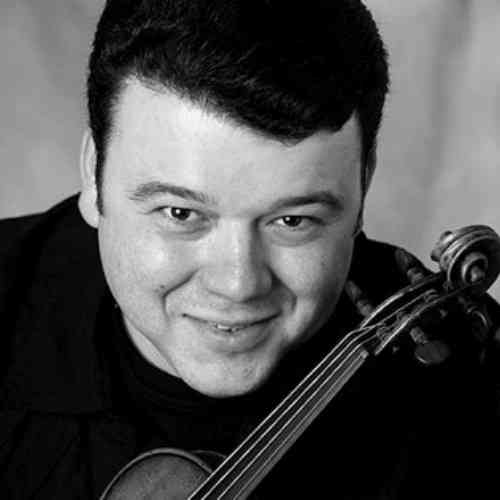
V adim Gluzman believes the violin has a living soul and, from the pile of performance reviews on my desk as well as from my own ears, I believe he knows something about how to give it breath.”
— Laurie Niles, Violinist.
I t has this unbelievable G string, it sounds like a del Gesu or a viola—dark, dark, dark; huge! If you think about both Glazunov and Tchaikovsky concerti, they both start on (A3) first position on the G string. Both were written for this violin.”M y regular employment involves engineering—informatics and computer science mostly, but occasionally chemical engineering as well. Recently, I was working on a project that involved calculating percentages of different dissolved compounds to achieve an optimal net chemical reaction rate.
— Vadim Gluzman, interview with Laurie Niles, Violinist.
I began, then, to daydream about how it is that we realize when a particular instrument is especially apt for us; how we realize when a particular piece of music is apt for us; how we choose combinations of these. Sometimes we realize this when we attempt to switch and try to play on an instrument (try to dissolve into a “solution”) that is less apt for us (in which we are less “soluble”), or when we attempt to play a piece of music that is less apt for us. Sometimes, we realize this when we serendipitously find an instrument that suits us particularly well, or encounter a piece that lies well under our “hand”, on account of cognitive and biomechanics reasons that we may or may not understand or be able to explain to others.
I n principle, could these highly subjective things be objectively measured? After all, enthalpies of transfer (ΔHtr) of electrolytes from one solvent into another solvent are routinely determined by comparing enthalpies of solution in the two solvents, where solid electrolyte is dissolved in each solvent and the heat exchange is measured. Sometimes, the reverse method is used (in which ΔHtr is derived from enthalpy of precipitation measurements, where electrolyte that was dissolved is caused to come out of solution as a solid precipitate). Waveform (enthalpic and entropic—) analysis of back-to-back digital recordings of Vadim Gluzman moving from Nino Rota to J.S. Bach? Put musicians and instruments in giant, room-sized bomb calorimeters and measure per-minute heat flux normalized to time-average identical sound emission?
O f course, musicians and instruments and compositions are not molecules or bulk-phase ensembles of large numbers of molecules, but nonetheless the statistical mechanics of solutions—the effects and the equations that are involved in these—are suggestive of phenomena we recognize when we are mixing musicians, instruments, and compositions. It is only half-serious, my daydream…

D o the components in mixtures of performer, instrument, and composition each have a property analogous to what, in chemistry, would be called ‘fugacity’? Suppose the answer is ‘Yes’: Performers-as-solutes; instruments-as-solutes; compositions-as-solvents; concert halls, recordings, etc., as ‘vessels’ to contain the resulting solutions.

B orn in Ukraine, violinist Vadim Gluzman began playing with a remarkable fugacity at age seven. When he was 16 his family moved to Israel and he continued his studies at the Rubin Academy of Music in Tel Aviv and later with Dorothy DeLay at Juilliard. At age 19, he arrived in Dallas, where he was a participant in the New Conservatory summer music program and subsequently became a student of Arkady Fomin at Southern Methodist University. Vadim Gluzman plays the 1690 ex-Leopold Auer Stradivari on loan from the Stradivari Society of Chicago. He is currently on the faculty of Roosevelt University. Vadim’s wife, pianist Angela Yoffe, was recognized as a high-fugacity musician-in-the-making at age four. She studied in the Darzinia School of Music in Riga, the Rubin Academy of Music in Tel Aviv and the Meadows School of the Arts in Dallas. Vadim and Angela perform as infinitely-miscible co-solutes all over the world and have recorded for Koch International and Bis.

N ino Rota’s solvent, ‘Improvviso in D minor,’ provides frequent exposure of A3 and other high-fugacity notes for the ex-Leopold Auer Strad, which facilitates Angela Yoffee’s accompaniment on her Steinway with an emphatic, dark lower register and nice miking on the recording.

[50-sec clip, Vadim Gluzman and Angela Yoffe, Nino Rota, ‘Improvviso in re minore, 1947’, 1.6MB MP3]

I mprovviso in D minor was composed in 1947, for the Gianni Franciolini / Carlo Ponti film ‘d’Amanti senza amore’ [Lovers without Love], adapted from Tolstoy’s novel, ‘Kreutzer Sonata’. Inharmonious doctor (played by Rolando Dupi) impulsively marries harmony-craving pianist (played by Clara Calamai)…

T he marriage is unhappy, and a despondent Calamai attempts suicide, only to be stopped by clueless Dupi. Desperate for real companionship, Calamai makes friends with the violinist (played by Jean Servais). Dupi suspects that his wife is having an affair, but when he obtusely discusses the matter with Servais, he discovers the suspicions are groundless.
S adly, Dupi realizes this after he has already murdered his pianist-wife.
C lara Calamai was 33 and Jean Servais was 38 when they played these roles, and Nino Rota was 36 years old when he composed this film music. Gluzman’s and Yoffe’s age, speed, passion, and fearlessness are especially well-matched (1) to Rota’s gypsy conceit, including its defiant, ‘diabolical’ coda, and (2) to the robust sonic preferences of their respective instruments.
G reat solution ‘chemistry’!

- Gluzman V, Yoffe A. Nino Rota: Improvviso in D minor. (Naxos/Bis, 2008.)
- Vadim Gluzman website
- Vadim Gluzman page at Roosevelt Univ, Music Conservatory of Chicago College of Performing Arts
- Niles L. Interview with Vadim Gluzman. Violinist.com blog, 25-NOV-2009.
- Lee L. Gluzman is a Modern Classicist. All Things Strings, 2009.
- Angela Yoffe page
- Rota N. Improvviso in D Minor. Schott Music, 1947.
- NinoRota.com
- Fugacity page at Wikipedia
- Chemical activity page at Wikipedia
- Fugacity lecture at Univ Iowa
- Trent Guidry fugacity page
- IRCAM.fr
- ISMIR.net
- Rao N, ver Heest F. Electrostatic dust modes in self-gravitating dense dusty plasmas with high fugacity. Phys Lett A. 2000;268:390-4.
- Gluzman V, Yoffe A. Fireworks: Virtuoso Violin Music. (Bis, 2008.)
- Gluzman V, Yoffe A. Auerbach: Ballet for a Lonely Violinist; Violin Sonata No. 2; Shostakovich: Violin Sonata; Jazz Suite No. 1. (Bis, 2006.)
- Gluzman V, Yoffe A. Auerbach: 24 Preludes for Violin & Piano. (Bis, 2003.)
- Pitzer K. Thermodynamics. 3e. McGraw-Hill, 1995.
- Clara Calamai page at Wikipedia
- Jean Servais page at Wikipedia

A ll violin sonatas are microtonal. ;-)”
— Steve Gregoropoulos, 27-FEB-2010, FaceBook.