Showing posts with label film music. Show all posts

Tuesday, May 25, 2010

Jo van den Booren Chamber Music for Films: Musical Narrator, ‘Third-Person-Limited’

 Altman book
T    here are three ways to play the drama: (1) you can play through a scene, establishing a mood that will ignore specific moments of greater or lesser intensity; (2) you can phrase a scene, carefully acknowledging both obvious and subtle shifts in emotional tone and dramatic content; and (3) you can hit the action, accenting specific moments in the drama with the music... ‘Playing through’ is really the earliest film scoring technique, dating back to the pre-sound era of silent movies. In those days the local pianist selected different pieces of music for each dramatic section and simply played through each scene until the next section.”
  —  Fred Karlin & Rayburn Wright, p. 238.
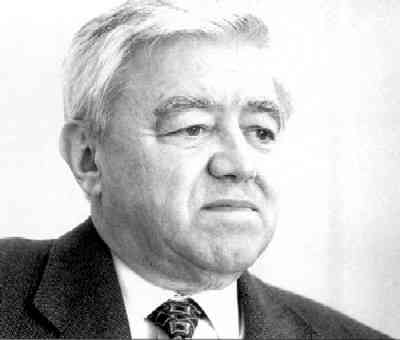
S hortly before Patelson’s closed last year, I was in there rummaging through what was left on the shelves. I found a copy of a peculiar score for brass quintet, entitled ‘Potpourri’, by the [now 75 year-old--] Dutch composer Jo van den Booren. This 10-minute piece is filled with surprising dynamics and exchanges between the players. The rapidly changing polymeter time signatures tell a story—mystery! a thriller!

 Jo van den Booren
W hat a fantastic find! I had never encountered any of van den Booren’s music before. I began to explore, to see what recordings of his works might be available. Sadly, the result was meager. But he has received a number of awards in Europe; his compositions in Donemus’s catalog number more than 200...

 Jo van den Booren
R eally marvelous, van den Booren’s sense of timing and suspense—in the brass quintet, and in other of his music. Not surprising, then, that he has done scores for films, including chamber ensemble works to accompany old silent films—his 1985 score for the 1928 silent ‘La Passion de Jeanne d’Arc’, directed by Carl Theodor Dreyer and starring Maria Falconetti, is highly regarded...

 Jeanne d’Arc, Falconetti
W e get natural competition between the visual gestures and actions in the silent film. By contrast, in contemporary films sound-effects compete with the music. But in silent films the sound-effects are implied by the on-screen action and, to some extent, by the sub-titles. Visual effects as surrogates for sound-effects. Sometimes, the musician(s) ‘tread water’ before the cinematic effect; at other times, they come smacking in with something ‘new’ right after the visual effect...

 Jo van den Booren
T rumpet-led ostinato ‘processional’ music; tuba-instigated ‘introspective’ music; trombone gone wild...

 Jo van den Booren, trombone gone wild
V an den Booren considers each scene as though it were a philosophical question, to be considered from multiple angles. This adds to the character development and serves as a stimulus for the viewer to engage her/his imagination. As such, van den Booren is a wonderful teacher to learn from. The composer, acting as an impromptu companion to the viewer, should regale the viewer with honest musical remarks. The viewer sees the wheels inside your head working; you are a kind of narrator, third-person, ‘limited’. Your remarks are not ‘inexplicable’; they are spontaneous but explicable. Most of the time, your remarks are friendly; but sometimes you can be difficult...

 Jo van den Booren, whip-lash
B    efore you phrase a scene you’ll need to select a tempo and rough-in the cue, putting correct timings at the top of every bar or two... consider adjusting the tempo slightly to accomodate any ‘hits’ that need to be precise. Compose your thematic material for the scene, or, if you already have the material, play it against the video without trying to fit it exactly to the scene. Place the thematic material roughly where you would like it to play. This may leave silent bars on one or both sides of the thematic statements, which you can fill in later. Now shift the material slightly and try playing it in several different places. When its location seems most compatible to your music in terms of your selected ‘hits’ or phrase-timings, lock it in. Use the SMPTE timecode to identify the start coordinate... Adding a soft string-pad under the theme as the heroine turns and says, ‘I love you,’ can be enhancing to the scene without disturbing the flow of the music.”
  —  Fred Karlin & Rayburn Wright, p. 307.


Tuesday, March 23, 2010

Vadim Gluzman: Mixtures of Human Virtuoso plus Virtuosic Instrument

 Improvviso in re minore, mm. 25-30
V    adim Gluzman believes the violin has a living soul and, from the pile of performance reviews on my desk as well as from my own ears, I believe he knows something about how to give it breath.”
  —  Laurie Niles, Violinist.
I    t has this unbelievable G string, it sounds like a del Gesu or a viola—dark, dark, dark; huge! If you think about both Glazunov and Tchaikovsky concerti, they both start on (A3) first position on the G string. Both were written for this violin.”
  —  Vadim Gluzman, interview with Laurie Niles, Violinist.
M y regular employment involves engineering—informatics and computer science mostly, but occasionally chemical engineering as well. Recently, I was working on a project that involved calculating percentages of different dissolved compounds to achieve an optimal net chemical reaction rate.

I  began, then, to daydream about how it is that we realize when a particular instrument is especially apt for us; how we realize when a particular piece of music is apt for us; how we choose combinations of these. Sometimes we realize this when we attempt to switch and try to play on an instrument (try to dissolve into a “solution”) that is less apt for us (in which we are less “soluble”), or when we attempt to play a piece of music that is less apt for us. Sometimes, we realize this when we serendipitously find an instrument that suits us particularly well, or encounter a piece that lies well under our “hand”, on account of cognitive and biomechanics reasons that we may or may not understand or be able to explain to others.

I n principle, could these highly subjective things be objectively measured? After all, enthalpies of transfer (ΔHtr) of electrolytes from one solvent into another solvent are routinely determined by comparing enthalpies of solution in the two solvents, where solid electrolyte is dissolved in each solvent and the heat exchange is measured. Sometimes, the reverse method is used (in which ΔHtr is derived from enthalpy of precipitation measurements, where electrolyte that was dissolved is caused to come out of solution as a solid precipitate). Waveform (enthalpic and entropic—) analysis of back-to-back digital recordings of Vadim Gluzman moving from Nino Rota to J.S. Bach? Put musicians and instruments in giant, room-sized bomb calorimeters and measure per-minute heat flux normalized to time-average identical sound emission?

O f course, musicians and instruments and compositions are not molecules or bulk-phase ensembles of large numbers of molecules, but nonetheless the statistical mechanics of solutions—the effects and the equations that are involved in these—are suggestive of phenomena we recognize when we are mixing musicians, instruments, and compositions. It is only half-serious, my daydream…

 Fugacity of mixture

D o the components in mixtures of performer, instrument, and composition each have a property analogous to what, in chemistry, would be called ‘fugacity’? Suppose the answer is ‘Yes’: Performers-as-solutes; instruments-as-solutes; compositions-as-solvents; concert halls, recordings, etc., as ‘vessels’ to contain the resulting solutions.

 Improvviso in re minore, mm. 49-54

B orn in Ukraine, violinist Vadim Gluzman began playing with a remarkable fugacity at age seven. When he was 16 his family moved to Israel and he continued his studies at the Rubin Academy of Music in Tel Aviv and later with Dorothy DeLay at Juilliard. At age 19, he arrived in Dallas, where he was a participant in the New Conservatory summer music program and subsequently became a student of Arkady Fomin at Southern Methodist University. Vadim Gluzman plays the 1690 ex-Leopold Auer Stradivari on loan from the Stradivari Society of Chicago. He is currently on the faculty of Roosevelt University. Vadim’s wife, pianist Angela Yoffe, was recognized as a high-fugacity musician-in-the-making at age four. She studied in the Darzinia School of Music in Riga, the Rubin Academy of Music in Tel Aviv and the Meadows School of the Arts in Dallas. Vadim and Angela perform as infinitely-miscible co-solutes all over the world and have recorded for Koch International and Bis.

 Vadim and Angela

N ino Rota’s solvent, ‘Improvviso in D minor,’ provides frequent exposure of A3 and other high-fugacity notes for the ex-Leopold Auer Strad, which facilitates Angela Yoffee’s accompaniment on her Steinway with an emphatic, dark lower register and nice miking on the recording.

 Improvviso in re minore, mm. 61-64


    [50-sec clip, Vadim Gluzman and Angela Yoffe, Nino Rota, ‘Improvviso in re minore, 1947’, 1.6MB MP3]

 Improvviso in re minore, mm. 65-70

I mprovviso in D minor was composed in 1947, for the Gianni Franciolini / Carlo Ponti film ‘d’Amanti senza amore’ [Lovers without Love], adapted from Tolstoy’s novel, ‘Kreutzer Sonata’. Inharmonious doctor (played by Rolando Dupi) impulsively marries harmony-craving pianist (played by Clara Calamai)…

 Improvviso in re minore, mm. 82-87

T he marriage is unhappy, and a despondent Calamai attempts suicide, only to be stopped by clueless Dupi. Desperate for real companionship, Calamai makes friends with the violinist (played by Jean Servais). Dupi suspects that his wife is having an affair, but when he obtusely discusses the matter with Servais, he discovers the suspicions are groundless.

S adly, Dupi realizes this after he has already murdered his pianist-wife.

C lara Calamai was 33 and Jean Servais was 38 when they played these roles, and Nino Rota was 36 years old when he composed this film music. Gluzman’s and Yoffe’s age, speed, passion, and fearlessness are especially well-matched (1) to Rota’s gypsy conceit, including its defiant, ‘diabolical’ coda, and (2) to the robust sonic preferences of their respective instruments.

G reat solution ‘chemistry’!

 Servais-Gluzman-Calamai-Yoffe
A    ll violin sonatas are microtonal. ;-)
  —  Steve Gregoropoulos, 27-FEB-2010, FaceBook.


Sunday, April 13, 2008

Polyrhythms Inside Polyrhythms: Alojz Srebotnjak and the Transcultural Economy of Music-in-Slovenia vs. ‘Slovenian’ Music

 Alojz Srebotnjak
L  abels, such as ‘traditional’, ‘modern’ and ‘post-modern’ are not oriented toward opposing ‘music in Slovenia’ and ‘Slovenian music’, but toward much more perplexed relations of the ‘cultural economy’—an economy of distributing certain values to the phenomena under discussion... In Slovenia, one could not speak of extreme examples of a ‘bricolage’ after whatever exists. It is not Cagean, but rather Feyerabend-esque ‘anything goes’: thus, we can rather speak of doubts regarding the slogans as ‘cross the border’ and ‘close the gap’. Nevertheless, the idea of openness is significant as an epistemological orientation point. If in fact the demand for differentiatedness is for the Slovenian composers permeated with a kind of (at least imaginary) ‘oceanic feeling’ of attachment to the world and its past, this Freudian metaphor seems ... to be increasingly shrinking the notion about oceans, often quite imaginary and, as a rule, partial. Hence, instead of a demand—there is a wish, or rather a necessity, for recasting the already-recognized ‘aesthetic capital’ by making use of one’s own creative potential through idiosyncratically understood cultural, ideological, aesthetic, or spiritual impulses.”
  —  Leon Stefanija, On the ‘National’ in Music: The Sloveneness of Slovenian Music, 2006.
Dubravka Tomšič (link to page on agent’s website here) gave a spectacular performance last night in Kansas City, to an appreciative crowd who began standing to applaud even before the interval. Her program included a performance of Macedonian Dances (1974), by her husband, the renowned Slovenian composer Alojz Srebotnjak.

Srebotnjak is best known for his film music from the 1960s and 1970s (see IMDB and Slovenian Film Fund links below), more than 60 scores in all. But he has written considerable choral music and a number of important twelve-tone and serialist pieces (link to Slovenian Composer’s Society website here).

There is Slovenian music (domača) and non-Slovenian music (tuja), but there is also music that is neither. This is “ex-home” music (bivša domača): suspenseful and ambiguous, at the boundary of Slovenian otherness. Macedonian Dances are pure Balkan “ex-home”.

The Macedonian Dances are rich with irregular rhythm patterns. These dances, intense and pointillistic, have figures that are, at times, reminiscent of Prokofiev, evoking frenzied Serbian-Macedonian feet striking the floor. Each of these pieces is highly motoric, with accentuated pulse and widely varied dramatic dynamics and tonal colors.

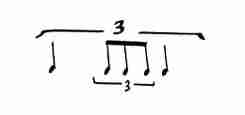
 Triplet embedding
The ostinato repetition of a single, insistent note—a sort of ethnic motivic minimalism—is a fascinating feature of these Dances. The first dance (Allegro vivace) is positively seismic, with percussive rhythms in 7/8 ? The next dance features a pensive motif in major seconds, fit into a bitonal (two different key signatures concurrently) context. The wandering melodic line moves in narrow intervals above the ostinato dance rhythms underneath.

 21-let, composed of 7 triplets
The third dance (Vivacissimo) is tremendously percussive—the sesquipedalian celebrants never trip, no matter how intricate their emphatic ‘steps’. The fourth dance (Adagio) is dark, ruminative, brooding—a meditation on a single note, drumming.

The fifth dance (Allegro rustico) boldly concludes Srebotnjak’s homage to Macedonian culture. This is not a sanitized ‘nice’ representational account of ‘folk music’ or of ‘Serbian-Macedonianness’. This is a raw, documentaristic collage of a cultural psyche in situ, the ‘real deal’, and we now realize that we have been, for these minutes just past, inadvertent anthropologist-observers of something very private, exotic-esoteric, and maybe taboo.

Presenters who wonder about the breadth of the appeal that a rhythmically esoteric and intermittently bitonal piece like Macedonian Dances may have for their audiences need not fear. This conservative Kansas City Friends of Chamber Music audience leapt to their feet in applause.

 Groys book
The Macedonian Dances ‘export’ succeeds, not only as a compelling ‘new music’ statement but also as an intercultural political-economic one. The ‘central banker’ in this polyrhythmic ‘economy of passion’, Dubravka and her interpretive ‘monetary’ powers are well-matched by Alojz and his creative and appropriational ‘musico-fiscal’ powers. It was a magical bivša domača evening, beginning to end: a most favorable balance-of-trade. Thank you, Dubravka. Thank you, Alojz.

 Insistent polyrhythm
F  irst of all, how many people off the street know who ‘Rach’ is? This uninformed notion that everyone likes Rach and no one likes ‘new stuff’ is annoying. The problem begins with the notion that ‘broad appeal’ is necessary for great art.”
  —  Greg Robin, Univ Alabama, NMB, 23-MAR-2008.
H  ave what it takes to write a Rach 2? Commission me and find out.”
  —  Phil Fried, ClassicalLounge.com, on the oppression of canonical works and people who obsess over them.
 Slovenian coat of arms