Showing posts with label cadence. Show all posts

Wednesday, July 25, 2012

Rheingau Musik Festival, Piano Trio at Schloß Johannisberg

Piano trio, 25-JUL-2012
W   hen the unexpected and non-functional seventh chords of mm. 5-6 yield to the relatively stable A minor of m. 7, the significant aural affect is heightened...”
  — William Hussey, MTO 2003;9(1).

T he performance last evening (of Shostakovich’s Op. 67 in E minor and Tchaikovsky’s Op. 50 in A minor) at Schloß Johannisberg by the piano trio comprised of Erik Schumann (violin), Leonard Elschenbroich (cello), and Anna Vinnitskaya (piano) was exceptionally good. These artists, each of whom is approximately 30 years old and each already with a number of competition wins and honors and awards behind them, are superbly matched to each other in terms of their musical vision or interpretive conception of each of these pieces and in terms of their playing style. That they thoroughly enjoy playing together is palpable and plain for all to see in performances like the one in the Fürst von Metternich Saal last night.

I n the last movement of the Tchaikovsky, Schumann broke a string. The music stopped, and the audience was expecting some confusion on stage—at least a 10-minute break while the string was replaced. The trio exited the stage, and we were astonished to see them return less than 3 minutes later, the violin re-strung and tuned. They took the last movement again in stride—with expressive coherence and emotional continuity as if no interruption, no catastrophe of breaking a string had taken place. Tremendous!

T he entire performance was admirable, but, for me, the poignancy of the first movement of the Shostakovich—and of the passacaglia—was especially compelling emotionally. The high-pitch harmonics in Elschenbroich’s walking figures at the beginning, with Schumann’s violin notes much lower, and Vinnitskaya’s piano in the depths below that—create a sense of profound danger and loss: as if denoting a war-time sorrow that has not fully registered with those who have experienced the loss, and as if it will take a lifetime to register it. The techniques include artificial harmonics excited at intervals other than a fourth. Different artificial harmonics can be produced by touching a perfect fifth above the stopped pitch, which sounds an octave higher than the note under the touched node. Another artificial harmonic is sounded by touching a major third above the stopped pitch, which then sounds two octaves above the lightly-touched spot on the fingerboard. Naturally, the pitches of these high-register harmonics are far less precisely controllable than ordinary stops in normal register—so the expressive effect is one of scary tight-rope walking, or great anxiety, or coping under great pressure and external constraints.

T he linear chromatic lines and their mercurial, untrustworthy melodic direction beg the questions ‘Where will the line end? Will it end?’ This cadence created by melodic contrast opposes traditional diatonic cadence mechanisms and tampers with our emotions. Hussey terms this ‘cadence by contrast’ in his analysis of the passacaglia in Shostakovich’s Op. 67, and, based on the experience of last night’s concert, we can say that when it is executed with conviction it is a really powerful rhetorical device!

T he slippery, descending chromatic bass lines in the cello and the piano erode our sense of certainty and demolish any comfort zone to which we might nostalgically have hoped to cling. This piano trio is, to me, Shostakovich in 1944 describing the conjectured future, now become our present 70-years-on fully-materialized reality. No more conjectures; no more chances to choose again.

T here are exuberant, happy figures in Op. 67, to be sure. But the overall effect of these, juxtaposed with the poignant and tenuous content, is ironical or backhanded horror-inducing. Fantastic performance; we went home with lots to absorb and think about!


Saturday, November 19, 2011

REBEL Baroque with Rufus Müller: Luminous, Numinous

Henry Ossawa Tanner, Annunciation
G    ood art reveals what we are usually too selfish and too timid to recognize—the minute and absolutely random detail of the World—and reveals it together with a sense of unity and form... the belief that the work of art reveals something of which the natural world is an imperfect image or symbol, and can reveal it more luminously if not more truly than [inartistic; uninterpreted] Nature.”
  —  Richard Elfyn Jones, p. 29.
L ast night’s Friends of Chamber Music REBEL performance with Rufus Müller (tenor)—a program entitled ‘Out of the Eclipse: Music of Transformation and Revelation’—was really excellent.

T he program was a meditation on Baroque idioms in terms of the Baroque chronotope of formation, the dynamics of space-time/dark-light interactions. Such interactions test the boundaries between truth and fiction, creation and destruction, conformity and iconoclasm.
  • Handel – Overture to Agrippina in G minor, HWV 6
  • Vivaldi – Sinfonia al Santo Sepolcro in B minor, RV 169
  • Handel – ‘Total Eclipse’ and ‘Your Charms to Ruin’ from Samson, HWV 57
  • Purcell – Chacony in G minor, Z 730
  • Telemann – ‘Wie? Kehren sich bei Jesus Krippen’ from Cantata No. 2 in C minor, TWV 1:1625
  • Bach – Concerto in A major, BWV 1055
  • Bach – ‘Zerschmettert mich, ihr Felsen und ihr Hügel’ from St. John Passion, BWV 245
  • Vivaldi – Sonata à quartetto al Santo Sepolcro in E-flat major, RV 130
  • Telemann – ‘Bei heißer Tränen dickem Regen’ from Cantata No. 13 in B minor, TWV 1:862a
  • Blow – Chacony in G major
  • Telemann – ‘Was gleicht dem Adel wahrer Christen’ from Cantata in F major, TWV 1:1511
  • Purcell – Fantasia No. 13 in F major ‘upon one note’, Z 745
  • Handel – ‘Tune Your Harps’ from Esther, HWV 50a
  • Handel – ‘His Mighty Arm’ from Jephtha, HWV 70
Q uestion’ figurations in ‘Wie? Kehren’ and ‘Bei heißer Tränen’ and elsewhere [much like mm. 8-9 of the tenor recitative ‘Wie hast du dich, mein Gott’ (Bach’s Cantata No. 21) or mm. 7-8 of the tenor recitative ‘Der Heiland ist gekommen’ (Bach’s Cantata No. 61] involve exchanges between the tenor part and the ‘contratenor’ line (viola in TWV 1:1625; violin in TWV 1:862a; oboe in TWV 1:1511). The questions—and the accompaniments to the answers—unfold a contrasting melodic pattern and a contrasting rhythmic pattern—which is how the composer creates structural contrasts among the motivic statements and develops depth. Constructing contrapuntal links out of the countersubject is a powerful method—a canon use-case that evokes a ‘receptive’ posture in the audience.

L eading/leaning tones abound, as we heard in the pre-concert lecture—especially in the pieces in the ‘dark’ keys (more than 2 sharps or flats), but the effect is not a cadential one. Instead, the melodic line moves in a peripatetic way... voice-leading that captures our attention by suggesting a self who has not made up her/his mind, or who is still discovering or questioning Life and the Divine... interrupted cadences on a large, “meta” scale that transcends the scope of individual works. This program—juxtaposing these pieces, strung together with hardly a pause between them—generates ‘hypercadences’, cosmic-scale implied plagal cadences. (Am I stupid for only now figuring out that that is what we mean by an excellent program or a good playlist?)

H andel’s cantatas have the women characters speaking/singing in their own voices, revealing a lot about their inner mental state, while the men tend to be detached, obscured by form and narrative. Stereotypically circumspect male, voluble woman. Lucrezia, Armida, Clori, or Diana, for example, versus Samson or Abdolonymus or Ruspoli [Harris, p. 51; presents arguments for interpreting the encoding and restraint used to veil same-sex meanings, while presenting alternative interpretations as well]. Müller’s Bach, Telemann, and Handel were powerful, inspiring, luminous.

I ndeed, as we listened our thoughts were wingèd, full of luminous hopes and dreams. And the dramatic changes in lighting in the darkened Grace & Holy Trinity sanctuary where REBEL performed helped to construct and reinforce the narrative authority that the music revealed to us... Revelations: by definition, novel; like dreams, they are subjective, and not readily corroborated by ‘evidence’. They persuaded us listeners to all-out belief, rather than reasoned with us or prove a specific predicate. One of my favorite performances! Bravo!

O  , zerschmettert mich, ihr Felsen und ihr Hügel! Wirf, Himmel, deinen Strahl auf mich! [O, crush me, ye rocks and mountains! O, Heaven, cast your bright beam upon me!]”   —  Bach, aria from St. John Passion.
T his is a peculiar passage that occurs several places in the Bible, notably Revelation 6:16... I imagine that Karen Marie Marmer (REBEL violinist who curated this ‘Transformation & Revelation’ program) selected this aria for inclusion in part because of this (compare Isaiah 2:19). This is not some Romantic, intellectual, filial, reverent ‘Crush me, please!’ This is a servile, prostrate Fear-of-the-Almighty-consuming-fire-and-brimstone-before-whose-alienness-and-majesty-none-can-stand ‘Crush me now, then!’ wish of a prey animal for the predator to just finish it off. The voice grows silent, no protection or security for her/him. Because Christ is now unfurling the once and future scroll that had been closed with seven seals. William Cowper (1731-1800) was fascinated by this same passage and used it in his poem ‘Truth’. I wonder whether the pietistic, Lutheran Bach ever read Cowper.
P   ieces of music are like any other form of human construction: whatever the patterns of intention lying behind them [sacred or secular], they instantaneously acquire an element of autonomy whether we wish them to or not... music, or any art for that matter, can affect us in ways that we could not expect—not because they have some secret property that only posterity reveals, or purely because our climate of reception predisposes us to see or value something that was irrelevant before, but because there is an unpredictable and circulating relation between the piece and its reception—it is not a one-way process.”   —  John Butt, p. 27.

Sunday, August 17, 2008

Memes of Exile: Composer vs. Performers/Listeners & Strategic Choice of Key

Allatson – McCormack book
H  ome’ is not just the place where we now live; it’s also the place where we first lived, and it’s the source of everything that our childhood meant to us.”
  —  Janet Schmalfeldt, keynote remarks at the 26th Society of Music Theory Conference, 2003.
Chopin’s piano Etude in G-flat major (6-flats key signature), Op. 10, No. 5 ‘lays so well’ under the hand. All black-keys and visually dense, sure. F-sharp (G-flat) major [D-sharp (E-flat) minor], all black keys, cognitively challenging. But, surprisingly, that Chopin Etude is as biomechanically natural as can be.

But what about timbrally and cadentially ‘natural’? What key signatures present expressive or rhetorical challenges, instead of cognitive or biomechanical ones? How about B minor (2-sharps key signature) for cello or viola? The tonic B puts this key a semitone below the pitch of the open bottom string on these instruments (C2 and C3, respectively). For a composer to sacrifice the gestural option of the low-note sonority on those instruments creates a unique sort of expressive tension or ‘challenge’.

I think a composer does not sacrifice the open low string unless the intent is specifically to deprive the player and the listeners of that sonority; unless the composer’s intent were to create an acoustic homeland where it is impossible to go, and to concomitantly make us aware of the land’s existence and attractiveness.

The ear and mind yearn to go to that note; the destination beckons. The transcultural naturalness of this is nearly universal. The metaphor of the tonic as a natural, cadential resolution is intuitive. Our familiarity with the timbres of each instrument makes us acutely aware of what registers are and are not being traversed; and the harmonies and voice-leading in the composition set up conditions that pull and pull toward the inevitable low. But the homeland stays impossibly beyond our reach. It is a powerful state of (psychic) exile.


    [50-sec clip, Aurora Quartet, Prokofiev String Quartet No. 1, Allegro, 1.4MB MP3]

And in fact Prokofiev’s String Quartet No. 1, Op. 50 (1931) was commissioned by the U.S. Library of Congress, during his period of ‘exile’ in Japan, the U.S., and Europe. The Andante is a tremendously veiled, circumspect thing. It has a ‘pinched’ quality about it, emotionally constrained, un-forthcoming, yet thin-skinned and approachable—we feel immediate empathy for the character embodied by each instrument’s part. The Quartet No. 1 is pensive in a way that is more ‘epic’ than the notes that comprise it.

Sergei Prokofiev
Compare the pensive, political effect to other B minor pieces for cello or viola:
  • Dvorák’s Cello Concerto in B minor, Op. 104
  • Casadesus’s Viola Concerto in B minor
  • Vivaldi’s Concerto in B minor for 4 Violins & Cello No. 10, Op. 3
  • Rota’s Intermezzo in B minor for Viola and Piano
  • Paganini’s Caprice No. 16 in B minor for Cello
  • Piatti’s Caprice No. 10 in B minor for Cello, Op. 25
  • Zemlinsky’s Quintet for Clarinet and String Quartet B minor, Op. 115.
The gesture of the Prokofiev quartet’s Andante—what strikes me as an ‘exile’ theme/meme—rises only to retrace its steps and return to a ‘form-fruste’ ledge in the lower register—hardly a home, psychologically, and barely a resting-place. More musical representations of exile and longing or ‘striving in vain’ take the form of motions from inner voices towards the main melody. Within the ascending arcs, an inner voice supporting the melody note begins a connecting motion to the next main melodic note. But it continues beyond this to reach into the octave above: the highpoint of the phrase and another tenuous ledge.


    [50-sec clip, Aurora Quartet, Prokofiev String Quartet No. 1, Andante, 1.4MB MP3]

Founding members of the Aurora String Quartet [Sharon Grebanier (violin), Mariko Smiley (violin), Margaret Tait (cello), Don Ehrlich (viola)] recorded a wonderful version of this Quartet in 1995. There are other versions, of course, but this one remains my favorite—for evoking this pensiveness and frustrated longing of diaspora, the boundary between what one wants and what can never ‘be’: the cadential low B of home.

Bard College’s Festival of Music this Fall is on Prokofiev. The Festival volume edited by Simon Morrison is a wonderful compilation of essays on topics that will be addressed at the Festival. Have a look, too, at the new book edited by Paul Allatson and Jo McCormack—for more ideas on the aesthetic theory of exile; David Goodman’s chapter on northwest China and ‘exile as quasi-nationality without a nation’ is especially good.

Morrison book

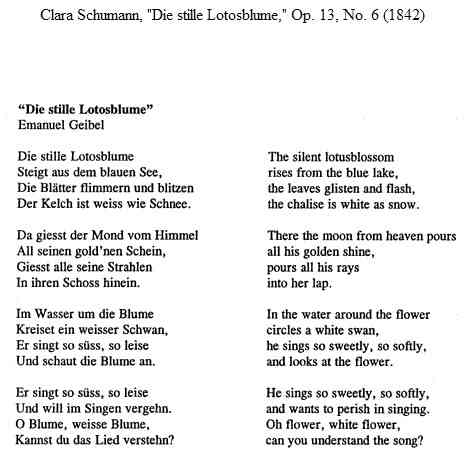
Emanual Geibel poem, Clara Schumann Op. 13; exile; liminality


Thursday, August 7, 2008

I Need a Semicolon Here: Punctuation in Instrumental Chamber Music

Mimi Stillman
H istory has left its residue in punctuation marks—and it is history, far more than meaning or grammatical function, that looks out at us, rigidified and trembling slightly, from every mark of punctuation.”
  — Theodor Adorno, Punctuation Marks.
W hen punctuation was first employed, it was in the role of handmaid of prose; later, the handmaid was transformed by the pedants into a harsh-faced chaperone, pervertedly ingenious in contriving stiff regulations and starched rules of decorum; now, happily, she is content to act as an auxiliary to the writer and as a guide to the reader.”
  — Eric Partridge, You Have a Point.


    [50-sec clip, Maxence Larrieu, C.P.E. Bach, Sonata for Flute or Violin and Continuo in G minor (BWV 1020), Adagio, 1.8MB MP3]

I was recently listening to C.P.E. Bach’s (or maybe J.S. Bach’s) Sonata in G minor for flute and continuo (BWV 1020), performed by Philadelphia-based Mimi Stillman on flute and Jeremy Gill on piano. Mimi’s playing was flawless, a near-miraculous realization of the coherence and feeling of the piece. But, in the Adagio, I found myself wishing for Gill to phrase his part more like Raphael Puyana did in the Maxence Larrieu 1994 Philips recording of this piece—more hesitantly, abstractly, resignèdly. Gill’s interpretation was technically fine, but the affect—the emotion—seemed a bit ‘flat’ to me.

What I was wishing for in the continuo part was something more like the Maxence Larrieu-Raphael Puyana phrasing——something more like the dour, contemplative phrasing that Glenn Gould used, for J.S. Bach’s Sarabande in D minor from French Suites No. 1 (BWV 812)—something that would’ve lent more of a dialogue effect to the interaction between the flute and the harpsichord. Each of us, I suppose, is entitled to his/her odd attachments to particular styles and interpretations.

Maxence Larrieu
Basically, I was wishing Gill had been applying more ‘semicolons’. A colon says, ‘Pay attention. This next bit I want to emphasize.’ But a semicolon is like politely clearing your throat. The semicolon says, ‘There’s still some caveat or paradox that I need to explain to you. There is a reservation I have about what I just said—something more you should know about.’ The semicolon speaks to the other performer(s), as well as to the listeners. What I wish is that we musicians added some new punctuation marks to our annotations of music—especially the semicolon.

A phrase that ends on a higher note than it began, followed by a rest (pause)—just as your voice does if you ask a question in Western languages—must almost certainly construed as a musical query (by Western players and listeners). Similarly, a phrase with a lower-pitched ending note gives the phrase a finality or semantic ‘terminal’ quality, just as when a question is answered—and is almost certain to be construed as declarative.

T here is a limit to the information any language can convey without introducing such devices as quotation marks that differentiate between what logicians call ‘language’ and ‘metalanguage’.”
  — E.H. Gombrich, Art & Illusion.
Q uotation stands at the intersection of Iconography and Intertextuality.”
  —  Michael Bal, Quoting Caravaggio.
Paragraphs, sentences with primary and subordinate clauses, and so on—all of these have near-equivalents in music. Once, 150 years ago, Robert Schumann had a dream of a “higher poetic punctuation in music, liberated from the tyranny of the measure.” Well, of course beyond bar lines, we have:

  • Rests
  • Ligatures
  • Cadences
  • Commas (above the staves, to indicate phrasing; breath marks)
  • Fermatas
  • Pedaling marks (for keyboard instruments)
  • etc.
But, except for some new-music compositions, fewer and fewer chamber music pieces have ‘adequate’ annotation as to phrasing.

Don’t get me wrong. I’m not wishing for obsessive instructions via more punctuation markings. It’s just that I think composers (and publishers’ copy-editors and typographers) have tended to under-value the artistic value of the commas and other markings. Jennifer Brody, Associate Professor of English, African American Studies, and Performance Art, at Northwestern University in Chicago captures perfectly the aesthetic/expressive sense that I have in mind.

D isagreeing with e.e.cummings’s poem ‘since feeling is first’ [‘life’s not a paragraph / and death i think is no parenthesis’], I argue that punctuation can be thought of as a matter of life and death as well as embodiment.”
  — Jennifer deVere Brody, Punctuation, p. 2.
Jennifer Brody’s nice new book recommends that punctuation need not be a handmaid or a chaperone but instead should be regarded as art in its own right. She does note that excessive punctuation can be a defect (stilted or overly affected or controlling). But liberal amounts of punctuation can be a valid element of performative style—extending the reader’s/performer’s power to interpret freely in broader ranges of expression [broader than an unannotated score may evoke]. Her treatment of ellipsis—which appears… to de-compose the page and speech [or musical utterances], and which leads to enigmatic or contra-dictory ends—is especially good. She uses Ralph Ellison’s ‘Invisible Man’ jazz idioms to reveal the blackness of Blackness and gender and racial dis/enfranchisement—encapsulated in phrasing marked by cadences and punctuation. Every bit of what Jennifer has to say about Ellison and jazz has direct correlates in discursive chamber music idioms.

A nd Death shall be no more;
Death, thou shalt die!”
  — John Donne, Holy Sonnet No. 6, inept edition.
A nd death shall be no more, Death thou shalt die.”
  — John Donne, Holy Sonnet No. 6, Gardner edition, quoted by Brody, p. 142, remarking on the effect of substituting a comma—how a semicolon is too theatrical in this context and, along with the line-break and exclamation point, ham-fistedly destroys Donne’s implied,subtle, aporetical meaning. Omitting the comma of address in the second phrase of the preferred Gardner version lends a hebephrenic inertia that’s consistent with Donne’s pervading fatalism and is also an elegant, coherent cadence.
Remember: National Punctuation Day is fast-approaching. More important than that, though, is the National Flute Association’s annual meeting, which this year is held in Kansas City at the Hyatt Regency Hotel. It begins today and runs through Sunday. There are several conference sessions and performances specifically devoted to the chamber music repertoire for flute. See you… there! (Full stop.)

I grew up with a lot of punctuation myself, so I can understand your nostalgia for parentheses,’ the dashing Sister Ka exclaimed to her dingbat friend across the periodic table.”
  — Harryett Mullen, Sleeping with the Dictionary.
National Punctuation Day, 24-SEP

How wrong to think there are ‘exact’ semantic correspondences between music and text punctuation. This wacked example is from ‘The Editor’s Toolbox,’ by Leland B. Ryan, Buck Ryan, Michael O'Donnell, p. 142.


Monday, May 26, 2008

Tempi and Saliency: Psychophysiology, or Why Deceptive Cadences Are Not Always Deceptive

 Sloboda book
W  e do not doubt that attention, recurrent computations, and complexity are important aspects to understand consciousness. However, we propose that these aspects are often trivially necessary rather than sufficient. For example, often it is assumed that consciousness emerges not before several hundreds milliseconds after stimulus onset. Hence, given the short time constants of membranes of neurons, recurrent connections are obviously necessary to store and process the stimulus before consciousness is reached. Complexity is for sure of primary importance for consciousness because networks with the same number of neurons can create trivial as well as complex behavior depending on their connectivity. Therefore, the important question is which kind of connectivity or which exact degree of complexity, determined with which mathematical norm, is sufficient for consciousness ...”
  —  Michael Herzog (Laboratory of Psychophysics, Lausanne), Michael Esfeld (Dept of Philosophy, Univ Lausanne), and Wulfram Gerstner (Computer Sciences and Brain-Mind Institut, Ecole Polytechnique Federale de Lausanne), Neural Networks 2007.
This is a quick post-script on the topic of the previous CMT post, about psychophysiology of modality and tempi.

It turns out that Tibor Bosse and collaborators at the Vrije University in Amsterdam have recently been developing mathematical models of attention, mostly for military applications. Some of these models (and the differential equations underlying them) resemble hydrodynamic models used in cardiovascular physiology (‘windkessel’ models; in German, windkessel means elastic reservoir) and in functional magnetic resonance imaging (fMRI).

 3-element windkessel electrical model
The effect of stimulus rate and its interaction with stimulus type on brain activity during the visual or acoustic stimulus has been investigated using fMRI. Different brain regions show differential responses as a function of time and as a function of the ‘tempo’ or stimulus rate. These results differentiate functionally specific responses in rate-dependent and rate-independent areas.

 4-element windkessel electrical model, with inductance-inertance element
The best approach to the dynamics, though, is probably not a ‘lumped-parameter’ analytical one, like simple windkessel models. Instead, nonlinear wave-front propagation models (Stefan moving-boundary differential-equations) or stochastic network representations may be more realistic as mathematical formalisms. An intermediate approach, such as mathematical approaches used to solve equations for liquid flow through porous media (like aquifers), may be useful, to represent the mesh-like connections and multi-path propagation of signals related to our brains’ perception of musical suspense and resolution (cadences). Have a look at Herzog’s and colleagues’ paper in the recent special issue of the journal Neural Networks and at Tibor Bosse’s papers for a glimpse of how feasible such a quantitative cognitive modeling project is these days.

The results of fMRI (and, presumably, of mathematical modeling of the rate-dependent effects) may enable us to better understand the inter-relationships between tempi and our apprehending meaning in music. For example, so-called ‘deceptive cadences’ to vi (or VI in the minor key) and similar progressions are normally treated in a time-independent way, as a prolongation of the dominant. But in some instances it is better understood as prolonging the tonic, through I-vi. Understanding it in that way, though, depends not only on the context but also on the tempo. In general, the second alternative only if the vi is a middleground harmony or key region and the tempo is relatively slow. Otherwise, we choose the first way as more compelling. The underlying idea of the expansion of the V is that tension in the dominant is not resolved by the deceptive move to vi, but actually heightened; it is only when the true tonic arrives that the tension is removed. But if the tempo is sufficiently slow, the mind anticipates everything. The mind calculates and re-calculates and gauges and re-gauges all the possibilities. The deceptive cadence becomes instead a meta-commentary on irony itself.

 Haydn Sonata Deceptive Cadence Example
In Five Graphic Music Analyses, Schenker showed that the Haydn Sonata analysis includes an extended prolongation of vi within the V that is the underlying harmony of the entire development (see the bass of the top system for the V; see mm. 81-111 of the other levels for the vi, which changes to VI (as V/ii) near the end of the passage).

By definition, a deceptive cadence is any phrase the ends in a way that is different from the anticipated outcome. Deceptive cadences can be disruptive, creating ‘Wow !’ moments in music. Usually, deceptive cadences require a melodic line and an accompaniment. A cadence is deceptive only if the melody ends up on the proper note to end the phrase, but the accompaniment contains unexpected harmony underneath. For example, if your song is in C-Major, you might expect the phrase to end up on a C Major chord, with the melody playing a ‘C’. If, though, the melody ends up on a ‘C’, but the harmony is an A-Minor chord, then this is an unexpected harmony and therefore a deceptive cadence.

Deceptive cadences are an example of how composers blur one phrase into the next. In a deceptive cadence, the melody is finishing off the phrase, while the harmony/accompaniment has already moved ahead, to the beginning of the next phrase. But if the tempo is slow enough, the synapses have had time to caucus with each other and anticipate everything. The ‘Wow!’ is of a totally different type. And the blurrings are no longer blurrings at all: they become meta-commentaries on what transitions are about, and why.

 Cadwallader-Gagne book; Mozart (K. 457) I, mm. 46-52
In Mozart’s piano sonata (K. 457, I), there is the tonic of mm. 36-41 leading to II6 in m. 46, suggesting the imminent arrival of an authentic cadence. But instead we get a deceptive cadence in mm. 47-48 that delays resolution to the mediant key. The delaying effect resets our expectations and inhibits our reaching conclusions so quickly or relying on them so much once we’ve reached them. Cadwallader and Gagne’s book is excellent in its extensive coverage of effects like these. They don’t talk about Glenn Gould’s peculiar treatments of Mozart, though.

In Glenn Gould’s 1981 recording of Bach’s Goldberg Variations he takes a much slower tempo for the aria/sarabande that bookends the variations, or Variation 7, for example. In the recordings of Haydn’s six late piano sonatas (Hob. XVI: 42, 48-52) he plays the slow
movements very slowly, and with more interpretive inflection. His interpretive eccentricities came not from perversity but from a deep fascination: a love that demands a lingering largo; an experimenter's desire to find out nature’s secrets by way of stop-motion photography; an introspection that was selfless, timeless, otherworldly. To Gould, the slow, measured tempi were tools to reveal hidden profundities—in much the same way as they are to Simone Dinnerstein, for example.

In summary, my idea of ‘funnels’ or hydrodynamic windkessel mathematical models for representing the psychophysiology of generation of musical meaning is, evidently, not so rash or novel after all. True, nobody has yet applied these techniques with fMRI and musical stimuli, in the way that Bosse and others have done with visual stimuli for naval and aviation psychophysiology. But the maths and experimental methods are today up to such a task. Cheers!

 Dayan-Abbott book

 Parasuraman book