
M adeleine Dring … was born [I was born] on the moon and can therefore claim to be a pure-bred lunatic. Arriving on a speck of cosmic dust, she [I] came face to face with the human race and never really recovered.”Flutist Leslie Marrs performed a wonderful set of new music chamber works by Robert Fruehwald and Wil Offermans as part of the National Flute Association annual meeting today, attended by about 2,000 flutists and a few composers.
— Madeleine Dring, humorous autobiographical diary fragment, quoted in Ro Hancock-Child’s biography of Dring, p. 1.
- Fruehwald: Hymntunes IV: Imenetuki; Three Fantasies on Irish Folk Tunes; Duo on Bulgarian Folk Songs;
- Offermans: Tsuru-No-Sugomori
The ‘Hymntunes IV’ and ‘Three Fantasies’, atmospheric essays performed on alto flute and bass flute, respectively, evoke ancient, ethereal folk epics and legends. Their strophic story-telling idiom is made especially vivid by subversive colors that the low registers of these instruments lend to the endeavor. In ‘Hymntunes IV’ the flutist produces thumping percussive effects by the protrusion of tongue suddenly into the flute headjoint aperture. Additional intriguing percussion is created by rapid, repetitive clapping of right-hand flute keys—not changing the pitch but merely clamping the pads quickly against the openings on the flute body. The acoustic effect is (as heard from a distance of about 5 meters from the stage, anyhow) like moist bamboo chopsticks plunging hungrily into a bowl mostly emptied of rice—subtle and evocative of the first large raindrops of an arriving storm hitting a metal roof. The resonance of the column of air accessed by the pads clapping down over their respective holes generates un-voiced clear pitches—similar to effects we sometimes hear in pizzicato strings or harp.
The solo piece by Wil Offermans is likewise an atmospheric meditation, replete with harmonics produced by over-blowing, tongue-flutters, pitch-bending, and undulating ‘tremolo’ dynamics. Bravo, to both Marrs and Trent!
Flutist Donna Shin performed the following flute-oboe-piano trio pieces:
- Demersseman-Berthélemy: Duo Brilliant ‘Guillaume Tell’
- Dring: Trio for Flute, Oboe, and Piano
The William Tell (arranged in 1865; adapted by flutist Jules Demersseman and oboist Felix Berthélemy from Rossini’s 1829 opera score) was delightful—an animated and inspiring display of rapid-tempo artistry by the three, playing in tight, crisp ensemble.
The trio by Madeleine Dring was remarkable—with rich sonorities, rapid chase ‘scenes’ between the flute and oboe, and wry humor powered by the fine balance achieved by Shin, Spiccati, and Yeh.
Madeleine Dring studied composition under Ralph Vaughan Williams, Herbert Howells, and Gordon Jacob. Although her output was substantially incidental music for television, radio, and films, she did compose a number of pieces that merit consideration in chamber music programming. Her husband Roger Lord, an orchestral oboist, provided Madeleine ample stimuli (domestic provocations?) for her several chamber music pieces for oboe as well as flute, clarinet, bassoon, and other wind instruments. The Trio performed at the NFA convention today is one of the better known of these works. (Madeleine died suddenly of a stroke at age 54, in 1977.)
Besides her accomplishments as a composer, Dring was also a singer, pianist, lyricist, actress, and—and cartoonist? This last avocation is amazing, especially considering the era in which she lived! How many women can you find—in England or anywhere else in the 1940s through 1970s—who were actively creating cartoons?
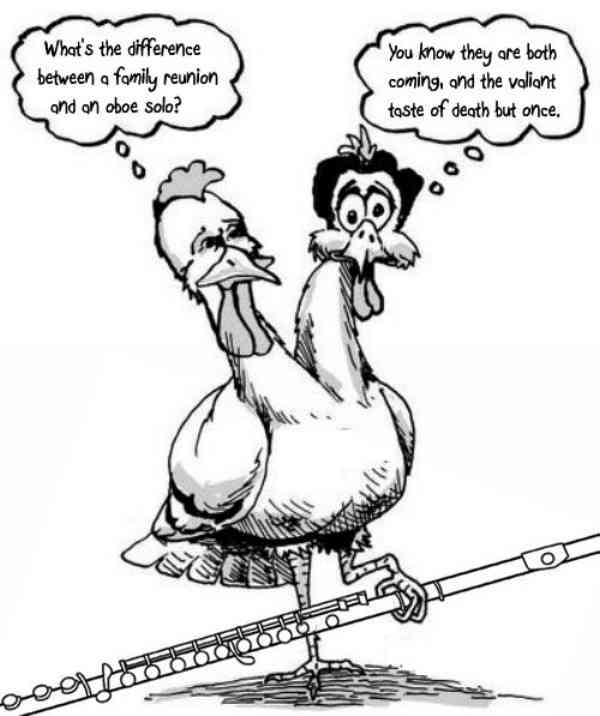
Madeleine had a remarkable sense of humor. It is a shame that this aspect of her personality is not more widely known. Many of her cartoons and line-drawings manifest an irreverence and hilarity that the passage of time does not diminish. Have a look at Ro Hancock-Child’s biography of Dring, which includes a number of Dring’s cartoons. In addition to drawing cartoons of her own, she also wrote incidental music for TV animation. She clearly enjoyed the challenge of creating music that is suitable for young audiences, in addition to the more serious works by which she is primarily remembered.
Dring’s composerly methods, especially in her miniatures (like the three movements of this Trio), are basically descended from “English Renaissance” style. But the content of her melodic and thematic writing often incorporates elements of English folk music.
Since the time of her death 30 years ago, Dring has been under-recognized as a woman composer. Madeleine’s work has been curiously neglected in many of the anthologies of music by women (see links below), penalized possibly because of the idioms that she favored, which do not conform to elite notions of ‘seriousness’. But any composer who has written works in chamber music idioms for the stage or for film or TV as Dring did so extensively—must consider such an omission to be ‘conspicuous’ and unfortunate. Not every composition has to be a warhorse for display of technical virtuosity for it to have value and become part of the chamber music repertoire!
Composed in 1968, much of this Trio is comprised of exchanges between the flute and oboe over a jocular piano part. The second movement, marked Andante, supposedly symbolizes a duet between lovers. It opens with romantic chords in the piano part, which gives way to a poignant oboe solo—very fable-like. In fact, one can readily imagine a ‘Little Mermaid’ or other Disney-type animated feature as one listens to this beautiful melody. Donna Shin’s flute enters, taking over the melody, and, subsequently, we have a respectful dialogue between the flute and oboe—evoking images of a world free of serious conflict, promising nothing but harmonious adventures and happy endings.
The Trio’s final movement, marked Allegro giocoso, is the most playful of the piece, with highly animated lines for the oboe and flute and a ‘conspiratorial’ piano. The piano is substantially in a minor mode, with incidental major seconds and the occasional erratic/ironic chord. The wild passages in the piano part set the stage for flute-oboe caricatures that follow. Late in the movement the flute and oboe play a crazed cadenza with maniacal unison playing and chasing, ending in a sweet duet in major thirds.
Without doubt Dring was gifted in her abilities to write miniatures for children’s plays and for TV and radio. But her droll wit is evident in her more serious compositions as well. None of her drawings and cartoons is profane, but they instead manifest a thoroughly British sense of humor. They have an edginess and faux self-deprecation that were, maybe, about 50 years ahead of their time. This flute-oboe-piano Trio is a much-appreciated ‘window’ through which to glimpse the fun-loving, comical temperament of Madeleine Dring. Shin, Spicciati, and Yeh did a brilliant job of bringing this piece to life. Bravo!
- National Flute Association (U.S.)
- Leslie Marrs page at Drake Univ
- Donna Shin page at Univ Washington
- Robert Fruehwald page at Southeast Missouri State Univ
- Wil Offermans website
- Madeleine Dring sheet music
- Boenke H. Flute Music by Women Composers: An Annotated Catalog. Greenwood, 1988. (incl. Dring)
- Bowers J, Tick J, eds. Women Making Music: The Western Art Tradition, 1150-1950. Univ Illinois, 1987. (nothing on Dring)
- Hancock-Child R. Madeleine Dring: Her Music, Her Life. Micropress, 2000.
- McClary S. Feminine Endings: Music, Gender, and Sexuality. Univ Minnesota, 2002. (nothing on Dring)
- Neuls-Bates C, ed. Women In Music: An Anthology of Source Readings from the Middle Ages to the Present. 2e. Northeastern Univ, 1995. (nothing on Dring)
- Pendle K, ed. Women and Music: A History. 2e. Indiana Univ, 2001. (nothing on Dring)
- Pendle K. Women In Music: A Research and Information Guide. Routledge, 2005. (incl. Dring)
- Sadie J, Samuel R, eds. Norton/Grove Dictionary of Women Composers. Norton, 1995. (nothing on Dring)
- Women in Music Festival, Eastman School of Music
- DSM. Allégresse: Situated Talk and the Piano-Flute-Oboe Trio Repertoire. CMT blog, 18-MAR-2008.


